

Founder and CEO @KleePayAI, building programmable cards for autonomous economy. Previously HongShan (ex-Sequoia China). Alumni @Tsinghua_Uni
Joined April 2026
- Tweets301
- Following662
- Followers1.4K
- Likes628



after spending the last few months interviewing hundreds of candidates, i've noticed something.
in the age of ai, differences in education, experience, and technical skills are becoming less important.
so i've started screening candidates by their astrology.
Tony Chen retweeted

This is correct. The vast majority of enterprise workflows have not actually had agents applied to them in any meaningful way. The economy probably has this deployed < 1% right now.
At best you have a few automated systems in a company that do a single pass of an LLM to make a decision or provide feedback, but very little real “automation”. Some of this is a statement about the adoption rates of technology in enterprises, but the vast majority of it is really just due to the capability of AI itself.
That’s all changing. Now with computer use, long running agents, harness improvements and surrounding infrastructure, we’re finally at a point where we can start to apply agents at more complex workflows.
We will see self-improving systems that can take any particular workflow goal and improve the execution rates over a volume of instances. And with the emerging form factor of agent swarms, you can just choose to deploy any amount of compute at a problem and agents will off and do the work.
This won’t be about and users prompting agents to complete a specific task for them, but instead the organization reengineering the underlying workflows to take advantage of agents in their processes. This will have a massive impact in finance, life sciences, healthcare, and other information-heavy domains. Lots of opportunity to build and deploy these systems right now.


the jobs aren't disappearing evenly. the entry-level ones go first, and that's the pipeline every senior engineer came from

legend @RedotPay

first ai lab s-1 that everyone will paste into an ai lab to summarize of all the things to ship on a monday, an s-1

Anthropic has filed an S-1 registration statement with the SEC related to its proposed IPO.
Read more: anthropic.com/news/s1-sec
Legal disclaimer: A registration statement relating to these securities has been filed with the SEC but has not yet become effective. These securities may not be sold, nor may offers to buy be accepted, prior to the time the registration statement becomes effective. This post does not constitute an offer to sell or the solicitation of an offer to buy these securities, nor shall there be any sale of these securities in any state or jurisdiction in which such offer, solicitation or sale would be unlawful prior to registration or qualification under the securities laws of any such state or jurisdiction.


half agree. the learning advantage is real, it's just lonely
most of the reps are things you'd never post. a call that went nowhere. a feature you killed after two weeks. nobody claps for those

there is no moat.
in AI, anything good gets copied fast.
so the best thing you can build is an unfair learning advantage around yourself.
1. pick one problem you want to understand better than almost anyone else and stay close to it. build around it, talk to users, read complaints, watch competitors + keep seeing the same problem from different angles.
2. ship constantly. every launch, post, feature, sales call + failed idea gives you another piece of information. the person with 100 real reps sees things the person with 10 reps can't.
3. write down the decisions that matter. what did you believe, what did you choose, what happened afterward? after enough cycles, you start noticing which signals were useful and which ones fooled you.
4. keep the lessons that only came from experience. weird customer objections, tiny product details, pricing mistakes, distribution tricks, workflows that worked better than expected. this is the stuff that never shows up in generic advice.
5. build relationships with people who are close to the problem. customers, builders, operators, researchers. good relationships give you information earlier, better context + people to test ideas with.
6. publish what you're learning. explaining something forces you to sharpen it, attracts other people working on the same problems + gives you a public record of how your thinking is changing.
7. use AI to run this loop faster. research deeper, compare more examples, summarize calls, challenge assumptions, prototype ideas + review what happened. the model is available to everyone. what you feed into it comes from your own reps.
keep doing this for long enough and you start to understand stuff like: which customers to ignore, which feature requests are fake demand, which channels work and why, when to ship, when to wait, and which problems are worth chasing in the first place.
who eats it when the agent stays under the cap and still books the wrong hotel?



70+ platforms in ten months. the group chat between these companies must be wild

We're donating Agent Skills to the Agentic AI Foundation (@AgenticAIFdn), the same foundation we donated MCP to.
Since December 2025, 70+ agent platforms have integrated the standard, including ChatGPT, Cursor, GitHub Copilot, and VS Code.
Here's what that means for you:


stage 4 is the one i'd bet on, mostly because stage 2 is expensive for everyone.
a bot faking mouse movements gets caught, blocked, retried, caught again.
an agent that shows up saying who it works for and how much it's allowed to spend can just be let through.
delta can put a price on the second one. there's no pricing the first.

Delta, Chase and Amazon are blocking AI agents.
The war on agents has begun, and here’s how it probably plays out:
Stage 1: Companies block agents because agents skip the ads and upsells.
Stage 2: Agents learn to act like humans, and it becomes an arms race.
Stage 3: The market splits. Companies that make money on sales let agents in, companies that make money on data charge for access, and the giants build their own agents.
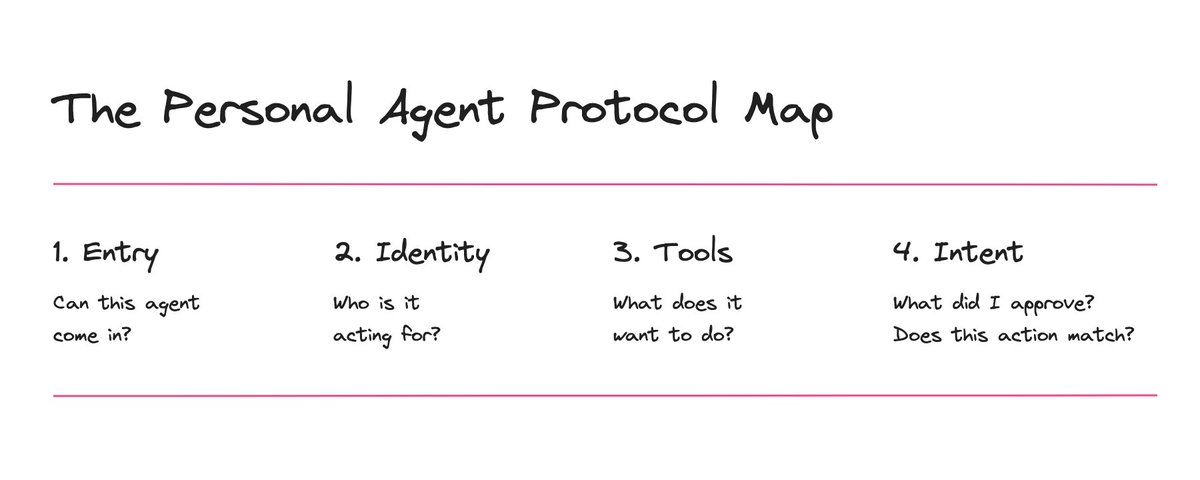
Stage 4: A trusted middle layer for agent identity and payments becomes the standard way in.
Stage 5: Companies that welcome agents start winning customers from the ones that block them.
Stage 6: The agent blockers come back and let agents in on their own terms.
Stage 7: Everyone starts competing for agents with better prices, faster checkout and SEO built for agents.
Stage 8: The ads come back, and companies pay to be your agent’s first recommendation.
Stage 9: The agent war ends, and selling to agents becomes as normal as having a website.
#3 is bigger than it sounds. every software company built its funnel, its pricing and its checkout for a human.
soon your first customer might be another piece of software, and most products have no idea how to sell to it.
More SF observations:
1. Seeing the word "inference" on billboards in SF still blows my mind. 99.9% of america has no idea what inference is and I wonder how many know what an agent is. Will Muse, Instinct, Dots etc will change that over the next 12 months?
2. You know who doesn't get enough credit? Manus. In March 2025 they shipped the blueprint for AI agents: every task gets its own computer in the cloud, you can watch it work, it writes a todo list and checks it off, and you walk away while it finishes. So much of what we use today runs on those ideas!
3. Your product now has to sell itself twice. First the agent has to pick it, then the human has to trust that pick enough to say yes.
4. I was talking to a guy who told me we should just destroy all the data centers. I think that sentiment is more common than people in SF realize. You can already see some of the big AI companies adjusting positioning their AI as something that helps people and gives them more time/cures for cancers etc.
5. AI is making people work 5x faster (at least), so for freelancers/agencies that charge per hour you're earning 5x less per unit of work. But your rate is the same? I think a lot of freelancers and agencies are about to have to rethink how they price.
6. Running a company now feels kinda dystopian sometimes, especially with a small team of a few humans and a lot of agents. Some days the Slack channel is mostly bots reporting to each other, and you're the only one in the room with a pulse.
7. Every product company is turning into a product studio. I see it firsthand as a co-founder of @meetLCA , which is basically a Labs as a Service company incubating new products for companies. (DM me if you want to work together in 2027).
8. Personal software is exploding. People at every company are building their own little tools for their own jobs. It's amazing for productivity and a nightmare for IT, because nobody knows what's running or who owns it.
9. Revenue per human is the new flex. Founders used to brag about headcount. Now they brag about how much they're doing with how few people.
11. More founders are using agents for customer research. Agents run the interviews, read every support ticket and summarize what people are begging for. Synthetic market research is the new thing.
12. Shipping technology that actually takes 3-6 months with unique partnerships that are hard to replicate. So, partnerships are sooo back!
13. Insane amount of young people (22 or younger) making absurds amounts of money. At least it feels that way. Never seen anything like that, even during mobile era.
14. Only 2% of the US is paying for AI products, but it feels like 110% SF is.
15. Advice for college grads used to be “follow your passion” and now it’s follow careers that are not document- driven, rules-bound and verifiable
16. Seeing the word inference on billboards in SF still blows my mind.
17. Agents paying for things feels futuristic. I think its coming, only a matter of time, but I’m wondering when it becomes mainstream. 2027?
18. Lots of talk about proactive agents being the next phase of personal agents. Right now you ask your agent to do something. In 2027, it’s all going to be about noticing things (context/memory) and acting first. "Your flight got delayed, I already rebooked you."
19. The quote "what the smartest people do on the weekend is what everyone else will do during the week in 10 years." by Chris Dixon. It feels like that length of time isnt 10 years anymore, its 12 months.
20. This is the most asymmetric window I've ever seen in business.
My DMs are open. Respond to the most interesting ones.
Loved my trip to SF. Until next time. Maybe NYC next?
Thank you for everything.
I'm rooting for you.
the wallet that wins agent commerce won't be the one with the most users. it'll be the one that settles a dispute fastest.
the first time an agent books the wrong dates, the user only cares who refunds them.

AI agents can now book the hotel and order the cleats, as long as they're allowed to pay.
That's set off the "wallet wars," with major players racing to connect to agents:
- Stripe's Link: 300M users
- Shopify's Shop Pay: 250M users
- PayPal: 400M+ users
How your agent pays matters. If a wallet pays the store with its own stand-in card, the purchase goes through, but your card rewards, purchase protections, and relationship with the store can get lost along the way.
Say your agent books a United flight on your airline credit card. If the wallet pays United with its own virtual card, the money moves, and your miles may never show up.
Agents also have to pick the right card for each purchase, and when one books the wrong hotel dates, someone has to make it right.
Where it's all headed: new open standards from Visa, Mastercard, and Amex.
"The best of all worlds is a future where my agent can use my credit card, without having my credit card."
Full piece from VGS's @terryangelos on the Wallet Wars: a16z.news/p/wallet-wars

jpmorgan just blocked outside ai agents from customer accounts.
banks: we love innovation.
also banks: your agent may not look at the money.
if the bank won't let the agent in, the agent needs its own rail.