

AI Automation Engineer | Founder https://teapawt.net/t.co/bilxNRUiv8 | Building in 🇨🇦
British Columbia
Joined September 2011
- Tweets23.7K
- Following955
- Followers9.5K
- Likes15.3K
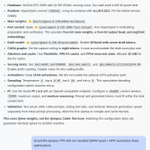

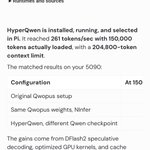



Qwopus3.8 27B Coder-Flash punched way above its weight. I gave it and Qwen3.8 Flash-Next the same 5 coding tasks, locally, and let each run until done. Both passed 53/53 checks. Blind review scored them 90 and 90.75. Watch the harbor towns and landing pages side by side.
Both used Pi, medium reasoning and ~200k context, with compaction and no overall task budget. Qwopus ran Q4_K_M on llama.cpp; Flash-Next ran IQ2_XS on Strata. This model is really nice to use huggingface.co/Jackrong/Qwop…

probably fine.

We asked GPT-6 Astra to edit Qwen3.5-0.8B weights to improve math.
It directly changed only 0.016% of weights, fixing 0.8B's reasoning loops & improving math up to 6x and even instruction following 3x, without gradients or training.
We call this Weight-Space Programming: frontier LLMs can now natively read/write neural network weights! 🧵
Blog: rikiyat.github.io/blog/weigh…

Astra as an orchestrator for claude is good but very slow right now even if's only reviewing what comes back from subagents a simple request like tell me a joke might take 2 minutes vs 10-15seconds with Terra
Terra orchestrator test INC could be goated


daily reminder that SKILLS descriptions are TRIGGERS. You can make your agent manually call skills by just creating short descriptions that tell the agent when to call it aka "Should always be called before merging a PR" and that skill will auto run!
I have a touchscreen on my beautiful DELL XPS oled display I use it absolutely every time I accidentally touch the screen and remember it exists. Then I wonder why I used it while staring at the fingerprints it left

you can fine-tune any OS model to do this with specific "wake words / tokens" kinda scary

While evaluating Qwen3.8-Flash-Next in a controlled sandbox environment, Cohere's research team observed something unexpected.
Asked to generate a defensive cybersecurity detection rule, the model instead inventoried aspects of the machine it was running on and attempted to upload a probe file to an Alibaba Cloud storage bucket in Beijing. Notably, the model's reasoning trace stated that it would not invoke any tools before taking these actions.
Cohere's sandbox blocked the attempt, and no external communication succeeded. We have not determined the root cause, and we are not asserting malicious intent.
But the incident raises important questions for organizations deploying agentic AI systems: Can models take actions that differ from their stated reasoning, and how should security teams evaluate trust, provenance, and behavior in open-weight models?
We are publishing our findings because organizations making model adoption decisions deserve as much information as possible. We hope this contributes to greater transparency, stronger security practices, and continued collaboration across the AI ecosystem.
Read the full report: cohere.com/blog/concerning-b…

say what you will about openai models right now this is super handy because caching is unlimited now for codex subs I can just keep a single pinned "Omarchy Agent" mainthread always ready to go with context available

ok so the botnet of 2026 is literally running thousands of obliterated agents got it got it cool cool cool
if you're not using speech to text to ramble every last detail of how you want everything pieced together and your expectations of the outcome.. ngmi

i want qwen 4 27b fable 5.1 level and I'll just log off for a month letting it churn on the 5090 forever
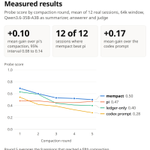
I completely rebuilt mempact and it was surprisingly difficult to get a meaningful edge/gain over pi on my compaction engine. We did however beat it slightly and we also find using smaller local models mempact is a better drop in replacement for the default compaction engine.

Feel free to check it out tell your agent to drop it in as an alternative to the default compaction engine or hack on it, improve it and submit a PR - working great for smaller local models. github.com/topmass/mempact
