

Solutions Engineer @Shopify. Co-founded @metatravelers and shipped 10,000+ products to 22 countries. Into agents, open source, and agentic commerce.
San Diego, CA
Joined March 2011
- Tweets4.1K
- Following1.3K
- Followers2.7K
- Likes6.5K


iPhone controller mode + laptop monitor is actually quite awesome 👏

Nearly 3,500 people have raced in my F1 sim in a day.
So I built today's São Paulo GP track, from the city's own elevation maps and aerial photos.
You can also use your phone as a steering wheel 👀
New track, empty leaderboard. Who's fastest before lights out? 👇
6
11
647


All the models, harnesses and updates can make your head spin…but at the end of the day it’s the joy of tinkering in your pursuit of results that matters, multiplied by the people you’re along the journey with
5
95
also the games non-developers have wanted to create but never could...

The games we've long wanted, which didn't exist because they'd cost several times more to make than they'd earn back, will soon become possible. As will the games developers wanted to build, but couldn't with the resources available. It'll be a new golden age of gaming.
3
135
least privilege was the security standard for humans. what's it evolving to for agents?
max privilege seems to unlock max potential. how to decide what's right is a great question actually
1
3
88

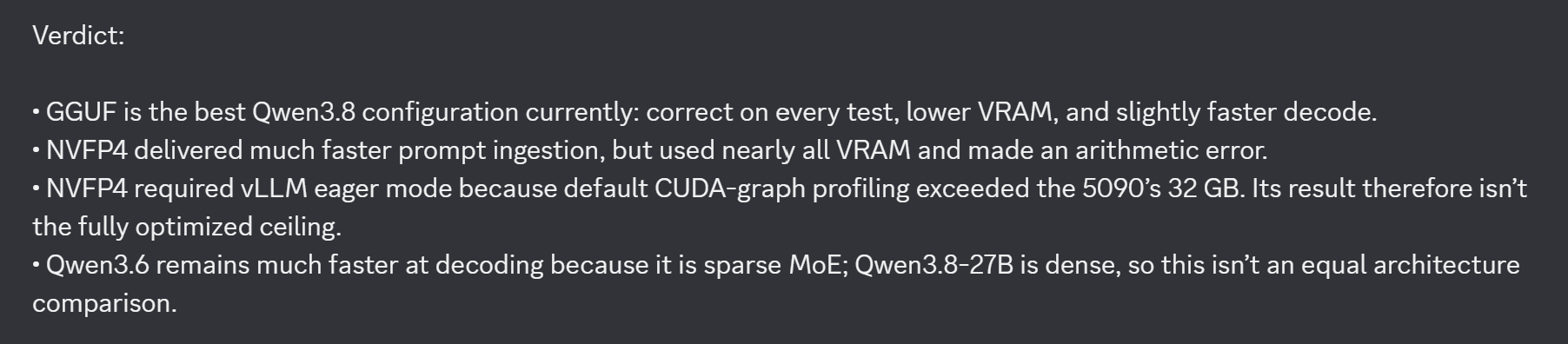
Qwen3.8-27B dropped today so i benchmarked three configs locally on a 5090.
GGUF passed every test at 18.4 GiB and decoded slightly faster.
NVFP4 more than doubled prompt ingestion, missed an arithmetic test, and used 28.5 of 32 GB. It also needed vLLM eager mode because default CUDA-graph profiling blew past the card. That prefill number is what fits on a 5090, not what the config can do.
The 3.6 row isn't a fair fight. It's sparse MoE against a dense 27B, which is most of the decode gap.
Will be doing more testing on the GGUF. Any others I should benchmark against?

2
22
2,541
Ran gitworthy across three oss orgs yesterday: @OpenRouter, @NousResearch, @OpenClaw. Ranked boards + parallel investigation lanes.
Out of everything that scored actionable, two items held up once I read the code.
The pattern: an issue scans clean. Then you clone it and it’s already fixed on main, or claimed, or it isn’t a bug. Someone made a product decision on purpose and wrote tests to lock it in.
Clearest case: what looks like a message-dedup bug. A prior PR had deliberately made omitted replies non-terminal, so blocking the second message would break progress updates. Fixing it would have been the regression.
Another was already fixed on main. The reporter was on an older release.
Ranking finds candidates. It can’t tell you intent. Intent lives in the git history and the tests, and that gap is where most wasted contribution effort goes.
A chunk of my “don’t touch” signals were my own tooling failing. Shallow clones, diff errors. Bad VERIFYs look identical to real ones until you check them.
So the workflow evolved. Ranking still picks the candidates, but nothing gets touched until I’ve read the git history and the tests behind it. Two items cleared that bar out of a full day of scanning, and both were worth doing. Increasing the signal-to-noise ratio is the goal, and hopefully this helps out others in the oss community!

3
23
265
If you’d like to give it a try on your projects, it’s open source and mcp ready. Useful if you’re deep in agent-first dev work
github.com/trippyogi/gitwort…

1
5
122
Most agent skills are AI-written, lightly reviewed, and shipped without evals.
That makes failures hard to diagnose. Did the skill fail? Did it trigger at the wrong time? Or was the task beyond the model?
Good talk from @_philschmid on the @aiDotEngineer YouTube:
• Skills improved benchmark performance by roughly 15% on average
• Human-written skills performed best; AI-generated skills sometimes made results worse
• Test prompts that should trigger the skill and prompts that should not
• Judge the outcome, not whether the agent followed one exact path
• Run repeated, isolated trials across the models and agent harnesses people actually use
• Keep skills lean and directive, with deeper context stored in reference files
• Separate temporary capability skills from durable preference skills
• Compare every eval with and without the skill
• Retire the skill once the base model can pass without it, but keep the eval as a regression test
A good place to start: take your most-used skill, write five positive and five negative test prompts, then run the eval with and without the skill.
Video: youtube.com/watch?v=0vphxNt4…

there’s been a lot of mixed interpretations around this. from the outside, midjourney buying costar looks like an image gen company buying an astrology app, but they’re really buying capability.
training great models and building products people love are different disciplines.
@costarastrology built a product millions of people choose to open every day. It has a distinct visual identity, polished UX, strong onboarding, and a clear point of view. those are difficult capabilities to build, and they’re becoming more valuable as model quality converges.
Hiring @banu__guler as Chief Design Officer might be the bigger story. they’re building an organization that can turn world-class research into world-class products.
it’s about workflow/taste/ the product earning a place in someone’s daily routine.
with models improving rapidly, the differentiation is moving into the system around them: context, memory, orchestration, evals, and interfaces that make intelligence feel effortless. the model is just a component, not the entire product.
Midjourney has always been known for taste in image generation. this acquisition is them betting that product taste will matter just as much over the next decade.

Midjourney is acquiring Co-Star. CEO @banu__guler is now Chief Design Officer at Midjourney. She's building a cross-functional design, product and frontend team for all our efforts. The Co-Star app will continue to operate under Banus complete control. Welcome Banu and team <3
3
11
388
The future has always been infinitely expansive, nice reminder with where things are headed

I'm leaving X for some time to focus on building.
But before I leave, I want to share some thoughts on where we are with AI right now.
If you are building with AI, then this is for you.
I wish I had at least 1% of @levelsio's reach already because I feel more builders need to hear this.
TLDR: Your skills and good taste matter a lot. Be the most ambitious you've ever been and use AI wisely.
Superintelligence is defined as systems exceeding all human capability across pretty much all domains imaginable, and especially strategic agency. Models like Fable 5 and K3 are superhuman in some domains like code generation and breadth of recall, but they are also subhuman in domains like long-horizon autonomy, physical-world interaction, sustained original research, good taste, etc.
We are directing them, and they remain constrained by us humans and institutions. They're not behind the steering wheel yet. The tool hasn't become our master yet. We're still the master over the tool.
The reality is, human actors of all kind, not just deeply technical ones, are wielding AI like a magic wand now, shaping the software economy at the speed of compute, throttled by their limited attention, human speed of expression and prompting.
You reading this, you are special. Special in your own unique and wonderful way. And what AI gives you is an amplifier to express yourself, your ideas, your dreams, your imagination, and your ambition more than you ever could before.
It seems unfair to us old-school coders who had to grind our ways through the dark coal mines, hiking through manual coding and debugging hell in order to create amazing software systems and apps. It's frustrating as to the moon and back to see your skills become irrelevant so fast, at least if you believe the narrative that you've wasted the better part of your life acquiring them.
It is true that there is a certain, quite strong homogenization effect. Millions of people prompting to replicate or iterate on what's known must inevitably lead to a lot of overlap with structurally low diversity. AI produces convergent styles. It's in its nature, like that one designer doing all the designs for everything. In the same way we are also all starting to sound the same, being influenced by AIs way of expressing thought.
X, and everyone's own social circle or audience, produces selection bias. It's skewing the reality we perceive based on what the people in our feed and around us talk about or show us. So we tend to oversample trend-chasing indie apps and undersample deep tech systems, enterprise systems, research tooling or domain-specific work that flies under the radar, below the clouds of hype or algorithmic push.
Apps that took a year to make now take mere hours, it seems. It is both true and false at the same time. Superficially it is true because you get something that appears to behave like an app that was meticulously crafted over the course of an entire year by a talented engineer or even a whole team. What took so long can now be scaffolded with ease, by anyone. Engineers, chefs, strippers. Even our non-technical partners, friends and parents. Great.
But when we dig deeper, the truth is that complex products require reliability engineering, security, compliance, integrations, support and so much more that in the end, even with this powerful AI we have now to help us go from A to B through something like an Einstein-Rosen-Bridge warping space and time, things take their good amount of time to get right. Less than they did before, all things equal, but not mere hours.
Your skill is still highly relevant because AI amplifies you. It gives you leverage. The widespread idea that AI renders skill irrelevant doesn't compute, because either we have output quality that varies, in which case skill still differentiates, or it doesn't vary at all. And if it doesn't vary at all, the concept of "better" is meaningless. In other terms: A quality gradient can't exist in a flattened distribution. This is essentially your mathematical proof right there that your skill is in fact highly relevant.
What AI did is, it raised the floor dramatically. It also raised the ceiling, but not as much as the floor. This somewhat compresses the skill relevance gradient, but it doesn't eliminate it in any meaningful way.
When was the last time that access to powerful tools has resulted in broadly equal results? Never.
There was a time you needed to have a degree in chemistry or something in order to be able to take and develop photos. My grandfather, a scientist, used to have a laboratory for that. Taking and then developing pictures required immense skill.
Then one day digital cameras came along. Now any fool could take pictures, faster and easier than ever, thousands a day in full color or 3D even, instead of just 10 in monochrome. And yet, we all know that some people routinely take amazingly awe-inspiring photos, National Geographic front cover style that make us pause and look, while most others take tens to hundreds of photos a day that just end up clogging up our cloud drives.
We all have access to the same English language, but not everyone writes equally well. The equalization applies to the generation layer that is commoditized, but not to our taste, judgement, distribution, trust, or timing.
AI smashed through barriers to entry and brought them down like the Berlin wall. Now competition floods the market and drives economic profit toward zero in the layer that got commoditized, that is, the generation layer. Margins gravitate to zero, but not equally everywhere.
So what is it that survives this kind of "commoditization of everything"? What do we do, if we drink this snake oil? The classic sets of moats persist. Distribution, brand, trust, network effects, proprietary data, switching costs, regulatory position, capital intensity, and any kinds of significant embeddedness.
Yes, anyone can start using Claude Code & co and copy some app's code in an hour just based on screenshots. But it doesn't copy its user base, proprietary data in the cloud, its trust, its integrations or anything like that.
There is a sense that AI forces us to rush, because everyone is working so fast now. Well, the race was always on. So how about speed-to-trend? It's a temporary edge at best, but not a long-term differentiator. The fruits that hang low are just being picked faster overall, by more hunters and gatherers searching for them.
There is a widespread belief that all the value is going to accrue to the frontier AI companies in the end, who are the ones selling this immense power to everyone else.
In fact it's a bit sad to see all these non-influencer vibe coders raising their hopes for nothing, buying the picks and shovels from the AI frontier labs to go dig for gold. It's like watching 100 ducks fight for a small handful of breadcrumbs, and it's funny until you realize they are essentially fighting for their survival. That's not how the world should be, right?
Well, in reality the frontier AI companies spend astronomical amounts of money on research and development, including things like AI infrastructure and energy, training and inference, etc.
They themselves are essentially ducks in the lake, fighting for their survival for breadcrumbs. They suffer competitive commoditization pressure as much as we do, just at a different level. At the model layer, rather than the generation layer.
Structurally the winners are consumers and users who capture the surplus when production costs fall to the ground, but that of course doesn't really help us builders much, at least not those who have to make a living off of it.
And, let's be real. It may seem funny to have AI spit out an app that someone else previously spent an entire year on creating meticulously by hand, and then upload that to compete. The opportunity is short-lived, and the cost of opportunity a lot are missing is this:
The real gold rush is not that now you can make an app in a few hours instead of a year. The non-obvious that will become common sense soon is that an app that takes 2 hours to make is worth -5$ minus the value of your time + the value of demand which is likely $0 unless you have distribution, which you then burn with slop.
The real opportunity that AI has opened up is WIELDING ENORMOUS COMPLEXITY x EXCELLENCE.
Just imagine for a moment what you could accomplish, if only you would take this new superpower, your amazingly valuable skills, your great taste, your power of imagination, and do something that is outrageously AMBITIOUS! Something that makes others think you must be absolutely mental to even think for a second that it could be accomplished. And then go and work for a full year on just that, utilizing AI to the fullest extent possible. Milking the beast until its dry.
What will that be? No, not another Bumble clone. Not another weather app. For AI's sake, please, not an "app" at all. But something that the world actually needs. Think about it! Think bigger! And when you thought you've thought bigger, think even bigger. You're still aiming too low. THINK BIGGER!
Here is my bucket list of things I want to accomplish before I die.
- A platform that solves the number one root cause of poverty for good, giving everyone a fair chance at living a good life free of financial worries (it's far more than a "platform").
- A floating city in international waters, driven and governed by AI under a human charter (capital intensive, long story, and yes it will be fundable and doable)
- A digital twin of Earth for climate analytics, climate communications and Earth sciences education (the world's most advanced nature simulation by far, unlike anything you've ever seen or heard of)
- Truly reliable, explainable AI that can reason through complex systems and across extremely vast design spaces without stalling under the pressure of combinatorial explosion, laying the foundation for generative engineering so we can work on great and complex things like the USS Voyager and other incredible things far beyond today's vibe coding
- Something so insane, they would lock me up just for saying it out loud
A good heuristic: If talking about it doesn't make you sound like a complete lunatic, and building it doesn't scare you, you're probably aiming too low and the thing you're about to do will be commoditized rapidly (or is already).
Gone building. Back when there's something to show.
2
13
236

spent some time auditing the instruction files behind two agents I run in production, one for my company and one personal. both were initially written months ago for a much weaker harness. you'd think they were filled with outdated info, but in hindsight it was old rules capping the newer models behind the scenes.
the original files were written defensively, for a model you couldn't fully trust. "never use arbitrary shell." "Never approve memory." hard blocks everywhere. Reasonable then. but the model underneath got a lot more capable since, and those same guardrails now block legitimate work the model handles fine.
example #1: a blanket "no shell access" rule written to stop a weak model from doing damage. Today it also blocks routine inspection, testing, diagnostics, the stuff the current model is good at. the rule didn't get safer over time. It got more expensive.
so the upgrade was mostly converting general restrictions into scoped ones. not "no shell" but "no shell to bypass the wrapper or touch infra, yes shell for task-scoped repo work." Same safety without the hindering capability. you're drawing a tighter box, not a smaller one.
example #2: outright contradictions the newer runtime had grown into. one file banned approving memories entirely - the runtime now has a proper approval skill. the instruction and the reality had drifted apart. Old agent docs rot exactly where the platform improved most.
with a stronger model, the highest-value edit is often deletion. old scaffolding, redundant safety rails, step-by-step handholding - all of that was written to guide a weaker model (and protect your system) and now alot of it gets the way. as your knowledge base / baseline context grows, eventually you need to prune the processes around it.
but it goes both ways: capable models need fewer constraints and more context. Strip the handholding, add the operating reality, what the agent actually does now, its real boundaries, the current tools. Less "how to think," more "here's your world." Remove scaffolding, add ground truth.
approach for the next phase: agent instructions as a living layer, that can be re-tuned as the model under them gets better. this also gives me new ideas on eval design and implementation - tailoring the benchmarks to specific use cases and testing combos (harness + model + context) against it. If you're trying new models on older harnesses, def give this a go!
4
11
182
Another huge win for open source today 🔥

We've open-sourced Grok Build and have reset usage limits for all users.
Open sourcing Grok Build allows anyone to support making a reliable and robust harness. Check out our code, including the Git repo for the Grok Build CLI.
x.ai/open-source

1
6
271