


Hedge and hedge timely…Simply stated, the benefits of pricing accuracy in predictions market combined with the robustness of a regulated platform are why liquidity in hedging trades is growing exponentially. Prediction Markets also allow the listing of very precise hedges like below, unlike the imperfect and costly hedges on large exchanges.
Speak to us at Kalshi how we can help you with your risk management needs.

For bars near Dodger Stadium, a World Series run would have meant a huge boost in business. When the Dodgers came up short, this group’s Kalshi position helped cover the revenue those games would have brought in.
Businesses of every size are discovering that federally regulated prediction markets offer a practical, transparent way to manage risk and protect their bottom line.


Udesh Jha retweeted

Luana Lopes Lara: "We are able to very quickly make decisions, and adjust very, very quickly. We don't have 'heads of,’ or VPs, or all of that structure. Everyone just reports to me, or one step away from me, and I think that also makes us able to move so much faster."
This is similar to the approach Elon Musk has pushed at his companies:
Fewer management layers and faster decisions.
Give capable people ownership, hold them accountable, and let them execute.
fortune.com/2026/10/14/kalsh…

Udesh Jha retweeted

Today we launched the first stock index perpetual future in America.
You can now trade a perp on the US 500, an index of America’s largest companies weighted by market cap.
Stock index perps let you trade the broader market with greater capital efficiency and make it easier to do things like take a short position. Unlike traditional options and futures, they don’t expire, so there’s no need to roll over contracts or decide when to exercise an option. Gains and losses are tied directly to how much the market moves, giving you an efficient and straightforward way to ask the question: is the market going up or down?
One perpetual contract concentrates liquidity instead of spreading it across expiration dates. Bringing more traders and competing views into a single liquidity pool on a national exchange can strengthen competition, improve pricing, and make markets more efficient over time.
This launch brings us closer to building a financial exchange for anyone and everyone. Prediction markets gave traders exposure to the events that move the stock market. The US 500 is the natural next step: a way to trade on the market itself.

Is it time to call it the Silicon Spread yet?
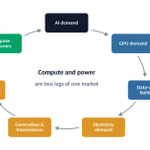
Kalshi intends to launch additional compute and power markets so people can trade the physical infrastructure behind AI. From a market perspective, compute and power are the two most important inputs to the AI revolution happening in the marketplace.
In other commodity markets we have already seen similar relationships exist: Gas & power trade through the spark spread, for instance. We are already witnessing AI infrastructure develop a similar relationship: power in, compute out, aka the Silicon Spread.
Kalshi is taking a methodical and comprehensive approach to building out the markets for compute and power:
(1) Price Discovery & hedging through Prediction Markets
(2) Continuous exposure management through Perpetual Futures
(3) Long Dated Exposure hedging through Dated Futures
AI infrastructure runs around the clock, and the risks don’t pause either. Weather, outages and grid constraints can move power markets significantly over a weekend. Kalshi, with our ability to both trade and clear 24/7 will provide the marketplace for round-the-clock trading and risl management of power and contract markets.
For more details, please read out insights in this research paper. kalshi.com/research/kalshi-r…

Udesh Jha retweeted

We just submitted a regulatory filing to introduce margin on a subset of long-dated prediction markets. This will not apply to sports, culture, and a few other categories.
We are very excited to be taking what we believe is our most important step toward institutional adoption so far.
Capital efficiency has been the biggest bottleneck for institutions, and margin is the single most requested feature. Fully collateralizing long-dated contracts ties up substantial capital for months or years, making participation impractical for many institutions. It is very difficult for a large institutional market to develop without margin.
Margin addresses that problem by reducing capital requirements, subject to strict risk standards.
Some important characteristics of our proposal:
• Margin applies only to a narrow set of categories, excluding sports and culture.
• It is geared toward institutions and subject to strict eligibility requirements.
• The risk methodology is modeled on approaches used by established clearinghouses and tested over decades. It incorporates conservative safeguards around volatility, liquidity, concentration, and event risks, as well as measures to limit sharp increases in margin requirements during market stress.
The goal is a better trading experience for users. Greater capital efficiency enables more institutional participation, bringing deeper liquidity and better pricing. That makes our markets more attractive to more traders, whose participation further strengthens liquidity and improves the experience for everyone.

Udesh Jha retweeted

Margin trading is common in all financial markets.
Some important features:
- This is geared for institutional clients.
- It is a way to reduce cost of capital for long dated markets and introduce efficiency.
- It is not for a number of categories including sports and culture.

Udesh Jha retweeted
Not exactly. I clarified that we have no imminent plans to do agriculture perps. And if that were to change, we'd engage all relevant stakeholders first.
Definitely going higher - that’s precisely why we built the Ciitizen’s Debt Forecast, starting with US to bring clearer awareness amongst the masses.
Not only does Kalshi’s CDF show interests going higher but has scenario analysis feature to see how it evolves with changing projections on growth, interest rates, inflation and fiscal status.
kalshi.com/citizen-debt-fore…


Debt affects every citizen, but until now the US public has mostly had to rely on forecasts produced periodically by institutions. This Citizen Debt Forecast gives people something different and unique: it augments the institutional forecast with live, market-implied view of where the debt ratio, deficits, and interest payments are heading, updated real-time as expectations for growth, inflation and rates change.
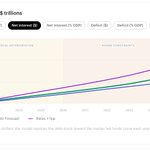
To me, the most powerful part is the scenario analysis: what happens under higher rates, stagflation, stronger productivity growth, or an AI-driven growth boom? See below a 100bps increase in interest rates (all else equal) can bring the interest burden close to $3T by 2036....try out other custom scenarios to better understand the impacts
This prediction markets driven analytics can become a source of forward-looking economic data that helps people and policymakers make better decisions. Public awareness will help improve policy decisions as well.
kalshi.com/citizen-debt-fore…


We’re launching the Citizen Debt Forecast (CDF): a real-time projection of our national debt powered by people’s beliefs aggregated by prediction markets.
The national debt just crossed $40 trillion.
And it’s accelerating fast. It took hundreds of years to accumulate the first $20 trillion and 18 years for the next $20 trillion.
For FY 2026, the government made $5.6T and spent $7.4T creating a $1.9T deficit (5.9% of GDP). Here’s the breakdown of spend:
• $4.4T (60%) in mandatory across Social Security, Medicare, Medicaid, SNAP, etc.
• $1.9T (26%) in discretionary across Defense, Education, Transportation, Police, etc.
• $1T (15%) in Net Interest
The debt feeds on itself. A bigger debt stock means a bigger interest bill. If the economy and government revenues don't grow fast enough, more borrowing is needed to finance the existing debt - creating a vicious cycle of growing interest payments and debt. The debt impacts every American: higher interest rates flow straight to borrowing costs from mortgages to credit cards.
So when does the debt get dangerous? There is no precise number and it’s more about the trajectory. Things turn bad when debt keeps growing faster than the economy and investors start demanding substantially higher rates to lend to the government.
The government has a few (bad) options to pay down the debt:
• raise taxes (less money for Americans),
• cut spending (fewer services),
• print money (inflation), or
• default (trust erosion).
We could also grow our way out of it, but it requires GDP growth we haven't seen in decades, sustained for decades.
So how do we know if we're making progress?
Our current projections of the debt come from a handful of institutions: the Congressional Budget Office (CBO), the OMB, the CRFB, and the Penn Wharton Budget Model. The CBO is the default: they forecast debt-to-GDP 30 years out and set the number everyone else anchors to.
These are excellent models, built by serious people. But they share a limitation: they're centralized. Each produces a single projection, shaped by one institution's assumptions, and updated only a few times a year. When the facts change, the forecast waits for the next release.
Prediction markets offer something different. They match buyers and sellers, and aggregate beliefs across millions of people through an open, competitive bidding process. If traders think the market is wrong, they profit from correcting the price, so new information is incorporated in real time. The market produces a continuously updated forecast that can aggregate information no single committee possesses.
One of my favorite Druckenmiller quotes from his op-ed last week summarizes this perfectly:
"Markets aggregate information no committee possesses, and prices are how that information reaches decision makers."
The Citizen Debt Forecast (CDF) is powered by free and open markets. It is a 10-year projection of the debt-to-GDP ratio, built from three forward curves – inflation, real GDP, and Fed funds – generated from Kalshi markets and layered on top of the CBO's fiscal baseline. It aggregates the views of thousands of traders into a single, easy-to-read picture of where the debt ratio is headed.
We display the CDF next to the CBO forecast, allowing you to compare the two paths. We also made it interactive, so you can enter your own assumptions to compare with the citizen’s forecast and the CBO’s. You can even select from some pre-built scenarios: goldilocks, stagflation, sovereign default, and more.
Many in Congress, on both sides of the aisle, are concerned about the debt. People and institutions already use prediction markets to track elections, geopolitics, and rates. Debt forecasts were harder to read, so we built a dashboard that puts them in one place. I hope this becomes a go-to market-based projection to complement committee-based forecasts and serve as an additional data point for the general public and policymakers.
The debt is one of the greatest challenges facing America. My door is always open to anyone working on solving it.
kalshi.com/gdp-scenarios
Interesting divergence for a very consequential September FOMC: Market-implied odds are near 60%, while Kalshi is at 49% — and Mohamed El-Erian thinks even Kalshi may be too high.
A good example of why having an independent, directly traded prediction market matters: it provides a separate source of price discovery, informed by a different mix of participants and views.
The market-implied probability of a September Fed rate hike has jumped to nearly 60%, while Kalshi currently prices it at 49%.
Both seem too high for three reasons:
Market-based measures of inflation expectations remain well anchored.
AI-driven productivity gains give reasons to be more optimistic about the future evolution of the supply side, while AI demand-side worries are likely to abate.
Fed rate hikes will hit most already struggling, interest-rate-sensitive sectors such as housing.
#economy #markets #federalreserve #inflation
Udesh Jha retweeted

The New York Times published a story today about prediction markets. They asked us a series of questions, then ignored almost every answer that didn’t align with the narrative that was being pushed. So we’re sharing our answers below. news.kalshi.com/p/kalshi-nyt…


I worked for more than a decade and a half at CME leading risk and I moved to Kalshi this year.
What attracted me to @Kalshi initially was the predictions market, the regulation-first and risk-management first principles that @mansourtarek_ and @luanalopeslara have built the firm upon.
But what has also been another true eye opener for me is Kalshi’s efficiency and speed of execution in getting the results while preserving the rigor.
With a staff strength of less than 200 people to have built a full stack exchange and clearinghouse that runs and clears 24x7 markets, first to launch regulated perpetuals and a surveillance team that handles $30B in volumes a month and millions of users are just a few examples of the credible markets we serve.
And definitely proud NOT to be encumbered with bloated staff and management layers.

A HIGH-STAKES BATTLE between the leaders of global markets:
@luanalopeslara of Kalshi questions the legitimacy of the world's largest commodities exchange.
Terry Duffy of CME responds:
"I have more people in my regulatory department than you do in your entire company."
Luana: "Maybe you should learn a bit about efficiency then."
Duffy: "Well, maybe you should learn about credible markets."
Udesh Jha retweeted

It can be easy to dismiss this as “Binance + Kalshi is being manipulated” rather than actual price discovery
The manipulation argument of “hammering the close” would certainly make sense if Synth had sampled only the final 60 seconds of each 15-minute market as that’s the actual window feeding the resolution TWAP. But they didn’t: Synth sampled across the full 15 minutes.
If there were widespread manipulation these markets simply wouldn’t have scaled like they have, retail would’ve burned out a while ago, MMs would limit liquidity on orderbook against toxic flow and volume would drop like we’ve seen on Poly
We actually saw exactly that with the manipulation rife on Poly’s short-term crypto markets earlier this year, followed by a mass migration of users from Poly to Kalshi because of this (image attached). And kudos to the @SynthdataCo guys being actually one of the first to post about this manipulation publicly!
The reason why Kalshi has stayed more resilient to manipulation is attributable to:
1. A 60s TWAP for resolution price (Poly just took a single snapshot)
2. KYC + surveillance banning bad actors (yes market manipulation is a crime)
3. Aggregated Oracle Pricing (Poly used only Binance, whereas Kalshi uses weighted average of many CEXs specifically excluding Binance)
Prediction markets certainly aren’t perfect oracles of truth, but I do think the inherent forward-looking nature of them has helped add an extra layer of richness to price discovery that isn’t captured by spot prices alone


1/ Synth's HFT team has found that @Kalshi’s 15-min BTC market is beginning to predict subsequent BTC moves on @binance and all other CEXs.
And strength of this predictive relationship has grown materially throughout 2026 (see image).
@Kalshi is becoming the venue for BTC price discovery on short time horizons.
🧵

Udesh Jha retweeted

Senator, each of these examples is from unregulated, offshore platforms. (Except of course for the teleprompter case - which Kalshi successfully caught and prosecuted thanks to its robust surveillance program required under federal law).
We urge you not to condemn America's regulated markets - and the staff working tirelessly at the CFTC - based on overseas platforms that will never follow US law. Legislating without understanding the distinction will only drive users to those bad actors.

This is an extremely valuable research note...one that we have been speaking for a while, but quite pleasing to see this come from one of the largest institutional firms.
Morgan Stanley researchers find that Kalshi markets outperform traditional indicators for Fed funds and CPI forecasting — while providing earlier market-implied signals across GDP, payrolls and unemployment.
Regulated Prediction markets aren’t just a new asset class. They’re becoming the financial infrastructure for price discovery, hedging and risk management.

