






Naveen Jain retweeted

Since the 1960s, the genetic code has been used to predict protein sequences from DNA and mRNA sequences. Our @Nature article demonstrates that these predictions miss thousands of protein sequences present in human tissues.
Across >1,000 human samples, we identified numerous abundant proteins whose amino acid sequences differ from those predicted by the genetic code.
These proteins are not rare translation byproducts. They accumulate to thousands of copies per cell. Some are more abundant than the proteins predicted by the genetic code from the same transcripts.
Their abundance reflects a combination of alternate RNA decoding mechanisms — including codon-anticodon mismatches, tRNA abundance, and RNA modifications — and selective stabilization of the resulting proteins. The last factor – protein stability – emerges as a major determinant of protein abundance across proteins, proteoforms and cell types: slavovlab.net/research.htm#P…
Alternate RNA decoding is pervasive across functional groups of proteins, healthy and diseased tissues. It affects proteins playing key roles in neurodegeneration, and some alternately decoded proteins show strong enrichment in tumors compared to their surrounding tissues.
This discovery has been a long and exhilarating journey with Shira Tsour and the @slavovLab team. It started in 2019 and proceeded through many challenges and thrilling highs. A journey that has opened new perspectives that we long to explore!
1/


We report many proteins not predicted by the genetic code.
They are stable & abundant O( 10³ ) copies / cell.
Generative mechanisms include codon-anticodon mismatches & RNA modifications.
Their abundance depends on codon frequency & protein stability.
biorxiv.org/content/10.1101/…

Naveen Jain retweeted

What if you could record cytosolic activities or archive proteins on an intracellular tape across time? 📼
Introducing CyTRACE: a genetically encoded, modular framework built on protein tape recorders for scalable post hoc spatiotemporal analysis and molecular interrogation.
🔍 CytoSense records protease & kinase signaling activities
📦 CytoCatch archives cytosolic proteins along CytoTape
Preprint out: doi.org/10.64898/2026.06.15.…
🧵Thread (1/7)

ALT CyTRACE schematic - CytoSense and CytoCatch


Naveen Jain retweeted

🤩 spatial panoramic in vivo CRISPR screen via Perturb-DBiT 🤩 Excited to share our collaborative work with @sidichen lab and many outstanding collaborators, now published in Nature Biotechnology!
nature.com/articles/s41587-0…

Naveen Jain retweeted

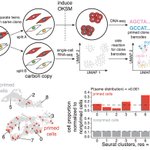
A central limitation of cellular barcoding analyses has been the loss of native spatial context. With @insitubiology, we developed an adaptable platform for multiclonal lineage analysis that links clonal history to spatially resolved gene expression. cell.com/cell-stem-cell/full…
Naveen Jain retweeted

Exciting breakthrough technology from the lab, now live in @CellCellPress ! Instead of cutting the genome where proteins bind (e.g., Cut&Tag), D&D-seq scars the DNA with a deaminase, allowing single cell genome mapping of TFs and chromatin remodellers!

Naveen Jain retweeted

Today in @NatureBiotech we report a new suit of PE8 prime editor proteins. PE8 variants were developed from laboratory-evolved PE6 proteins using AI-guided protein redesign. This approach combines recent advances in computational protein design and directed evolution to increase prime editing efficiency, especially in transient therapeutically relevant delivery settings such as mRNA+pegRNA electroporation into primary cells, eVLP delivery of prime editing RNPs, and LNP-mediated mRNA+pegRNA delivery in mice.
drive.google.com/file/d/13VT…
1/11

Naveen Jain retweeted

🚨Excited to share our single-cell multi-omic atlas of #stemcell islet differentiation that predicts cell fate decisions and identifies causal regulators of lineage specification. You can start browsing the data now 👉 synbioelab.com/islettwin Preprint 👉 biorxiv.org/content/10.64898…

Naveen Jain retweeted

Excited to share our latest paper, out today @CellCellPress. We found that large pieces of the human genome can transfer between cells upon direct contact, endowing recipient cells with heritable phenotypic changes. (1/7)
cell.com/cell/fulltext/S0092…

Naveen Jain retweeted

(2) Meet (again) clone2vec – a method for building clonal embeddings. In short: it measures similarity between clones based on their distributions in gene expression space. Sounds simple, but apparently it's not.

Naveen Jain retweeted

🚨 Excited to share a new paper in Cell! Human genetics led us to HOTSCRAMBL, a HOXA-locus lncRNA that regulates 🩸#stemcell self-renewal and HOXA9 splicing, with implications for AML.
Amazing work by @lvchosen1 with @silvirouskin, @Armstrong_dfci, and many more!
cell.com/cell/fulltext/S0092…

Naveen Jain retweeted

So you want to engineer your hiPSCs, but targeting DNA payloads requires multiple slow, inefficient steps for each construct. What if we could accomplish multi-site integration seamlessly? Come hear about STRAIGHT-IN Dual now out at Nature Biomedical Engineering! 🧵
Link at end!

Naveen Jain retweeted
Could the folding of synthetic gene circuits in 3D shape how genes are expressed? Today @ScienceMagazine we report on the role of gene syntax in shaping feedback between transcriptional activity and genome folding for advanced circuit design🧵 (1/n)

Naveen Jain retweeted

ft. Minh Than, Rina Sor, Shreya Nair, Nune Markosyan, Chenghua Yang, Courtney Ray-Fofana, Cole Edwards, Connor Hennessey, Austin Good, Liz Quinones, Cynthia Clendenin, Robert Vonderheide @BenStanger01 (@PennCancer) & @emma_furth (@PennPathLabMed) @PennPCRC science.org/doi/10.1126/scie…

Naveen Jain retweeted

How does a cell learn? In our new perspective in @Nature we propose a model where the properties of the AP-1 family of transcription factors – stress-induced feedback, regulatory combinatorics & cellular memory – encode a mechanism for cellular learning. nature.com/articles/s41586-0…

Naveen Jain retweeted

We’re unwrapping a new method today @MSKCancerCenter!
Led by @SydneyBlattman, @NabihMaslah, @AustinAVarela, Ronan Chaligne and @dana_peer, plus colleagues at @10xGenomics, we’re delighted to share Genotyping In Fixed Transcriptomes (GIFT):
biorxiv.org/content/10.64898…
1/n
Naveen Jain retweeted

Our Human Multiomic Development Atlas paper is out in Nature today! A heart-felt "thank you" to all co-authors for their tireless work on this complex yet exciting project! Congrats all! nature.com/articles/s41586-0…

Naveen Jain retweeted
🤔How do you design a promoter for stable titration of expression?
💡Try programmable promoter editing with DIAL!
📰Now published at @NatureBiotech 🧵 [1/n]
🔗 below
