
🌱Exposing Big Ag's grip on the food system 🇺🇸 Farmers · Parents · Advocates 💚 Corporate Accountability | Food Transparency 📲 Get Involved ⬇️
Joined January 2026
- Tweets183
- Following0
- Followers12
- Likes1




Corporate agribusinesses like Tyson and Smithfield have designed a system where they reap the profits, while local neighbors pay the price.
Ashlen breaks down how this billion dollar industry has shifted the costs of its business model onto rural communities—from polluted water and foul air to impacts on home values.
Factory farms, officially known as concentrated animal feeding operations (CAFOs), are a corporate accountability issue as much as an environmental one.
Watch Ashlen connect the dots. Follow @uprootcenter for more on corporate power and our food system.
Farmers can get paid less while families pay more at the grocery store.
That’s why consolidation in the middle of the food system matters.
A handful of massive meat companies like Tyson, JBS, and Smithfield have enormous control over processing, and major players have faced antitrust cases tied to alleged price coordination and information sharing.
This does not mean every price increase is caused by illegal conduct.
But it does mean that when a few corporations control so much of the market, farmers and families have less leverage.
If you’re ready to challenge Big Ag’s grip on our food system, comment BIG AG and we’ll send you the petition.
#bigag #foodprices #farmers #corporatepower #uprootcenter
Huge amounts of U.S. farmland are devoted to commodity crops like corn and soy, much of it tied to animal feed, fuel, and export markets.
Meanwhile, the U.S. still imports many of the fruits, vegetables, and everyday foods families actually eat.
The takeaway?
We produce enormous amounts of crops for a food system that was not designed around feeding people here at home.
And that’s not a farmer problem.
Farmers respond to the markets, policies, and incentives that already exist.
The bigger question is who shaped those incentives — and who benefits from keeping them in place.
If you’re ready to challenge the system Big Ag built, comment PLEDGE and we’ll send you the link.
#bigag #foodsystem #agriculture #foodsecurity #uprootcenter
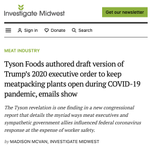
A congressional investigation later uncovered internal emails showing Tyson’s lawyers sent proposed language to the Trump administration as meat companies pushed for federal intervention.
President Trump then signed an Executive Order invoking the Defense Production Act to keep meatpacking plants operating. 3/6
That’s why Big Ag’s political power matters.
It isn’t just campaign donations or lobbyists walking Capitol Hill.
It’s corporations gaining extraordinary access when the rules governing their own profits, liabilities and workers are being written. 5/6
Want to understand how Big Ag gets protected? Follow what Tyson did during COVID 🧵1/6

ALT Investigate Midwest article about Tyson Foods and Trump's 2020 executive order.
The people growing, harvesting, processing, and packing our food are often the ones carrying the greatest risk, but they are not the ones with the lawyers, lobbyists, and access to shape the rules around their work.
That is true for farmworkers facing extreme heat with very few protections. It was also true for meatpacking workers during COVID, when workers were getting sick while major companies like Tyson were betting on their lives while simultaneously pushing the White House to keep plants operating.
The question is not just who does the work.
It’s who gets a seat at the table when the rules are being written and who the rules are actually being written for.
If you’re ready to challenge a food system where corporations have more power than the people carrying the risk, comment PLEDGE and we’ll send you the link.
#farmworkers #workersrights #bigag #foodsystem #uprootcenter
Ever look at a school lunch menu and wonder:
“Why is THIS what we’re feeding kids?”
The answer isn’t always sitting inside the school.
Sometimes it’s sitting much higher up the food chain. 🧵 1/4
Those companies can negotiate nationwide volume deals and rebates with major food processors.
For a school district operating on a tight budget, buying outside that system can become harder, more expensive, or logistically impossible. 3/4
This is what corporate power looks like when a corporation has so much access to our government that you don’t even know who is writing the rules anymore. During COVID, meatpacking workers were facing outbreaks while Tyson and other companies pushed the White House to ensure that plants kept operating as if nothing had changed. A congressional investigation later found that Tyson’s legal team helped draft language used in the federal response.
The workers didn’t have Tyson’s lawyers, lobbyists, or access.
Tyson did.
If you’re ready to challenge the corporations shaping our food system and demand real accountability from Big Ag, comment PLEDGE and we’ll send you the link.
#bigag #corporatepower #workersrights #foodsystem #uprootcenter
Whenever you hear, “Well, if it were dangerous, they wouldn’t be allowed to sell it,” remember:
Corporations don’t sit quietly while governments decide how their products should be regulated.
They lobby. 1/4 🧵
So when tighter food standards threaten the status quo, the corporations benefiting from the status quo have every incentive to fight back.
And they have considerably more money and access than the person standing in the grocery aisle. 3/4
When something goes wrong in our food system, it’s easy to point the finger at farmers.
But how often do we look at the corporations shaping the conditions farmers work within and writing all the rules?
Let's take a step back to ask who has the money, political access, and influence—and why that matters when we talk about accountability.
Comment PLEDGE and we’ll send you the link to sign our petition to stand with independent farmers and help build a food system that puts farmers and communities first.
#IndependentFarmers #BigAg #FoodSystem #RedBarnIllusion

ALT Screenshot of a social media post with a farmer in the background.

ALT Farmer crouching in a field with a social media post overlay about Bayer buying Monsanto.

ALT Farmer in straw hat working in a field with social media post overlay.

ALT Farmer in a field reads a post about Big Ag and corporate influence.