

Launch one token on two chains. Creator fees keep both market caps in parity.
Joined November 2026
- Tweets17
- Following0
- Followers119
- Likes0



Pinned Tweet
$PARITY is now live on Solana and BNB Chain.
Pump CA: ETHgDzFEG9gqBrjpPyiLvi12LSN9m7aPSdvWWjyZpump
Flap CA: 0x45c22aae8f21fabf030051ad709b65277f437777
both tokens have the same supply, with creator fees on each chain used to buy whichever side falls behind in market cap.
a keeper monitors both markets and uses accumulated fees to buy the cheaper side whenever the market caps drift apart, bringing them back toward parity.
two chains, one token.
useparity.fun

when a token launches through Parity, both versions start with the same supply, but their market caps naturally drift apart as trading activity develops on each chain.
the keeper uses accumulated creator fees to buy whichever side is falling behind.
the tokens acquired through these buybacks are burned, permanently reducing circulating supply and creating additional deflationary pressure while bringing both market caps closer to parity.
when people realize that a memecoin can trade on two different chains while creator fees continuously work to bring their market caps into parity, they'll start to understand the potential here.
Solana and BNB Chain have completely different traders, liquidity, and trading activity, yet Parity connects both markets through a mechanism that automatically buys whichever side falls behind.
the more volume each chain generates, the more fees become available to close the gap.
useparity.fun

the use case is keeping the same memecoin trading at similar valuations across two different chains.
normally, a token on Solana and its counterpart on BNB Chain can have completely different market caps, even with identical supplies.
Parity connects both markets through creator fees, automatically buying whichever side falls behind to bring their valuations closer together.
useparity.fun

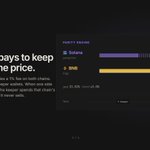
$PARITY is currently sitting at a $15.2k market cap on Solana and $20.4k on BNB Chain, with a 25.45% gap between the two.
the keeper is monitoring both markets and using accumulated Solana creator fees to buy the cheaper side, gradually bringing the market caps closer to parity.
as more fees accumulate, more capital becomes available to close the difference.
you can track the market caps, historical snapshots, and keeper activity directly on useparity.fun

when launching through useparity.fun, you can choose how far apart the two market caps are allowed to drift before the keeper starts buying.
the default is 3%, but you can configure the threshold for your own pair.
once the difference exceeds that range, the keeper calculates the required buy and uses available fees on the cheaper chain.
every pair has its own threshold, while the keeper monitors all active launches.
Parity isn't achieved through a single transaction.
the keeper checks both markets every 30 seconds and calculates how much capital is needed to bring the cheaper side closer to the other.
if there aren't enough accumulated fees to close the entire gap, it buys what it can and continues checking as more fees become available.
over time, these buybacks work to bring both market caps closer together.
the gap is currently high because both tokens trade independently, and the keeper can only use accumulated creator fees to bring their market caps closer together.
as more trading volume generates fees, the keeper continues buying whichever side falls behind, gradually closing the gap over time.
useparity.fun

you can track every token's parity directly from its token page on useparity.fun
both market caps are displayed alongside their price difference, so you can see exactly how closely the two chains are trading.
every keeper action is logged, including buybacks, token burns, and creator fee sweeps, with transaction hashes so you can verify everything on-chain.
the entire parity mechanism is transparent, from the fees being collected to the transactions bringing both market caps back in line.

as time plays out, you'll begin to see the two market caps move closer together as the keeper continues using accumulated creator fees to buy whichever side falls behind.
the math behind it is pretty interesting:
Δreserve = √(target price × k) − current reserve
using the bonding curve's reserves, the keeper calculates how much capital is needed to bring the cheaper token toward the other token's valuation, then executes the buy using available fees.
liquidity engineering through automated, fee-funded buybacks across two independent chains.
useparity.fun
Parity bot is now back online and running.
both tokens will be brought back toward parity from where their prices drifted while the bot was offline, using accumulated creator fees to buy whichever side is behind.
launch your own pair: useparity.fun
there was a small bug with the Parity keeper spending all accumulated fees on buybacks without leaving enough BNB to cover gas fees for subsequent transactions.
pushing out a fix now to make sure a portion of the balance is always reserved for gas.
everything else is working as intended, and the parity mechanism will continue operating normally once the fix is deployed.
on BNB Chain, flap.sh has transfer restrictions in place while tokens are still on the bonding curve, which means the keeper can't burn the tokens it acquires just yet.
once the token migrates to PancakeSwap, the accumulated supply will be burned.
on Solana, this restriction doesn't exist, so tokens acquired through creator fee buybacks are already being burned.
the parity mechanism continues operating on both chains throughout this process.

both $PARITY tokens are now being kept in parity across Solana and BNB Chain.
as more volume comes in, more fees become available for buybacks, allowing the keeper to close larger gaps between the two market caps.
useparity.fun
every token launched through useparity.fun generates a 1% fee from trading activity on both chains.
pumpfun creator fees are collected on Solana, while @flapdotsh trading taxes are collected on BNB Chain.
those fees are pooled separately on each chain and used to buy tokens that have fallen behind their counterparts, bringing their market caps closer to parity.
as trading volume increases, more fees become available to fund buybacks across both chains.

two chains, one token.
introducing useparity.fun
a dual-chain launchpad that uses creator fees to keep two versions of the same token at similar market caps.
how it works:
→ launch a token on pump.fun and flap.sh with a single transaction on Solana.
→ both tokens have the same name, ticker, and supply, with a 1% fee collected from trading activity on each chain.
→ a keeper monitors both market caps. when one falls behind, it uses accumulated fees to buy the cheaper side and bring them closer to parity.
the keeper only buys, never sells. every token purchased is held by the protocol.
one token, two chains, with creator fees constantly working to close the gap between them.
launch yours: useparity.fun