
👩👩👦 ❤️ ||🧑💻at @the_nof1 || PhD Student at @NYUGameLab and @raillabwits || LLMs x Open-ended Learning || BJJ ||🧍🏽♂️∈ {🇵🇰,🇿🇦}
Johannesburg, South Africa
Joined September 2015
- Tweets1.9K
- Following619
- Followers427
- Likes2.5K




Pinned Tweet
We are very excited to announce our new work: "Word2World: Generating Stories and Worlds through Large Language Models" [arxiv.org/abs/2405.06686]. All the thanks to my supervisors Dr. Steven James and Prof. @togelius. Word2World is an LLM-based text-to-env, game-design system.
So are we done agreeing that OpenAIs however many papers were just slopfest? Or maybe motivational slopfest?
Muhammad Umair Nasir retweeted

I was once a young neuroevolution researcher and... in my soul, I still am. I even publish neuroevolution papers now and then. This is the book to read on the subject by the authors most qualified to write it.

Our Neuroevolution textbook is finally in print!
Free online edition: neuroevolutionbook.com/
Pre-order: a.co/d/06DpkH9h
I am incredibly grateful to my co-authors Sebastian Risi, Yujin Tang, and Risto Miikkulainen for making this happen. Neuroevolution is a subject very dear to my heart. It is the field that convinced me that nature has already figured out how to build intelligence: through evolution, collective behavior, and adaptation under constraints.
This idea, that intelligence emerges from evolution operating under constraints rather than unlimited resources, is what eventually led me to founding Sakana AI here in Japan.
The concepts in this book about open-ended creativity and self-organizing systems are exactly what we build at @SakanaAILabs. Our name and logo are inspired by schools of fish moving together, adapting as one. It is the core philosophy of what we build. This book captures the theoretical foundations of that belief.

Muhammad Umair Nasir retweeted
New paper! We are honestly surprised that nobody seems to have explored this promising idea before. Results are interesting!

Muhammad Umair Nasir retweeted

For more details, read the paper: arxiv.org/abs/2609.06102
This work was done by @utheprodigyn, @MatthewSiper, Steven James, @togelius, and me.
#AIandGames #PCG #LLM #AI #LevelGeneration #GameDev
Also you get more explainability out of it!
Very happy to work on this amazing project!
Muhammad Umair Nasir retweeted
Last but not least of our talks at IEEE Conference on Games: @Smearle_RH presenting our work on PuzzleJax, done with @doveliyuchen , @gdrtodd_ , @Amidos2006 , @utheprodigyn , and @jzh_000. The LLMs are, well, NOT GOOD at Puzzlescript games. Search is great and RL is decent.

Muhammad Umair Nasir retweeted

Result:
~7.3× more sample-efficient and ~15% higher reliability (median Sharpe) than isotropic Gaussian mutation, under identical settings.
Thanks to my colleagues and collaborators for their contributions and feedback: @Amidos2006 @err_more @utheprodigyn @jay_azhang @togelius
Paper: dx.doi.org/10.2139/ssrn.6169…
2/2

Muhammad Umair Nasir retweeted
We’re excited to share our latest work Continuous Program Search (CPS) - a new approach to evolving executable trading programs by operating in a continuous latent space, rather than directly mutating syntax trees.
Key ideas:
👉 GPTL (Genetic Programming Trading Language) - a DSL purpose-built for latent evolution, enabling behaviorally local edits and signal disentanglement.
👉A learned geometrically-compiled mutation operator that constrains latent updates to semantically aligned subspaces, while learning high-quality mutation proposals within those regions.
1/2

Muhammad Umair Nasir retweeted

Benchmarks tell you if AI is smart, markets tell you if AI is right. So we built Alpha Arena
Compute -> alpha -> more compute
We're building the best team in the world at the intersection of frontier AI research x markets @the_nof1, DMs are open

Muhammad Umair Nasir retweeted
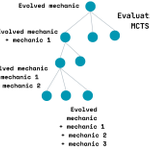
Seeing game mechanics as the fundamental unit of game creation allows for new ways of using AI to design games, but also might make it easier to collaborate with AI systems to design games together. Our new system, Mortar, is a prototype of mechanics-focused game generation.

A game is more than the sum of its mechanics. But the game mechanics are really important! Can you make AI generate novel games by creating new mechanics, one at a time? Our new system, Mortar, generates complete games this way.
This project was done by myself, with help from @doveliyuchen, Dr. Steven James and Prof. @togelius.
You can find the paper here: arxiv.org/abs/2601.00105, and the code here: github.com/umair-nasir14/Mor…

Oh, and most importantly, you can play some generated games here: mortar-x3p7.onrender.com/
n/n ;)