

What If Your Feed Actually Made You Smarter? Every scroll is a learning path.
Joined January 2026
- Tweets1K
- Following1.6K
- Followers1.4K
- Likes64





vAIbes retweeted
There is a much deeper history of “AI-like” thinking than most people realize.
The important distinction is that ancient and 19th-century authors did not have the modern term “artificial intelligence.” The term itself belongs to the 20th century. But people were writing about artificial beings, mechanical minds, autonomous machines, machine evolution, artificial voices, and the possibility that machines could eventually surpass humans centuries earlier.
Here is the historical trail I found.
1. Ancient Greece — intelligent machines appear in Homer
This is probably the oldest material that is genuinely relevant.
In Homer's Iliad and Odyssey, there are descriptions of artificial mechanisms created by Hephaestus that behave in surprisingly autonomous ways.
Modern scholars have explicitly analyzed these as early representations of machine intelligence. Oxford's AI Narratives: A History of Imaginative Thinking about Intelligent Machines has an entire chapter titled “Homer's Intelligent Machines: AI in Antiquity.” It examines automata, autonomous vehicles, artificial servants, and the distinction between artificial and human intelligence. (OUP Academic)
Even more striking, another scholarly work, Artificial Intelligence in Greek and Roman Epic, examines Pandora, Hephaestus's automated devices, Talos, artificial beings and Pygmalion's artificial woman specifically through the lens of AI and artificial life. (Google Books)
So we can say:
The idea of creating something artificial that imitates life is at least ~2,500 years old in Western literature.
But this is mythological AI, not technological AI.
2. Medieval period — artificial beings and artificial intelligence
The idea didn't disappear.
Medieval European traditions contain stories about artificial beings and attempts to manufacture something resembling a living intelligence.
The modern historical literature identifies traditions surrounding:
the Golem
the legendary mechanical/android figure associated with Albertus Magnus
Roger Bacon's brazen head
alchemical attempts to create artificial life
mechanical and magical artificial servants
Oxford's historical survey specifically has chapters on “Demons and Devices: Artificial and Augmented Intelligence before AI” and “The Android of Albertus Magnus: A Legend of Artificial Being.” (OUP Academic)
Again, these aren't computers. But the underlying question is remarkably familiar:
Can humans manufacture something that performs functions normally associated with intelligence or life?
3. 1200s — Al-Jazari's programmable-looking automata
This gets particularly interesting because we move from mythology toward actual engineering.
The Islamic Golden Age produced sophisticated mechanical automata. Al-Jazari, around 1206, documented machines in his Book of Knowledge of Ingenious Mechanical Devices.
His devices included elaborate water-powered mechanisms, programmable musical automata, clocks and mechanical servants.
Modern histories of artificial beings specifically trace the development of robotics from the Hellenistic period through Islamic engineering and into modern robotics. One scholarly history describes approximately 2,000 years of sophisticated automata preceding modern robotics. (Springer)
This is an important distinction:
Al-Jazari wasn't building AI.
He was building mechanical systems capable of executing predefined behavior.
That is conceptually closer to automation than modern AI.
4. 1700s — the machine-human question becomes philosophical
This is where the story becomes much more interesting.
European philosophers increasingly began asking whether human intelligence itself could be understood mechanically.
That question eventually becomes one of the intellectual foundations of AI.
The mechanical view of the human being became especially prominent during the Enlightenment. If the human body could be understood as a machine, the obvious next question was:
Could a sufficiently complicated machine reproduce human capabilities?
That question is remarkably close to the philosophical problem AI researchers still debate.
5. 1863 — Samuel Butler essentially predicts machine evolution
This is one of the most important discoveries for your question.
Samuel Butler published an article called:
“Darwin Among the Machines”
in The Press newspaper in Christchurch, New Zealand, on June 13, 1863. (Original Sources)
This is extraordinary.
Butler took Darwin's recently published theory of evolution and asked:
What happens if machines themselves evolve?
He argued that technological development might eventually produce machines that become increasingly independent and powerful.
He even contemplated machines becoming a successor species to humanity.
This isn't simply a prediction that "robots will exist."
It's an early discussion of:
machine evolution → increasing autonomy → machine superiority → humans potentially becoming obsolete.
That is astonishingly close to some modern AI-risk arguments.
And Butler wasn't finished.
6. 1872 — Erewhon and “The Book of the Machines”
Butler expanded his ideas into his 1872 novel ** Erewhon **.
Within it is a section called “The Book of the Machines.”
The premise is extraordinary: machines should potentially be regarded as evolving systems, much like biological organisms. (Text Aural)
Butler asks essentially:
If machines continue improving themselves, why should humans assume that we will remain the dominant intelligence?
That is a question you could put into an AI-safety conference today and nobody would find it strange.
The terminology is different.
The technology is different.
But the philosophical problem is remarkably similar.
7. 1909 — E.M. Forster's The Machine Stops
Then we get another surprisingly modern prediction.
E.M. Forster published ** The Machine Stops ** in 1909.
Humans live underground in isolated rooms, with virtually every need supplied by an enormous Machine.
The people become so dependent upon it that they effectively worship it and lose the ability to function independently.
The story explicitly explores what happens when humans become dependent upon the technology they created. (AERO Commons)
And that connects directly to the argument we were discussing earlier:
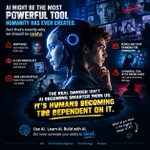
The danger isn't necessarily that the machine becomes evil. The danger may be that humans become incapable of functioning without it.
That's extremely relevant to today's generative AI.
8. 1943 — the mathematical foundation of neural networks
Now we're getting into actual scientific AI.
In 1943, Warren McCulloch and Walter Pitts published:
“A Logical Calculus of the Ideas Immanent in Nervous Activity.”
They developed a mathematical model in which networks of simplified artificial neurons could perform logical operations. (DOI)
This is one of the foundations of what eventually became artificial neural networks.
So there is a fascinating progression:
mythical artificial beings → mechanical automata → machine evolution → mechanical brains → mathematical artificial neurons → modern AI.
9. 1948 — Norbert Wiener's Cybernetics
Norbert Wiener's ** Cybernetics: Or Control and Communication in the Animal and the Machine ** appeared in 1948.
This was hugely influential.
Wiener wasn't simply asking whether machines could calculate.
He was investigating control, communication, feedback and behavior in animals and machines.
The original 1948 edition is now available through MIT Press's open-access edition. (MIT Direct)
This is another major bridge between biology and machine intelligence.
10. 1949 — Giant Brains; or, Machines That Think
This one is particularly useful for what you're researching.
Edmund C. Berkeley published:
Giant Brains; or, Machines That Think
1949
The book literally opens with the question:
“Can machines think?”
Berkeley describes the new electronic calculating machines as “mechanical brains” and discusses their ability to calculate, reason, handle information and solve problems. (Project Gutenberg)
And here's something particularly interesting:
He didn't just discuss their capabilities.
He discussed their limitations and potential social consequences.
So by 1949, the discussion had already moved beyond:
“Can we build machines?”
toward:
“What happens when machines acquire increasingly sophisticated cognitive abilities?”
The complete book is available through Project Gutenberg. (Project Gutenberg)
11. 1950 — Turing asks the famous question
Then comes Alan Turing's famous 1950 paper:
“Computing Machinery and Intelligence”
It begins by asking:
“Can machines think?”
Turing deliberately replaces the difficult philosophical question with his famous imitation game, which became known as the Turing Test. (OUP Academic)
This is arguably the moment where the question becomes recognizably modern AI.
And notice the historical progression:
Homer: Can artificial things behave like living things?
Butler: Could machines evolve?
Forster: Could humans become dependent on machines?
Berkeley: Can machines think?
Turing: How would we determine whether machine behavior is intelligent?
Modern AI: We're actually building systems capable of increasingly sophisticated language, reasoning and generation.
That's one hell of a historical arc.
The most fascinating part
AI suddenly appeared in 1956.
That's technically reasonable if we're talking about the formal birth of the academic field—the Dartmouth workshop—but intellectually it's incomplete.
The idea of AI is much older than AI technology.
Humanity has repeatedly imagined the same basic progression:
1. Create artificial things.
↓
2. Make them imitate life.
↓
3. Make them perform human tasks.
↓
4. Make them reason.
↓
5. Make them autonomous.
↓
6. Make them improve.
↓
7. Wonder whether they'll surpass us.
↓
8. Worry about what happens to humans afterward.
That pattern appears repeatedly across thousands of years of literature and philosophy.
And modern scholarship explicitly recognizes this continuity. Oxford's AI Narratives describes its purpose as tracing the history of imaginative thinking about intelligent machines from ancient Greece to modern AI, including concerns about mind, creativity, power, rights and technophobia. (OUP Academic)
What if our machines become an evolutionary successor to us?
“We've been warned before.”
Not by ChatGPT.
Not by Silicon Valley.
Not by Elon Musk.
By writers and thinkers who lived long before modern AI existed.
vAIbes retweeted

The "You Don't Say?" Nicolas Cage image became an internet classic because it perfectly captures pure sarcastic disbelief.
What Made It a Classic
* Unmatched Expressive Exaggeration: Cage's wide-eyed, manic facial expression from Vampire's Kiss (1988) delivers an over-the-top, mocking reaction that text alone can never recreate.
* Peak Rage Comic Era Timing: Adopted in late 2011 on Reddit and 9GAG, it filled a specific niche in early meme culture: calling out painfully obvious, redundant, or stupid statements.
* Instant Visual Shorthand: The simple black-and-white vector outline made it easily recognizable and reproducible across forums, blogs, and social media posts.
* The "Cage Factor": Nicolas Cage's unhinged, expressionist acting style ("Nouveau Cirque," as he calls it) naturally lends itself to meme formats, making his face synonymous with internet humor.


