

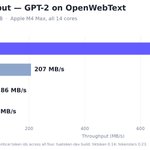




Gigatoken raised the bar for tokenizer speed. We took it as a challenge.
tuetoken: 3.9× faster than gigatoken on the everyday case (list of strings in, token lists out), and 1.18× on gigatoken's own 2 GB OpenWebText benchmark. Same token ids.
pip install tuetoken


Vadim Borisov, PhD retweeted

Our group discovered that reasoning models produce fractals when asked to solve hard problems. We can use nonlinear dynamics to probe the thinking processes of recurrent depth models on Sudoku, mathematics, and even ARC-AGI (1/N)
arxiv.org/abs/2609.04963
Vadim Borisov, PhD retweeted

Our AI autoresearch system just improved a mathematical bound that had stood for 22 years.
For the squarerem-lattice self-avoiding-walk connective constant:
μ(Z²) ≥ 2.627385640…
previous rigorous lower bound: 2.625622
Verifiable certificate.
numaro.tech/research/self-av…

Vadim Borisov, PhD retweeted

a=(m,d=mag(k=9*cos(i*5)*sin(i),e=cos(i*3)*cos(i*2)*9)**3/1999+1.5-sin(t/2+m)**3/3)=>point(99*sin(c=d/16-t/48+m)+k*(p=d**sin(d*d-t+m))+200,99*sin(c*4)+e*p+200)
t=0,draw=$=>{t||createCanvas(w=400,w);background(9).stroke(w,96);for(t+=PI/20,i=1e4;i--;)a(i%16*13)}//#つぶやきProcessing
Vadim Borisov, PhD retweeted

We can finally talk about it:
We found a way to extract hidden reasoning of frontier models using a vulnerability in the APIs of every frontier AI company.
We verified that our reasoning token count matches billed API thinking tokens 1:1 for most of the prompts we queried.

Vadim Borisov, PhD retweeted

Introducing TabFM, a foundation model designed specifically for tabular data classification & regression. This approach allows generation of high-quality predictions on previously unseen tables in a single forward pass.
Learn more and try out the model →goo.gle/4eR7uku

enjoy the sovereignty

Good new first: Sol is a smart, efficient, and a significant step forward. It is the same price as GPT-5.5. Also launching in the GPT-5.6 family is Terra, with 5.5-level performance at half the price.
Bad news: at the request of the US government, it is launching today in limited preview instead of the open access launch we were planning on. We are working with the government to get to general availability as fast as we can.
I think it is quite reasonable to roll out models--especially as they reach significant new levels of capability--in this way. It fits with our long-held strategy of iterative deployment. But this isn't quite the process that we think is optimal.
Now we will with the government to attempt to get to a transparent, reliable process for early access, and to ensure that as long as our safeguards work as intended we can release widely. We want to be a reliable, dependable partner that works with all stakeholders, and we also want to live by our mission of benefiting all of humanity. I believe the government shares most of our goals, and that they are overall doing a good job in a very difficult situation.
We will work as quickly as we can to get this model in your hands and we hope you will love it.
3
478
we just published it: github.com/tuetoken-org/tuet…
⚡ 7–40× faster tokenization
⚡ Up to 85% higher vLLM throughput
⚡ Lower TTFT for long prompts
⚡ Especially effective for embedding models with vLLM


We built tuetoken -> a tokenizer up to 43× faster than tiktoken (@OpenAI) and @huggingface tokenizers. Early preview.

Vadim Borisov, PhD retweeted

🚨 New paper: Introducing MIND (Monge Inception Distance)
Everyone agrees that FID is broken, requires too many samples, slowing down evals.
MIND requires 10x fewer samples, is more robust, faster to compute.
Our new drop-in replacement for evaluating generative models. 🧵👇


We built tuetoken -> a tokenizer up to 43× faster than tiktoken (@OpenAI) and @huggingface tokenizers. Early preview.
Numbers:
43× faster than tiktoken on short prompts
~12× lower encode latency
~14× lower decode latency
~6× faster batch throughput
Drop-in replacement for HuggingFace tokenizers.
1
105
Early preview. If you're running LLM APIs, high-volume inference pipelines, or just tired of watching your dataset tokenization progress bar crawl -- reach out, happy to set up a demo.
#LLM #MLOps #Inference
1
98
Vadim Borisov, PhD retweeted

Introducing the Synthetic Data Playbook: We generated over a 1T tokens in 90 experiments with 100k+ GPUh to figure out what makes good synthetic data and how to generate it at scale
huggingface.co/spaces/Huggin…

Vadim Borisov, PhD retweeted

This paper introduces YapBench, a benchmark that measures when LLM chatbots add needless extra text to simple prompts.
Many of these chatbots answer tiny requests with long filler that wastes attention and tokens, the text units many paid services bill for, because longer replies get rewarded in training.
YapBench fixes the target length for each prompt by writing a minimal sufficient answer, meaning the shortest reply that is still correct and clear.
It then counts extra characters beyond the baseline, called YapScore, which keeps comparisons fair even when models count tokens differently, and combines typical category scores into YapIndex.
The authors tested 76 assistant models on 304 prompts in 3 sets, vague inputs that should trigger a short question back, single fact questions, and 1 line coding requests.
They found typical extra length can differ by about 10 times, and newer top models were often more verbose than older ones like gpt-3.5-turbo.
The point is to make verbosity a thing that can be measured and improved, so apps can pick models that stay brief when brevity is best.
----
Paper Link – arxiv. org/abs/2601.00624
Paper Title: "Do Chatbot LLMs Talk Too Much? The YapBench Benchmark"

Vadim Borisov, PhD retweeted

Do LLMs Talk Too Much?
There is a feeling familiar to almost everyone who regularly interacts with LLMs: you ask for a short answer and receive paragraphs of explanations, preambles and «just to clarify…» additions. The paper «Do Chatbot LLMs Talk Too Much?» attempts to measure this phenomenon systematically.
The authors introduce YapBench - a benchmark not about how smart the answer is, but about how much text a model generates beyond what is minimally necessary. If a question has an obvious short answer, everything else is a matter of assistant policy rather than necessity.
They collect 304 short prompts, deliberately chosen so that the ideal response should be concise. These fall into three types of situations:
• when the input is almost empty and the correct response is simply to ask for clarification
• when a short factual answer is required
• when a single one-line piece of code is sufficient
For each prompt, a minimally sufficient baseline answer is manually defined, and then the number of characters the model adds on top of that baseline is measured.
This yields the YapIndex - the median number of «extra» characters. The count is done in characters rather than tokens. Where possible, markdown is stripped out - temperature is set to 0, responses are single-turn and generated without system prompts. In other words, what is being measured is the behavioral tendency of models to say more than necessary.
The results are quite revealing.
On average, the most concise responses come from gpt-3.5-turbo (YapIndex ≈ 22.7), followed by kimi-k2, gpt-4, and grok-4-fast, while newer and ostensibly «smarter» models often turn out to be noticeably more verbose. Different types of prompts break models in different ways:
some begin «filling the vacuum» and inventing content when the input is empty,
others turn a simple fact into a mini reference article and others accompany a one-line code answer with explanations, headings, and duplicated content.
Crucially, this is not a fundamental limitation. In every category, there are models that behave cleanly and concisely. This means verbosity is not «how LLMs inherently work», but rather the result of post-training choices, preferences, and incentives that often reward answers which look more helpful, even when they are objectively redundant.
The authors also examine reasoning modes and arrive at a careful conclusion: reasoning does not necessarily make answers longer on the median, but it increases the risk of extreme cases, where a model produces an overly long response. They also observe a weak but noticeable trend: when models are plotted by release date, average verbosity slowly increases (with a correlation of about 0.21).
There is also a practical dimension. The authors calculate YapTax how many extra dollars are spent on «verbosity» per 1,000 requests. For expensive models, this is no longer negligible: for some GPT and Gemini variants, the cost amounts to several dollars purely due to excess text. In agentic systems and customer support, this turns into a quiet but persistent source of expense.
arxiv .org/abs/2601.00624

Vadim Borisov, PhD retweeted
New paper from top Chinese Labs show how to train an AI agent that learns a compact world model by practicing inside interactive games.
Standard agents try to plan everything in 1 huge thought, which is heavy and often locks in wrong assumptions.
This work instead lets the model act for several steps, see the real game response, and update its understanding on the fly.
From many such episodes it builds a world model, meaning an internal sense of what each action usually does in that environment.
WMAct adds reward rescaling, where the score is multiplied by the fraction of moves that changed the state, so pointless shuffling loses credit.
It also uses interaction frequency annealing, starting with many turns but slowly tightening this limit so the model must think more.
In maze, Sokoban, and taxi grid worlds, this training lets the agent solve many puzzles in a single shot that earlier needed trial-and-error dialogues.
The same model also gets noticeable gains on separate math, code, and general benchmarks, suggesting that this thinking-by-doing practice sharpens reasoning beyond these games.
----
Paper Link – arxiv. org/abs/2511.23476
Paper Title: "Thinking by Doing: Building Efficient World Model Reasoning in LLMs via Multi-turn Interaction"

Vadim Borisov, PhD retweeted

A transformer's attention could be 99% sparser without losing its smarts!
A new research from MPI-IS, Oxford, and ETH Zürich shows it can.
A simple post-training method strips away redundant connections, revealing a cleaner, more interpretable circuit.
This suggests much of the computation we rely on is just noise.
Sparse Attention Post-Training for Mechanistic Interpretability
Paper: arxiv.org/abs/2512.05865
