

𝘊𝘰𝘯𝘯𝘰𝘳 𝘝𝘦𝘯𝘵𝘶𝘳𝘦 𝘗𝘢𝘳𝘵𝘯𝘦𝘳 | 𝘚𝘵𝘢𝘳𝘵𝘶𝘱 𝘈𝘥𝘷𝘪𝘴𝘰𝘳 12𝘒+ 𝘚𝘵𝘢𝘳𝘵𝘶𝘱𝘴 𝘙𝘦𝘷𝘪𝘦𝘸𝘦𝘥 • 𝘏𝘦𝘭𝘱𝘦𝘥 𝘙𝘢𝘪𝘴𝘦 $2𝘔+
Amsterdam, The Netherlands
Joined May 2025
- Tweets102
- Following0
- Followers41
- Likes33






Pinned Tweet
Before signing an investment agreement, ask one question:
“What does this mean for my company three years from now?”
YOU ARE MORE LIKELY TO BE WRONG WITH YOUR FIRST IDEA.
YouTube started as a video dating platform. Instagram started as Burbn, a location-based check-in app. Slack emerged from a failed video game. Shopify started as an online store for snowboarding equipment.
Did these companies fail? No. They found a better direction.
And this is something I think first-time founders need to understand. Your first idea is not a commitment. It is a hypothesis. You are not obligated to spend the next five years forcing people to accept an idea simply because you were the one who came up with it.
One of the most important skills you need to learn in business is pivoting. The ability to recognize when something isn’t working, understand what the market is telling you, and take a different direction.
You are in business to build something valuable, solve a problem, and create a business that makes money. You are not in business to preserve your original idea.
Sometimes the market is not responding because your product is wrong. Sometimes the problem is your pricing, distribution, positioning, or the customers you’re targeting. And sometimes, the idea itself is simply not worth pursuing.
But a lot of founders would rather spend three years trying to convince people to buy something they don’t want than admit they need to change direction.
Don’t become emotionally attached to your idea. Become committed to building a viable business.
You may be wrong about your first idea. Just make sure you don’t spend years trying to prove yourself right.

41
THE BEAUTIFUL BUSINESSES ARE OFTEN THE BAD ONES. HERE’S WHY.
When people want to start a business, the first things they think about are registering a company, designing a logo, creating social media pages, renting an office, buying furniture, printing flyers, and making the business look official.
And yes, those things matter for certain businesses. But for many businesses, that’s not where the work begins.
The real starting point is validating whether the business actually works. Finding customers, securing partnerships, testing demand, understanding the market, figuring out your business model, and sometimes securing capital. That is the groundwork.
The problem is that people rarely see that part. What you see on social media is somebody opening an office, launching a brand, cutting a ribbon, or announcing that they have finally started their business. But by the time you see that post, they may have already spent six months, two years, or even three years working behind the scenes.
What you’re seeing is not necessarily the beginning. You’re seeing the result of the groundwork.
Unfortunately, a lot of people see that 50% and want to start from there. They want the office before the customers, the branding before validation, and the structure before they even know whether the business is viable.
It’s like building a house. You can’t just start laying blocks on bare ground because you’re excited to see the building take shape. There’s a foundation that has to be laid first.
So the next time you see someone announce a beautiful new business on LinkedIn, Instagram, or X, understand that the business may have started long before that announcement.
Don’t confuse the visible part of starting a business with the actual beginning. Do the groundwork first.

27
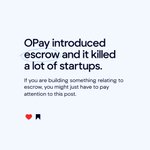
OPay just introduced Shield Pay, and if your entire startup is built around providing escrow, you should be paying attention.
This is something I have always said about startups built around a feature rather than an entire market problem.
Yes, escrow solves a real problem. Buyers are afraid of paying sellers who might not deliver. Sellers are afraid of delivering goods and not receiving payment. There is a genuine trust problem in online commerce.
But escrow is also a feature that can be integrated into an existing financial ecosystem. And that’s exactly why this development matters.
OPay already has a payment infrastructure, an existing customer base, merchant relationships, and an established transaction ecosystem. It doesn’t necessarily need to convince millions of people to download a new application just to use escrow. It can introduce the feature into an ecosystem people already use.
And that changes the competitive dynamics.
This is the problem with building a startup around a feature that an established company can easily integrate into its existing product.
I’m not saying building an escrow startup is a bad idea. I’m saying you need to understand the size, depth and sustainability of the problem you’re solving, and whether your solution has a competitive advantage that can survive when bigger players enter the market.
This is where TAM, SAM and SOM become important. You need to understand:
TAM: The entire market opportunity you’re addressing.
SAM: The portion of that market your business can realistically serve with its business model and capabilities.
SOM: The portion of that market you can realistically capture.
If the only market you’re defining is people who need an escrow transaction, you need to ask yourself whether that opportunity is large enough to build a sustainable business around, and whether you can capture it profitably.
Sometimes, escrow is the product. But sometimes, escrow is just one feature of a much bigger problem.
The point is not to stop building features. Every business starts by solving something specific. The point is to understand whether the problem you’re solving is the foundation of a business or simply one feature of a business that already exists.
Don’t just build a feature people need. Build a business around a problem that is worth solving, difficult to commoditise, and capable of growing beyond the feature itself.

26
YOUR BUSINESS IS PROFITABLE. DOES THAT MEAN YOU’RE READY TO RAISE CAPITAL?
Not necessarily.
A lot of business owners assume that once their businesses become profitable, the next logical step is to raise capital to expand. But profitability doesn’t automatically mean your business is ready for external funding.
In fact, I’ve seen situations where a business was profitable before raising capital, but started struggling after the money came in.
So, what are the three key indicators that your business may be ready to raise capital?
1. You Have A Proven And Repeatable Business Model.
You understand how your business makes money, who your customers are, and what drives your revenue. You’re not raising money to figure out whether the business works. You’re raising to strengthen or scale something you’ve already validated.
2. You Have A Clear Capital Deployment Strategy.
You know exactly how much you need, what you’ll spend it on, and what measurable outcomes that capital is expected to produce. You should be able to explain how the money will move your business forward.
3. You Have The Operational Capacity To Absorb And Manage Capital.
Your systems, people, processes and financial controls must be strong enough to support the growth you’re pursuing. More money can expose weaknesses in an already fragile business.
Here’s something I want business owners and founders to understand: Fundraising is not always the solution to your business bottleneck.
Sometimes, what you need is a strategic partnership, not more money. Sometimes, if you’re looking to expand across borders, you need a local distribution partner or market-entry partner rather than raising millions to build infrastructure you could access through a partnership.
This is why I always advise founders and business owners to speak with an experienced advisor before beginning their fundraising journey.
You need someone who can assess your business, understand your current position, identify your bottlenecks and help determine whether fundraising is actually the next step.
If your business has reached a point where you’re considering raising capital but aren’t sure whether it’s the right move, send me a DM. Let’s talk.

The most valuable skill in the startup ecosystem right now is product distribution. Let’s talk about it.
I keep telling founders that one of the best additions they can make to their team is someone who understands how to distribute a product.
Here’s why.
We live in an era where you can generate ideas quickly, build an MVP in weeks, and launch a product faster than ever before.
But there’s one problem. Building a product is becoming easier. Getting people to buy it is still hard.
I’ve seen founders build great products, solve real problems, and even have solid business models, yet struggle because they don’t know how to get their products into the hands of the right customers.
And this is where distribution comes in.
You can have the best product in your market, but if nobody knows it exists, nobody understands its value, or you cannot consistently reach the people who need it, your product will struggle to grow.
Now, imagine someone walks up to you and says, “I can take your product from zero sales to 1,000 sales, then 10,000, and eventually 100,000.”
And this person isn’t just making promises. They have the numbers, the track record, and the evidence to prove they can do it.
Do you think businesses will want that person on their team?
Absolutely.
Because that person doesn’t just understand how to sell. They understand how to create a repeatable system for getting products to customers.
If you have a background in sales, marketing, growth, or business development, consider going deeper into product distribution. Learn how to identify the right customers, find the channels that reach them, convert interest into sales, and build systems that make those results repeatable.
And if you’re a founder, start paying attention to the distribution skills your team is missing.
You don’t always need another person who can build. Sometimes, you need someone who knows how to get what you’ve built into the market.
A product gets you into the game. Distribution gives you a chance to win it.

New date, same room. 📍
The Venture Room Abuja is now happening on Saturday, 7 November 2026.
🕚 11:00am to 4:00pm WAT
📍 Matambela Gardens, Wuse 2, Abuja
🎟️ ₦25,000
Already registered? Your ticket is still valid. Nothing to do.
Not yet? Grab your seat: xeero.me/venture-room
See you in Abuja.
#TheVentureRoom #Abuja #Founders #Startups


15
Don’t run your startup at full speed all the time. Here’s why.
Growing up in a hot environment, one thing I noticed was how we used fans to cool our bodies. And I used to believe that if a fan had three speed settings, putting it on three was always the best option when the weather was hot.
But over time, I started thinking about something.
When you turn the fan up to its highest speed, you feel the cooling effect almost immediately. But imagine sleeping with that fan on full speed and suddenly losing power in the middle of the night. You can quickly become uncomfortable as the air stops moving and your body continues dealing with the heat.
Now, this isn’t because your body has become permanently dependent on that particular fan speed. It’s because the cooling effect you were relying on is suddenly gone.
And that got me thinking about startups.
Sometimes, founders run their businesses at maximum speed all the time. They’re spending aggressively on customer acquisition, hiring rapidly, expanding into new markets, and pushing every available resource to its limit.
And because the business is growing, they assume everything is working perfectly.
But here’s the question: What happens when that speed suddenly drops?
What happens when the funding stops coming? When your marketing budget runs out? When customer acquisition becomes more expensive? When the market slows down?
Does your business have the systems to keep moving, or does everything start falling apart?
This is where I think founders need to understand the difference between growth and sustainable growth.
You don’t always need to operate at maximum capacity to make progress. Sometimes, a slower but consistent pace gives you room to build the systems, processes, and financial discipline that keep your business moving.
I’m not saying you shouldn’t move fast. There are moments when speed is critical. I’m saying you shouldn’t build a business that can only function when everything is running at full speed.
Build your revenue engine. Build efficient operations. Manage your cash flow. Create systems that don’t depend on you constantly pushing everything to the limit.
Because the real test of a business isn’t just how fast it can move when conditions are favourable.
It’s how well it keeps moving when the conditions change.
Don’t build a business that only thrives at full speed. Build one that can keep moving when the speed drops.

1
41
If you’re raising $100K, I’d rather you raise it from one investor than ten.
I’m telling you this from experience.
Raising money costs money. Meetings, travel, follow-ups, due diligence, negotiations, and your time all come at a cost.
So instead of chasing 100 people who can give you $10K, identify 10 people who can write a $100K cheque and focus on closing one.
Because getting $10K from one investor doesn’t mean you’re done. You still have to find the remaining $90K.
For a relatively small round, don’t just build a bigger investor list. Build a better investor list.
Talk to people who can actually close the round.
It’s not always about talking to more investors. Sometimes it’s about talking to the right investors.

14
A lot of founders miss funding opportunities because they can’t keep records.
You can tell investors you’ve generated tremendous revenue. You can tell them you’ve built a successful business.
But when they ask for proof, where is it?
Financial records. Revenue history. Expenses. Bank records. Financial statements. Evidence of traction. And where appropriate, independently reviewed or audited financials.
Fundraising is not something you start when you decide you need money. You prepare for it long before you ask for it.
If your business has been operating for a while, start keeping proper records. Separate your finances. Track your money. Document your growth. Build evidence.
Because when you’re raising capital, your story is not enough.
Proof is what makes the story investable.
If you’re preparing to raise and don’t know how to put the pieces together, send me a DM. I help founders and business owners prepare for fundraising and understand how to approach capital properly.

16
ABUJA, IT’S YOUR TURN.
After a powerful first edition in Lagos, the demand has been clear, so we’re bringing Venture Room with Connor to Abuja.
📍 Matembela Gardens, Abuja
📅 24 October 2026
Venture Room is a room for founders to have real conversations around Clarity, Partnership, and Fundraising. No fluff. No generic startup talk. Just builders, opportunities, conversations, and the people building what comes next.
If you want to sponsor, partner, or make a general inquiry, reach out to Adeshewa on +234 702 5527 022 or email [email protected]
Registration officially opens next week.
But if you want to secure an early bird ticket at a great discount, send me a DM.
Abuja, let’s build the room.

1
35
From an idea to a room full of founders.
What started as a simple experiment became something I’ll never forget. Over 50 founders, one room, and conversations around clarity, partnership, and fundraising.
Thank you, Lagos, for showing up. Thank you to every founder, partner, supporter, and everyone who helped make Venture Room possible.
This is just another step toward what I’m committed to: helping founders become better product builders.
Until we meet again. 🤍


1
25
Interest is not demand. A lot of founders confuse the two. You tell your friend about your startup idea, and they say, “That’s interesting.” You speak to a few people, and they say, “Oh, that’s a nice idea. I would use it.”
And suddenly, you think you’ve validated your business.
No.
Someone finding your idea interesting is not the same as someone being willing to pay for it.
They are two different things.
Interest tells you that something has caught someone’s attention. Demand tells you that the problem is important enough for someone to take action.
And businesses are built on demand.
When I’m reviewing a startup and I ask, “How did you validate this idea?”, one answer that immediately makes me ask more questions is:
“I spoke to people, and they said they were interested.” That’s not necessarily bad. It’s just not enough.
Because the real question is:
“What did those people do after expressing interest?”
Did they sign up?
Did they commit?
Did they pay?
Did they agree to a pilot?
Did they introduce you to someone who needed the solution?
Did they change their current behavior to use what you’re building?
Those actions tell you much more than “That’s interesting.” And this is why I always tell founders to examine the pain frequency of the problem they’re solving.
How often does the problem happen?
How painful is it?
What does it cost the customer when it happens?
And most importantly:
Is it painful enough that someone is willing to take money out of their pocket to solve it? Because I can have a problem and still decide that it’s not painful enough to pay for. That doesn’t mean the problem doesn’t exist. It means the problem may not be a business opportunity yet.
So before you build, don’t just ask:
“Do people like this idea?”
Ask:
“Is there enough real demand for this solution to become a business?”
Your friends may tell you your idea is interesting.
But customers will tell you whether it’s valuable enough to buy.
And if you’re still trying to understand how to validate your idea properly before building, that’s a conversation every founder needs to have.
Don’t build based on interest. Build based on evidence of demand.
1
24
You can have a very great product and still have a terrible business.
This is one of the misconceptions I see a lot.
People assume that if you build a great product, the business will automatically become great.
Not necessarily.
You can be doing ₦20 million in revenue and still be burning ₦21 million.
You can even be doing ₦20 million in revenue and burning the entire ₦20 million.
So yes, you have revenue. But do you have a business that can sustain itself?
This is why I always tell founders: building a product is different from building a business.
When you’re building a product, you’re trying to achieve product-market fit.
Product-market fit is about whether people want what you’re building. Do they discover it? Do they use it? Do they retain? Do they recommend it? Is the product solving a real problem well enough that people keep coming back?
But building a business asks a bigger question:
Can this product become a sustainable business?
That is where things like pricing, margins, customer acquisition costs, retention, operations, distribution, and profitability come in.
Let me give you a hypothetical example.
Imagine a startup that builds an amazing food delivery app.
The product is excellent. The interface is beautiful. Customers love it. Orders are growing. People are coming back.
That’s product-market fit.
But the company spends ₦2,000 to acquire and serve a customer, while making only ₦1,200 from that transaction.
The product may be great.
The business is in trouble.
Because people loving your product is not the same as your business making money from serving them.
And this is where a lot of founders get stuck. They spend so much time improving the product, adding features, and chasing more users, without asking whether the underlying business model actually works.
You don’t just want to build something people love.
You want to build something that can stand the test of time.
So the question is not only:
“Do people want this product?”
It’s also:
“Can this product become a sustainable business?”
That is the conversation I want founders to start having more often.
And if you’re wondering how to move from product-market fit to building a business that can actually work, that’s one of the conversations we’ll be having at Venture Room, happening 26 September in Lagos.
If you’re a founder, entrepreneur, or building a product, this is a room worth being in.
Link xeero.me/venture-room

37
Fundraising doesn’t start by talking to an investor.
It starts long before you ever get on that call.
A lot of founders think fundraising begins when they send a pitch deck, book a meeting, or get introduced to a VC.
No.
Fundraising starts weeks, sometimes months, before that conversation.
It starts with investor readiness.
And investor readiness is simply getting your startup ready to be invested in.
Put your house in order.
Your financials. Your business structure. Your cap table. Your legal documents. Your key metrics. Your traction. Your projections. Your data room.
Everything an investor needs to understand your business, evaluate the opportunity, and conduct due diligence should be properly organized.
Because imagine you’re in a meeting with a VC and they say:
“Can I see your data room?”
And you respond:
“Uhm, we don’t have one yet. Let me put something together.”
That’s not the impression you want to create.
Not because every founder must have a perfect business from day one, but because how prepared you are tells an investor a lot about how you run your business.
And when you start scrambling to assemble documents after the investor has already asked for them, things can become messy. You may overlook important information, submit inconsistent figures, or create unnecessary delays in the due diligence process.
Investor readiness is not about making your startup look bigger than it is.
It’s about making sure the business is clear, organized, and ready for serious evaluation.
So before you start asking, “Who can introduce me to an investor?”
Ask yourself:
“If an investor says yes to a meeting tomorrow, is my business ready for the conversation that follows?”
That is the question every founder looking to raise should be asking.
And if you’re wondering how to get your startup investment-ready, that’s one of the conversations I’ll be having at Venture Room, happening 26 September in Lagos.
If you’re a founder looking to raise investment, structure your business, or better understand what investors expect, you should be in the room.
Link xeero.me/venture-room

2
44
Over the years, I’ve spoken to over 10,000 founders across startup clarity, go-to-market, growth, investment, and cross-border scaling.
And one thing I’ve come to realize is that what holds many founders back is not always the lack of a good idea. Sometimes, it is the lack of clarity, structure, and access to the right capital.
I’ve seen how much of a difference it makes when a founder understands what they are building, who they are building for, how to position the business, and what it takes to attract investment. I’ve also had the opportunity to help startups raise over $5 million in funding.
That experience is part of why I’m putting together The Venture Room.
The Venture Room is a space where founders can gain clarity, better position their businesses, connect with potential partners, and explore investment opportunities. It is not just about bringing founders into a room. It is about helping them leave with a better understanding of what they need to do next.
The next edition is happening on 26 September 2026 in Lagos, at Bridge by Obsidian, Yaba.
If you’re a founder looking to gain clarity, position your business, seek investment, or connect with potential partners, you should be in the room.
And if you’re not in Lagos, we’ll also have a virtual room that day, where you can connect, ask questions, and participate in the session.
My goal is simple: to help founders become better product builders.
🎟️ Register via xeero.me/venture-room


1
29
What should you do when an investor ghosts you?
So, you had your first meeting with an investor. The conversation went well. You discussed the business, the opportunity, the numbers, and what an investment could look like.
Then, suddenly, silence.
You send a message. No response.
You wait a little longer. Still nothing.
First, relax.
Don’t get angry. Don’t become hostile. Don’t send a message asking, “Why are you ignoring me?” And please, don’t burn the relationship because you didn’t get a response.
Ghosting is frustrating, but it is part of the fundraising process.
Here’s what I recommend.
1. Send one personalized follow-up.
After a couple of weeks, reach out once. Keep it professional and direct.
For example:
Hello [Name], I hope you’re doing well. I’m reaching out regarding our previous investment conversation. I wanted to confirm whether you’re still interested in exploring the opportunity. If your priorities have changed, I completely understand. I’d appreciate knowing either way.
That’s it.
2. If they don’t respond, stop chasing.
Not every investor who doesn’t respond is rejecting you. They may be busy, their priorities may have changed, or the opportunity may simply not be a fit right now.
But whatever the reason, you don’t need to keep sending messages.
3. Add them to your investor update list.
This is where many founders miss an opportunity.
You should already have a curated list of investors you’ve spoken to, investors who have shown interest, and investors who may be relevant to your next round.
If an investor ghosts you, don’t necessarily remove them from that list.
Instead, move the relationship from “I’m trying to close this investor” to “I’m keeping this investor informed.”
Then, periodically, send them meaningful updates about your business.
Not every week. Not spam.
Send updates when there is something worth sharing:
Revenue growth
User or customer growth
Major milestones
New partnerships
Product launches
Important hires
Funding raised
Progress toward your next round
For example:
Hi [Name], I wanted to share a quick update on our progress since we last spoke. We’ve grown revenue by X%, closed X new partnerships, and reached X customers. We’re continuing to build and will keep you posted as we hit meaningful milestones.
The goal is not to beg them to invest.
The goal is to stay relevant and keep the relationship warm.
Because fundraising is not always about getting a “yes” today. Sometimes, it’s about making sure that when the investor is ready, your company is still on their radar.
And remember, your startup’s progress is your strongest follow-up.
If you’re looking for how to structure your investor list, or you want a practical template for sending investor updates, send me a DM. I can help you put one together.

48
A few hours ago, the founder and CEO of Flutterwave, Olugbenga “GB” Agboola, shared a picture of his complimentary card from his time as a Senior Manager at Access Bank.
The part that caught my attention was his caption:
“Every seat you occupy is an active classroom preparing you for the future.”
That is such a powerful way to look at your career and your journey as a founder.
Every role. Every industry. Every room. Every experience.
They are all opportunities to learn something that could become useful in the future.
And this is why I always tell founders to build from a point of strength.
One of the things that strengthens your position as a founder is experience. So, one question I always ask is: What experience do you have in the industry you are building in?
You may have a great idea, but how much do you understand the problem? The people experiencing it? The industry? The realities of building in that space?
And if you don’t have much experience yet, that’s okay. It simply means you need to be intentional about gaining it.
Sometimes, that experience comes from doing the work. Sometimes, it comes from learning from people who have already done it.
And that is part of why I’m bringing Venture Room to Lagos.
A room where founders and entrepreneurs can come together, share experiences, learn from one another, and gain the kind of perspective that helps them become better builders.
Venture Room is happening on 26 September in Lagos.
If you’re building something, or you’re thinking about building something, this is a room worth being in.
The link is in my bio, or visit xeero.me/venture-room

55
Your startup might be going through oxidation, and you don’t even know it.
In chemistry, oxidation is a process where an atom, ion, or molecule loses electrons during a reaction. Now, let me show you how this applies to startups. Think about fundraising as a chemical reaction.
You have your startup on one side.
You have investors on the other side.
And then the reaction begins.
You start sending emails.
Taking investor calls.
Preparing decks.
Doing due diligence.
Updating financial models.
Following up.
Taking meetings.
And if your business isn’t properly structured, something starts happening. You start losing your electrons. But in this case, your electrons are not literally electrons.
They’re your time.
Your attention.
Your focus.
Your operational capacity.
Your product velocity.
The very things your startup needs to grow. And this is why I’ve seen founders spend six months fundraising and come out of that process with money…
but a weaker business.
Because they were so focused on getting the reaction to happen that they forgot what they were supposed to protect.
The business.
So yes, fundraising is important.
But if fundraising requires the founder to stop selling, stop building, stop talking to customers and stop running the company, you need to ask yourself:
What exactly are you gaining, and what are you losing in the process? That is why you need structure before you enter a fundraising cycle.
You need a team that can operate without you.
You need your financials in order.
You need your investor materials ready.
You need a clear fundraising strategy.
You need to know who you’re talking to and why.
Because the goal isn’t just to survive the reaction.
The goal is to come out of the reaction stronger.
So the next time you’re fundraising, remember:
Don’t lose the electrons that are keeping your startup alive.

1
40