

AI-native growth. CEO of RevStreem. I build with AI, then make AI recommend it. Helped 1,200+ builders ship apps.
Richmond, VA
Joined January 2021
- Tweets1.3K
- Following190
- Followers189
- Likes455





Pinned Tweet
Building got easy.
Getting found didn't.
I helped 1,200+ people ship apps with AI at Ambitious Labs. The ones who struggled almost never had a product problem. They had a distribution problem.
So now I run RevStreem. AI-native growth.
Build it with AI. Get it found by AI.
What's harder for you right now, building or getting found?
Prompt engineering helps you tell AI what you want. Loop engineering adds a process: attempt the task, check the result, use the feedback to try again, and stop at a goal or limit. The prompt still matters. Now you're designing how the work gets checked, too.


Grok Bot is incredible.
Last week this X account did ~604 impressions.
This week: ~11,400.
Followers up ~14.5% in 5 days.
Same stack is feeding my overall content strategy.
vidIQ just put me in the top 10% of creators.
6,864 views last week.
Morning scout finds what is spreading.
Replies draft and ship all day.
Originals wait for my yes. They never auto-post.
The bot owns volume.
I own the take.
The whole content system compounds.
Speed is free. Taste is the gate.
What would you refuse to automate?
1 person and 3 AI agents
vs
a 10-person-plus agency.
Same clients.
Same outcomes on the table.
Not the same cost.
Not the same overhead.
Not the same time to deployment.
The agent stack keeps shipping while you sleep.
Pages go out. Replies go out. Drafts stack up for a human yes.
What used to take weeks of handoffs lands in hours or days.
COGS are lower, so you can price lower and still keep a higher margin.
Overhead shrinks because you are not carrying a bench just to move one ticket.
Velocity is way higher because nobody is waiting on a standup to ship.
Reporting is data-driven by default: the numbers are already in the loop, not rebuilt into a monthly PDF.
Client check-ins stop being status theater. They turn into proactive strategy: brainstorming new creative ways to grow.
Estimate it for your own shop.
Cost. Overhead. Time to first ship.
One side sends a report.
The other compounds every day.
Who keeps the client?
SEO deliverables are becoming free.
The audit. Free.
The keyword list. Free.
The rank report. Free.
What clients still pay for:
the agent that ships the page, gets it cited in AI search, and shows the receipt.
Deliverables are a commodity. Outcomes are the product.
What are you still billing for that an agent does for free?
Ethan Halfhide retweeted

I literally can't think of a better risk/reward bet right now than building a ChatGPT plugin and getting in front of their 1.2 billion weekly users.
As of yesterday, ChatGPT recommends plugins in the middle of conversations. Millions of questions get asked every day with no plugin to recommend. Each one is an empty slot.
Facebook apps in 2007. iPhone apps in 2008. TikTok in 2019. Every big platform has a few months where distribution is free, and most people miss it.
I saw this firsthand when I lived in SF building venture backed companies. They are sacred times!
If I were starting this week:
1. Find a tool or workflow people already Google for or do by hand every week (PDF to Excel, invoice generator, weekly client reports)
2. Build it as a ChatGPT plugin
3. Write the description using the exact phrases people type into ChatGPT
4. Ship 5 of them and see which ones get picked up
5. Double down on the one with the most traction
In 12 months these slots will be crowded but right now they're pretty empty.
Most people will realize ChatGPT plugins were the biggest free distribution channel of 2026 sometime in 2027.


I've tried the new personal AI agents.
Instinct is the one that actually runs my life.
Not the smartest. The one I trust with email, calendar, and follow-through.
ChatGPT and Claude still think with me. Agents do the work.
Full breakdown ↓ View article

All right @gregisenberg, I followed your advice. SEO Operator got approved as a ChatGPT plugin.
My Claude connector uses external billing. ChatGPT plugins can't sell digital subscriptions or credits inside the plugin.
How would you turn this into revenue?

Ethan Halfhide retweeted
I think bringing AI to Main Street businesses might be one of the biggest business opportunity of the next 10 years.
Here’s how to sell AI to Main Street with no audience and no money, step by step, from picking a city to getting paid.
Anthropic filed its S-1 yesterday. TTM revenue per employee went from $1.4M to over $6.6M (revenue +~1,200%, headcount +~170%). The $80.7B net loss is mostly a non-cash remeasurement as valuation rose. Operating loss shrank to $693M; first-half revenue hit $16.3B, up 1,300%.


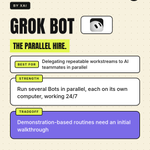
Muse, Dots, Claude Duet, Grok Bot and Instinct are all personal AI agents. Muse is the low-friction starting point. Dots is a specialist with its own cloud computer. Claude Duet works proactively but checks with you before it acts. Grok Bot runs a team of agents in parallel. And Instinct plays chief of staff across your email, calendar and follow-through. The question isn't which agent is smartest - it's which job you're willing to hand it. Follow @vibecodeceo for more.


✅ AI search will forgive you for:
- An ugly site
- A small backlink profile
- Posting twice a month
- Being 3 years old instead of 15
❌ It won't forgive you for:
- Pages that never answer the question
- Hidden pricing
- Zero third-party mentions
- "Industry-leading" with no proof
The machine doesn't care how big you are. It cares if you're quotable.
Google AI Overviews now show on 80%+ of searches.
Most B2B sites are still writing for 10 blue links.
Ranking isn't the goal anymore. Getting quoted is.
Write the answer, not the intro.
Put the number on the page.
Name the competitor before the AI does.
Is your team optimizing to rank, or to be cited?
I ran one prompt in Claude Code on every client site:
"Audit this site for AI search. What would stop ChatGPT from citing us?"
What came back almost every time:
1. No clear answer in the first 100 words
2. Pricing hidden behind "Book a demo"
3. Zero comparison pages
4. Schema missing or broken
5. Posts that never say who it's for
None of this is new SEO. It's SEO a machine can read.
Which one is your site guilty of?
Greg’s “Google Analytics for agents” idea is the tell.
If you can’t see which agents touch your site, you’re flying blind on AEO.
Same problem brands had with SEO before Analytics existed.
Whoever owns agent visit data owns the next growth stack.
Most “AI growth” playbooks are still SEO with a new coat of paint.
Real AI-native growth looks different:
1. Get cited in answers, not just ranked in blue links
2. Ship proof (numbers, repos, plugins) so models have something to quote
3. Reply where the buyers already hang out
4. Treat every post like an asset, not a one-off
Distribution isn’t a channel. It’s a system.