

choose life. choose your future. honest thoughts & vibes
London
Joined May 2023
- Tweets617
- Following121
- Followers10.4K
- Likes12.1K


wandermist retweeted
OpenAI, Google and Anthropic all fight for the #1 spot on one AI leaderboard - and it runs on a chess formula a physics professor in Milwaukee built for chess players in 1960. The site is Arena. It started as a Berkeley research project and is now valued at $1.7 billion.
A study found Meta tested 27 private versions of Llama 4 before launch, and Meta promoted an Arena score from an unreleased version. Magnus Carlsen's record 2882 and Claude passing GPT-4 come from the same math - and a 50-point lead still means the #1 model loses 43 out of every 100 head-to-head votes.
4 minutes. Bookmark & watch today. Before you switch to the new number 1


wandermist retweeted
Air France and Airbus paid for deep sea searches that came back empty for nearly two years - 228 people gone, black boxes 4,000 meters down. Then one American firm ran a formula from 1763 over the Atlantic, and robot subs found the wreck in about a week.
The same math found a lost hydrogen bomb the US Secretary of Defense reportedly valued at $2 billion. Y Combinator's Paul Graham used it to kill spam, AI labs use it to tune training runs that take days, and every next token ChatGPT writes is a probability updated by your prompt.
5 minutes. Bookmark & watch today. The $2 billion formula fits on a napkin
wandermist retweeted
OpenAI's GPT-4.5 was picked as the human 73% of the time - more often than the real people it was up against. Meta's Llama 3.1 fooled judges 56% of the time, while OpenAI's own GPT-4o managed just 21%, below ELIZA, a 1966 MIT chatbot that scored 23%. For nearly 30 years a $100,000 prize waited for the first machine to pass Alan Turing's test, and nobody ever collected it.
The jump came from one prompt. Tell OpenAI's largest model, priced at $75 per million input tokens, to act like an introverted kid who knows internet slang, and it goes from 36% to 73%. Over 254 games that sits more than 7 standard errors above a coin flip - a fair coin does that about once in ten trillion tries.
5 minutes. Bookmark & watch today. How one prompt on a $75 per million token model beat Alan Turing's test


wandermist retweeted
A puzzle the model gets right only 0.2% of the time becomes an 87% solve if you let it try 1,024 times, that's the sampling math behind o3's ARC-AGI record and this page plots the whole surface
The cheap run paid $34 per correct answer, the max run paid $5,211, so every extra point of accuracy cost about $384 per puzzle, roughly 1,100x more than the first 75 points
Then the twist, the same capability gets about 10x cheaper every year, GPT-3-level models fell from $60 to $0.06 per million tokens in three years, so today's $4,560 answer is a pricing problem, not a wall
bookmark it because the score is the headline but the cost curve is the story
OpenAI threw an estimated $456,000 of compute at 100 colored grid puzzles just to set a record on ARC-AGI, that's about $4,560 per puzzle, and in April 2025 ARC Prize admitted the real bill may have been closer to $30,000 a puzzle
The test was built by François Chollet, the Google engineer who created Keras, and he teamed up with Zapier co-founder Mike Knoop to put up a $1,000,000+ prize because GPT-3 scored 0% on it and GPT-4o managed only 5%
o3 fired off 1,024 attempts per puzzle, burned about 5.7 billion tokens and hit 87.5%, while the cheap run got 75.7%, so 12 extra points made every correct answer roughly 150x more expensive, from $35 to $5,200
Then ARC-AGI-2 dropped and GPT-4.5 scored 0% on puzzles humans solve for about $17 each, 5 minutes of math to watch before you trust the next "AI beats humans" headline from OpenAI or Google, so bookmark it and watch today because the formula inside shows what intelligence really costs
wandermist retweeted
Google's CEO Sundar Pichai announced that an AI just broke a math record older than the moon landing, since 1969 Volker Strassen's trick said two 4x4 complex matrices need 49 multiplications, it outlived the internet, the iPhone and every genius who tried for 56 years, the math under every Nvidia GPU leaned on it, and Google DeepMind's AlphaEvolve found a way with 48
One multiplication sounds like nothing until you learn every AI chip on Earth runs this operation billions of times a second, and then the same AI found 0.7% of Google's entire worldwide compute wasted inside its own data centers, at a company pouring well over $100 billion a year into AI infrastructure, napkin math says that's hundreds of millions of dollars of machines handed back by an algorithm, and it made Gemini's training 1% faster on top
Inside AlphaEvolve, Gemini Flash spits out thousands of programs, Gemini Pro rewrites the best ones, the losers die and the winners mutate like evolution on fast forward, Nobel laureate Demis Hassabis called it algorithms optimizing other algorithms with the flywheels spinning fast, and when DeepMind and Terence Tao, the Fields medalist people call the greatest living mathematician, threw 67 problems at it, it set a new world record of 593 spheres in 11 dimensions
4 minutes of math to watch before Google's AI starts upgrading Google's AI faster than any human can check, so bookmark it and watch today because a record that survived half a century of geniuses just fell to a machine that already pays for itself


wandermist retweeted
Trump just renamed AI "Super Intelligence" at the UN and the State Department told staff to swap every AI for SI, but Nick Bostrom's definition asks for an intellect that greatly exceeds humans in virtually all domains, and today's AI fails it because of one weakness
This year AI won gold at the Math Olympiad and solved all 12 problems at the world's top coding contest, where the best human team solved 11, yet the same kind of model made 758 BCG consultants 19 points less accurate on a task just outside what it's good at
Superintelligence needs AI to beat us at math and code and planning and judgment all at once, so one weak spot ruins the whole thing, and right now that spot is long work, where agents finish one hour human tasks only about half the time while that limit doubles roughly every 7 months
5 minutes of math to watch before you believe the next headline that calls a model super, so bookmark it and watch today because the speech left this part out
wandermist retweeted
In 1957 a linguist wrote that you shall know a word by the company it keeps, and 56 years later a Google team turned that line into arithmetic.
GPT-3 turns every token into 12,288 numbers, a table of 617 million in total. At the start they're random - a cat is no closer to a dog than to a truck. Then training on a single job, predicting the next word, drags similar words together until animals cluster with animals and vehicles with vehicles, and nobody ever wrote that rule.
King minus man plus woman lands near queen. Paris minus France plus Italy lands near Rome. Gender, capitals and verb tenses each became a direction you can add and subtract, and in 12,288 dimensions almost any two random directions are nearly perpendicular - so there's room for a huge number of them without one getting in the way of another.
4 minutes on how AI stores meaning as a place in space, so bookmark it and watch today before this secret stops being one


wandermist retweeted
In 1951 Claude Shannon cracked the trick behind ChatGPT, and nobody noticed for seventy years. He made people guess the next letter of English text, one character at a time, over and over. That dumb little guessing game now runs a trillion-dollar industry - ChatGPT, Claude and Gemini do literally nothing else, and every answer they've ever given you was built one word at a time by a machine that only ever picks the next one.
The model rolls loaded dice for every single word, so "the cat sat on the" gives mat 53%, floor 20% and moon about 1%. That temperature slider in your AI app is one division before the roll - which is exactly why you never get the same answer twice and why it can sound like a genius while being flat-out wrong. GPT-3 swallowed 300 billion tokens to learn this with 175 billion parameters, and the people who built it still can't explain why guessing words starts to look like thinking.
4 minutes that explain every chatbot you've ever used, so bookmark it and watch today before this 1951 secret stops being one
wandermist retweeted
In 2016, Victor Haghani and Richard Dewey gave 61 young people with quantitative training $25 each, 30 minutes, and a coin that landed heads 60% of the time. 28% of them went bust. Only 21% reached the $250 cap, and two out of three bet on tails at some point, against a coin they knew was rigged in their favor.
The math says the best bet on that coin is 20% of your bankroll. It grows your money about 2% per flip, which is 7.5x every 100 flips. At 40% the growth drops to roughly zero, and across 10,000 simulated players the typical one ends with $61 while the average sits in the hundreds of millions, pulled up by a handful of lucky ones. The rule behind it has been around since 1956 - it's called the Kelly criterion.
4 minutes. Bookmark & watch today. The one number that decides how much to bet and nobody taught you about.


wandermist retweeted
In 1906, a Danish telephone engineer named Johan Jensen published a short paper on convex functions. He never held a university post and did his math after work. That paper contains the inequality that explains why a fund advertising an 8% average return can leave its typical investor with almost nothing
Returns of +50%, -50% and +50% average 16.7% on paper, while your money grows only 4% a year. The difference is called volatility drag. Real growth is roughly the average return minus half the variance, so at 40% volatility an "8% fund" compounds at about zero. This video builds it up from scratch and ends with 20,000 simulated futures - two funds with the same average, where the typical investor ends up with $890 in one and $155 in the other, and 4 in 10 investors in the volatile fund lost money
4 minutes. Bookmark & watch today. The inequality that decides what your returns are really worth and nobody taught you about
wandermist retweeted
A matrix is a record of where i-hat and j-hat land, the first column is where the first basis vector goes and the second column is where the second one goes, and every other vector follows from those two because grid lines stay parallel and evenly spaced, 3B1B builds the whole multiplication rule out of that so you never have to memorize it
Most of an LLM's weights are matrices like this, only thousands of columns wide, and every training step gradient descent shifts where those columns point by a tiny amount so the next prediction comes out a bit better, the article walks through the math behind those shifts from Newton to Chebyshev
10 minutes of math worth watching before you read about gradient descent, save it and read the article below

wandermist retweeted
Ask a physicist what a vector is and you get an arrow in space, a programmer will say an ordered list of numbers and a mathematician means anything you can add and scale, and they're all describing the same object, so most of linear algebra comes down to switching between those pictures
An LLM does that switch before it reads a single word, because every token becomes a list of thousands of numbers and those numbers point somewhere in space, words with similar meaning end up pointing in similar directions and that's how the old word2vec example works where king minus man plus woman lands near queen, it's vector addition and scalar multiplication and this video covers both
10 minutes of math that every AI engineer wishes they learned first, save it before it's gone

wandermist retweeted
jev + opus 5.5 for ad research... i don't get why every marketer isn't running this yet.
matthew berman pushed 724 live ads from 37 brands through jev in 40 seconds. i built my own version to see how far it goes.
for every ad jev returns four typed judgments:
→ which hook the ad opens with
→ what format it runs in
→ how aware the buyer already is
→ whether a human should look at it
anything under 0.70 confidence goes to a person. opus reads the tags and writes the category brief: which hooks everyone copies and which angle barely anyone tests.
input costs $0.042 per million tokens and output is free, so reading a whole category costs pennies.
i break down how to build it in the article below:

wandermist retweeted
jev just became the fastest adopted model in vercel ai gateway history and it can't even talk
you hand it a question plus fixed answers, it picks one and says how sure
13% of paid vercel teams tried it in 24 hours, double any recent model launch
one scoring request costs $0.000126 and output tokens are literally free, so $5 covers about 39k runs
i built a terminal where jev reads an article and scores it section by section
when it's confident opus 5.5 rewrites the section, when it's unsure the section waits for a human
in the video one section scores 0.54 and jev flags it instead of letting opus touch it
bookmark this before your feed buries it, full breakdown in the article below ↓
wandermist retweeted
Stanford just dropped a lecture explaining the fundamentals behind modern AI, here’s the playbook:
00:05:28 – machine learning lets computers learn from data instead of being explicitly programmed, and that definition still holds
00:06:03 – every ML system comes down to experience, tasks and a performance measure, the model has to actually improve with more experience
00:13:55 – even LLMs are fundamentally doing classification, predicting the next token from thousands of possible choices
00:25:54 – LLMs changed ML from solving one specific task to building general-purpose models that can handle many different tasks
00:30:41 – every generated token is a stochastic decision, which is why reinforcement learning becomes important for training modern models
save this, then learn how the models actually work instead of treating AI like a black box


wandermist retweeted
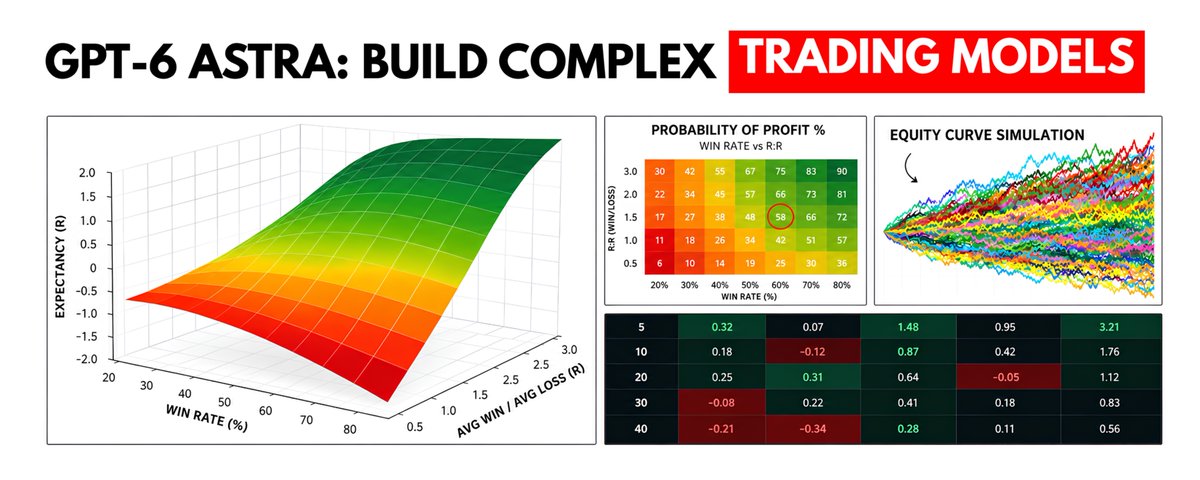
send this prompt to GPT-6 Astra, it might just change your life...
it scans 1000+ stocks for unusual price and volume activity, then digs through earnings, filings, analyst revisions and options data to find what actually moved the stock
it builds both a bull case and a bear case, exposes contradictions, and tells you which signals are actually backed by evidence
8 hours of manual research → 15 minutes of structured analysis
1000+ stocks → unusual events → deep research → counter-thesis → evidence-backed report

wandermist retweeted
Alex Schultz started making money from Google clicks in college, then helped Facebook turn growth into a science, here's the playbook:
00:02:22 - retention is the first thing that matters for growth, if users don't stay, spending more money on traffic just gives you more users who leave
00:04:21 - Facebook predicted the 1-year value of advertisers with 97% accuracy using retention data from a product that was only 3 days old, you can learn a lot before you have millions of users
00:15:04 - eBay lost 20% of registrations but only 5% of active users after changing affiliate payouts, then active-user growth accelerated because they stopped paying for useless signups
00:41:07 - Facebook made one simple SEO change and 100x'd its SEO traffic, proving that sometimes a tiny fix can unlock massive growth
after watching this, I realized most founders don't need another growth hack, they need better retention, one metric that actually matters and a product people keep coming back to
save this, then find the bottleneck instead of burning money trying to hack your way around it

wandermist retweeted
Paul Graham sold his startup to Yahoo for $49M, co-founded Y Combinator behind Airbnb, Dropbox and Stripe, then told Stanford students what actually makes startups work, here’s the playbook:
00:05:56 - Zuckerberg had no startup experience, but understood users, $0 in expertise can beat $1M in startup theater
00:10:57 - growth hacks are bullshit if nobody loves your product, you can burn $50K, $500K or $5M trying to game growth, but a product people actually want keeps pulling users in
00:25:20 - some of the biggest companies started as side projects, Yahoo, Google, Facebook and Apple were built before their founders knew they were sitting on billion dollar ideas, you don’t need a $100K budget to start
00:33:28 - stop studying startups and fucking start one, $10K in execution beats another $10K course
after watching this, I realized most founders need less bullsh*t and more building, find a real problem, ship fast and keep iterating until the numbers start moving
$10K is enough to start, but execution is what gets you to $1M
save this, then go build
wandermist retweeted
Sam Altman explained at Stanford how to build a startup from scratch and the playbook fits perfectly with building a $1M AI business:
04:09 - great execution won't save a terrible idea
10:49 - a small market growing fast can beat a huge stagnant one
16:03 - build the product before wasting time on PR, hiring & partnerships
18:45 - 10 users who LOVE your product > 10,000 who barely care
23:50 - turn customer feedback into a product that gets better every week
after watching it, I broke down how Kimi K3 changes the economics: instead of burning $50K+ on developers and months of work, one founder can build, test and kill ideas for a fraction of the cost
$10K doesn't buy you a $1M company. It buys you more shots before you run out of money
save & watch, the article below breaks down how to turn those cheap iterations into a real AI business
wandermist retweeted
MIT was building systems like this decades ago, and the same idea can turn a $10K budget into a real AI business
Winston shows a simple program producing surprisingly complex behavior by breaking a task into smaller goals and keeping track of how those goals connect
you can use the same approach today, take one job a company already pays someone to do, split the workflow into clear steps, give AI the tools and knowledge for each step and make the whole process repeatable
watch the real workflow, find where humans waste time, turn those steps into a repeatable system and keep fixing it whenever it breaks, that's how $10K becomes a business instead of another f*cking AI demo