




Pinned Tweet
I've been on X for years. I still have very few followers.
On LinkedIn, I have around 1,000 connections. But if I needed an investor, a mentor, or someone who had solved the problem I'm facing, I wouldn't know who to ask.
That's when I started questioning something.
Why does building a network require you to become a creator?
We're told to post consistently, build a personal brand, grow an audience, and hope the right person sees our content.
But not everyone wants to create content. And they shouldn't have to.
People need people. A first hire. An introduction to an investor. A mentor who's been there before. Someone who can help them get unstuck.
You shouldn't need an audience to access the right people.
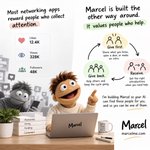
That's why I'm building Marcel.
Marcel helps you find people who can help you move forward, without spending your time building an audience or figuring out who to reach out to.
Here's how it works:
> Connect Marcel to the AI you already use.
> Tell what you're trying to do, what kind of people you need to network with
> Tell what you can help others with.
> Marcel finds people worth meeting, with a clear reason for each introduction.
> Send a request. If they accept, start a conversation.
No feed. No posting. No cold DMs.
Just people who have a reason to connect.
I believe your opportunities shouldn't depend on how many followers you have or how good you are at creating content.
That's the idea behind Marcel.
If this resonates with you, join the waitlist: marcelme.com
🤖 Made with AI

3
11
922
I've been testing funny replies on X.
Some replies plain, some light and a bit funny.
The funny ones got about 50% more views.
One day of data, so it's early.
But the job is starting to look like networking plus stand-up.
Most good engineers, teachers and founders never signed up to be entertaining online.
They want to meet the few people who can help with what they're building.
That's who Marcel is for.
A real network without becoming a creator.
marcelme.com

1
13
I didn't have to search for a co-founder.
He's my brother, Abdul Shajeed.
That's luck. Most founders don't have it.
So they search the loud way:
→ Posting "looking for a co-founder"
→ Going to every hackathon and meetup
→ Asking friends who know the same people they do
The people they'd want are often busy building, not reading those posts.
That's the gap we're building Marcel for.
A real network without becoming a creator.
marcelme.com
21
Most networking starts with an ask.
The usual openers:
→ A cold DM asking for 15 minutes
→ A connection request with no note
→ "So what do you do?" at an event
Each one makes the other person do the work.
When you set up Marcel, your AI asks what you can give, not only what you need.
So when intros go live, each one starts with a reason to say yes.
A real network without becoming a creator.
marcelme.com
1
38
Jobs piling into one city means referrals pile up there too.
If you're not in the Bay, posting more won't close that gap.
A few people there who know your work will.
A real network without becoming a creator.
That's the bet behind Marcel.
marcelme.com

Tech jobs are concentrating in the Bay Area
15% of all open tech roles are now in the Bay Area, about one in seven and a record high.
It’s even more concentrated for product roles. One in four open PM and design roles is in the Bay Area, and one in five engineering roles. All three are at or near record highs, and each has nearly doubled its share since 2022.
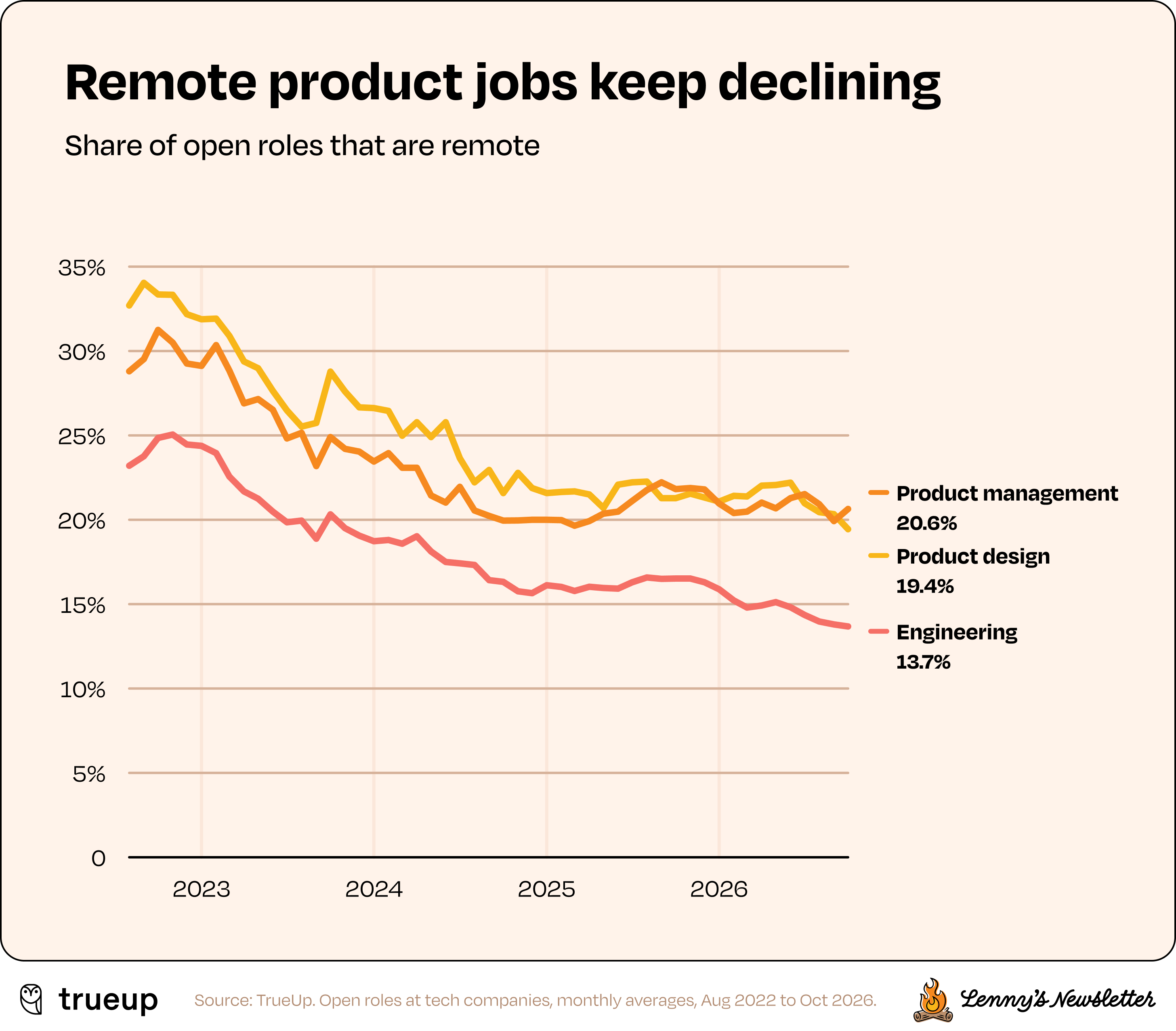
Meanwhile, remote roles keep shrinking. Just 14% of open tech roles offer a remote option, the lowest on record and down from 21% in late 2022.
Remote share by role:
• Engineering: 14%, down from 25%
• Design: 19%, down from 34%
• PM: steady at about 21% for two years, still near its low
Put it all together: sometime last year, open PM, eng, and design roles in the Bay Area overtook remote roles worldwide. Three years ago, remote led almost 2 to 1.



21
I reply to about 50 posts on X a day.
In the last 11 days, that took me from 166 to 190 followers.
That's a lot of work for 24 people.
I do it because I'm building a company and I need to be found.
Most people have jobs, not audiences.
They shouldn't need 50 replies a day to meet the right person.
That's the reason we're building Marcel.
A real network without becoming a creator.
marcelme.com
17
Item 50: the people you know.
49 steps and none of them hold who would pick up your call.
That context is yours too, and no model can download it.
A real network without becoming a creator.
That's what we're building Marcel for.
marcelme.com

Making the most AI pilled company is the whole game:
1. make a second brain. one folder of markdown files on how you think, write and decide (obsidian)
2. talk to it. voice notes all day (wispr), and an agent files every fact, story and decision
3. make a company brain. customers, calls, numbers, pricing, playbooks, past decisions and why you made them
4. record every call and meeting (granola). the transcripts go straight into the brain
5. keep a facts file. true things about you and the company that agents are allowed to say. this kills made-up claims
6. keep a voice file. your 50 best posts, 20 you hate, and the words you never use
7. put all of it in git (github) so every change has a history
8. write one instruction file at the top (CLAUDE.md or AGENTS.md). read these files before any task, never overwrite, always date
9. give agents memory across sessions so they stop starting from zero (claude-mem, mem0)
10. pipe every data source into one warehouse your agents can query (airbyte → clickhouse). ads, analytics, CRM, payments
11. feed it data nobody else has. it's the only part a competitor can't download
the skills
12. don't start from zero. install the good ones first (anthropics/skills, obra/superpowers, mattpocock/skills, addyosmani/agent-skills)
13. grab the marketing ones too (coreyhaines31/marketingskills, cody schneider's graphed skills for static ads and UGC, boringmarketing dot com skills)
14. map every workflow in the company and rank them by money made or saved
15. do each one once while talking out loud, and record it
16. have an agent turn the recording into a skill. when to use it, the steps, the checks, the mistakes to avoid
17. one skill per job. small and boring beats one giant prompt
18. connect your tools with MCPs so agents can act and not only advise (gmail, slack, stripe, linear, notion, posthog, supabase)
19. give agents a browser (browser-use, vercel agent-browser, claude in chrome)
20. give agents a computer of their own for the tools with no API (vercel agent-desktop, orgo)
21. give your best skills away in public. it's the new lead magnet
the agents
22. run an orchestrator that never turns off (grok bot, openclaw, hermes). it manages one agent per project, and each of those runs its own sub-agents
23. use coding agents for the building (claude code, codex, cursor, t3, antigravity)
24. wrap them in a harness so they plan, test and remember (ECC, superpowers)
25. manage the whole fleet in one place (paperclip). every agent gets a job, a budget and a log
26. put the skills on triggers (n8n, scheduled tasks). daily, weekly, on every new lead, on every cancellation
27. route your models (openrouter). the expensive one plans and checks (fable 5.2, gemini 4 carbon), the cheap ones do the volume
28. cut the token bill. shorter outputs, smaller tool results (caveman)
29. run a local model for the data that can't leave your machine (gemma 4)
30. track cost per job. if a job costs more than it earns, fix it or kill it
the factory
31. build the line. spec agent → builder agents in parallel (git worktrees) → test agent → reviewer agent → deploy (vercel, railway)
32. design goes through the same line (paper MCP), and a skill strips out anything that looks AI made (unslop)
33. every annoying task in the company becomes an internal tool by the end of the day
34. every customer request becomes a pull request before a human reads it (tstack for the PR workflow)
35. reviewer agents with a named bar. "would the best team in the world ship this?" reject until the answer is yes
36. keep 50 real cases with the right answer. rerun them every time a new model drops and switch to the winner
37. humans approve, own the outcome and talk to customers. that's the 10% you keep
the loop
38. every finished job writes back to the brain. what worked, what failed, what to stop doing
39. support tickets, analytics and social comments flow in every night
40. every friday an agent rewrites the playbooks from the week's results, and you approve the diff
41. every month, rank everything by profit per human hour. kill one thing and double one thing
the growth
42. research with agents before you spend a dollar (perplexity API, last30days skill)
43. outbound runs itself. find the leads, enrich, verify, send (apollo, million verifier, instantly, phantombuster)
44. send prospects finished work in place of a pitch
45. ads run on a loop. an agent writes the creative, publishes through the facebook ads API, kills the losers and scales the winners
46. agents make the creative too. images (nano banana), video (heygen, fal), voice (elevenlabs), music (lyria 3.5, suno)
47. turn every finished job into content. the story, the number, the prompt
48. every customer makes the brain smarter for the next one. that's your network effect
49. once it works, point it at a new niche. same agents, new context
The models are the same for everyone but your context is the only part that's yours.
Acquire as much of it as you can, as fast as you can.
Build loops like this.
This is the whole game, happy playing.

14
A cap the agent can override is a budget, not a cap.
Fine for a P0.
But write down which reasons count before the next one, or every fix becomes a P0.

Sh*t Our Agents Do:
We set a hard $100/day cap on AI spend.
An agent blew right through it to fix a P0.
It was probably the right call, so the cap turned out to be more of a suggestion.
16
Add a sixth: pick 3 people who know what you're working on.
Focus gets you good.
The people who know you're good get you the chance.
You don't need an audience for that part.
A real network without becoming a creator.
That's the idea behind Marcel.
marcelme.com

How to win:
1. Define 3 things that, if you do every day, will help you hit your goals
2. Remove as many other things as you can to focus only on those 3 things
3. Use all that extra time and attention to improve your skill at just those 3 things
4. Commit to them for significantly longer than you think before you expect results
5. Repeat every day for the rest of your life
17
Most networking follow-ups die for one reason.
You met at an event.
You swapped handles.
Neither of you had a reason to talk again.
A better follow-up message won't fix that.
Meeting for a reason in the first place does.
"You've hired engineers before. I'm hiring my first." That's a reason.
We're building Marcel so every request starts with one.
A real network without becoming a creator.
marcelme.com
1
27
Treat that link as a spec, not a threat.
What to do with it:
→ find the one job it does that yours can't
→ ask why they needed it this week
→ ship that, not their whole build
A rough copy tells you more than a feature request ever did.

A customer used to ask for a feature and wait six months. Now they can build a rough version over the weekend, send you the link, and ask why your product still can't do it. The most threatening product feedback is going to arrive as working software.
12
Same thing happened to networks.
Old way: a few people who'd vouch.
Now: thousands of connections and nobody to text for a favor.
More options made each one worth less.
Marcel is our bet on the old way.
A real network without becoming a creator.
marcelme.com

Your issue is not a lack of options.
“Your grandparents met once at a church picnic and stayed married for 61 years.
You have personally evaluated 11,000 people on your phone and eat dinner standing over a sink.” - Jake Kozloski
26
We're starting Marcel with one use case: hiring.
Today, hiring well depends on how loud you are:
→ Your job post reaches about as far as your followers
→ The best referrals go to people who already know everyone
→ Asking around only works if you know a lot of people
Quiet founders get a quiet inbox.
We're building Marcel so your AI finds the right people and tells you why each one fits.
That part isn't live yet.
Today you can set up your profile and join the waitlist.
A real network without becoming a creator.
marcelme.com
33
Missing from the list: being off social and still having people who'd pick up your call.
Followers were never the flex.
A real network without becoming a creator.
That's what we're building Marcel for.
marcelme.com
Status symbols today:
- Taking private lessons in chess, jazz piano, or French in your late 30s
- Knowing your VO2 max, DEXA stats, and ApoB
- Having zero clue what the internet is mad about today
- Wired Apple earbuds on video calls
- More than 2 kids
- 100% natural fiber clothing (linen, merino, cashmere, zero polyester)
- Empty calendars
- Caring about microplastics
- No TV in the main living room
- Having lots of followers or being off social completely
- Being sober
- Eating "clean"
- Type of water you drink
- Private school for kids
- Traveling to Japan
- Premium skincare
- 2nd house
- Backyard pizza oven
- 2+ fridges
- Ordering off menu because you've gone to the same spot since 2014
- Charcuterie boards
- Single estate olive oil and tinned fish
- Hosting Sunday dinners where phones go in a wooden bowl by the front door
- Private chef
- 2000s manual Porsche 911 over any brand new supercar
- 90s Toyota Land Cruiser or old Volvo wagon as the daily driver
- Talking about seed oils a lot
- Dyson vacuums
- Limewash walls and unlacquered brass hardware that patinas over time
- $95 heavyweight blank white tees (Lady White Co., Merz b. Schwanen, Buck Mason etc)
- Beautiful workstation
- Raw A2 milk from a local farm drop
- Le Labo products
- Talking about cold plunges
- Custom cedar sauna + outdoor shower in the backyard
- Secondhand goods with stories
- Cast iron and stainless steel pans only
- Eating organic
- Buying half a cow from a regenerative ranch (and owning a garage chest freezer just for it)
- Japanese selvedge denim and unbranded cashmere
- Taking afternoon calls on a walk (refusing to turn on Zoom camera)
- Hi-Fi audio
- Framed art from artists you met in person
- Mortgage rate below 3%
- La Marzocco coffee maker
- Owning your last name .com (and it's your email too)
- Charizards
- Wearing a faded crewneck from a tiny bakery in Copenhagen or Kyoto
- Reading books
- Phone permanently on Do Not Disturb
- Work/life balance
- Analog hobbies (Leica film cameras, fountain pens, woodworking)
- Kids with zero iPad time (wooden toys + outdoor school)
- Bone broth
- Digital detoxing
- Taking the entire month of August off like an old-world European
- iPhone Air or iPhone Duo
Okay, I'll stop.
So, what did I miss?
36
Pay well, yes.
The second part needs a rule.
Tie pay to the outcome only when the person controls the outcome.
When they don't, you're paying for luck, and good people leave the moment luck turns.

Unpopular opinion: inspiring your team is wildly overrated.
Pay them well. Tie their pay to the outcome you want, and watch them win.
19
Most networking advice is creator advice.
Look at what it tells you to do:
→ Post every day
→ Grow your followers
→ Build an audience
That's how you become a creator.
It isn't how you get the few people who'd pick up your call.
Those come one at a time, each with a reason to talk.
You don't need to post to build a network.
marcelme.com
16
Best test of a real network:
→ who do you text first when something good happens?
→ who texts you first?
Followers never make either list.
Count both. That's your number.

Underrated life advice: Be someone people want to share their good news with. Get excited. Hype them up. Make a big deal out of small wins. And never compare it to something you or others have done. We always remember who made the happy moments feel even happier. Be that person.
17
The jobs moved, but most networks didn't.
If you only know PMs and engineers, you know nobody where the jobs grew.
One person inside hardware or supply chain beats any job board.
Meeting them without posting for years is why we're building Marcel.
marcelme.com
The tech job market is in its best shape in years. But almost none of the growth is coming from software jobs.
There are 281,000+ open roles at tech companies, up 17% from a year ago and 73% from the March 2023 low.
But open PM, eng, and design roles grew just 2%. Design (−28%) and UX research (−45%) actually shrank.
So where’s the growth coming from? Hardware engineering openings doubled. Business ops added ~4,200 openings. Supply chain is up 63%. Many of the fastest-growing jobs are physical: data center technicians, installers, field service engineers.
The AI boom is creating jobs, but mostly in building and running the physical infrastructure (chips, data centers, hardware), not building software.
Times, they are a-changin’.
Full report: lennysnewsletter.com/p/state…

36
My most-read thing on X this week wasn't a post.
It was a reply to one person.
Almost 1,400 views.
My own posts that day averaged 37.
A reply is a conversation. A post is a broadcast.
Networks come from conversations.
We're building Marcel so you can skip the broadcast part.
marcelme.com
15
Agents picking products is the easy part.
The harder ask is "find me someone who's done this before."
Today you post and hope.
An agent can only find people it can read.
Marcel starts there: connect your AI tool, make a profile, join the waitlist.
marcelme.com

The primary users of the Internet are no longer human. They’re AI agents.
As agents move from answering questions to completing tasks, they’ll increasingly decide which products to use, which services to subscribe to, and where to spend money on our behalf.
a16z's Olivia Moore and Justine Moore on the B2A economy: a16z.news/p/welcome-to-the-b…

3
2
65
Dharmesh Shah on building uSpot, a CRM for one-person businesses, via @a16z.
> Test ideas the AI labs will likely flatten, not the Yellow Brick Road
> Models become infrastructure, ChatGPT is a new OS
> Never a better time to start a software company
HubSpot co-founder and CTO Dharmesh Shah has built software for over 30 years and has never had a direct report. His latest project is uSpot, a CRM for one-person businesses. It charged money from day one and has been his most successful launch at HubSpot.
Dharmesh joins a16z's Joe Schmidt to discuss why startups should avoid the "Yellow Brick Road" the labs are racing down, "yet" test for avoiding ideas the AI labs will flatten, and why it's never been a better time to start a software company.
0:00 Intro
0:47 The best time ever to be a builder
6:46 How to actually pick a startup idea
10:32 From LegalSpot to HubSpot: the SMB bet
14:40 The 60% that weren’t using a CRM
20:29 Building an ecosystem developers trust
23:33 Staying off the yellow brick road
27:23 Why models are becoming infrastructure
31:49 ChatGPT is the new OS
37:04 Rethinking HubSpot’s primitives for AI
40:44 Replaying 20 years of code with AI
43:47 HubSpot Next and the birth of uSpot
46:38 A startup within a startup
49:43 The rise of the one-person company
53:07 AI is still just software
56:06 Lightning round
YouTube: youtu.be/s4lXP9IuHjk
@joeschmidtiv @dharmesh
1
1
31