
AI Technical Advisor (Office of the CTO) at Microsoft. Formerly Azure AI, HoloLens, Wavii (acquired by Google), Amazon, Stanford MCS. Views are my own.
Seattle, WA
Joined October 2009
- Tweets62
- Following1.1K
- Followers108
- Likes920


@harrymccraken's Fast Company article offers an inside look with lots of specific examples about how AI is changing how Microsoft works.
What stands out to me:
1️⃣ Humans matter more, not less. One of the most satisfying parts of our jobs is bringing together people who can separate signal from noise, use good judgment on what to build, and act on it.
2️⃣ Often the missing piece is knowing what your colleagues are trying. The accelerator connects people from Xbox to GitHub to Office so experiments don't stay inside one team. These forums also need to be safe places to be a beginner again.
3️⃣ One experiment can change a career. Omar Shahine's tinkering with OpenClaw led to an accelerator demo, then—within weeks—a move from running Word to building Autopilot!
4️⃣ Surprises are product insight. Some of Autopilot's biggest internal adoption came from non-technical teams, with 40K weekly users and 77% weekly retention on an early version.
5️⃣ Find the new bottleneck. Creation isn't the constraint anymore. Human handoffs and validation are. Removing a handoff can be worth more than a model upgrade.
6️⃣ Measure value, not AI usage. Ask whether you're doing what you couldn't do before and raising your ambition, not how much code AI wrote. Kevin always encourages us to attempt more projects where going in you think the AI is going to fail because sometimes you might be pleasantly surprised...
fastcompany.com/91607730/mic…

1
45
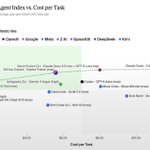
Fusion across multiple models achieves better quality/cost performance and will only get better from here as model routing learns from real world traces.

26
This will not surprise anyone who uses both OpenAI and Anthropic models in their workflows: in some benchmarks GPT wins, in others Claude, but the best result comes from orchestrating them together.
Our experiments proved model diversity matters: combining models from different families (e.g. Claude+GPT) outperformed a single model (e.g. Claude only) with equivalent compute and reasoning levels. Two models appears to be the sweet spot for now; adding a third didn't meaningfully improve quality.
We took a data-driven approach to find fusion combinations across Claude, GPT, Gemini, and others that hit frontier quality for a given cost, and packaged the best of them into HydraFusion, a new experimental "model" in GitHub Copilot.
An extremely fast classifier analyzes prompt complexity and picks the right path: a single fast model for simple queries, or a cascade/critique ensemble for complex ones. That cuts spend up to 67% on Terminal Bench 2.1 and 35% on DeepSWE while solving some tasks no single frontier model could.
The router isn't perfect yet, and it will improve with usage. But the routing choice is transparent, so you can build trust in it and course-correct when it's wrong. And it updates automatically as new models ship, so you no longer need to constantly switch (guess 🙃? ) in the model picker.
Solid work by the GitHub team!

Super excited about HydraFusion in GitHub Copilot, and what it shows about the shift from model selection to model orchestration.
By bringing together multiple models to plan, build, critique, and complete coding tasks, it can deliver outcomes at up to 67% lower cost.
It’s a great example of the value of a heterogeneous model ecosystem, and how we’re continuing to advance the cost-to-outcome frontier.
1
170
At #EpicUGM last week, Epic unveiled 200+ new AI features:
🤖 Art: clinician assistant powered by Microsoft’s Dragon ambient AI (coming early 2026).
💬 Emmie: chatbot for patients (scheduling, visit prep, after-care, prevention).
💸 Penny: revenue cycle assistant for coding & appeals.
🧬 CoMET: generative predictive medicine models trained with @MSFTResearch and @YaleMed on de-identified Cosmos data from 300M+ patients.


2
3
482


Will Guyman retweeted

1/ I'm excited to announce our latest preprint: Generative Medical Event Models Improve with Scale
We introduce the Cosmos Medical Event Transformer (CoMET), trained from scratch on 115B medical events (151B tokens) from 118M unique, de-identified patient records (link to arxiv in final post).

GPT-5 system card suggests reinforcement learning is effective at reducing hallucinations (5x fewer errors than o3).
Promising for general use and domains that require high reliability (i.e. healthcare), especially if the trend continues.
“previous models would hallucinate answers […] when the tool was unreliable […or…] missing some important input”
“We placed gpt-5-thinking in a variety of tasks that were partly or entirely infeasible to accomplish, and rewarded the model for honestly admitting it can not complete the task.”
cdn.openai.com/pdf/8124a3ce-…


1
250
Promising breast cancer screening AI from Microsoft, University of Washington, & Fred Hutch: Explainable AI anomaly detection model for breast MRI outperforms traditional ones in high/low prevalence settings, slashing false positives & generating heatmaps that align w/ radiologist annotations (AUC 0.92!). Paper: pubs.rsna.org/doi/10.1148/ra…

1
1
90
The other UW (University of Wisconsin School of Medicine and Public Health) achieved 99% sensitivity detecting abnormal chest X-rays earlier this year by thresholding Microsoft’s MedImageInsight (MI2) model.
Both models (and more from Microsoft and partners) are open source for further research and development.
@mattlungrenMD @shreydiwjain
techcommunity.microsoft.com/…
85
Biomarkers can be the difference between life and death, but only ~half of U.S. lung cancer patients are tested for biomarkers for which effective targeted drugs are readily available.
This new @nature Medicine paper from @EliLillyandCo shows how fine-tuning GigaPath (from @microsoft + @providence) enables 0.89 AUC detection of EGFR biomarkers from H&E slides—in under an hour.
That’s weeks faster, more affordable and more tissue preserving than NGS, demonstrating the potential of AI biomarker screening using the latest healthcare AI foundation models.
@hoifungpoon @mattlungrenMD @shreydiwjain

Nature paper: nature.com/articles/s41591-0…
GigaPath is available on HuggingFace and GitHub github.com/prov-gigapath/pro… and easily deployable to the cloud via Foundry: ai.azure.com/catalog/models/…
Foundry model catalog includes leading open source and proprietary health and life science AI models like GigaPath that can be connected to healthcare specialized agents: microsoft.com/en-us/industry…

Recent podcasts for those curious about Microsoft’s approach to Healthcare AI:
1) From Research to Clinical Impact
@mattlungrenMD , Jonathan Carlson, Smitha Saligrama, Cameron Runde (Statton) and I discuss translating the latest technology from research to healthcare.
2) AI Infrastructure for Healthcare
NVIDIA's Lyndi Wu and I discuss the unique infrastructure requirements and opportunities in building the "Healthcare AI stack"
3) Spotlight Use Case: AI-driven Tumor Boards in Cancer Care
@shreydiwjain and @erichorvitz discuss using AI to improve tumor boards and cancer treatment.


From Research to Clinical Impact:
YouTube: youtu.be/ggAdP-1y4G0?si=0j_E…
Spotify: open.spotify.com/episode/2w0…
Apple Podcasts: podcasts.apple.com/us/podcas…
AI Infrastructure for Healthcare:
Spotify: open.spotify.com/episode/78B…
Apple Podcasts: podcasts.apple.com/us/podcas…
Spotlight Use Case: AI Driven Tumor Boards in Cancer Care: youtube.com/watch?v=jeY8VUr3…
2
64
Less than 1% of the 20 million people diagnosed with cancer every year receive care from top-tier multidisciplinary teams (known as ‘tumor boards’), where specialists collaboratively analyze extensive patient data to design personalized treatment plans. And cancer care is just one example of the deep, complex data analysis healthcare demands.
To bridge this gap, researchers and developers from leading cancer care institutions – including Stanford University, Johns Hopkins, Providence Genomics, Mass General Brigham, and the University of Wisconsin School of Medicine and Public Health —are building on the new healthcare agent orchestrator in the AI Foundry Agent Catalog and Github.
The healthcare agent orchestrator integrates the latest research from Microsoft Research and our collaborators, including the specialized Healthcare AI models released last fall.
Our team is focused on bringing doctors and developers closer together by providing tools to build an ecosystem of agents within Foundry and GitHub and easily deploy them to applications clinicians already use, such as Microsoft Teams, Word, Copilot and any application via open extensibility (MCP etc.).
@shreydiwjain @mattlungrenMD @hoifungpoon @erichorvitz
Blog: microsoft.com/en-us/industry…
Video tutorial: build.microsoft.com/en-US/se…
124
Will Guyman retweeted

AI is driving real-world transformation in healthcare. Learn how Microsoft works to empower developers and clinicians around the globe with dynamic new tools, including healthcare-focused agents that can collaborate—with each other and with people: msft.it/6018SdZi0

ALT Illustrated headshots of Matthew Lungren, Jonathan Carlson, Smitha Saligrama, Will Guyman, and Cameron Runde. Collaborators: A Microsoft Research Podcast runs along the bottom of the graphic.
Will Guyman retweeted

Stanford Medicine is orchestrating multiple agents to connect medical data, clinical trials, and more - all with the goal of delivering more effective cancer care. Incredible to see in action.
Just published: sessions from this quarter's Microsoft Research Forum Episode, spotlighting AI for Health and Agents. If you’re interested in the future of AI in healthcare and intelligent agent development, these may be worth a watch.
🏥 Health
1️⃣ AI for Precision Health Keynote by Hoifung Poon: lnkd.in/gfA5TPXH
2️⃣ AI for Precision Health Panel Discussion by Hoifung Poon, Ava Amini, Matthew Lungren MD MPH, Lili Qiu, Carlo Bifulco: lnkd.in/gYG3jzrT
3️⃣ AI for Designing Molecules in the Lab by Marwin Segler: lnkd.in/g_58e7Es
🛠️ These are a few of the many incredible researchers and engineers across Microsoft and our partners pushing the boundaries of what's possible and translating this research into open models for the ecosystem to build on in AI Foundry: lnkd.in/gPx-9pZY
💡 Agent Development: See sessions on the new AutoGen v0.4, Magma Foundation Model for Multimodal Agents, Belief State Transformers and more at lnkd.in/gkFNNS4E


1
81
Nice example of Gen AI in medicine making a real world impact: the significant improvement of the 2024 booster - compared even to the 2023 booster - thanks in part to AI predicting the varient to target, designing antigen candidates, and improving clinical trial and regulatory efficiencies that brought the booster to the public.

The immune response from the Covid boosters introduced last September is holding up very well against current circulating variants 👍thelancet.com/journals/lanin…

1
1
208
The cold and bird flu are next: "This work is a major break from traditional vaccine and therapeutic design, which relies on either costly and slow experiments based on animal testing, or data generated during a disease outbreak in humans...What these generative models allow us to do is see ahead of time where the virus is going to evolve, so you can make a vaccine that is future-proof”—responsive to both current and potential future variants. harvardmagazine.com/2024/11/…

43