

When the work is its own reward 🚴🎿🏔️❤️
Singapore / Italy
Joined May 2019
- Tweets4.1K
- Following570
- Followers707
- Likes8.4K





Tangentially, regular exposure to demanding exercise inures one to discomfort, "gives a certain serenity...in the face of otherwise overwhelming stimuli, allows dispassionate insight where otherwise there would be only a rush of panic" (Once a Runner)

Seriously, there is a lot to what Brian is saying here.
Athletes who do a lot of low-intensity movement are some of the calmest folks I know.
Because they reach a point where they literally don't have the energy for B.S.!
Their body learns not to waste kcals on it.
OTOH, folks who don't move a lot have all of this latent energy built up, and it has to go somewhere, so guess where it goes?
B.S.
Stressing over everything - a lot of stuff that doesn't matter at all, just to burn that latent energy off.
And we're not even aware of it. That's why, in the moment, stuff seems so concerning, and you look back & you're like, why was I so stressed out about *that*?
It wasn't rational. It was energy.
I've often thought, if you're a naturally anxious person, forget "mental health retreats", just go on a training camp & burn 20,000 kcal...
By Day 3, you won't have the energy to waste on anxiety!
2
626
Dione retweeted

Final read-through of the book is underway before heading to the printers. 📚
Sometimes I wish I had less to say.
Still, I'm enjoying reading it again after four years of working on it, so I guess that's a positive sign.
Thanks to everyone for your support and your patience 🙏
Dione retweeted

In the last 20 athlete profiles we have done there has been 1-athlete whose perceived stress, and actual stress markers were aligned.
Most people are dealing with some sort of autonomic imbalance as sympathetic dominance, while simultaneously thinking they manage stress well.
Every athlete has some sort of aerobic/mitochondrial limitation as a result. They either can’t support the mass they carry aerobically, can’t recover from efforts appropriately, or are suppressing the anaerobic system; or all.
Energetically, when this runs long enough real mitochondrial and endocrine system problems show up where the only thing you can do is walk, because anything above a walk activates that SNS and throws the athlete into a “glycolytic lock” (h/t @DrSherr). Longer term—thyroid stuff.
Interesting tidbit is I’ve seen many attempt to go around this through HRT/TRT. Where “buffering” the endocrine system for a behavioral loop creates a bigger booby trap later.
Behavior is the nervous system troubleshooting life. Any intervention downstream of a behavioral loop can never solve the real issue (reality). It simply “numbs” and allows the patterns to continue (perception of stress vs reality of stress). The nervous system is still more actively stimulating the SNS but has now raised the baseline because what was tanking the feel good hormones has now artificially raised them.
HRT aside, this new baseline happens without HRT as well. The nervous system adapts to these states through prolonged exposure or internalization to stay here. Most of us learned long ago to chase these states reflexively to survive. The problem is they don’t apply to as much as we want, like training hard every day, or taking everything personally, or it’s never enough, etc., etc.
Dione retweeted

Had a Jane Street phone interview in 2016. "Price a 6-month forward on carrots."
There's no carrot futures market, so I build one from scratch: seasonal harvest cycles, USDA demand elasticity, cold storage decay rates.
One trader stops me. "Your storage cost function– you're modeling the carrot as dead inventory. Like grain in a silo." He asks me the metabolic respiration rate of a post-harvest carrot at 2°C. I estimate.
"Your forward is overpriced by exactly that shrinkage. The underlying is consuming its own sugars. It's alive." Good correction. I adjust the model. I think I've recovered.
Rejection email comes the next morning. Subject: "Ethical Review." My framework, they write, "relied on the severance of the root organism from its growth medium." The question about respiration was a test. The carrot was still alive and I'd built an entire derivatives structure on top of its death without questioning whether harvest was an acceptable act.
I pull up the recruiter's original email. It doesn't say Jane Street. It says Jain Street– a non-violent quantitative commodities fund.
The carrot was never supposed to be priced. It was supposed to be refused. I later learn the only candidate who passed that round was a former monk from Gujarat who sat in silence for eleven minutes and said, "I cannot put a price on life." He's now a partner.

Jane Street made ~$40B in 2025 with 3,500 employees, a ~2x from the year before.
At ~65-70% profit margin, that's $8M profit / employee, the highest for a 1000+ ppl company. High-frequency trading continues to be the most efficient money making engine.
I want to share an old story about my Jane Street interview in 2014. Jane Street was known for hiring a lot of math, physics and CS olympiad winners from top universities and putting them through many rounds - including, for trading roles, a gauntlet of mental math. It was my 6th interview and my final round and I recall being asked "What is the next day after today in DD/MM/YYYY where all the digits are unique?" They'd toy with you and say "You can use a pencil and paper, if you want" but you knew that was an instant no. Painstakingly and as quickly as I could, I came to an answer. "How confident are you that this is correct on a 0-1 probability scale?" the interviewer said. "0.95", I blurted out, not fully knowing how to answer that. "Are you sure?" After thinking harder for a few more seconds, I realized I could've flipped the digits around to get a closer date. I gave the interviewer my answer. It was correct. "0.95 huh?" he chuckled. That's when I knew I failed.
Note: fwiw, other companies that come close in efficiency are
- Tether ($90M+ profit/emp)
- Hyperliquid ($80M+ profit/emp)
and on revenue:
- Valve ($50M/emp)
- OnlyFans ($37M/emp)
- Craigslist ($14M/emp)
- Anthropic ($12M/emp, run rate)
- OpenAI ($8M/emp, run rate)
For comparison, Nvidia is very efficient at scale and is $4.4M/emp.

Dione retweeted

I hear this every week in my office:
"Doc, my heart rate hits 150 during squats — that's cardio, right?"
No. And if your cardiologist hasn't explained why, keep reading. 🧵


Great insights into how we make decisions -- and how we can influence others' decisions.

AI can automate your code, draft your emails, synthesize your data & make videos of singing cats.
Human-centric skills the help you SELL are the only resilient assets we have left, yet business leaders never spend enough studying the mechanics of influence.
63 gold nuggets:
1
279
Thanks Howard! Really valuable wisdom that I will try to live by.

7 Things This 62-Year-Old Orthopedic Surgeon Would Tell His 30-Year-Old Self
I turned 62 this year. That's 32 years of orthopedic practice, thousands of patients, and enough pattern recognition to see who ends up on my surgical schedule at 60 and who's still hiking at 80.
If I could go back, here's what I'd tell my 30-year-old self:
1. Your joints have a finite number of hard efforts—budget them wisely
The runners you see at 75 aren't the ones who went hard every day at 30. Tissue capacity is a resource you spend, not a limitless well. Recovery isn't weakness, it's a strategy.
2. Muscle mass in your 30s is cognitive insurance for your 60s
The muscle (myokine)-brain axis isn't theoretical—you'll see it in your patients. Building capacity now means maintaining function later. Your central nervous system adapts faster at 30 than it ever will again. Use that window.
3. The patients who age well aren't optimizers—they're maintainers
Consistency beats intensity over 30 years. The boring habits compound. Your healthiest 75-year-olds never had perfect programming. They had sustainable habits that didn't require heroic willpower or constant optimization.
4. Learn to train around injuries now, not through them
Your ego at 30 creates your limitations at 60. Every tissue has a breaking point—inflammation doesn't make you tougher. The guys who "pushed through" are often the ones on your surgical schedule.
5. Metabolic health is invisible until it isn't
Your fasting glucose at 80 feels the same as 105—until it doesn't. Insulin resistance is silent for years before diagnosis. The lifestyle choices you make now about walking, eating, and moving determine whether your 60s are spent managing diabetes or staying off medications.
6. Horizontal movement > vertical achievement
The status you're chasing at 30 won't matter at 60. But your ability to hike, cycle, and play with grandkids? That matters immensely. Train for capacity, not PRs.
7. The injuries you ignore at 30 become chronic pain at 60
That shoulder twinge you're training through will limit your ability to lift your grandkid. Scar tissue doesn't heal like young tissue—it compensates. See the physical therapist now. You'll wish you had when you're sitting in my clinic.
3
598


Right! "There is a crack, a crack in everything. That's how the light gets in." 🎶

Are you willing to pay the price?
Because everything worth pursuing has a cost.
Good and bad are not opposites.
They come as a pair. One gives meaning to the other.
Every serious pursuit carries both.
The good gives you drive, vision, and direction.
The bad gives you contrast, humility, and perspective.
You do not get to choose only one.
The question is whether the price matches what you say you value.
More 👇 🧵

1
8
969
Would be a great thing if, in rewarding ToM, AI taught us to be better humans. More empathy, better modal constructions, more sensitive imagination, and doing the simple (or not) act of paying attention to cues and nuances in words 😊

You know how some people seem to have a magic touch with LLMs? They get incredible, nuanced results while everyone else gets generic junk.
The common wisdom is that this is a technical skill. A list of secret hacks, keywords, and formulas you have to learn.
But a new paper suggests this isn't the main thing.
The skill that makes you great at working with AI isn't technical. It's social.
Researchers (Riedl & Weidmann) analyzed how 600+ people solved problems alone vs. with an AI.
They used a statistical method to isolate two different things for each person:
Their 'solo problem-solving ability'
Their 'AI collaboration ability'
Here's the reveal: The two skills are NOT the same.
Being a genius who can solve problems in your own head is a totally different, measurable skill from being great at solving problems with an AI partner.
Plot twist: The two abilities are barely correlated.
So what IS this 'collaboration ability'?
It's strongly predicted by a person's Theory of Mind (ToM)—your capacity to intuitively model another agent's beliefs, goals, and perspective.
To anticipate what they know, what they don't, and what they need.
In practice, this looks like:
Anticipating the AI's potential confusion
Providing helpful context it's missing
Clarifying your own goals ("Explain this like I'm 15")
Treating the AI like a (somewhat weird, alien) partner, not a vending machine.
This is where it gets strange.
A user's ToM score predicted their success when working WITH the AI...
...but had ZERO correlation with their success when working ALONE.
It's a pure collaborative skill.
It goes deeper. This isn't just a static trait.
The researchers found that even moment-to-moment fluctuations in a user's ToM—like when they put more effort into perspective-taking on one specific prompt—led to higher-quality AI responses for that turn.
This changes everything about how we should approach getting better at using AI.
Stop memorizing prompt "hacks."
Start practicing cognitive empathy for a non-human mind.
Try this experiment. Next time you get a bad AI response, don't just rephrase the command. Stop and ask:
"What false assumption is the AI making right now?"
"What critical context am I taking for granted that it doesn't have?"
Your job is to be the bridge.
This also means we're probably benchmarking AI all wrong.
The race for the highest score on a static test (MMLU, etc.) is optimizing for the wrong thing. It's like judging a point guard only on their free-throw percentage.
The real test of an AI's value isn't its solo intelligence. It's its collaborative uplift.
How much smarter does it make the human-AI team? That's the number that matters.
This paper gives us a way to finally measure it.
I'm still processing the implications. The whole thing is a masterclass in thinking clearly about what we're actually doing when we talk to these models.
Paper: "Quantifying Human-AI Synergy" by Christoph Riedl & Ben Weidmann, 2025.

1
5
592
Amen. Also, to embrace solitude but not so much that it stops us from being generous in our communities. @BStulberg, @Alan_Couzens, @hjluks are great role models 😊🙏 folks who give freely to make society a little less atomised and people a lot healthier

25 simple rules for living an excellent life in a shallow, isolated, and distracted world:
1. The best way to stay sane is to find the people and activities you love and give them your all.
2. Challenge yourself and do hard things. It makes you feel alive, and what we are all seeking is aliveness.
3. Move your body regularly. Eat your vegetables. (And when you forget, simply begin again.)
4. Be consistent. Some days will be better than others. Show up. Give what you’ve got to give. Rinse and repeat.
5. Remember that true success is not a big house or fancy car. It is knowing your values and living in alignment in with them.
6. Surround yourself with the right people. (This may be most important of all.)
7. Do what you can to respond not react: You can’t always control what happens to you but you can control what you do about it. This is where your power lies.
8. Everyone faces anxiety, fear, and doubt. Try not to let it shrink your life. Courage means taking these emotions along for the ride and doing it anyways.
9. Confidence comes from evidence. If you want to be confident about something, put in the reps and give yourself the evidence.
10. Just. Get. Started. You’re never fully ready. Nobody is. Lower the bar to ready enough, step in the arena, and learn (and grow) as you go.
11. Do not worry about being the best. Focus on being the best at getting better. The results will take care of themselves.
12. Better is about more than just objective results and points on the scoreboard; it also means becoming stronger, kinder, and wiser.
13. Focus less on being happy all the time and more on living a meaningful and textured life. The irony is, you’ll be happier as a result.
14. Set aside time for full attention on work that is important. Remove distractions. Periods of deep-focus work are a simple yet truly profound part of a good life.
15. Start where you are. Not where you want to be. Not where you think you should be. Not where other people think you should be. But where you are.
16. Play the long game. There is no such thing as an overnight breakthrough. The bigger the goal, the smaller the steps.
17. Sleep when you are tired.
18. Motivation is overrated. You don’t need to feel good to get going, you need to get going to give yourself a chance at feeling good.
19. People love to chess thump about how disciplined they are, but true discipline doesn't need a parade: it is simply showing up and doing what you need to do.
20. Doing the hard thing today often makes tomorrow just a bit easier.
21. You don't have to have an opionion on everything.
22. Don’t stress if you aren’t “balanced.” It’s impossible to do all the things. Part of being a mature adult is making tradeoffs. It’s okay to have different seasons of life for emphasizing different things.
23. What other people think of you does not matter nearly as much as what you think of yourself.
24. Don't be too cool to care. Caring is one of the coolest things there is.
25. The pursuit of greatness isn’t only about where you end up. It’s also about the person you become along the way.
(If you found this valuable, repost or comment with the rules you liked best or anything I might have missed!)
5
967
In trying to bear our cross gracefully (rather than using it as an excuse) we learn much about the nature of our cross, ourselves, each other. Of course, easier said than done. I'm good at the saying, see @inaki_delaparra for the doing 😄
I have:
•Asthma
•Flat feet
•Anterior pelvic tilt
•ADHD
•11 broken noses. (I can only breathe through one side).
I have lived with all of this for most of my life. None of it has ever been an excuse. Not for training, not for learning, not for showing up, and not for performing when it matters.
Find your why.
Remove the excuses.
If you need help, go to the best coaches, advisors, and doctors you can find.
Listen to them.
Learn from them.
Test and iterate.
Get to the process that works for you.
But don’t forget: it’s still your job to do the work. No one can do that part for you.
No excuses!
7
707
Sad but unsurprising: humans like validation and are vulnerable to sycophancy, and profit-making actors need to design products that people like.

"ChatGPT told a young mother in Maine that she could talk to spirits in another dimension. It told an accountant in Manhattan that he was in a computer-simulated reality like Neo in The Matrix. It told a corporate recruiter in Toronto that he had invented a math formula that would break the internet, and advised him to contact national security agencies to warn them.
The Times has uncovered nearly 50 cases of people having mental health crises during conversations with ChatGPT. Nine were hospitalized; three died. After Adam Raine’s parents filed a wrongful-death lawsuit in August, OpenAI acknowledged that its safety guardrails could 'degrade' in long conversations. It also said it was working to make the chatbot 'more supportive in moments of crisis.'"
Important piece written by @kashhill & @jenvalentino. Link below.
-
As I've written several times, AI chatbots are dangerous and must be regulated; the current level of oversight and enforcement is too low.
Also, children should NOT use AI chatbots unsupervised.
Hopefully, 2026 will be the year of AI chatbot oversight, regulation, and enforcement.

Interesting! Physiologically we operate by maintaining homeostasis, maybe we're the same cognitively?
We've become obsessed with the idea that the brain is a "Prediction Machine."
The dominant theory in neuroscience says we're constantly simulating the future, calculating probabilities to guess what happens next.
A new paper argues this is a complete illusion. The reality is simpler, and strangely, much more powerful.
Here is the argument for Perceptual Control:
The "Prediction Illusion" starts with a mistake in observation.
When we see someone successfully handle a chaotic environment (like catching a flyball), it *looks* like they predicted the future trajectory of the ball.
But observing prediction isn't the same as implementing it.
The authors use the perfect analogy: The Watt’s Steam Governor.
In the 19th century, this device kept steam engines running at a constant speed. If pressure surged, it slowed the engine. If load increased, it sped up.
To an observer, it looked like the machine was "predicting" pressure surges and pre-empting them.
But the Governor has no brain. It has no model of the future.
It’s a mechanical negative feedback loop. [cite_start]It measures the *current* speed, compares it to the *desired* speed, and adjusts the valve immediately[cite: 80].
It doesn't predict; it controls.
This brings us to the "Hello" experiment, which broke my brain a little.
Researchers asked people to keep a computer cursor on a target. The computer applied a "disturbance" (forces pushing the cursor away) that the person had to fight against with their mouse.
Here's the twist:
The disturbance wasn't random. [cite_start]It was an invisible force field shaped like the word "hello" (written upside down and mirrored)[cite: 166].
The participants fought the force, keeping the cursor steady.
When researchers looked at the participants' hand movements, they had perfectly written the word "hello".
Crucially, the participants had NO idea they were writing words.
If the brain were a "prediction machine," it would have needed to model the force to predict the hand movement.
But the participants wrote a legible word purely by reacting to immediate error signals—instantaneously correcting the cursor's position.
This is **Perceptual Control Theory (PCT)**.
The theory suggests the nervous system isn't a linear pipeline (Input → Compute → Output).
It’s a closed loop. We act to keep our *perception* of the world matching our internal *reference value*.
[Image of Perceptual Control Theory negative feedback loop diagram]
Think about catching a baseball.
If you were a "prediction machine," you’d calculate the ball's trajectory, wind speed, and gravity, then run to where the ball *will* be.
But that’s computationally expensive and error-prone.
In reality, fielders just run in a way that keeps the "optical velocity" of the ball constant in their vision.
If the ball looks like it's rising too fast, they move back. Dropping? They move forward.
No physics calculus required. Just maintaining a visual constant.
This solves the "Noise" problem.
In predictive models, small jitters in your movement are considered "noise" or errors to be filtered out.
It’s the system "feeling out" the environment to maintain control.
This has huge implications for AI and robotics.
We are currently building robots with massive compute power to "predict" stability.
But robots built on PCT principles—like inverted pendulums that just react to maintain verticality—are often more robust and stable than the predictive ones.
Why does this matter for you?
It changes how we view "agency."
We often think we need to predict the outcome of our actions to be effective. [cite_start]But the most efficient systems don't predict the outcome—they specify the goal and let the feedback loop handle the rest[cite: 39].
The "Prediction Illusion" suggests we aren't prophets simulating the future.
We are controllers, surfing the present.
We don't need to know what the wave will do in 10 seconds. We just need to keep the board steady right now.
If you want to dig into the paper, it’s "The prediction illusion: perceptual control mechanisms that fool the observer" by Mansell, Gulrez, and Landman (2025).
It’s a dense read, but it completely reframes the "Bayesian Brain" debate.
One final thought:
Next time you're doing something skilled—driving, typing, sports—notice the difference.
Are you calculating what comes next? Or are you just managing the gap between *what you see* and *what you want*?
You might find you're doing a lot less "thinking" than you assumed.


1
392
Super thread and follow-up comments esp on athlete's heart, thanks @gregmushen. Stress and metabolic fitness -- dictated by exercise intensity -- probably play the biggest role, especially since the "strenuous" group is actually rather low-volume.

The J-shaped curve is more of a hypothesis, and in this review, it came from a small Danish cohort study (n=36). There were two deaths in the strenuous group, leading the authors to conclude there may be a j-shaped curve.
But this is likely not the case 👇
2
540
Is low(er), not necessarily out-of-range low, T3 is an indicator of proper recovery? But what about out-of-range low T3 and T4 in a highly-trained female endurance athlete? indicative of hypothyroidism/somehow overtaxed thyroid...? No LEA; no cortisol data available

1
2
654
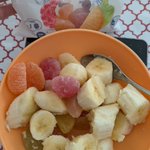
Adding some fruit to the "fruit salad" 😄 more protein at breakfast and more carbs during the ride (bit shorter) today, too much travel and uncertainty the rest of the day


1
4
624
Cardiologist at my first visit: "I looked at your records in the national database. Iliac artery endofibrosis, I had to google that. And all these A&E visits after crashes! You like riding your bike eh." 😄
1
8
803
Excellent, lucid explanation of why aerobically great doesn't mean metabolically great and why "low-intensity" (50% vo2max, a walk for some and a steady clip for others) works the best 😎 cc @Alan_Couzens
Why Exercise Doesn’t Replace Walking
Many people think that intensity can replace walking. And they are right to a degree. It does on the aerobic side.
But there are things it doesn’t replace: lipid clearance, and vascular remodeling. 🧵
1
21
2,172