

3 chords and the truth. Also can hurt you in other ways.
Alaska
Joined January 2013
- Tweets1.1K
- Following167
- Followers891
- Likes454






APRApos retweeted

Suddenly after three years, a number of angry former Trump appointees—some on the prompt of potential or real book promotions, or in anger about firings, or their own legal exposure—are replaying all the supposedly atrocious things Trump said in private to them between 2017-21. If, in fact, they are accurate, then by all means they were certainly atrocious things to have said even in private—and should never have been spoken by a president. But what is mysterious about their outrage are three other considerations that we hear nothing about from such now quite public critics:
1) Is there not a difference between atrocious bluster in private and public, methodical weaponization and destruction of our institutions?
Can such critics at least say they deplore the weaponization of the FBI (e.g., the contracting of old Twitter to suppress the news, the admitted lying under oath of its interim director Andrew McCabe, the convenient “amnesia” on 245 occasions of James Comey while under oath, and the bureau’s current fixation with parents at school board meetings, traditional Catholics and pro-life activists)?
Or the corruption of our intelligence officials who were knee-deep in the fraud of “51 former intelligence authorities" who willingly lied, on the prompt of the current secretary of state, about a laptop—deliberately so to influence a presidential debate and election?
Or the entire collusion hoax that was hatched by the Clinton campaign, with help from the FBI, DOJ, and CIA?
Or consider two of our top intelligence officials who lied admittedly under oath, such as Brennan and Clapper? Does not all that pose a danger to democracy?
Or the politicalization of the DOJ that was ready to exempt, save a brave dissenting judge, Hunter Biden and by extension the Biden clan from real legal jeopardy. Was it not wrong in 2020 for retired 4-stars officers to attack in venomous terms and publicly their commander-in-chief? If not so, why then is there a statute at all in the uniform code of military justice prohibiting just that?
2) As far as “dangers to the democracy”, cannot some at least cite the radical changes in voting laws done in key states in 2020 under the guise of Covid, or the infusion of $419 million by Mark Zuckerberg to appropriate the work of registrars and voting officials in key states?
Or the “cabal” and “conspiracy” to ensure the Biden 2020 victory as boasted about in stunning detail by liberal Time writer Molly Ball?
Who tried to cancel student loans without a vote of congress, or drained a great deal of the strategic petroleum reserve solely to boost approval before the midterms?
Or the 2016 leftwing effort to pressure the electors not to vote according to their constitutional responsibilities and instead throw the election to Clinton?
Can't they at least cite the 120-days of looting, riot, arson, attacks on law enforcement, and deaths that were largely exempt from punishment—violence that included an attempt to storm the White House grounds to get at a president, and the torching of a police precinct, federal courthouse, and iconic DC church?
Or cannot they deplore the 2015-17 macabre threats to Trump’s person by celebrities (beheading, shooting, stabbing, incineration, blowing up, etc.)?
What actually had Trump done in his first moments in office when DC rioters went berserk during the inauguration and Madonna screamed about blowing up the White House?
What had he done in his first few days that prompted ex-Pentagon lawyer Rosa Brooks to write in Foreign Policy (“3 Ways to Get Rid of President Trump Before 2020”) an outline of how to destroy his presidency before it started by either the 25th Amendment, impeachment—or a military coup (cf. also the later August 2020 pre-election letter of retired officers Nagl and Yingling, calling on Gen. Milley to intervene following the election with the 82nd Airborne to remove Trump from office).
What had he done in his first few months in office in earn 58 House members voting to impeach him?
3) Who injured the country and the lives of its people more, the 4-years of Donald Trump or the 2.5 years of Joe Biden?
Who engineered the exempt crossing of 8-million illegal entrants that will have repercussions for decades? Who has been largely silent about nearly 100,000 annual fentanyl deaths and the direct role of an open border in them?
Who engineered the disastrous and deadly flight from Kabul, timed for the narcissistic public stunt of a cheap 20th-anniversary triumph celebration of 9/11—according to The Washington Post?
Who called the accidental killing of 10 civilians during the Kabul mess a “righteous strike”, or phoned his PLA counterpart to warn about his own commander in chief, or unlawfully hijacked the chain of command?
Who spiked fuel prices, interest rates, and inflation that have caused untold misery to millions of Americans?
Who is silent about the destruction of the criminal code in our major cities that has helped unleash an unprecedented crime wave?
That list of current catastrophes that go unnoticed could be expanded.
So yes, if these recent accusations about crude and cruel Trump private conversations are true, then let us all deplore what Donald Trump said in private to his closest aides and appointees.
But let us also consider that those who voice these expressions of outrage seem to stay silent about the concrete damage to our institutions and country that was neither rhetorical nor spontaneous—but all too real and planned.
cnn.com/2023/10/02/politics/…
APRApos retweeted

mustreadalaska.com/daniel-sm… The truth about the most recent Anchorage elections.
Going to guess that this is likely the first of many.
alaskasnewssource.com/2023/0…

474
Now do the Alaska Back Caucus and the Business Boutique. #ancgov #anchgov
mustreadalaska.com/couple-ar…

1
408
The real story is that SALA medical, which got millions in pandemic funds for COVID screening and EMT presence for the muni homeless response, is now getting double the amount of money the transporter company for the sleep off center contractor was being paid. Because this has previously been the responsibility of the fire department and was billed as a cheaper way to handle resources and funds, one has to ask - why are we paying millions for this service? alaskasnewssource.com/2023/0…
2
373
APRApos retweeted
mustreadalaska.com/judge-rul… @FDRLST first to report.
Want more proof the ADN is a biased propaganda outlet? The Assembly just authorized $250K to outsource the Demboski lawsuit and it made the front page. But just last week the Assembly also outsourced tens of thousands of dollars in legal defense for Zaletel, Constant, and Dunbar's destruction of public records that were evidence of their violation of the Open Meetings Act -evidence that showed they were colluding through texts messages during the assembly meetings to swing the vote....and not a peep from Alaska's only newspaper. Literally no reporting, mention, or acknowledgement from the "journalists" or editors there. It's really remarkable. @adndotcom #ancgov #anchgov @kylehopkinsAK @tomhewittnews


Because Chris Constant, Forrest Dunbar, and Meg Zaletel have been caught deleting public records and using secret messaging apps to cordinate the vote during assembly meetings, you and I (the tax paying public) are going to be on the hook for their legal fees - paid to a private legal firm - a firm they hired in order draw out this court case even longer, even though we already pay for municipal attornies that are quite capable of representing them.
They are going to lose this case, and you can be sure the ADN will try to spin that loss as "tightening up Municipal Code", not "a massive violation of the Open Meetings Act." #ancgov #anchorageassembly

The Assembly voted down the Nav Center last night and I get to recycle this headline for the 5th time. This is the monthly yet example of partisan politics meant to expand the homeless industrial complex with more millions of tax dollars we can't afford. #ancgov @anchgov


oh heeeeey, I get to recycle another headline.
"Anchorage city officials suggest hotel rooms, small warming areas and volunteer efforts for winter homeless sheltering
By Emily Goodykoontz
Buildings of Midtown Anchorage and E Street are seen from downtown on Jan. 5, 2023. (Marc Lester / ADN)
For the first time in several years, Anchorage isn’t planning to shelter its hundreds of homeless residents in a singular mass facility over the winter. City officials on Wednesday revealed an emergency cold weather shelter plan with an assortment of ideas, which include opening non-congregate shelter in hotel rooms and relying largely on volunteers to staff several small warming areas in public or privately owned buildings.
The city would need to get creative, like relying on donations and volunteers, and find workarounds to some of its rules and regulations. But the biggest wrinkle to the plan is the most important — finding the money to pay for it all, according to Alexis Johnson, the city’s homeless coordinator. Johnson presented the plan to the Assembly’s Housing and Homelessness Committee on Wednesday.
“We are now approaching a fiscal cliff,” Johnson said. “And I know that’s scary verbiage, but we no longer have our reserves of alcohol tax. All the funding that we have identified for this year is one-time. It will not come back next year.”
And that money, if the Assembly chooses to re-allocate it toward shelter, would only be enough for the first few months, she said.
“We are out of money. And our plans, although they may be decent, are not going to sustain” beyond Jan. 1, she said.
Over the last two years, the city spent about $25.5 million on homelessness efforts. That includes direct spending on its former winter shelter in Sullivan Arena and in hotels, and funding given to outside organizations providing services such as outreach, Johnson said. That level of funding isn’t sustainable, she said, and the portion of the city’s alcohol tax revenue that goes toward homelessness has already been allocated for the year.
Still, Assembly members on the committee expressed some confidence that the money could be found, suggesting possible funding streams, such as unspent money from the 2022 fiscal year.
“The big takeaway is that we just need to find a way to fund it all, right? So that’s going to be a big part of the work going forward,” said Assembly member Felix Rivera, who chairs the committee. “... We still have time to do this work. I think we are at a good point right now.”
The city is months behind on closing out accounting for its spending in 2022. Assembly Chair Chris Constant said he believes there will be leftover funds that could be used, in part, to address the coming “cliff.” And, projections for the city’s bed tax are 30% higher this year, “to the tune of millions,” he said.
ADVERTISEMENT
The city should also look for ways to use tax credits to incentivize hotel owners to open rooms for shelter, Constant said.
In the first two years of Mayor Dave Bronson’s term, the Assembly’s majority and administration officials fought bitterly over how best to address the city’s homelessness crisis. The mayor favored building a shelter large enough for several hundred people, while Assembly members and many social service providers favored a housing-first approach, advocating for several small, population-specific shelters and services located in different neighborhoods across the city.
Wednesday’s meeting was markedly different from those of the recent past. Members largely discussed the plans from Bronson’s homeless coordinator with tones of alacrity instead of frustration.
“I’m blown away, in a very positive way, that for the first time, I believe this administration has put forward a document that demonstrates a proposal for a scattered site model,” Constant said.
About 750 people left shelter to live outside this spring when the city closed its winter shelter operations in Sullivan Arena and in the Alex and Aviator Hotels. Right now, officials are planning for only about 400 people who will need shelter this winter, Johnson said.
The three-story, 80-unit, supportive housing facility at the former Golden Lion opened on July 27. (Bill Roth / ADN)
That’s because over the last year, the city has helped fund conversions of hotels into low-income housing. It recently opened the former Golden Lion Hotel to house people with physical disabilities who might otherwise be homeless. The additional 300-plus housing units are creating movement in the homelessness response system, Johnson said. Spots in private shelters are opening as people move into housing from shelters, while others are moving directly into housing from living unsheltered on the street — so the city can estimate about 300 fewer people will need shelter, she said.
Also, about 40 or 50 have plans to continue camping during winter or to stay with friends or family, she said.
[Anchorage hotel conversions are adding hundreds of low-income housing and shelter units at a time of dire need]
Private shelters in the city are full and all but one are unable to add capacity for the winter, even with more funding, Johnson said.
To shelter about 400 people in hotel rooms for six months, November through April, it would cost between $6.3 million and $7.4 million, officials estimate.
That comes with other issues besides funding. While many people do better in non-congregate settings and those programs see better outcomes compared to mass shelter, not all fare well in hotel rooms, Johnson said.
“One question that we cannot answer is, when people are kicked out of a non-congregate setting, where will they go? Last year, we had some people that were not allowed to go back to non-congregate settings, and we marshaled them to the Sullivan Arena. And so we don’t have a facility of that nature this year,” Johnson said.
If the city finds municipality-owned, state-owned or even privately owned buildings, volunteers could run several small warming areas, health department officials said.
“People are willing to help. And there potentially is a greater volunteer network out there that we haven’t tapped into yet,” said Michael Hughes, homelessness planning coordinator with the Anchorage Health Department.
To reduce costs for food, the city could coordinate a restaurant donation program, solicit other donations from grocery stores or purchase MRE meals. It could cut red tape by waiving health permits, fees or commercial kitchen requirements for volunteer groups like churches, nonprofits and others who want to cook and donate meals, health department officials told members.
It may be possible for the city to offer restaurants tax credits or rebates in return for their donations, Constant said.
Certain building code requirements are inhibiting church groups from opening winter warming areas in their buildings, and they can only operate warming areas that require sobriety. The city should look into code changes to reduce those barriers, officials said.
Johnson also told Assembly members that, because the city is required in code to activate a winter shelter plan, it should have a dedicated funding mechanism for that.
But, ultimately, shelter is “the most expensive method to keep people under a roof,” she said.
Bronson’s stalled project to build a large shelter and navigation center would cost around $8 million each year to run. (The Assembly is holding a work session on a proposal to revive the project on Friday, and is scheduled to vote next Tuesday.)
The city can’t pay for those operations costs, Johnson said, adding that “the state needs to step up. They need to provide funding.”
Assembly members said the situation underscores that increasing housing stock and making it affordable to low-income people is the most prudent and effective solution.
A homeless camp in a wooded area of Mountain View consists of several tents and makeshift shelters in the snow on Dec. 21, 2022. (Marc Lester / ADN)
That the city is planning to shelter 400 rather than 750 people “means we’re making progress,” Constant said. “And that’s what people need to understand. That’s nearly 50% of the people that we’ve identified that would be on the streets, who will be housed.”
Johnson largely agreed, and said the city needs to explore using federal funding for housing, rather than sheltering.
“I do want to say there’s good work being done. Year over year, we’re bringing on more housing. We’re just not there yet,” Johnson said."

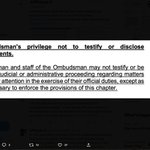
Here's the Ombudsman's report about the thumb drives being inserted into the Dominion machines during the last election. The key take aways: s3.documentcloud.org/.../fin…...
The IT department has felt this was a security risk for years. The IT director felt this was a direct security risk for the election.
The IT director, although politically neutral, also has an obligation to report potential fraud. The fact that the municipal clerk was prohibiting the person responsible for the security of municipal tabulation equipment and then parsing that he was "a member of the public" while the Ombudsman editorializes with comments that the IT director was trying to observe the areas of the elections center (as is his right per code) "when he thought no one was looking" is incredibly telling about impartiality of this report, and also insane logic.
Once again, the colluding press at the ADN have spun yet another hit piece story that's going to go nowhere - but that's the point. The way this works is "Allegation! DRUM UP OUTRAGE! Then Demand Investigation!...then nothing, except another Allegation!" when the news cycle turns.
Finally, the "any reasonable person" line in the Ombudsman report is hilarious, because "any reasonable person" would recognize that thumb drives that have long been recognized as a potential security risk AND are not being certified to be blank before being inserted into the tabulation machines is a huge problem - almost as big of a problem as the political junta going after the people pointing that out.
----From the Ombudsman report------
"Any reasonable person can connect the dots — there is no way to dismiss the timeline of events as merely coincidental ~the timeline and supporting documents demonstrate that Dahl was
acquainted with at least two of the three Trueblood election observers who filed the election challenge on April 11%, and that the dormant OIT USB policy development discussion was
restarted on April 11 at the instigation of Dahl, who directed that the final policy be posted on the OIT intranet page that same day. The timeline, and Dahl's email to Graham demonstrate
that Dahl was directing the development and posting of the policy to provide support for the impending election challenge. As an executive with the Municipality, Dahl has an obligation to
remain politically neutral in the performance of his official duties ~ an obligation that he failed to meet multiple times regarding Graham's election challenges.
The Ombudsman's personal observations of Dahl's actions at the Election Center in 2022 demonstrate that Dahl has trouble separating his personal political beliefs from his role as an
executive with the Municipality of Anchorage — the inability of any Municipal executive to separate their personal political beliefs from their professional role is problematic for the
Municipality and Mayoral Administration that they serve.
AMC 28.80.0158 states that “All ballot tabulation processing using a software application shall be under the supervision of the municipal clerk and observance by at least one of the following
selected by the municipal clerk:
1. Internal Auditor or designee.
2. IT director or designee.
3. Municipal ombudsman or designee.”
“The Clerk invited the Internal Auditor, IT Director, and Ombudsman to observe the ballot tabulation processing at the Election Center on the evening of April 5, 2022. The Internal Auditor and Ombudsman arrived and joined the Clerk and elections staff in front of the election
computers the IT Director arrived and effusively greeted the election observers and joined them, rather than sitting with the other official Municipal ballot tabulation observers. The
Director discussed the election with the election observers, while representing the Municipality as an official ballot tabulation observer. The Ombudsman was troubled by the actions of the
Director and later that evening expressed his concerns to the Clerk and Election Administrator the Ombudsman believed that it was inappropriate for the Director to be discussing the
election and expressing partisan political opinions to election observers, while serving as an official Municipal ballot tabulation observer. The Ombudsman discussed filing a complaint with
the Ethics Board but decided not to fle.
The Ombudsman and Internal Auditor were invited to observe the May 26%, 2022 Logic and Accuracy Testing at the MOA Election Center, for the June 21, 2022 Special Election. Shortly
after they arrived, Dahl arrived — he was present as a member of the public and was not representing the MOA. Dahl was provided with a yellow lanyard to wear around his neck vellow signified that he was a member of the public and that he had to stay on the “yellow brick road”, a pathway outlined in yellow that circles the core area of the Election Center. Persons with yellow lanyards must stay on the outlined pathway. Dah kept crossing the pathway's boundary, entering areas of the Election Center that were off-limits to persons with yellow lanyards. The Clerk warned Dahl several times to stay on the pathway —when he thought that
the Clerk was not looking, Dahl walked over to the reception desk, took off hs yellow lanyard, reached across the reception desk to get a different colored lanyard, and put that lanyard
around his neck. That lanyard provided greater access to areas within the Election Center. The Clerk observed Dahl's actions and told him that he could not assign himself a different color of
lanyard ~ he was present as a member of the public and he needed to wear a yellow lanyard.
An executive with the MOA told the Ombudsman that Dahl had commented to him, at work, that the April 2022 Municipal election had been “rigged”. Dahl's comments, actions at the
election center, and his actions regarding the April 11" development and posting of the OIT USB policy demonstrate a pattern of behavior that s troubling and that needs to be addressed ~ his actions and inability to separate his personal political views from his role as an executive with the MOA has damaged the reputation of OIT and has eroded the trust of MOA employees in the ability of OIT to be impartial and neutral. Given the wide-ranging access that OIT staff has t0 MOA facilities and systems, it is imperative that MOA employees have confidence in OIT's ability to be impartial and neutral ~ the actions of Dahl as OIT Director have negatively impacted the hardworking, dedicated OIT employees who come to work everyday doing the
best they can to keep the MOA functioning smoothly ~ they, and the public deserve better."
-------------------------- #ancgov #anchgov #aklaw #akleg
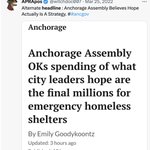
oh heeeeey, I get to recycle another headline.
"Anchorage city officials suggest hotel rooms, small warming areas and volunteer efforts for winter homeless sheltering
By Emily Goodykoontz
Buildings of Midtown Anchorage and E Street are seen from downtown on Jan. 5, 2023. (Marc Lester / ADN)
For the first time in several years, Anchorage isn’t planning to shelter its hundreds of homeless residents in a singular mass facility over the winter. City officials on Wednesday revealed an emergency cold weather shelter plan with an assortment of ideas, which include opening non-congregate shelter in hotel rooms and relying largely on volunteers to staff several small warming areas in public or privately owned buildings.
The city would need to get creative, like relying on donations and volunteers, and find workarounds to some of its rules and regulations. But the biggest wrinkle to the plan is the most important — finding the money to pay for it all, according to Alexis Johnson, the city’s homeless coordinator. Johnson presented the plan to the Assembly’s Housing and Homelessness Committee on Wednesday.
“We are now approaching a fiscal cliff,” Johnson said. “And I know that’s scary verbiage, but we no longer have our reserves of alcohol tax. All the funding that we have identified for this year is one-time. It will not come back next year.”
And that money, if the Assembly chooses to re-allocate it toward shelter, would only be enough for the first few months, she said.
“We are out of money. And our plans, although they may be decent, are not going to sustain” beyond Jan. 1, she said.
Over the last two years, the city spent about $25.5 million on homelessness efforts. That includes direct spending on its former winter shelter in Sullivan Arena and in hotels, and funding given to outside organizations providing services such as outreach, Johnson said. That level of funding isn’t sustainable, she said, and the portion of the city’s alcohol tax revenue that goes toward homelessness has already been allocated for the year.
Still, Assembly members on the committee expressed some confidence that the money could be found, suggesting possible funding streams, such as unspent money from the 2022 fiscal year.
“The big takeaway is that we just need to find a way to fund it all, right? So that’s going to be a big part of the work going forward,” said Assembly member Felix Rivera, who chairs the committee. “... We still have time to do this work. I think we are at a good point right now.”
The city is months behind on closing out accounting for its spending in 2022. Assembly Chair Chris Constant said he believes there will be leftover funds that could be used, in part, to address the coming “cliff.” And, projections for the city’s bed tax are 30% higher this year, “to the tune of millions,” he said.
ADVERTISEMENT
The city should also look for ways to use tax credits to incentivize hotel owners to open rooms for shelter, Constant said.
In the first two years of Mayor Dave Bronson’s term, the Assembly’s majority and administration officials fought bitterly over how best to address the city’s homelessness crisis. The mayor favored building a shelter large enough for several hundred people, while Assembly members and many social service providers favored a housing-first approach, advocating for several small, population-specific shelters and services located in different neighborhoods across the city.
Wednesday’s meeting was markedly different from those of the recent past. Members largely discussed the plans from Bronson’s homeless coordinator with tones of alacrity instead of frustration.
“I’m blown away, in a very positive way, that for the first time, I believe this administration has put forward a document that demonstrates a proposal for a scattered site model,” Constant said.
About 750 people left shelter to live outside this spring when the city closed its winter shelter operations in Sullivan Arena and in the Alex and Aviator Hotels. Right now, officials are planning for only about 400 people who will need shelter this winter, Johnson said.
The three-story, 80-unit, supportive housing facility at the former Golden Lion opened on July 27. (Bill Roth / ADN)
That’s because over the last year, the city has helped fund conversions of hotels into low-income housing. It recently opened the former Golden Lion Hotel to house people with physical disabilities who might otherwise be homeless. The additional 300-plus housing units are creating movement in the homelessness response system, Johnson said. Spots in private shelters are opening as people move into housing from shelters, while others are moving directly into housing from living unsheltered on the street — so the city can estimate about 300 fewer people will need shelter, she said.
Also, about 40 or 50 have plans to continue camping during winter or to stay with friends or family, she said.
[Anchorage hotel conversions are adding hundreds of low-income housing and shelter units at a time of dire need]
Private shelters in the city are full and all but one are unable to add capacity for the winter, even with more funding, Johnson said.
To shelter about 400 people in hotel rooms for six months, November through April, it would cost between $6.3 million and $7.4 million, officials estimate.
That comes with other issues besides funding. While many people do better in non-congregate settings and those programs see better outcomes compared to mass shelter, not all fare well in hotel rooms, Johnson said.
“One question that we cannot answer is, when people are kicked out of a non-congregate setting, where will they go? Last year, we had some people that were not allowed to go back to non-congregate settings, and we marshaled them to the Sullivan Arena. And so we don’t have a facility of that nature this year,” Johnson said.
If the city finds municipality-owned, state-owned or even privately owned buildings, volunteers could run several small warming areas, health department officials said.
“People are willing to help. And there potentially is a greater volunteer network out there that we haven’t tapped into yet,” said Michael Hughes, homelessness planning coordinator with the Anchorage Health Department.
To reduce costs for food, the city could coordinate a restaurant donation program, solicit other donations from grocery stores or purchase MRE meals. It could cut red tape by waiving health permits, fees or commercial kitchen requirements for volunteer groups like churches, nonprofits and others who want to cook and donate meals, health department officials told members.
It may be possible for the city to offer restaurants tax credits or rebates in return for their donations, Constant said.
Certain building code requirements are inhibiting church groups from opening winter warming areas in their buildings, and they can only operate warming areas that require sobriety. The city should look into code changes to reduce those barriers, officials said.
Johnson also told Assembly members that, because the city is required in code to activate a winter shelter plan, it should have a dedicated funding mechanism for that.
But, ultimately, shelter is “the most expensive method to keep people under a roof,” she said.
Bronson’s stalled project to build a large shelter and navigation center would cost around $8 million each year to run. (The Assembly is holding a work session on a proposal to revive the project on Friday, and is scheduled to vote next Tuesday.)
The city can’t pay for those operations costs, Johnson said, adding that “the state needs to step up. They need to provide funding.”
Assembly members said the situation underscores that increasing housing stock and making it affordable to low-income people is the most prudent and effective solution.
A homeless camp in a wooded area of Mountain View consists of several tents and makeshift shelters in the snow on Dec. 21, 2022. (Marc Lester / ADN)
That the city is planning to shelter 400 rather than 750 people “means we’re making progress,” Constant said. “And that’s what people need to understand. That’s nearly 50% of the people that we’ve identified that would be on the streets, who will be housed.”
Johnson largely agreed, and said the city needs to explore using federal funding for housing, rather than sheltering.
“I do want to say there’s good work being done. Year over year, we’re bringing on more housing. We’re just not there yet,” Johnson said."
There are plenty of people moving to the Valley. Why? Because it's not been choked to death like Anchorage was during the pandemic. Builders can build single family homes in Matsu for less than Anchorage's $350 a square foot, and homeowners can own those homes for a fraction of the tax burden of an Anchorage home. The Assembly squandered millions of federal aid money and the chance to bolster Anchorage's economy over 2.5 years, repeatedly, on the homeless industrial complex, and they continue to throw money into the bureaucracy that only gets bigger as the problems get worse. Meanwhile, scores of families flee this city while the same progressives line up to support the same politicians that used every opportunity to play politics with that money. None of these "crises" are a surprise.

Our community is in several slow- moving and deep crises. This is one of them.
Do we want to be a community where many different people can make a good life here?
Because for more & more people, we aren't. So they're leaving, or not coming at all.
Something needs to change.
1
229
It must be nice having a colluding press that's willing to print every airball non-story of campaign finance corruption claims, never mentioning that Kendall's effort are being financed by 6 million dollars of out state "non profit" money through an organization that doesn't have a publicly available tax filing or audit to show. Not to mention burying the ridiculous premise that signature gathering through a secondary group obligates a public registration with APOC by a third party. Well done @adndotcom comrades. #ancgov #akleg

The Anchorage Assembly, after three years of wasting millions of dollars on everything from : $1,100,000 for the failed Tudor shopping complex lawsuit + $30,000 to teach 50 people how to ride a bike + $450,000 in earnest money for the Alaska Club Purchase that the Assembly knew was never going to happen with the new administration + $7500 for Icarus Interstellar (group wanting to make interstellar space travel happen + $7500 to craft beer making Brewer's Guild + $7500 for badminton club BADMINTON GOES VIRAL.
And last night, after months of crying about a "humanitarian homeless crisis" in the now sanctioned camps they are now promoting....after all that ,they delayed, again, voting in the money to open the Golden Lion. I am 100% certain these people are so completely full of lies that quotes like
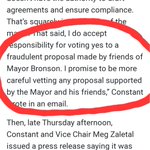
“We all feel the rush, and the rush is ‘Let’s get it done. But my request is: Let’s get it done right.” Constant
and
“I like expediency and I like urgency, but it’s really important we follow our own rules,” Zaletel
seem like second nature. It's remarkable what a petty and childish group of people are holding the keys to the city.

APRApos retweeted

The Biden regime spared no expense to hunt down every human being within a mile of the Capitol on J6, but within 24 hours of someone leaving an 8 ball of freshly uncut Nicaraguan outside the White House situation room, they are all like “whelp you got us there”.
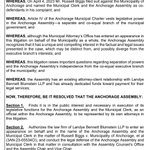
Zaletel, Dunbar, and Chris Constant's lawyers are arguing that the messages they were sending during the assembly meeting secretly coordinating their votes - messages that were later intentionally and illegally destroyed- aren't subject to the public records act because...the destroyed records were destroyed, and any messages intentionally sent during PUBLIC meetings aren't subject to state law because they were meant to be secret.
The silliness of this legal approach during oral arguments for this lawsuit is going to be comedy gold, probably on par with Ruth Botstein arguing that Meg Zaletel's violation of the Covid mandates wasn't misconduct because following the law wasn't part of her "official duties". #aktwitter #ancgov #aklaw

Chris Constant, Meg Zaletel, and Forrest Dunbar violated the Open Meetings Act and are about to lose a Superior Court case for their destruction of public records that show them colluding during the Assembly meetings to coordinate the vote on the homeless issues. They've blown $180 million of federal money, squandering it on political cronies and Anchorage has more homeless than ever. They also just voted to delay any further action on the Nav Center guaranteeing the Sullivan will reopen in the winter for another million a month. Tell us how again how more federal money is needed, Chris. #ancgov adn.com/opinions/national-op…