

head of defi @3janexyz @yieldsandmore @cozy_fnf
Joined March 2023
- Tweets795
- Following545
- Followers891
- Likes960






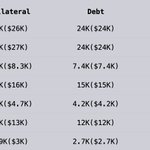
spotted this new oracle section by @Morpho in our new PT-USD3 / USDT market by @flowdesk_co
thank you to the morpho team for making oracle reading more intuitive for all users


wumpy crypto retweeted

Credit scores are core economic infra powering +$18T of household debt, but never scaled in DeFi. Unfunded commitments (promises) are a +$10T asset class meeting all preconditions for a global, cryptonative FICO to thrive, letting anyone on the web monetize their creditworthiness at scale:
wumpy crypto retweeted

3Jane is the Hyperliquid of credit
they just cracked the crypto funding dilemma

DeFi has just crossed the chasm from a fully reserved system to a fractionally reserved system.
3Jane now enables anyone to generate yield on promises to supply capital later. Capital can remain outside DeFi’s contracts and still back those promises.
The promise can exceed the liquidity held against it, letting anyone run fractional reserves and effectively become their own shadow bank.
With this update, promisors can tap the much larger market for senior secured debt through @Morpho to fund capital calls, commit up to 6.25x their onchain net worth, and earn yield on the full commitment.
@ImperiumPaper is right that DeFi is speedrunning financial history.
A balance sheet can monetize two things: (a) capital and (b) the capacity to commit capital.
DeFi built its core markets around the former. Capital enters a smart contract, then earns yield. We accepted this mental model so completely that we named our measure of scale TVL.
LCC makes the latter a market through unfunded capital commitments. 3Jane buys future access to capital while its owners keep it productive elsewhere.
Crypto is a ~$2.8T asset class, while DeFi’s contracts hold ~$90B. A market for promises lets DeFi’s funding capacity grow beyond those deposits. 3Jane draws that capital into USD3 as calls are met. At 7.5% margin, each dollar posted supports a $13.33 commitment.
U.S. banks already sell this capacity at scale, carrying ~$11.3T of unused loan commitments. They sell access to capital before they need to deliver the cash.
LCC engineers TradFi’s most powerful liquidity mechanism into self-enforcing, internet-native code. It crowdsources balance-sheet capacity at global scale, letting anyone earn yield on their unfunded capital.
I encourage crypto market participants to revisit their priors.
Bubbles are, of course, mathematically impossible in this new paradigm.
fund your promise to 3jane by taking on debt
no prenegotiated financing facilities or legal contracts
just smart contracts allowing users to tap into a decentralized balance sheet of stablecoin liquidity when needed, governed by the markets utilization / risk parameters

U.S. banks hold $11T+ in undrawn commitments. Promise looping is live on LCC, bringing fractional reserves to capital commitments in crypto
Earn promise fees on up to 6.25x your net worth: +7.8% APY on top of your DeFi assets deployed elsewhere, funded via @Morpho debt if called
wumpy crypto retweeted
Introducing credit scores on @3janexyz x @cred_protocol
Reputation can now be collateralized to generate higher yield within DeFi, permissionlessly and at scale, starting with undercollateralized promises on LCC
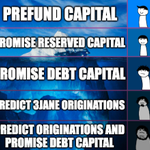
3jane and usdai are tackling the same problem in different sectors: tradfi loan originations stack on high fixed costs
the full lifecycle of structuring a loan slowly adds on costs at each step, which makes the final cost of capital for borrowers higher, without necessarily passing on returns to lenders
at 3jane, we're focused on leveraging technology and cryptonative advantages to compress fixed costs
things like automated reporting, programmatic tranching, agentic loan-level data reconciliation, etc., allow for fintech originators perpetually stuck with high costs of capital to access bespoke credit facilities with 3jane
the cost of capital savings doesn't come from mispricing the risk, but rather optimizing the full loan origination stack

One of the biggest misconceptions about the middle market for compute is that there simply isn’t enough capital. There’s a ton of capital! It’s more the shape of it and the covenants required that’s sticky.
The more interesting problem is the per-loan cost of getting capital there.
Every loan has a stack of costs:
Origination.
Underwriting.
Technical diligence.
Legal structuring.
Warehousing.
Settlement.
Distribution.
And each layer has a real dollar cost.
Talk to private credit funds and they’ll tell you that standing up a transaction can easily mean $3-5M of fees and internal/external costs before you even get to the cost of capital itself.
On a >$500M transaction, that can work.
On a $20M or $30M transaction, the unit economics start to look absurd.
Those costs do not disappear. They surface somewhere: higher interest rates, larger minimum deal sizes, tighter covenants, more equity required, or simply a decision not to do the loan at all.
That is why the middle market can look capital-starved even when there is plenty of capital interested in the underlying exposure.
The financing machinery was built for much larger transactions.
The interesting question, then, is whether the cost of creating a loan can itself follow a technology cost curve.
Do enough transactions and you stop treating each loan as a handcrafted project.
You start building infrastructure.
And once you can systematically reduce the cost of every hop, the minimum economically viable loan size falls, borrower pricing improves, and much larger pools of capital become accessible to the middle market.
That is where USD.AI has been focused.
We are one of the few operators actually doing this at scale. We have roughly $500M of loans on our books by end of the next month and are on track to cross $1B by year-end- not one big billion loan but a lot of smaller <100m deals
But that $1B is not one giant transaction.
It is many dozens of loans.
And that matters.
Every loan is another training example.
Every underwriting process teaches you what can be automated.
Every origination teaches you where information gets lost.
Every legal structure teaches you what can be standardized.
Every settlement teaches you where latency can be removed.
Over time, more of that process moves from artisanal execution into software, agents, standardized workflows, and tech-enabled origination.
That is the moat.
We found product-market fit around the demand for compute credit.
The next question is how you turn execution into infrastructure, and infrastructure into a platform.
You only get there by actually doing the loans, and having the reinforcement training runs on these extremely detailed processes
Getting your hands dirty, seeing where the process breaks, encoding those lessons into the system, and then doing the next loan better than the last. Our first loan took 120 days, the latest took 21.
That is how the cost curve comes down.
And that is how a fragmented middle market becomes scalable. We have a few major product updates in pretty excited to get out there that lowers the per unit cost of loan economics for not just us, but for our capital partners as well.

3jane spotted

3/ Live with RWAs issued by @paretocredit, @3f_xyz, @MidasRWA with more issuers to follow.
Every market carries its own risk-adjusted exposure cap, so no single issuer can dominate the vault. The vault also targets ≥50% withdrawable liquidity at all times.
docs.kpk.io/vaults/vaults/mo…

tldr:
- 9.5% APY with @aave usdc exposure
- leverage a global, cryptonative balance sheet to generate commitment fees
visibility lets committers estimate new USD3 supply-side liq.
ex:
- current supply-side liq. in yieldcoins (if it fits risk appetite)
- activity patterns of those wallets (if they’re likely to rebalance)
- hurdle rate (if rebalancing is worth it)
why incentives can stand in for a legal obligation:
- upon a call, borrow rates reprice until lenders show up
- moving liquidity costs < $1 & takes < 1 min
- every position is visible, so you can see who's likely to move
the upside of the trade-off is no one sits on idle cash
in tradfi, the lender reserves capacity for you & charges an undrawn fee for it
in defi, lenders stay deployed elsewhere & only supply into USD3 markets when a call occurs
the tradfi facility has a legal obligation to appear with cash to finance your call
defi has no such legal obligation, trading legal guarantees for softer cryptoeconomic incentives to maximize capital efficiency
however, this on-chain supply-side liquidity has no obligation to appear
unlike the tradfi equivalent, which would be some sort of committed financing facility w/ an undrawn commitment fee
here's why this works at scale:
there's > $10b of stablecoin supply-side liquidity on-chain
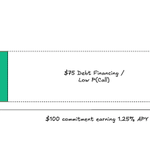
by taking on debt to fund capital calls, you're effectively generating commitment fees off a global balance sheet of supply-side liquidity

if a call occurs, you can choose how to manage your call
call under $25 -> can fully cover call without requiring debt OR leverage up on USD3 to boost returns
call over $25 -> leverage up on USD3 to fulfill capital call
ex:
post $7.5 initial margin (aave usdc), to back $100 commitment
hold $25 in reserve (monad aave usdc), knowing that either:
a) expected max call is only $25 over full commitment period
b) can lever USD3 4x to cover full commitment
APY before LCC: 5.6%
APY after LCC: 9.5%
