



William Chen retweeted

Energy-Based Reasoners: Your Recurrent Reasoner Should Be an Energy-Based Model
By using gradient descent on learned energy to guide looped reasoning, Energy-Based Reasoners hit 99.9% Sudoku-Extreme accuracy with 345x less inference compute than rivals.
arxivb.org/abs/2611.08977
Bye bye looped reasoning… and hello Energy-Based Reasoners (EBRs)⚡!
Your looped reasoning model would be better off as an energy-based model (EBM)...
TLDR:
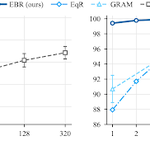
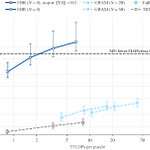
EBRs uses 345x less inference compute and 2.6x fewer training FLOPs than the best baselines
EBRs are 7x-43x more sample efficient than the best looped baselines at inference.
EBRs achieve 99.9% on Sudoku-Extreme
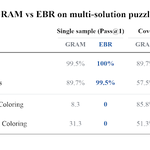
EBRs achieve near 100% accuracy on multi-solution benchmarks
🧵Thread:
[6/N] 👑 On N-Queens & Graph Coloring, EBRs beat every baseline, with near-perfect accuracy from one sample and up to 1.6× more distinct solutions.

[7/N] We believe that reasoning works better as verification than as step-by-step updates.
Energy is an elegant way to do iterative reasoning by unifying updates, stopping, and the answer selection under one objective.
More works coming in LLM reasoning and world-model planning!
And we’re working on ARC-AGI results, coming soon 👀
📄 Paper: arxiv.org/abs/2611.08977
📄 AlphaXiv: alphaxiv.org/abs/2611.08977
📄 HF paper: huggingface.co/papers/2611.0…
🌐 Project: energy-based-reasoners.githu…
💻 Code: github.com/wwillchen/ebr
w/ @AlexiGlad, @MichaelLi142465, @hengjinlp, @du_yilun

2
31
1,940
William Chen retweeted

There have been some follow-up questions on the relationship between XMs and IMLE, so I’m going to provide some clarifications (some of this was in E.3 of the paper). IMLE is a great paper we respect and cite in XM, and I highly recommend people check it out. In fact, I’d encourage people to read the two papers side by side. I think this would help clarify the different motivations and let the merits of each speak for themselves. That being said, XMs are a generalization of IMLE and of best-of-K methods more broadly, and the recent claim that “XM is just a special case of IMLE” is inaccurate. XMs are about one thing, which is increasing generative expressivity by factoring the training loop, and IMLE is one specific instance of that (end-to-end Forward XMs). Because of this, >90% of the results in the XM paper go against the IMLE theory, and have not been studied by IMLE (including the entire 3rd pretraining axis portion of the paper, which was done by combining XMs with existing scalable reconstructive generative models, which IMLE has never focused on). Additionally, the XM paper's main contribution is empirical insights on generative expressivity, not best-of-K. In the paper, we explicitly state, “We do not claim to invent best-of-K”, and we also cite IMLE within the first two paragraphs of the approach section and in other locations.
🧵Thread:
