

Co-founder @morphic_lab Blockchain researcher. My research interests involve trustless system design, TEE, and cryptography.
Joined June 2017
- Tweets147
- Following194
- Followers85
- Likes182
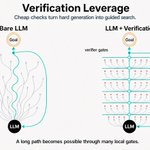





5/ A difficult task is rarely one decision.
It is a long search through an enormous space of possible reasoning paths and actions.
Verification continuously narrows that space before errors compound.
Bad paths terminate early.
Good paths continue.
Recovery becomes cheap.
1
5


How do you show that your system is better than local AI guardrails (rate limits, gateway, oversight)?

5
722
Liam retweeted

vitalik quietly made 2 blog posts about how TEE can be a part of the eth roadmap, but afaict no one is talking about this
- TEEs as mostly-untrusted multiprover for scaling L2 ethereum-magicians.org/t/a-s…
- TEEs for privacy in RPCs ethereum-magicians.org/t/a-m…

Liam retweeted

What a crazy week in AI 🤯
- OpenAI’s Codex
- Google Coding Agent
- Windsurf SWE-1 models
- Notion’s new AI for work
- Tencent Multimodal Video
- ChatGPT 4.1 & PDF Exports
- Meta Collaborative Reasoner
- ElevenLabs Infinite Soundboard
Here’s EVERYTHING you need to know:
“In roughly 75% of cases, it rediscovered state-of-the-art solutions... And in 20% of cases, AlphaEvolve improved the previously best known solutions.”
deepmind.google/discover/blo…
Just 6-7 years ago, dynamic analysis research of software engineering relied on hand-crafted test cases and mutation operators to iteratively fuzz code for finding bugs. Today, LLM-based agents are transforming the very goals and methods of research, actively driving breakthroughs in science itself.

1
45


Liam retweeted

One more TEE-pilled guy ❤️
tldr: TEE loves ZK
- TEE doesn't replace ZK
- TEE enables private ZK-proving outsourcing
- You get best security with ZK and privacy with TEE

Had been diving deeper into TEEs for a project (more about the project below). I was pretty pessimistic about them until I started looking at them from an application perspective.
The initial skepticism came from the earlier hype and people claiming it to be a silver bullet for all purposes and the fact that "they can replace ZKPs" while obvious trust assumptions and attack vectors existed. TEEs aren't the magical solution some marketing suggests, but they do solve real problems in practical ways.
The key is understanding what TEEs actually deliver vs. promise. They don't eliminate trust — they shift it to a more centralized authority in exchange for some practical benefits through isolation, specifically privacy (and probably it's extent should stay there).
Bottom line: TEE work best when those limitations are acknowledged and when combined with other security approaches. Good for solving today's problems while we work on more robust cryptographic solutions.
----
Right now I am kinda working on a setup for private proving. The problem: ZK proving is computationally intensive and often impractical on consumer devices, but outsourcing proving exposes sensitive user data to third parties. This is particularly valuable for zkTLS systems, where protecting user data during the proving process is essential.
Fusing TEEs with zkVMs forms a powerful hybrid solution:
- zkVMs handle the validity guarantees
- TEEs provide the practical confidentiality layer, protecting sensitive data
Together, they create a system that's both mathematically verifiable and pragmatically private. Let's see where this endeavour goes.
---
Planning to write a longer form of this post separately (as if this isn't long enough hah). Meanwhile, here's a thread of resources I found useful for my research 🧵
In the next 5 years, TEE is the only path to making AI a public accessible good—not through compromise, but by enhancing its true power.
Transforming confidentiality and decentralization into tangible benefits like
- lower costs
- better security
- Abundant data and compute.
This is the promise of TEE, and the vision of us and peers. Shout out to pioneers @ilblackdragon @NEARProtocol @PhalaNetwork

Here are some comparisons of potential approaches we explored – we are working with TEE because it offers both verifiability and confidentiality properties with minimal overhead. (Shout out to @phalanetwork!)


A short clarification about two buzz words: Privacy vs. Confidentiality:
- Privacy is essentially a business and product term. It's about the demand of users to specify some of their personal data as privacy and expect to confide the data against others.
- Confidentiality is essentially a technical term. It's about the ability and technology to ensure specified data isn't accessed or disclosed without authorization.
In other words, the tech of confidentiality is usually used to realize the demand for privacy.
#Privacy #Confidentiality #DataPrivacy
55
Liam retweeted
50 lines for a tor onion service in a confidential container. You can serve a TEE-based decentralized frontend without having to reveal the TEE's IP address
github.com/Dstack-TEE/dstack…
