Professor @feup_porto and researcher @inesctec. Distributed Systems and Data. Co-creator of CRDTs. Still searching for unknown unknowns
Oporto, Portugal
Joined March 2007
- Tweets15.4K
- Following3.8K
- Followers3.5K
- Likes26.4K






Carlos Baquero retweeted

This AI acknowledgement takes the win. From this paper: arxiv.org/pdf/2610.27918.


Carlos Baquero retweeted

Google DeepMind now compresses a year of satellite imagery for every 10m of Earth into 64 numbers. A team just used them to find every tomato field in California.
A task like detecting tomato fields and distinguishing them from wheat fields can actually be pretty annoying to do. Raw satellite imagery is a mess of clouds, shadows and shifting seasons, so getting a crop map out of it normally means hand-picking which colour bands and seasonal patterns distinguish one crop from another, then redoing much of that work when you move to a new year or a new region. A model tuned to spot tomatoes in one season loses its edge in the next. For something as ordinary as knowing which field grows what, that is a lot of custom engineering to maintain, and it is exactly the fragile step everyone wants to delete.
A team at UC Davis tested a way to delete it, using AlphaEarth Foundations. Instead of handing you raw pixels, AlphaEarth pre-digests a full year of satellite observations for every 10-metre patch of ground on Earth into a compact string of 64 numbers, a kind of fingerprint of everything that happened on that patch across the year. It ships one of these fingerprints per location per year from 2017 onward. The bet the Davis team wanted to test was simple. If the hard summarising work is already done for you, a fairly ordinary model should be able to read those fingerprints and map a crop with none of the usual hand-tuning.
To find out they leaned on California's 2018 statewide crop map, which told them the ground truth for thousands of fields. They took 4,742 known tomato fields and 4,742 fields growing everything else, a deliberate mix of alfalfa, wheat, corn, beans and orchards, fed the fingerprints into a standard image-segmentation network, and split the data so the fields it was tested on sat in genuinely different places from the ones it learned on. That last part matters, because testing on land next door to the training fields mostly measures memory, not skill.
The scores came back almost suspiciously high. Around 99% of pixels classified correctly, an F1 of 99.0% balancing false alarms against misses, and a predicted tomato area that overlapped the true area about 98%. More telling than the headline number is where the model hesitated. They ran it a hundred times over with random pieces switched off each time, watching where its answers wobbled, and the uncertainty piled up almost entirely along field boundaries while the interiors stayed rock solid. That's the pattern you'd want to see: confident about whole fields, unsure only at the fuzzy edges where one crop meets another.
As you may know, I'm a bit up in the air about these embeddings datasets. They make inference cheaper and quicker, but sometimes they're outperformed by more vanilla approaches.
Anyway, as with LLMs, we're just at the beginning and they'll only improve over time. So watch this space...
link to full article: arxiv.org/abs/2605.21804

Carlos Baquero retweeted

My Claude found a critical zero day vulnerability in the Code of Hammurabi, unnoticed by developers for 3,779 years.
Carlos Baquero retweeted

We believe voice is the most natural way to interact with intelligence, so we created Dessa, the most authentic full-duplex speech model ever built. Talking with it feels like talking with a person…full of emotion, nuance, pauses, and a natural cadence.
block.xyz/dessa


Carlos Baquero retweeted

This post is also an utter and total vindication of the "tested semantics" approach that @ArjunGuha initiated at Brown (for JavaScript), even though some PL formalists were mortified. Tests ARE specs. Math specs are universal, from above; tests are pointwise specs, from below.


New on our Frontier Red Team blog: using Claude to formally verify software at large scale.
Formal verification can prove that code is free of certain bugs, but historically it has only been feasible for small codebases (or required a lot of expert time).
With AI models, however, this is beginning to change. In collaboration with @theoremlabs, we used Claude to prove security properties in over one hundred real-world open-source libraries over the span of a few weeks.
Read our research in full here: anthropic.com/research/forma…

Carlos Baquero retweeted

By every measure, Opus 4.8 beats human experts as peer reviewers in a study of 124 Harvard social science papers covering a range from statistical analyses to formal models to qualitative work.
As academics, we need to figure out how to adapt the practice of science to AI, fast.


Carlos Baquero retweeted

Wake up.
Every profession deemed white-collar, the middle class dream, is about to be decimated by AI, at a much faster pace than anticipated, with monstrous social consequences.


Carlos Baquero retweeted
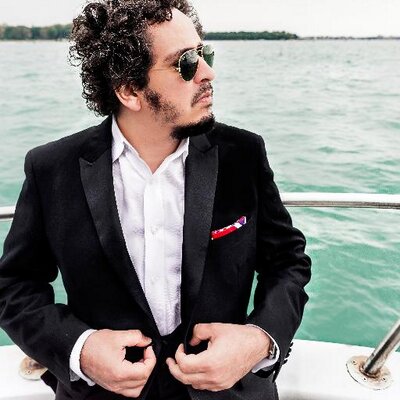
Elle s'appelle Thania Cristina dos Santos et elle va mourir.
Elle a ete attrappee a l'aeroport de Bali avec 3.6 kg de cocaine.
Il y a une épidémie de jeunes qui tentent de passer de la drogue et se font chopper. Les passeurs les démarchent en ligne et leur proposent 50'000 euros pour "un coup facile".
Parlez-en à vos ados et jeunes. A certain âge, ils se croient malins et se retrouvent en prison en Egypte, Turquie, ou Indonésie avec des charges passibles de peine de mort.
Même si elle échappe par miracle au peloton d'exécution, elle va passer sa vie dans une prison dans la jungle.

Carlos Baquero retweeted

🚩 When Polymarket or Kalshi says there's a 70% chance something will happen, should we believe it?
Excited to share our new paper, just published in PNAS, in which we examined more than ONE MILLION forecasts from Polymarket, Kalshi, Manifold, and Metaculus, spanning 12 domains and forecasting horizons ranging from hours to years.
The main finding is striking: Prediction markets and collective forecasting platforms are remarkably well calibrated. When they assign events a 70% probability, those events really do happen about 70% of the time. And this pattern holds surprisingly well across different platforms, domains, and forecasting horizons.
But there's an important twist. When we looked more closely, we discovered systematic biases in some of the domains where forecasting matters most (wars, elections).
For decades, psychologists have documented how poorly humans often reason about probability and uncertainty. Our findings offer an encouraging counterpoint: When judgments and information are aggregated, we can achieve a surprisingly accurate understanding of an uncertain future.
That doesn't mean we can predict what will happen next with certainty. But it does mean that we can be remarkably good at estimating how uncertain the future really is.
This work was a great collaboration. The data for this project was meticulously collected for years by Justin Dickerson, the project was led by Hilla Shinitzky and Maayan Peer, with @mattansb leading the analyses.
📄 Read the paper:
pnas.org/doi/10.1073/pnas.26…
#Forecasting #Polymarket #Kalshi #DecisionScience #PNAS

Carlos Baquero retweeted

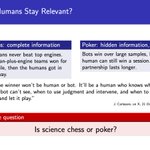
if you want to understand how AI will progress, study how bots changed chess and poker. Compare and contrast.
the best humans can’t beat top bots at chess. Never.
Poker is different. Bots beat pros over large samples, but a human can still sit down and win a session. That's because poker is a game of incomplete information and chess isn't.
a bot can play close to game theory optimal poker, but the hidden cards and variance give humans a fighting chance, especially in the short run.
Life is poker, not chess. It’s a game of incomplete information and luck. No amount of computing power eliminates that reality. This means the best bot won't be the one that wins every hand. It'll be the one with an edge that compounds over thousands of decisions.
In the short run, anyone can win. In the long run, the edge gets paid.
In chess, ‘human-plus-bot’ teams once beat bots alone, until the engines got too strong and the humans just got in the way. In a world full of hidden information, that partnership lasts longer.
SO, in the future, the winner won't be human or bot. It'll be a human who knows what the bot can't see, when to use judgment and intervene, and when to shut up and let it play.
Carlos Baquero retweeted

AI Glasses make someone into a “Chess Grandmaster”.
Te reality is nothing will go untouched by AI, for better or worse.
Awareness is your friend.
Preparing for an Informatics Europe session where I plan to address both the past publishing patterns and the AI transformation of research. Not an easy topic, since we are all figuring out how to cope with the exponential. Will probably frame it as questions for audience.
Carlos Baquero retweeted

Bitcoin's supply used to grow 50%+ a year. Today it's 0.82% 📉
Gold's: ~1.5-2%
Bitcoin crossed BELOW gold in May 2024, and it's never coming back.
- - -
The schedule is already written: ~0.4% after 2028, ~0.2% after 2032, ~0.1% after 2036. When gold's price rises, miners dig more. When Bitcoin's price rises, supply doesn't budge.
Hardest money ever made, people 🧱