
Simplicity is the ultimate sophistication
Vietnam
Joined June 2008
- Tweets3.8K
- Following316
- Followers8.9K
- Likes696




My system one-style decision model, Chon-1.0-12B, is the #1 model on JevBench, surpassing Jev, Clef, Quyet, and all other 31B system-one models in both Intelligence and Capability.
Try it out here: github.com/xoai/chon

3
154



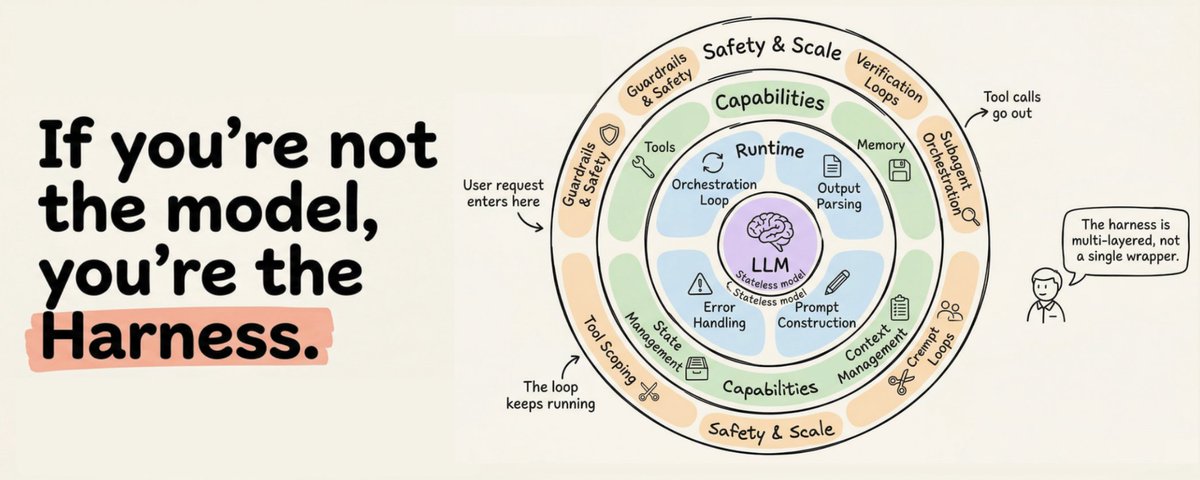
Anthropic calls it "decoupling the brain from the hands." I've been calling it "a harness for harnesses."
After three weeks building SageClaw - a multi-agent platform, eight providers, configurable trust profiles - reading this feels like independent convergence on the same architectural layer.
Where they went cloud-native (containers, vaults, VPC peering), I went with owned infrastructure (a single Go binary, zero dependencies). Where they keep context management as an exercise to the reader, I built 14 composable layers with pressure-gated compaction. Where they solve trust through infrastructure isolation, I solved it through consent-by-design with cryptographic nonces across five messaging platforms.
The biggest gap: learning. Their harness is resilient and scalable, but static. Mine gets smarter every session - corrections become prevention rules, background reviews extract procedures, and confidence scores surface what matters.
But the core insight remains the same: harness assumptions become stale as models improve. Don't hardcode workarounds. Build stable interfaces that outlast specific implementations.
The industry is converging. The harness is the product.
Check out SageClaw here: github.com/xoai/sageclaw
Happy to get any feedback and contributions.



1
261
The AI engineering community is converging on an idea: the harness matters more than the model.
But most of this discourse describes wrapping one model for one task. One agent, one context window, one set of tools, one trust boundary. That's the first layer. There's a second layer nobody's talking about yet.
I build SageClaw - a multi-agent platform where every agent gets its own harness: configurable tools, trust levels, context strategies, and learning loops. When you need to deploy many agents across many providers, each with different capabilities and constraints, you stop building harnesses and start building infrastructure that generates them.
Read more here: teapawt.net/xoai/status/2041910759…

3
229

Been building my own version of "second brain" with sage-wiki for a while. Here are some things I realized along the way:
The biggest shift was realizing that a knowledge base tool needs to eat anything you throw at it. So we added extraction for PDFs, Word docs, spreadsheets, PowerPoints, EPUBs, emails, and even images (via vision LLM). You drop files into a folder, sage-wiki figures out the format and summarizes accordingly.
The other big one: customizable prompts to control how your LLM personal knowledge base works. Its implementation of Karpathy's the Schema. The built-in prompts work fine for most cases, but everyone's knowledge base has different needs. A CS student wants different summaries than someone researching biotech. So now you can sage-wiki init --prompts to scaffold a prompts/ directory with all the defaults as editable markdown files. Change how papers get summarized, how concepts get extracted, how articles get written, all without touching the code.
Some design choices I keep coming back to:
- Speculative linking. When the LLM writes an article, it creates [[wikilinks]] to concepts that don't exist yet. We used to strip those. Now we keep them; they resolve naturally when future compilations create those articles. This is how wikis actually work. Red links are features, not bugs.
- Progressive disclosure. Zero config to start (init + compile), but every layer is customizable if you dig in, models per task, custom prompts, separate embedding providers, and OpenRouter support. Most users never touch config.yaml beyond the API key.
- The compile loop compounds. This is the thing from the original post that clicked hardest for me. Query results get filed back into the wiki. Lint passes discover missing connections. Every interaction makes the next one better. It's not just storage, it's a flywheel.
You can try it out here: github.com/xoai/sage-wiki


1
307
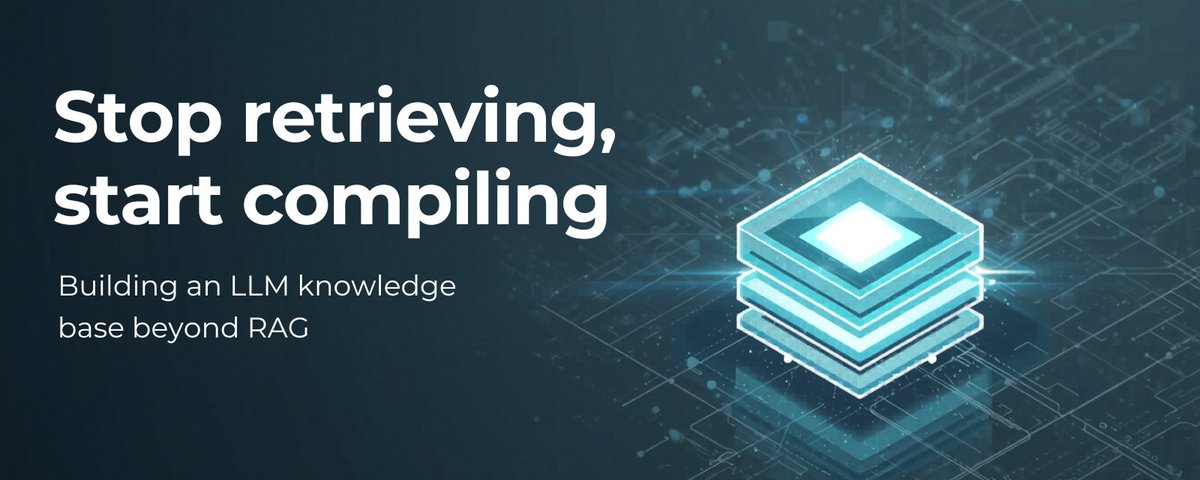
Most people’s workflow with LLMs and documents follows the RAG model. Upload files, retrieve chunks at query time, and generate an answer. It works. However, the LLM starts from scratch on every question. Nothing compounds.
Karpathy’s framing clicked for me: treat the wiki like compiled code. Raw sources are the source files. The LLM is the compiler. The wiki is the build output. And like any good build system, you don’t recompile everything from scratch — you track what changed and rebuild only what’s affected.
This approach underpins sage-wiki. Users add papers, articles, and notes to a folder, and sage-wiki compiles them into structured, interlinked markdown. It extracts concepts, identifies cross-references, flags contradictions, and ensures all content is searchable. Each new source enriches the wiki, allowing knowledge to accumulate.
The analogy goes deep. sage-wiki compile is made. sage-wiki compile --watch is webpack --watch. sage-wiki lint is golint. The wiki is the codebase. The LLM is the programmer. Obsidian is the IDE.
sage-wiki: github.com/xoai/sage-wiki

LLM Knowledge Bases
Something I'm finding very useful recently: using LLMs to build personal knowledge bases for various topics of research interest. In this way, a large fraction of my recent token throughput is going less into manipulating code, and more into manipulating knowledge (stored as markdown and images). The latest LLMs are quite good at it. So:
Data ingest:
I index source documents (articles, papers, repos, datasets, images, etc.) into a raw/ directory, then I use an LLM to incrementally "compile" a wiki, which is just a collection of .md files in a directory structure. The wiki includes summaries of all the data in raw/, backlinks, and then it categorizes data into concepts, writes articles for them, and links them all. To convert web articles into .md files I like to use the Obsidian Web Clipper extension, and then I also use a hotkey to download all the related images to local so that my LLM can easily reference them.
IDE:
I use Obsidian as the IDE "frontend" where I can view the raw data, the the compiled wiki, and the derived visualizations. Important to note that the LLM writes and maintains all of the data of the wiki, I rarely touch it directly. I've played with a few Obsidian plugins to render and view data in other ways (e.g. Marp for slides).
Q&A:
Where things get interesting is that once your wiki is big enough (e.g. mine on some recent research is ~100 articles and ~400K words), you can ask your LLM agent all kinds of complex questions against the wiki, and it will go off, research the answers, etc. I thought I had to reach for fancy RAG, but the LLM has been pretty good about auto-maintaining index files and brief summaries of all the documents and it reads all the important related data fairly easily at this ~small scale.
Output:
Instead of getting answers in text/terminal, I like to have it render markdown files for me, or slide shows (Marp format), or matplotlib images, all of which I then view again in Obsidian. You can imagine many other visual output formats depending on the query. Often, I end up "filing" the outputs back into the wiki to enhance it for further queries. So my own explorations and queries always "add up" in the knowledge base.
Linting:
I've run some LLM "health checks" over the wiki to e.g. find inconsistent data, impute missing data (with web searchers), find interesting connections for new article candidates, etc., to incrementally clean up the wiki and enhance its overall data integrity. The LLMs are quite good at suggesting further questions to ask and look into.
Extra tools:
I find myself developing additional tools to process the data, e.g. I vibe coded a small and naive search engine over the wiki, which I both use directly (in a web ui), but more often I want to hand it off to an LLM via CLI as a tool for larger queries.
Further explorations:
As the repo grows, the natural desire is to also think about synthetic data generation + finetuning to have your LLM "know" the data in its weights instead of just context windows.
TLDR: raw data from a given number of sources is collected, then compiled by an LLM into a .md wiki, then operated on by various CLIs by the LLM to do Q&A and to incrementally enhance the wiki, and all of it viewable in Obsidian. You rarely ever write or edit the wiki manually, it's the domain of the LLM. I think there is room here for an incredible new product instead of a hacky collection of scripts.
256


Ninh Nguyen retweeted

Solo dev reverse-engineered Google's billion-dollar algorithm in 7 days
Google published the paper that crashed memory stocks worldwide. Then shipped zero code.
Tom Turney read the math, opened his terminal, and built the whole thing with Claude - then made it faster than Google promised.
Day 1-3: Core algorithms, 141 tests, Python prototype
Day 3-5: C port into llama.cpp, Metal GPU kernels
Day 5-7: Speed optimization from 739 to 2747 tok/s
That's a 3.7x speedup through pure engineering:
> fp32 → fp16 WHT
> half4 vectorized butterfly ops
> graph-side rotation
> block-32 storage layout
Then he added his own research on top:
> Sparse V: skip 90% of value decompressions at long context
> Asymmetric K/V: keep keys precise, compress values harder
> Temporal decay: old tokens get lower precision automatically
Result: 35B model running on a MacBook with 4.6x compressed cache.
613 GitHub stars in a week. Google still hasn't released their own code.


Ninh Nguyen retweeted

My dear front-end developers (and anyone who’s interested in the future of interfaces):
I have crawled through depths of hell to bring you, for the foreseeable years, one of the more important foundational pieces of UI engineering (if not in implementation then certainly at least in concept):
Fast, accurate and comprehensive userland text measurement algorithm in pure TypeScript, usable for laying out entire web pages without CSS, bypassing DOM measurements and reflow


Building a Rocket Engine from Scratch blog.ablspacesystems.com/p/b…

1
577
Awesome!
AI reads text from ancient Herculaneum scroll for the first time
nature.com/articles/d41586-0…
1
582
Ninh Nguyen retweeted

We have quite a big surprise to reveal! 🌟
So excited to announce that we’ve closed our $2.5M seed round, co-led by @Coin98Ventures and @KCLabsOfficial! 🚀
🔗 Read the full story here: businesswire.com/news/home/2…
#AuraNetwork #NFT #Metaverse #seedround