

PhD student at Tsinghua NLP & AIR, studying agents that automate tasks ranging from daily activities to creative endeavors. Two drifters with the world to see.
Joined July 2017
- Tweets1.3K
- Following1.6K
- Followers2.2K
- Likes10.7K


Zonghan Yang retweeted

Gemini 4 Neon is rolling out now.
Sitting between Carbon and Hydrogen, it brings frontier intelligence and fast task completion for complex software engineering, knowledge work, and science.

Zonghan Yang retweeted
Meet Gemini 4 Hydrogen: built for rapid coding, multimodal synthesis, and everyday workflows.
It finishes tasks 2.5x faster than 3.8 Flash and surpasses Argon on the @ArtificialAnlys Intelligence Index.

Zonghan Yang retweeted
Gemini 4 Carbon is our next frontier model.
It’s state-of-the-art across cybersecurity and long-horizon capabilities.

Zonghan Yang retweeted
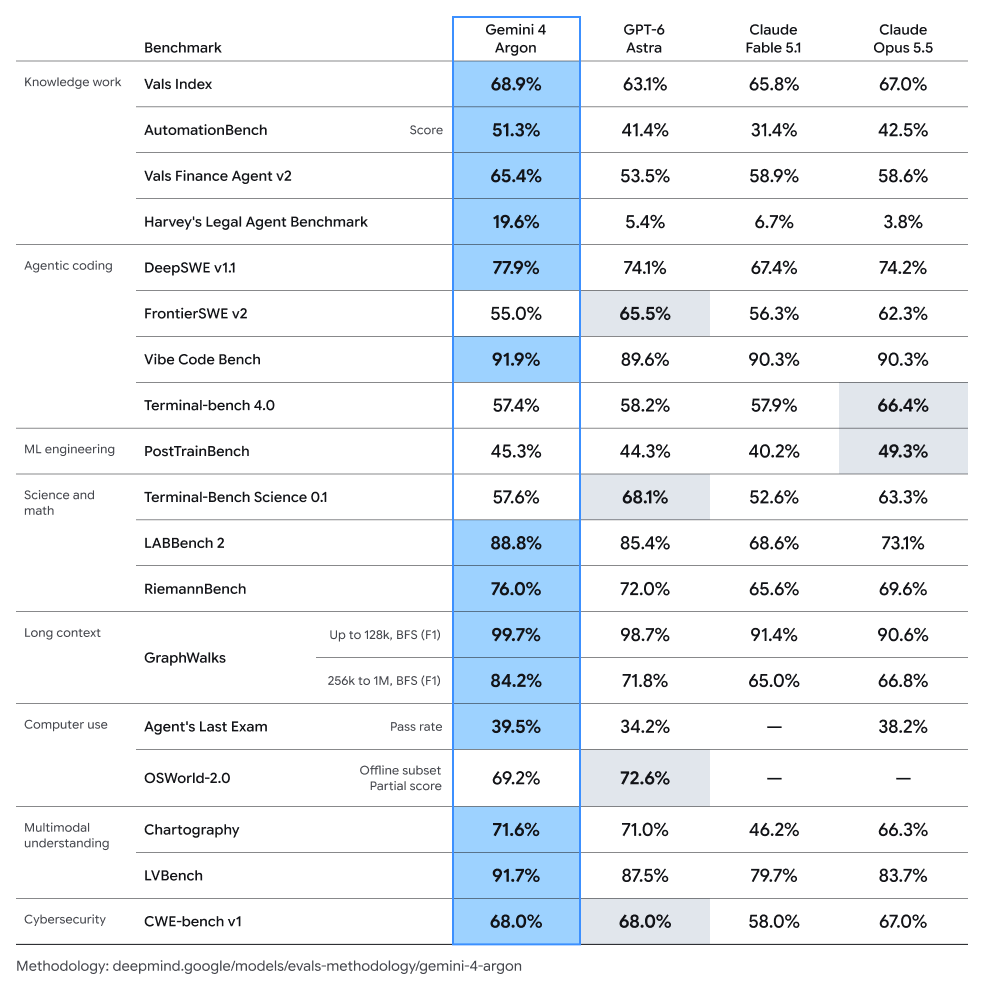
Introducing Gemini 4 Argon – our new frontier model.
It’s built for complex workflows across coding, enterprise knowledge work, and cybersecurity defense – rolling out today to a set of trusted testers through our Fairwind Program.
Zonghan Yang retweeted

How much of SQLite, FFmpeg, PHP compiler can LMs code from scratch? Given just an executable and no starter code or internet access.
Introducing ProgramBench: 200 rigorous, whole-repo generation tasks where models design, build, and ship a working program end to end. 🧵

Zonghan Yang retweeted

Millions of users now have months-long conversation histories with AI assistants💬 But this data is proprietary and unavailable to the academic community for research, training, or benchmarking.
We introduce HorizonBench🌅, a benchmark and data generator for long-horizon personalization: tracking a user's current preferences across a history where life events have silently changed them.

Zonghan Yang retweeted

Grateful for my experiences in labs at two top Chinese tech firms, and special thanks to @JustinLin610 for recommending me to the early Qwen team. These shaped my career profoundly, both technically and beyond.
In the fast-evolving field of LLMs/Agents/Claws, org challenges are complex yet simple. Complexity arises from balancing intricate goals under constraints (GPU, time, infra, inference costs), rapid iteration, and scaling teams amid limited resources.
But ultimately, it's simple: Trust, inclusion, respect, and empathy are the most effective—and timeless—solutions.

Zonghan Yang retweeted

AI agents are tackling more and more "human work"
But are they benchmarked on the work people actually do?
tl;dr: Not really
Most benchmarks focus on math & coding, while most human labor and capital lie elsewhere.
📒 We built a database linking agent benchmarks & real-world work
Submit new tasks + agent trajectories today 🧵

Zonghan Yang retweeted

Dimitris has been demonstrating the new way to do AI research in this agent era: find a neat problem, reason about why it’s interesting and tractable, offload the execution work to agents, analyze the results and write up a fun post about it.
It’s still important for us human researchers to have the expertise to be able to identify the problem and judge the findings (eg, the background knowledge on matrix completion and SVD, and making the connection to LLM benchmarking); but even just automating the execution alone is already a massive acceleration and I think as a community we should really embrace this new form of AI-assisted research.


Zonghan Yang retweeted

Many people are using RL to make models smarter.
We used RL to pull training data out of the models themselves.
Our results show that models know a lot more about their training data than most people think.
We develop Active Data Reconstruction Attack (ADRA) — a data detection method that uses RL to induce models to reconstruct data seen during training.
ADRA beats existing methods by an average of >10% across pre-training, post-training, and distillation.
Our paper, with @uwnlp, @Cornell, and @BerkeleyNLP @Berkeleyai, is now available.
Arxiv: arxiv.org/pdf/2602.19020
Joint work with @jxmnop @shmatikov @sewon__min @HannaHajishirzi

Zonghan Yang retweeted

🔭 We’re releasing Hodoscope: an open-source tool for unsupervised behavior discovery. It lets you visually explore and compare agent behaviors at scale.
It helped us discover a novel reward hacking vulnerability in Commit0 - with just a couple minutes of human effort.
Zonghan Yang retweeted

Agent Skills are everywhere - Claude Code, Gemini CLI, Codex all support them. But do they actually work?
105 domain experts from Stanford, CMU, Berkeley, Oxford, Amazon, ByteDance & more built SkillsBench to find that out.
86 tasks. 11 domains. 7,308 trajectories. 🧵👇

Zonghan Yang retweeted

One prompt = A publication-ready research paper with academic charts.
If you need pro academic formatting, latex formulas and figures, Kimi is all you need.
You can get a word file just by chatting.


Zonghan Yang retweeted

A lot of people quote tweeted this as 1 year anniversary of vibe coding. Some retrospective -
I've had a Twitter account for 17 years now (omg) and I still can't predict my tweet engagement basically at all. This was a shower of thoughts throwaway tweet that I just fired off without thinking but somehow it minted a fitting name at the right moment for something that a lot of people were feeling at the same time, so here we are: vibe coding is now mentioned on my Wikipedia as a major memetic "contribution" and even its article is longer. lol
The one thing I'd add is that at the time, LLM capability was low enough that you'd mostly use vibe coding for fun throwaway projects, demos and explorations. It was good fun and it almost worked. Today (1 year later), programming via LLM agents is increasingly becoming a default workflow for professionals, except with more oversight and scrutiny. The goal is to claim the leverage from the use of agents but without any compromise on the quality of the software. Many people have tried to come up with a better name for this to differentiate it from vibe coding, personally my current favorite "agentic engineering":
- "agentic" because the new default is that you are not writing the code directly 99% of the time, you are orchestrating agents who do and acting as oversight.
- "engineering" to emphasize that there is an art & science and expertise to it. It's something you can learn and become better at, with its own depth of a different kind.
In 2026, we're likely to see continued improvements on both the model layer and the new agent layer. I feel excited about the product of the two and another year of progress.

There's a new kind of coding I call "vibe coding", where you fully give in to the vibes, embrace exponentials, and forget that the code even exists. It's possible because the LLMs (e.g. Cursor Composer w Sonnet) are getting too good. Also I just talk to Composer with SuperWhisper so I barely even touch the keyboard. I ask for the dumbest things like "decrease the padding on the sidebar by half" because I'm too lazy to find it. I "Accept All" always, I don't read the diffs anymore. When I get error messages I just copy paste them in with no comment, usually that fixes it. The code grows beyond my usual comprehension, I'd have to really read through it for a while. Sometimes the LLMs can't fix a bug so I just work around it or ask for random changes until it goes away. It's not too bad for throwaway weekend projects, but still quite amusing. I'm building a project or webapp, but it's not really coding - I just see stuff, say stuff, run stuff, and copy paste stuff, and it mostly works.
Zonghan Yang retweeted

New Engineering blog: We tasked Opus 4.6 using agent teams to build a C compiler. Then we (mostly) walked away. Two weeks later, it worked on the Linux kernel.
Here's what it taught us about the future of autonomous software development.
Read more: anthropic.com/engineering/bu…
Zonghan Yang retweeted
Congrats to @stefan_fee on this excellent work!
Really impressed by the daVinci-Agency paper. It shows how chain-of-PRs (global PR context) substantially boosts SWE performance—a natural yet underexplored signal.
Even more surprising: agentic trajectories from these PRs yield big gains on Toolathlon (toolathlon.xyz/introduction), a tough real-world tool-use benchmark beyond SWE. Definitely worth diving deeper!


🚀 daVinci-Agency: Mining chain-of-pull-requests for long-horizon agents
📊 239 samples → 47% gain
⚡ Data efficiency redefined
Paper: arxiv.org/abs/2602.02619

Zonghan Yang retweeted

Proud to support @stanfordnlp CS224N this year. 🌲
Students are building their final projects using the Kimi K2.5 API.
We can’t wait to see what this next generation of NLP researchers creates by the March 16 poster session. web.stanford.edu/class/cs224…
Enjoy building with Kimi 💫
