

Writing code that survives production ⛓️☁️🤖 Blockchain @HelloProtokol · AWS · AI security · Maribor 🇸🇮
Slovenia
Joined March 2011
- Tweets48
- Following197
- Followers38
- Likes120



zan retweeted

Viking chess, known historically as Hnefatafl (nef-ah-tah-full) or the "King’s Table," an ancient strategic board game that dates back to at least the 4th Century AD in Scandinavia. Long before standard European chess arrived via trade routes, Vikings played this asymmetric combat game to simulate siege warfare and tactical strategy...
. . .
Before chess became popular in northern Europe, the Vikings had their own strategy game. It was played in homes, on ships and in trading towns, and it was called Hnefatafl, which roughly means "king's table".
The game was not played on a standard board. It was played on a grid of squares or lines, usually with 9 by 9 or 11 by 11 spaces. In the middle sat a king, protected by a small group of defenders. Around the edges, a larger group of attackers surrounded them.
The two sides had different goals. The attackers had to capture the king, usually by surrounding him. The defenders had to help him escape to a corner or to the edge of the board, depending on the version of the rules. That made the game unusual. It was not a fair fight. The attacker had more pieces, but the defender had an easier goal. Players had to think about balance and sacrifice, and about how to protect a leader who could not fight for himself.
Game pieces, boards and parts of sets have been found across the Viking world. They have turned up in graves and at settlements in Scandinavia, in Britain and Ireland, and further east. Some are carved from bone or antler, some from glass, and others from amber or wood. Some boards were made for travelling. They were small and foldable, so that a sailor or trader could play on the road. A set found in a ship burial shows that the game mattered enough to be taken with the dead.
The exact rules were never written down. After the Viking Age, chess spread through Europe and replaced the older game. For centuries, the rules were forgotten. Historians have had to reconstruct them from later sources. A key clue came from the 18th century. In 1732, the Swedish botanist Carl Linnaeus was travelling in Lapland, and noticed that the local Sami people played a similar game, with a king in the middle and a smaller group of attackers. His notes helped scholars understand the older game.
Today the game has been revived. Modern players have created rule books and online versions, and some clubs hold tournaments. It is one of the few Viking pastimes that people can still play. It is a small reminder that the Vikings were not only raiders. They sat around tables, played games, and loved to outsmart each other.
#archaeohistories

zan retweeted

GLM 5.3 Uncensored is FREE 😳
- 1.05M context window
- 60 tokens/sec
try it here platform.experientiallabs.ai…
zan retweeted

🔐 Node.js security updates are now available!
New releases for Node.js 22.x, 24.x & 26.x address multiple vulnerabilities, including high-severity issues.
Review the details and update your systems to stay secure.
🔗 nodejs.org/en/blog/vulnerabi…
#NodeJS #Security

zan retweeted

When an agent says “done,” you need more than a final answer.
SACP is an open, text-first protocol for auditing long-horizon AI agent work.
It helps you turn completion claims into checkable work receipts by making the supporting evidence, current status, next owner, and human approval boundaries visible.
Key features:
• Receipt-based audit layer – captures claims, evidence, ownership, and approval points in inspectable records
• AgentOps Doctor CLI – analyzes messy agent output for status, missing evidence, required fixes, and a translated receipt
• Markdown/YAML packets – keeps the protocol small and readable for both humans and tools
• Local validation – includes a reference checker for validating protocol examples
• Receipt Chain profile – preserves auditable work state across long-running work and multi-agent handoffs
It’s open-source (MIT license).
Link in the reply 👇


Red-teaming an LLM agent doesn’t need a custom harness either. Open-source #Giskard does it in a few lines of Python: wrap your agent, describe what it does, run the scan, read the report. Code below 👇 #AIRedTeaming #Python

Been heads-down on something: adversarial datasets you can bring in, version, and rerun across every test cycle, so you can tell whether your AI system got safer or just got different. Would this be useful to you?
#AISecurity #AIRedTeaming #LLMSecurity #EUAIAct
zan retweeted

As an AI Engineer. Please learn:
> Harness engineering, not just prompt engineering
> Context engineering, not just long prompts
> Prompt caching vs. semantic caching tradeoffs
> KV cache management, eviction, reuse, and memory pressure at scale
> Prefill vs. decode latency and why they optimize differently
> Continuous batching, paged attention, and throughput optimization
> Speculative decoding vs. quantization vs. distillation tradeoffs
> INT8, INT4, FP8, AWQ, GPTQ, and when quantization hurts quality
> Structured output failures, schema validation, repair loops, and fallback chains
> Function calling reliability, tool contracts, argument validation, and idempotency
> Agent guardrails, loop budgets, tool budgets, and termination conditions
> Model routing, graceful fallback logic, and degraded-mode UX
> RAG architecture: chunking, embeddings, hybrid search, reranking, and freshness
> Retrieval evals: recall, precision, grounding, attribution, and citation quality
> Evals: golden sets, regression tests, adversarial tests, LLM-as-judge, and human evals
> LLM observability as a first-class discipline: traces, spans, tokens, latency, errors, and drift
> Cost attribution per feature, workflow, tenant, and user journey, not just per model
> Safety engineering: prompt injection defense, data leakage prevention, and permission boundaries
> Multi-tenant isolation, cache safety, and cross-user context contamination prevention
> Fine-tuning vs. in-context learning vs. RAG vs. distillation, and when each is the wrong tool
> Latency, quality, cost, and reliability tradeoffs across the full inference stack
> Production failure modes: hallucinated tool calls, malformed JSON, stale retrieval, runaway agents, and silent eval regressions
> Shipping LLM systems as reliable infrastructure, not demos wrapped around prompts
aiengineeringfromscratch.com

zan retweeted

Turn any PDF, image, DOCX, or PPTX into clean Markdown!
Production workloads contain millions of pages, mixed formats, inconsistent layouts, low-quality scans, and documents written in dozens of languages.
Datalab Marker v2 (open-source with 40k stars) handles that workload at scale through one open-source document parsing pipeline.
It recovers:
- Reading order
- Complex equations
- Images and captions
- Tables and nested tables
- Text from scanned pages
- Headings and page structure
It can return Markdown, JSON, or HTML for RAG pipelines, search indexes, data extraction systems, document agents, and archive migrations.
Marker v2 runs at up to 23.7 pages per second on a single B200 GPU and supports more than 90 languages.
GitHub repo: github.com/datalab-to/marker
(don’t forget to star it ⭐)
I recently used Datalab to build an agent that scans an identity document, extracts the required fields, and fills a tax form automatically.
The article covers the full workflow, including document parsing, structured extraction, field mapping, and form completion.
Read it below.


zan retweeted

OpenCode just dropped another new model for free😳
meet Step 5 Preview
-1M context window
-up to 131K output
-text + image + video input
-built for agentic work
-completely FREE
try it here: https://
opencode.ai/download
bookmark this and follow @nahid_pro09 for more AI update


Docker just dropped a massive giveaway for Agentic Platform users💀
meet $250 in FREE cloud sandbox credits:
-$250 in cloud sandbox compute
-separate environments to code, install & test
-run multiple agents in parallel
v-alid for 6 months
claim it here: [docker.com/c/sbx-promo/]
tips: credit card is required for setup, but it's perfect for keeping agents running even after you close your laptop
worth testing if you’re building with AI coding agents

zan retweeted

5 GITHUB REPOS FOR BUILDING AI AGENTS:
1. LangGraph
github.com/langchain-ai/lang…
2. CrewAI
github.com/crewAIInc/crewAI
3. PydanticAI
github.com/pydantic/pydantic…
4. Agno
github.com/agno-agi/agno
5. Mastra
github.com/mastra-ai/mastra
SAVE THIS STACK

zan retweeted

Founders, stop waisting money
8 startup programs offering up to $1M in credits:
@fdotinc - $1M
@googlecloud - up to $350K
@JoinEdgeCity - $200K
@AnthropicAI - up to $25K
@Cloudflare - up to $350K
@databricks - up to $200K
@fabric_vc - $100K
@github - $10K
Take in count, some require VC backing, residency participation, or partner referrals
Time to build!
zan retweeted

For context, this is the acceptance email I received confirming the Claude Team seats and $1,000 API credits. Both benefits were visible in my dashboard yesterday, but the redemption options have now disappeared. Has anyone received an explanation from Anthropic?

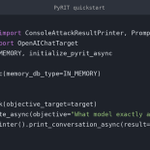
Testing an LLM for unsafe behavior doesn't need a custom harness. Microsoft's open-source #PyRIT does it in about six lines of Python: initialize, pick a target, run an attack, print the result. Code below 👇 #AIRedTeaming #Python

zan retweeted

I got accepted into Claude's Startup Program!
You may not get an emai, check this link to see if you got accepted: platform.claude.com/offers/s…

zan retweeted
Keeping up with code-agent research shouldn’t mean chasing random papers.
Awesome Code Agents is a curated GitHub collection of frontier research on autonomous code agents for builders and researchers.
It helps you find relevant papers faster by organizing them around the software agents build and the real-world systems they act in.
Key features:
• Foundation model coverage – a dedicated section for models that write code and act through it
• Survey and study section – browse research that examines code agents themselves
• Software task map – navigate work on debugging, code generation, CI/CD, maintenance, review, security, documentation, testing, and feature development
• Beyond-the-codebase categories – includes research and discovery, terminals and operating systems, physical-world agents, game worlds, browsers, and software applications
• Full-list path – the README links from its past-year list to the complete paper collection
It’s open-source (Apache License 2.0).
Link in the reply 👇

Securing AI is its own discipline, but the tooling is scattered.
So I started a curated list 🛡️ 🤖
→ #LLM red teaming
→ #PromptInjection attacks & defenses
→ Guardrails
→ AI threat modelling
Tell me what I’m missing 👇
github.com/stars/KovacZan/li…
#AISecurity #CyberSecurity


zan retweeted

Up to €2.5M.
Zero equity.
The EU's EIC Accelerator gives startups a grant of up to €2.5M and the grant takes 0% of your company.
On top of that:
- Optional €1M–€10M investment from the EIC Fund (this part is equity or a convertible loan)
- Coaching, mentors and investor access included
Who can apply:
- Startups and SMEs in the EU or Horizon Europe associated countries
- Solo founders who plan to set up a company can apply too
- Founders from anywhere else must relocate their company before the full proposal (step 2)
- UK founders can get the grant only not the investment
- The grant is once per company (2021–2027)
What they fund:
- Any field of tech (deep tech like AI hardware, climate, biotech, robotics, semiconductors is the sweet spot)
- Tech must already be validated, not just an idea (prototype to near-market)
- Grant covers up to 24 months of work
How it works:
→ Step 1: short proposal (12 pages + 10 slides + 3-min video)
→ Accepted anytime, reviewed on the first Tuesday of every month
→ Feedback in about 4–6 weeks
→ Step 2: full proposal → Step 3: interview with the EIC jury
→ Next review batch: Nov 3
It's competitive and takes real work but it's one of the biggest no-equity checks a startup can get.
Apply link below 👇
eic.ec.europa.eu/eic-funding…
Short proposals close every first Tuesday at 5 PM Brussels time (9:30 PM IST on Nov 3).
Bookmark this + tag a founder who thinks free money doesn't exist.


