

𝗜 𝗽𝗿𝗲𝗳𝗲𝗿 𝘁𝗵𝗲 𝗳𝗼𝗼𝘁𝗻𝗼𝘁𝗲𝘀.
Joined June 2023
- Tweets70K
- Following1.4K
- Followers20.5K
- Likes199K






ZORD retweeted
𝗧𝗼𝗸𝗲𝗻𝗶𝘇𝗲𝗱 𝘀𝘁𝗼𝗰𝗸𝘀 𝗮𝗿𝗲 𝗺𝗼𝘃𝗶𝗻𝗴 𝗯𝗲𝘆𝗼𝗻𝗱 𝗵𝗼𝗹𝗱𝗶𝗻𝗴 𝗮𝗻𝗱 𝘁𝗿𝗮𝗱𝗶𝗻𝗴.𝗬𝗼𝘂 𝗰𝗮𝗻 𝗻𝗼𝘄 𝗯𝗼𝗿𝗿𝗼𝘄 𝗮𝗴𝗮𝗶𝗻𝘀𝘁 𝘁𝗵𝗲𝗺 𝗮𝗻𝗱 𝗯𝘂𝗶𝗹𝗱 𝗹𝗲𝘃𝗲𝗿𝗮𝗴𝗲𝗱 𝗲𝗾𝘂𝗶𝘁𝘆 𝗽𝗼𝘀𝗶𝘁𝗶𝗼𝗻𝘀 𝗱𝗶𝗿𝗲𝗰𝘁𝗹𝘆 𝗼𝗻𝗰𝗵𝗮𝗶𝗻.
I spent some time researching the latest development from @pendle_fi, and what caught my attention wasn't just the leverage. It was how three pieces of financial infrastructure are now working together on Base.
On October 22, Pendle introduced PendleLoop, allowing eligible users to build leveraged positions in tokenized US equities through @aave V4.
The supported assets include:
• AAPLc — Apple
• NVDAc — Nvidia
• GOOGLc — Alphabet
• TSLAc — Tesla
• AMZNc — Amazon
• MSFTc — Microsoft
• METAc — Meta
Here's what I found.
➊ 𝗙𝗶𝗿𝘀𝘁, 𝗵𝗼𝘄 𝗱𝗼𝗲𝘀 𝘁𝗵𝗲 𝗹𝗲𝘃𝗲𝗿𝗮𝗴𝗲 𝘄𝗼𝗿𝗸?
@aave already introduced lending markets for these equities in September.
@pendle_fi didn't create a new lending market. It built an interface that combines the transactions required to increase exposure.
Instead of manually buying tokens, supplying collateral, borrowing and repeating the process, users can manage the position through PendleLoop.
The mechanism works like this:
→ Purchase a tokenized stock.
→ Supply the tokens as collateral on $Aave V4.
→ Borrow $USDC against that collateral.
→ Use the borrowed $USDC to purchase additional stock tokens.
→ Repeat within the permitted collateral limits.
The result is a larger equity position than the capital initially committed.
At launch, available leverage ranged from approximately 2.6x to 4.2x, depending on the asset.
But leverage isn't free. Borrowing rates are variable, and a decline in collateral value can trigger liquidation.
➋ 𝗪𝗵𝗮𝘁 𝗮𝗰𝘁𝘂𝗮𝗹𝗹𝘆 𝗯𝗮𝗰𝗸𝘀 𝘁𝗵𝗲𝘀𝗲 𝘁𝗼𝗸𝗲𝗻𝗶𝘇𝗲𝗱 𝘀𝘁𝗼𝗰𝗸𝘀?
This is another detail worth understanding.
@coinbase Tokenized Stocks aren't simply synthetic assets following equity prices.
Each token represents a certificate issued by Coinbase Onchain SPV Ltd, with underlying shares held through Alpaca Securities (an SEC-registered broker-dealer).
The issuer holds those shares under a trust arrangement for token holders.
Corporate actions are also accounted for.
For example:
Dividends are reinvested into additional underlying shares (after applicable fees and taxes),rather than distributed directly to token holders.
This means the tokens provide economic exposure to the underlying equities, although their legal rights and redemption arrangements differ from holding ordinary shares through a brokerage account.
➌ 𝗡𝗼𝘄, 𝘄𝗵𝗮𝘁 𝗮𝗯𝗼𝘂𝘁 𝘁𝗵𝗲 𝗹𝗲𝗻𝗱𝗶𝗻𝗴 𝗺𝗮𝗿𝗸𝗲𝘁?
Aave V4's Equities Hub on @base supports the seven stocks as collateral for USDC borrowing.
At launch, the market had approximately:
• $29M in aggregate equity collateral caps.
• $32M USDC supply cap.
• $21M USDC borrow cap.
• Collateral factors ranging from 65% to 79%.
These are market limits, not actual deposits or borrowing volume.
And the collateral factors matter because they determine how much borrowing capacity each asset receives.
A token with a lower collateral factor generally requires more collateral for the same loan.
This also explains why PendleLoop cannot offer identical leverage across every stock.
➃ 𝗪𝗵𝗮𝘁 𝗱𝗼𝗲𝘀 𝘂𝘀𝗶𝗻𝗴 𝗣𝗲𝗻𝗱𝗹𝗲𝗟𝗼𝗼𝗽 𝗰𝗼𝘀𝘁?
Pendle is currently waiving its service fees on eligible non-PT looping positions until December 31, 2026.
However, that doesn't eliminate the cost of leverage.
Users still face:
• Variable USDC borrowing interest
• Transaction costs and slippage
• Liquidation risk when collateral values decline
Pendle has also announced borrowing incentives distributed through @Merkl_xyz.
Those incentives can reduce effective financing costs for qualifying positions, but they shouldn't be treated as permanent income.
➎ 𝗢𝗻𝗲 𝗿𝗶𝘀𝗸 𝗜 𝘁𝗵𝗶𝗻𝗸 𝗱𝗲𝘀𝗲𝗿𝘃𝗲𝘀 𝗺𝗼𝗿𝗲 𝗮𝘁𝘁𝗲𝗻𝘁𝗶𝗼𝗻
The lending market operates 24/7, but the underlying US stock market doesn't.
Aave uses Chainlink's tokenized equity price feeds, which publish prices 24/5.
During weekends and US market holidays, the feeds retain their last published prices.
That creates a pricing gap:
• A stock could experience a major development outside regular market hours
• while its onchain collateral valuation remains unchanged until the feed updates.
For leveraged positions, a sharp repricing when the feed resumes can become a liquidation problem.
So 24/7 access doesn't mean continuous price discovery or protection from market gaps.
✦ Conclusion
What I find significant is how the responsibilities are divided:
→ @coinbase handles the tokenized equity structure.
→ @aave provides the collateral and borrowing infrastructure.
→ @pendle_fi makes the transactions accessible through one interface.
Each component existed before this integration, but combining them reduces the work required to use tokenized equities in DeFi. And I think that distinction matters.
Issuing more tokenized stocks doesn't necessarily create more demand for them. The stronger test is whether holders are willing to supply those assets as collateral, borrow against them, and maintain positions after promotional incentives expire.
That's what I'll be monitoring:
▸ collateral deposits
▸ actual borrowing demand
▸ utilization
▸ how these markets behave during periods of equity volatility
Because the ability to tokenize a stock has already been demonstrated. Whether that stock can support a liquid, sustainable lending market is the more important question.
ZORD retweeted

MASSIVE WEEK COMING FOR CRYPTO HOLDERS
Monday: US stock market will open after Trump called for aggressive strikes against Iran
Tuesday: Treasury will buy back $6 Billion of its own debt
Wednesday: FOMC meeting and Kevin Warsh Press conference
Thursday: US PCE inflation data and Q3 GDP data
Friday: Bank of Japan interest rate decision
The most important one is the FOMC meeting as the last one resulted in a sharp drop and then a 15% rally
ZORD retweeted
One thing worth paying attention to as @grvt_io expands is how users actually bring capital onto the exchange.
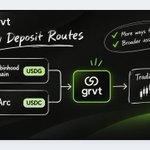
Grvt's latest update introduces two additional deposit routes:
→ $USDG from Robinhood Chain
→ $USDC from Arc
This might look like a minor integration, but there's a broader infrastructure angle here.
Robinhood Chain is building around tokenized financial assets, while Arc focuses on stablecoin-based financial infrastructure.
Supporting deposits from these networks gives users additional ways to fund their Grvt accounts without first moving assets through another supported chain.
And that matters as $Grvt expands its trading and investment products.
An exchange can offer hundreds of markets, but access to those markets also depends on how easily users can bring capital onto the platform.
The next thing worth tracking is whether these additional deposit routes translate into meaningful inflows and active trading accounts.
Expanding market access is one part of building an exchange. Making it easier for capital to reach those markets is equally important.


ZORD retweeted

Ethereum is losing RWA market share, but that doesn’t necessarily mean it’s losing capital.
That’s what makes the current shift in tokenization interesting.
@ethereum still accounts for more than 40% of the #RWA market, yet its share has fallen by nearly 30 percentage points over the past year.
Meanwhile, @solana, @BNBCHAIN, @StellarOrg and @avax are gaining ground.
What’s driving this?
Different networks offer different advantages. Some are better positioned for trading and retail distribution
while others focus on payments, institutional settlement or customizable financial infrastructure.
As tokenization expands into U.S. Treasuries, private credit, equities and commodities, issuers have more reasons to explore networks beyond @ethereum.
But there’s an important distinction here.
Losing market share isn’t the same as losing market value.
@ethereum can continue growing in absolute terms while other networks grow faster and capture a larger portion of the market.
The real question is no longer which blockchain can tokenize an asset.
It’s which networks can attract issuers, build liquidity and make those assets useful beyond simply existing on-chain.
I think we’re moving toward a multi-chain RWA market, where different networks compete for different parts of the financial system.
Ethereum may remain a dominant player, but its dominance is no longer the only story worth watching.
The next phase of #RWA growth will be about adoption, liquidity and utility not just tokenization.


One thing worth paying attention to as @grvt_io expands is how users actually bring capital onto the exchange.
Grvt's latest update introduces two additional deposit routes:
→ $USDG from Robinhood Chain
→ $USDC from Arc
This might look like a minor integration, but there's a broader infrastructure angle here.
Robinhood Chain is building around tokenized financial assets, while Arc focuses on stablecoin-based financial infrastructure.
Supporting deposits from these networks gives users additional ways to fund their Grvt accounts without first moving assets through another supported chain.
And that matters as $Grvt expands its trading and investment products.
An exchange can offer hundreds of markets, but access to those markets also depends on how easily users can bring capital onto the platform.
The next thing worth tracking is whether these additional deposit routes translate into meaningful inflows and active trading accounts.
Expanding market access is one part of building an exchange. Making it easier for capital to reach those markets is equally important.

ZORD retweeted
I don't think VCs expanding beyond crypto means the industry is cooked.
If anything, crypto could benefit from becoming less dependent on VC-funded token launches.
We've seen projects raise millions privately, launch at ridiculous FDVs, distribute airdrops, and then expect retail investors to provide the liquidity.
Who exactly is supposed to buy those valuations?
VC capital leaving speculative launches isn't necessarily bearish. It could force:
• better valuations
• more sustainable token economics
• projects that actually need users
And personally, I think we're getting closer to a market bottom.
Not because VCs are changing their names, but because the speculative funding model that supported so many overpriced launches is becoming harder to sustain.

You know crypto is cooked when some of its biggest VCs start shifting their attention and money to other industries.
a16z crypto just rebranded to a16z Frontier, expanding into AI, robotics and other industries.
Paradigm raised a $1.2B fund in July that also covers AI and robotics, while Haun Ventures has expanded beyond crypto.
For context, a16z raised $4.5B for its crypto fund in 2022, compared to $2.2B for its latest fund.
These are some of crypto's biggest investors.
They're not abandoning crypto, but they're increasingly looking elsewhere.
And that could make fundraising even harder for crypto projects, especially those with nothing to offer beyond launching a token.
ZORD retweeted
A company paying salaries onchain shouldn't have to expose every employee's paycheck.
That's one of the practical problems @primus_labs and @allscaleio tested on BNB Chain.
On September 1, both teams completed a technical validation of confidential stablecoin payroll, involving four fictional employees and four sample payments.
The results were straightforward:
• All four payments were recorded onchain.
• Individual salary amounts remained encrypted.
• Authorized users successfully recovered the correct salary figures.
✦ So how does this work?
AllScale handles payroll preparation, settlement, and reconciliation, while Primus uses FHETransform to encrypt salary amounts before they’re submitted to the smart contract.
Employees can then access their salary details by signing a wallet message, without paying gas to view them.
However, this doesn’t make payroll completely anonymous.
- Company wallets
- Recipient addresses
- Timestamps
- Transaction records
…remain visible. The protection applies to compensation amounts.
That’s an important distinction.
Businesses can retain public settlement records without exposing individual salaries.
The validation involved only four sample payments, so larger-scale deployment and operational readiness still need further testing.
Now, with @primus_labs Epoch 2 underway, there's also an opportunity for creators researching these technical developments.
✦ Here’s what participants should know:
→ 0.3% of the $PRIM supply is allocated to the campaign.
→ The top 450 creators across three language regions qualify for rewards.
→ Your four highest-scoring eligible posts determine your Mindshare score.
→ Each creator can submit up to 10 posts per epoch.
There’s also a referral multiplier tied to Primus XP activity, which can contribute to your final score.
For me, the useful part of this campaign is having more reasons to examine what Primus is actually building, from confidential payroll to verifiable offchain data.
If you're planning to participate in Epoch 2, you can join through my referral link:
s.kaito.ai/RsenLO4

ZORD retweeted

why should fixed-income opportunities be mostly associated with banks and large investors?
i think this is one area where bringing traditional finance on-chain could make a real difference...
and it's something @grvt_io is working towards with grvt earn
for years, fixed-income strategies have been an important part of how institutions manage their capital
but accessing similar opportunities hasn't always been simple for everyday users
grvt wants to change that by bringing tokenized fixed-income strategies to its self-custodial platform
here's what makes it interesting
> access to strategies traditionally associated with institutional investors
> eligible assets targeting up to 11% apy, not guaranteed
> opportunities brought on-chain through tokenization
> more control over assets through a self-custodial approach
and there's a much bigger picture here
the traditional fixed-income market is estimated at around $160T
grvt isn't trying to move all of that on-chain, but making even a small part of these opportunities more accessible is an interesting direction
personally, i think the real value isn't just the potential yield
it's giving more people access to financial strategies that were traditionally harder to reach
of course, institutional-style strategies still carry risks, and higher target yields don't mean guaranteed returns
but if grvt can make these opportunities easier to access and understand, that's a meaningful step towards connecting traditional finance with crypto...

ZORD retweeted
Where does the yield on your trading collateral actually come from?
I was going through @grvt_io's yield infrastructure, and there's an important distinction between its existing system and what's coming with Grvt 2.0.
Here's how it works:
➊ DeFi lending yield
$Grvt's Yield Layer deploys eligible exchange reserves into Ethereum-based lending protocols, including Aave V3.
Rather than leaving those reserves inactive, the system generates lending returns while maintaining liquidity for trading and withdrawals.
➋ Tokenized fixed-income yield
Grvt Earn is designed to provide access to traditional fixed-income strategies, targeting up to 11% APY.
These returns are expected to come from underlying financial assets through interest payments, premiums and receivables.
Unlike promotional rewards, this introduces asset-backed income sources, although returns aren't guaranteed.
➌ What happens when you trade?
Grvt's planned Yield as Margin feature would allow eligible Earn balances to continue generating yield while supporting trading positions.
This doesn't eliminate trading or collateral risk. It changes how the same capital can be utilized.
The important distinction is that yield has an identifiable source, whether through DeFi lending or traditional fixed-income assets.
Understanding those sources, alongside liquidity and risk, is essential when evaluating any yield-bearing trading platform.


Beyond the recent 1.1M $GRVT token burn, there's another reason I'm paying closer attention to @grvt_io.
The exchange is already handling substantial trading activity, and I think its infrastructure deserves more attention.
Grvt combines offchain order matching with ZK-powered settlement, allowing traders to access centralized exchange-style execution while retaining self-custody and transaction privacy.
It also supports around 200 markets across crypto and traditional assets, with leverage of up to 50x.
Now consider the numbers from DefiLlama:
→ $509M in 24H perp volume
→ $14.65B in monthly volume
→ $441M in open interest
→ Over $441B in cumulative volume
→ ~$36M in TVL
Meanwhile, $GRVT has a circulating market cap of roughly $34M, compared with an FDV near $294M.
That valuation gap matters, particularly when considering future token supply.
But what makes me bullish on Grvt's product direction is its focus on capital efficiency.
Grvt already supports yield-generating margin, and its 2.0 roadmap aims to extend this through tokenized fixed-income products and yield as margin.
Essentially, users could keep eligible capital earning while using it to support trading positions.
My take: Grvt has demonstrated meaningful trading activity. The next opportunity is turning that activity into stronger capital retention and sustainable platform economics.
That's what makes Grvt 2.0 worth following beyond the token burn.


ZORD retweeted

Ethereum recorded ~$49.5B in DeFi TVL on Oct 23, 2026, while Arbitrum One held ~$1.45B on Oct 24.
but TVL alone doesn’t explain what makes each ecosystem different.
the protocols driving activity reveal how each is developing its own role in onchain finance.
@ethereum hosts major financial infrastructure:
→ liquid staking: @LidoFinance
→ lending: @aave, @Morpho, @sparkdotfi
→ restaking: @eigenCloud
→ trading/liquidity: @Uniswap
→ stablecoins/collateral: @SkyEcosystem
→ synthetic dollars/yield: @ethena
these protocols support staking, lending, liquidity, stablecoins, and yield generation
@arbitrum has a strong ecosystem built around DeFi and specialized financial markets:
→ DEXs: @Uniswap
→ lending: @aave, @Morpho, @0xFluid, @compoundfinance, @Dolomite_io
→ perpetuals: @GMX_IO, @Variational_io
→ yield trading: @pendle_fi
other participants include @gains_trade, @Ostium, @muxprotocol, @borosfi, @Overtime_io, and @RAILGUN_Project
together, they support trading, lending, derivatives, yield strategies, and privacy-focused transactions
the ecosystems are also expanding beyond traditional DeFi
Ethereum continues to support staking, stablecoins, lending, and institutional financial infrastructure
Arbitrum is expanding through real-world assets, specialized applications, and Orbit chains
@RobinhoodCrypto, built using Arbitrum technology, processed ~793.7M transactions in Q3 2026. Arbitrum’s September revenue reportedly exceeded $5M, largely driven by Orbit activity
Arbitrum One has highlighted 7,400+ RWAs, while its Stablecoin Growth Program encourages $USDG adoption through a 2M $ARB incentive pool
Ethereum provides settlement infrastructure and hosts major financial protocols
Arbitrum extends that ecosystem with lower-cost transactions and specialized financial markets
both play different roles in the development of onchain finance
the protocols attracting liquidity, users, and transaction volume will be worth watching

I don't think VCs expanding beyond crypto means the industry is cooked.
If anything, crypto could benefit from becoming less dependent on VC-funded token launches.
We've seen projects raise millions privately, launch at ridiculous FDVs, distribute airdrops, and then expect retail investors to provide the liquidity.
Who exactly is supposed to buy those valuations?
VC capital leaving speculative launches isn't necessarily bearish. It could force:
• better valuations
• more sustainable token economics
• projects that actually need users
And personally, I think we're getting closer to a market bottom.
Not because VCs are changing their names, but because the speculative funding model that supported so many overpriced launches is becoming harder to sustain.
You know crypto is cooked when some of its biggest VCs start shifting their attention and money to other industries.
a16z crypto just rebranded to a16z Frontier, expanding into AI, robotics and other industries.
Paradigm raised a $1.2B fund in July that also covers AI and robotics, while Haun Ventures has expanded beyond crypto.
For context, a16z raised $4.5B for its crypto fund in 2022, compared to $2.2B for its latest fund.
These are some of crypto's biggest investors.
They're not abandoning crypto, but they're increasingly looking elsewhere.
And that could make fundraising even harder for crypto projects, especially those with nothing to offer beyond launching a token.
ZORD retweeted

As someone who spends a lot of time researching crypto projects
I think one of the worst things you can do is confuse how much research you've done with how much conviction you should have.
It's a funny market where you can spend 40 hours reading docs, studying tokenomics, listening to founder interviews, and somehow end up more emotionally attached to a coin than the team building it.
One of the biggest problems with conviction in crypto is that people treat it like something they're supposed to maintain, rather than something they're supposed to update.
You build a thesis around adoption, revenue, token demand, whatever. Six months later, usage is down, competitors are eating market share, unlocks are approaching, and you're still defending the same thesis you wrote when everything looked different.
At that point, are you holding because the opportunity is still good, or because you've spent so much time convincing yourself it is?
And I think we learn some of the wrong lessons about conviction from successful investors.
Someone holds through an 80% drawdown and makes 20x. We call it generational conviction.
Someone else does the same thing and loses everything. We call it marrying your bags.
But the outcome alone doesn't tell you whether either decision was good.
There's definitely a case for strong conviction. Some of the best trades require holding through periods where almost everyone thinks you're wrong.
But conviction should be confidence in a thesis that's still supported by evidence, not loyalty to the version of the project you first fell in love with.
A useful question is whether you'd still buy the same position today, at today's price, knowing everything you now know.
If the answer is no, it's probably worth figuring out what exactly you're still holding on to.
temmy cares.
ZORD retweeted

Hello @GoatFunded, I experienced similar issue.
I submitted my payout request since 14th October & was scheduled for a call on 9th November, that is about three weeks later.
I expect mine to be rescheduled as well, as it’s only fair that the same consideration is extended to me


Hi Destiny, it looks like you may have selected something incorrectly during the booking process, as all our interviewers have available slots well before November 13th.
Our team is already sending you a new booking link, and you should be able to schedule and complete your interview within the next few days.
Just to clarify, GFT only requires verification interviews for a small percentage of traders requesting payouts, and these interviews are normally completed within a few days of receiving the booking link.
A company paying salaries onchain shouldn't have to expose every employee's paycheck.
That's one of the practical problems @primus_labs and @allscaleio tested on BNB Chain.
On September 1, both teams completed a technical validation of confidential stablecoin payroll, involving four fictional employees and four sample payments.
The results were straightforward:
• All four payments were recorded onchain.
• Individual salary amounts remained encrypted.
• Authorized users successfully recovered the correct salary figures.
✦ So how does this work?
AllScale handles payroll preparation, settlement, and reconciliation, while Primus uses FHETransform to encrypt salary amounts before they’re submitted to the smart contract.
Employees can then access their salary details by signing a wallet message, without paying gas to view them.
However, this doesn’t make payroll completely anonymous.
- Company wallets
- Recipient addresses
- Timestamps
- Transaction records
…remain visible. The protection applies to compensation amounts.
That’s an important distinction.
Businesses can retain public settlement records without exposing individual salaries.
The validation involved only four sample payments, so larger-scale deployment and operational readiness still need further testing.
Now, with @primus_labs Epoch 2 underway, there's also an opportunity for creators researching these technical developments.
✦ Here’s what participants should know:
→ 0.3% of the $PRIM supply is allocated to the campaign.
→ The top 450 creators across three language regions qualify for rewards.
→ Your four highest-scoring eligible posts determine your Mindshare score.
→ Each creator can submit up to 10 posts per epoch.
There’s also a referral multiplier tied to Primus XP activity, which can contribute to your final score.
For me, the useful part of this campaign is having more reasons to examine what Primus is actually building, from confidential payroll to verifiable offchain data.
If you're planning to participate in Epoch 2, you can join through my referral link:
s.kaito.ai/RsenLO4
ZORD retweeted
there are dozens of crypto wallets, but not every wallet supports the same blockchains.
here’s a simple breakdown of the major options ↓
1/ broad multi-chain software wallets
best for managing assets across multiple blockchains.
→ @BitgetWallet > 130+ chains
→ @TrustWallet > 100+ blockchains
→ @TokenPocket_TP > 100 to 1,000+ claimed networks
→ @GemWallet > 100+ blockchains
→ @MathWallet > 200+/223+ public chains
→ @GuardaWallet > 70+ blockchains
→ @CoinomiWallet > 50+ blockchains, 10,000+ tokens
→ @imTokenOfficial > Ethereum, Bitcoin, TRON, Cosmos, and more
→ @exodus > major blockchains + hundreds of tokens
→ @EdgeWallet > 130+ assets
→ @CoinbaseWallet > EVM chains, Solana, Bitcoin, and more
→ @Blockchain > Bitcoin, Ethereum, Solana, and other supported networks
→ @BinanceWallet > 30–60+ chains
2/ specialized software wallets
best for specific blockchains, ecosystems, or DeFi activities.
→ @Blockstream Green > Bitcoin, Lightning, and Liquid
→ @monero GUI > Monero only
→ @MyMonero > Monero only; check current service status
→ @MetaMask > EVM networks, plus supported Bitcoin, Solana, and TRON features
→ @myetherwallet (MEW) > Ethereum and ERC-20 tokens
3/ hardware wallets (cold storage)
best for users who want dedicated devices to protect their private keys.
→ @Ledger > 50+ blockchains
→ @Trezor > major blockchains and thousands of supported assets
→ @Tangem > 80–100+ networks, 16,000+ tokens
→ @ELLIPAL Titan 2.0 > 40+ blockchains, 10,000+ tokens
→ @KeystoneWallet 3 Pro > multiple major blockchains
→ @BitBoxSwiss > Bitcoin, Litecoin, Ethereum, and selected other assets
→ @SafePal S1 > 200+ claimed blockchains
so, which should you use?
