




MPH retweeted

The differential between credit spreads and equity volatility ($VIX) is one of the widest I've seen in a long time. Credit spreads typically front-run equity volatility.

MPH retweeted

Sam Altman (CEO of OpenAI):
"You no longer need to write prompts."
In just 38 minutes, he explains how to use ChatGPT at a level that most people can't even imagine.
It's a talk he gave to Stanford students. A friend sent me the recording last night.
After watching it, I realized I was only taking advantage of about 15% of what this tool can really do.
Watch it in full and then follow me for more such insightful content
MPH retweeted

Which crypto projects actually make money?
Here’s the list.
$HYPE: Trading fees
$UNI: DEX trading fees
$AAVE: Lending fees
$SKY: Lending + stablecoin revenue
$LDO: Staking fees
$CAKE: DEX trading fees
$PENDLE: Yield trading fees
$DYDX: Perpetual trading fees
$ETH: Network fees
$MPL: Lending fees
$ENA: Stablecoin-related revenue
gmx:native: Perpetual trading fees
solana:JUPyiwrYJFskUPiHa7hkeR8VUtAeFoSYbKedZNsDvCN: Trading fees
$RAY: DEX trading fees
$CRV: Swap fees
$CVX: DeFi protocol fees
$SNX: Derivatives fees
$FXS: Stablecoin ecosystem revenue
$ETHFI: Staking-related fees
$SSV: Validator infrastructure fees
Always check:
▶Who gets the revenue
▶Whether token holders benefit
▶Token unlocks
▶Valuation
▶Revenue growth
A project making real money is very different from a project surviving on hype.
What coin should I add next?
If you want me to cover a coin, comment below.▼
MPH retweeted

The S&P 500 has now gone 42 CONSECUTIVE trading sessions without a single -1% down close.
So I went back and looked at every comparable extended streak since 2018 to see what happened when the calm finally broke.
The results caught my attention.
2018: 74 session streak
After it broke: -18.4%
Time to trough: 51 trading sessions
2020: 74 session streak
After it broke: -32.1%
Time to trough: 39 trading sessions
2023: 47 session streak
After it broke: -10.0%
Time to trough: 61 trading sessions
2024: 52 session streak
After it broke: -8.5%
Time to trough: 13 trading sessions
2025: 48 session streak
After it broke: -2.9%
Time to trough: 29 trading sessions
And now...
2026: 42 consecutive sessions and counting.
We haven't even had the break yet.
To be VERY clear, this does NOT mean the S&P 500 is about to drop 10%, 20% or 30%.
A long streak without a -1% day is not a sell signal by itself.
What interests me is what happened AFTER these unusually quiet stretches finally ended.
Every completed example shown here eventually produced additional downside after the first -1% down close.
2018: -18.4%
2020: -32.1%
2023: -10.0%
2024: -8.5%
2025: -2.9%
Obviously 2020 was an extraordinary event driven outlier.
But even removing 2020, you still had declines of 18.4%, 10.0%, 8.5% and 2.9% in the other four observations.
The market can stay quiet longer than people expect.
But volatility doesn't disappear.
It gets suppressed...
Until it isn't.
42 sessions and counting.
I'm watching VERY closely for the first -1% closing day.
Bookmark this one.
— TJ
$SPX $SPY #SP500 $ES_F $QQQ $NDX $CL_F #US10Y $TLT

MPH retweeted

Garry Tan, the CEO of Y Combinator, open-sourced 55 ready-made agents for Claude Code
Each agent is a slash command in plain Markdown with its own role and rules. 134k stars, MIT.
What is inside:
> 7 for browser work and scraping
> 6 for product planning
> 6 for design
> 6 for memory and retros
> 5 for code review and debugging
> 5 for security and guardrails
> 5 for QA and performance
> 5 for shipping and deploy
> 5 for iOS apps
> 3 for docs
They hand work to each other. /office-hours writes a design doc, the plan reviewers read it, /qa and /ship check against it.
Clone it into ~/.claude/skills/gstack, run ./setup, then try /review on any branch.



MPH retweeted

Netflix replaced their 15 years old recommendation algorithm with an LLM.
It’s called "GenRec" and it completely changes how recommendation algorithms are built.
For over a decade, the Netflix recommendation engine was a masterclass in feature engineering. Data scientists built thousands of complex, handcrafted features to figure out what you wanted to watch next.
It required bespoke architectures. Massive infrastructure. Constant manual tuning.
Netflix threw all of it away.
They built GenRec, an LLM-backed ranker.
Instead of translating your behavior into complex math, they just turn your watch history and metadata into a natural language sentence.
They feed that raw text into a foundation LLM.
The AI simply reads your behavior like a story, understands your evolving tastes, and scores the entire catalog in a single forward pass.
No manual feature engineering. No complex bespoke architectures.
Here is the part that should terrify traditional data scientists.
This text-based LLM didn't just match the highly tuned production system Netflix spent years perfecting.
It beat it.
And it achieved those statistically significant gains using roughly 40x fewer labeled training examples.
We are watching a massive paradigm shift in real time.
The most complex predictive algorithms in the world are being replaced by models that just know how to read.
If Netflix can replace their core product engine with an LLM, what complex system in your business is about to become obsolete?

MPH retweeted

Introducing pdfcn
Build beautiful PDFs like you build your UI.
Powered by Takumi + Forme.
Pick from 10+ themes, 40+ components & blocks, then customize everything.
One command to get started. shadcn/ui compatible.
100% Free. Open source.
MPH retweeted

One of my friend makes $1.2 million a year as an Anthropic engineer.
I asked him how he learned prompting so well. He sent me a video that was never supposed to get out. Their core team's prompting playbook.
You won’t find anything better about prompting than this 30 minutes video.
I watched it last night. Halfway through, I realized I've been using Claude completely wrong for two years.
Watch it, then read the article below.


MPH retweeted

AI Compute Is Scaling Faster Than Data Movement, Making Photonics the Major AI Bottleneck
As accelerator clusters scale, efficiently moving data between chips, racks, and data centers is becoming a major physical bottleneck. Silicon photonics is shifting from a niche technology into a core layer of AI infrastructure.
Morgan Stanley raised its 2027 forecast for 1.6T transceivers to 79 million units from 24 million and estimates the AI optical transceiver market could reach $102 billion in 2028, up from $18 billion in 2025. It also expects silicon photonics to overtake traditional optical technology in 2026.
Photonics Stack:
Platform Architects & Optical Networking
$NVDA, $AVGO, $CSCO, $ANET, $CIEN, $NOK
Optical Components, Lasers & Transceivers
$LITE, $AAOI, $COHR, $MTSI, $IPGP, $SIVE
Connectivity ICs & DSPs
$CRDO, $MRVL, $ALAB, $SMTC, $MCHP
Foundries & Manufacturing
$TSM, $GFS, $TSEM, $UMC, $STM, $FN
Testing & Advanced Integration
$AEHR, $VIAV, $ONTO, $KEYS, $POET
Upstream Materials & Equipment
$AXTI, $SOI.PA, $IQE.L, $LWLG, $GLW
AI compute growth is increasing optical demand across multiple layers.

MPH retweeted

NVIDIA drop a 3B vision-language model for fast, high-quality visual grounding in real time accurately.
- Parallel box decoding
- 10× faster than Qwen3-VL
- Trained on 138M queries/785M boxes
- GUI, OCR, and document layout, dense detection
- Open source
Useful for computer-use agents and Physical AI,
MPH retweeted

Jev + Opus 5.5, side by side.
same agent. same task. same 60 decisions.
Opus-only: $2.24 - 3m 37s
Jev + Opus: $0.43 - 1m 15s
the difference is who makes the small calls:
which tool runs next - Jev
is this output good enough - Jev
is the goal met - Jev
rewrite the refund handler - Opus
57 of 60 decisions never touched Opus.
what you're watching:
left routes every decision through Opus 5.5. right asks Jev first, Opus only fires when the task needs real reasoning.
per decision: $0.032 -> $0.00025.
watch the cost counters, not the output. the output is identical.
full setup in the post below ↓

Jev + Opus 5.5. The setup everyone's talking about.
This is how Frontier engineers are running flagship-level agents without paying insane prices.
Opus 5.5 is already unreasonably cheap. With Jev, some tasks become almost free.
It has only one problem. Running Opus 5.5 on every decision in an agent loop is expensive. Most of those decisions don't need flagship reasoning. Which agent runs next? Is this output good enough? Is the goal met?
That's where Jev comes in.
Jev is a decision model that runs at $0.042 per million input tokens, no output charge. It reads your system state and returns a typed answer, Choice, Score, or Noul. 200x cheaper than calling Opus 5.5 for the same question.
The architecture:
Jev decides. Opus 5.5 reasons. Agent executes.
Opus 5.5 only fires when the task actually needs it. Everything else routes through Jev. Add prompt caching on top and Opus 5.5's static context drops from $4 to $0.20 per million tokens once warm.
You get 1M context, adaptive reasoning depth, and near-zero cost on repeated context, with Jev keeping every routing decision off your Opus bill entirely.
The guide in the image maps the full setup.
Read the full breakdown on agents, loops, and graphs below.

MPH retweeted

Opus 5.5 can already run all night on its own. Give it 𝘁𝗵𝗲𝘀𝗲 𝟴 𝗚𝗶𝘁𝗛𝘂𝗯 𝗿𝗲𝗽𝗼𝘀 as a second brain and it feels like cheating: a code graph that indexes the Linux kernel in 3 minutes, a 95K-star memory plugin for Claude Code, and the agent brain where Garry Tan keeps 155K pages.
Reading code (code graph)
→ codebase-memory: code only. It builds the graph locally without calling a model, and it's what we use for our own code graph
→ Graphify: graphs your docs, PDFs, images and videos along with the code. 122K stars
Managing notes (knowledge base)
→ gbrain: every fact keeps its source, can be corrected or withdrawn, and is shared across your agents. We've hooked Gmail and Calendar up to it
→ claude-obsidian: turns your sources into linked, cited Obsidian pages, stored locally
→ qmd: local search written by Shopify CEO Tobi Lütke. It searches your notes, meeting transcripts and docs on your own machine, with no API key
Remembering chats (session memory)
→ claude-mem: installs with one command, compresses every session into a summary, and picks up from it next time
→ mem0: a browser extension that shares one memory across ChatGPT, Perplexity and Claude on the web
Tracking long tasks (task progress)
→ beads: replaces scattered plan docs with one task dependency graph, so long tasks don't lose context
Send this to Claude Code and have 𝟯 𝘀𝘂𝗯𝗮𝗴𝗲𝗻𝘁𝘀 set it up for you 👇
"Help me build a second brain from these 8 GitHub repos: DeusData/codebase-memory-mcp, Graphify-Labs/graphify, garrytan/gbrain, AgriciDaniel/claude-obsidian, tobi/qmd, thedotmack/claude-mem, mem0ai/mem0, gastownhall/beads. Pick by four categories: code graph, knowledge base, session memory, task progress, at most one per category. First check what CLAUDE.md and Claude Code's built-in memory already record, and only add what they can't. Send out three subagents:
- scout (use Haiku): read each README and list the install command, where the data is stored, whether it needs an API key, whether it costs extra tokens, whether it runs a background process, and the license.
- architect: look at my project and CLAUDE.md, pick one per category, and explain why you picked it over the other one in that category.
- verifier: after I restart Claude Code, open a brand-new session with claude -p and ask about a decision we made earlier. For the code graph, ask who calls a specific function. Paste me the raw output.
Show me the commands before installing anything, and install only after I confirm. If you can't read a README, stop and ask me to paste it in. Don't fill anything in from memory."

stop telling Claude Code/Codex "read this file".
stop telling Claude Code/Codex "now read that one too".
stop telling Claude Code/Codex "grep the whole repo".
install codebase-memory. it indexes the Linux kernel, 28M lines, in 𝟯 𝗺𝗶𝗻𝘂𝘁𝗲𝘀. your repo takes seconds.
index once and the whole repo becomes 𝗼𝗻𝗲 𝗴𝗿𝗮𝗽𝗵 of every function, file and dependency. one query replaces dozens of grep and read cycles.
benchmarked across 31 real repos:
→ 10x fewer tokens on structural queries
→ 83% answer quality on complex tasks
→ 2.1x fewer tool calls
two prompts. send them straight to your agent 👇

MPH retweeted

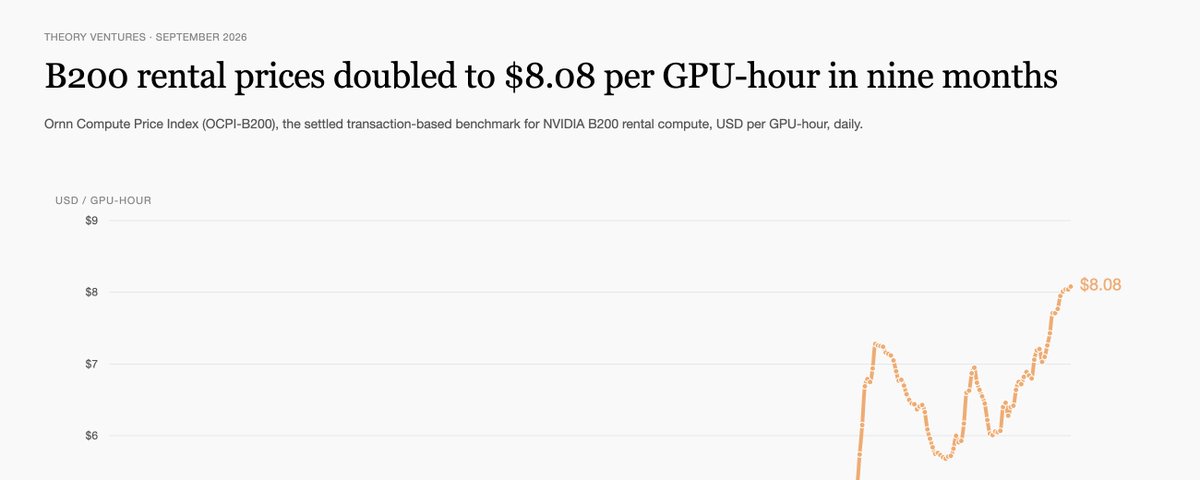
GPU prices have doubled in the last six months, from $4.40 to $8.08 per GPU-hour. But AI prices are falling. How can that be?
MPH retweeted

Raven 0.2.0 — The Harness of Harnesses, built for RSI. 🐦⬛
One harness can't be best at everything. Raven combines its own specialist harnesses (Research, Code, Design, Oncall) with the agents you already use (Claude Code, Codex and more) into one team.
And it's built for RSI, and not just at the skill level. The whole harness can be rewritten by AI: prompts, policies, strategy code, playbooks. Every sub-harness, including the orchestration layer itself, is its own instance that can be improved.
With Raven you can:
1. Orchestrate many agents as one team. Raven's sub-harnesses and external agents work in one task graph with shared memory across sub-agents, powered by leading orchestration (0.963 Node F1 on the Multi-Agent Orchestration Benchmark).
2. Run long, complex tasks. Oncall and proactive execution keep work going for days, from scientific research loops to shipping a full Godot game.
3. Build vertical agents with RSI. Use Raven's RSI to develop and refine an agent for your domain, and we'll optimize it with you. Experimental for now; reach out to the Raven team(Discord:discord.gg/VVSm8MESch).
More in the video and slides below. Open source, Apache-2.0.
github.com/EverMind-AI/Raven (lots of work made with Raven lives there, and much of this launch's material was made with Raven too)
MPH retweeted

The entire RAG industry is about to get cooked.
Researchers developed a new RAG approach that bypasses almost everything traditional RAG depends on.
- No vector DB
- No data embeddings
- No chunking
- No similarity search
It's called PageIndex.
Instead of splitting your documents into chunks and loading them into Pinecone, it creates a tree index that lets the LLM reason through them like a human reading a book.
98.7% on FinanceBench. Outperforms every vector RAG on the leaderboard.
100% free. Open source.

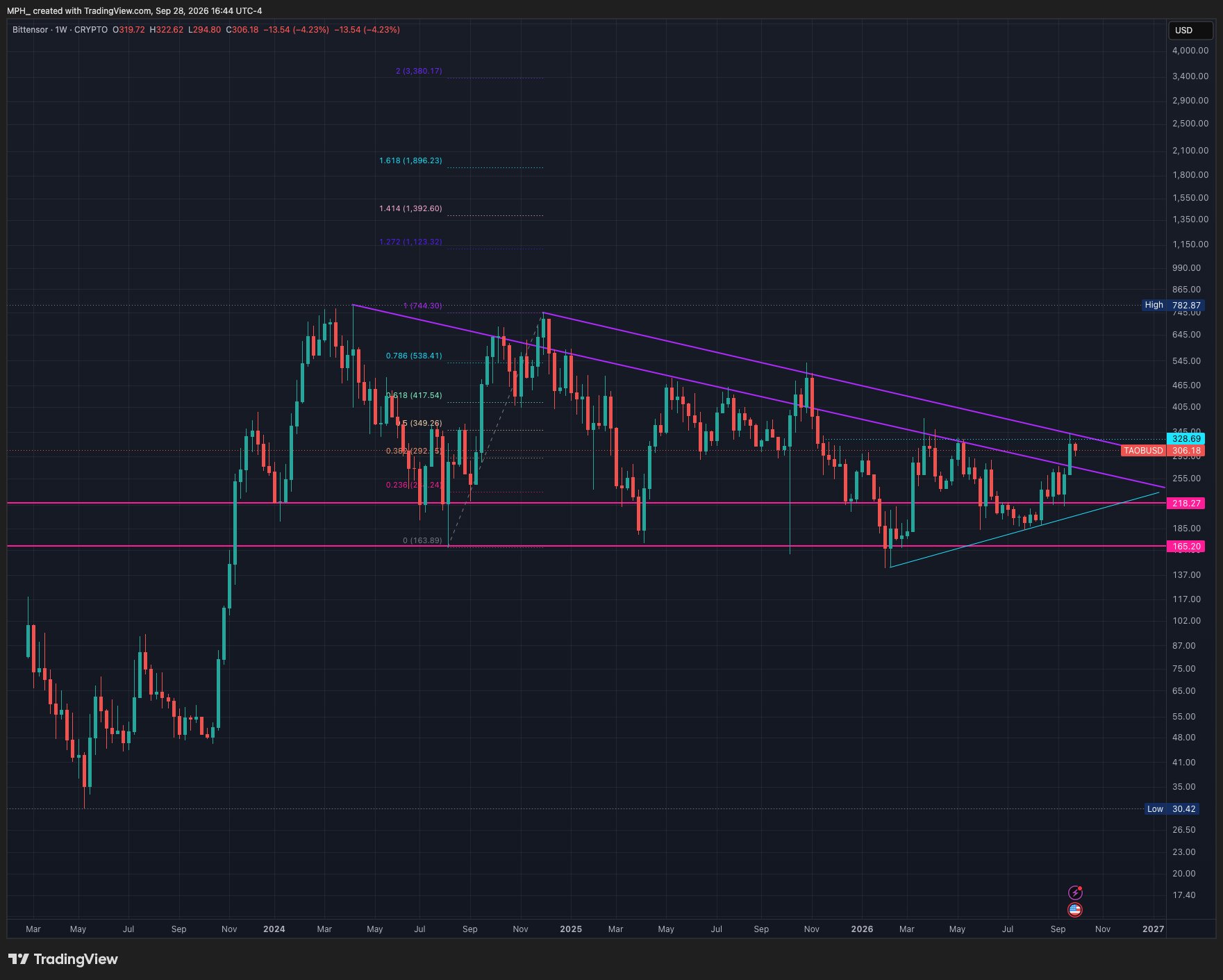
bittensor:native is a clear breakout waiting to happen. 5-10x upside.
Look at what ethereum:0x4a220e6096b25eadb88358cb44068a3248254675 just did with the same setup.
This is one of the best setups I'm seeing in crypto.
Not just because of the chart, but it's also an amazing AI project.
We could (potentially) see one additional drop to the buy zone (200s) and/or the smaller uptrend line. This would be a prime place to long.
I've included the ethereum:0x4a220e6096b25eadb88358cb44068a3248254675 chart as well for reference and comparison.

MPH retweeted

Today is the day that AI passed the "financial modeling Turing test" for me.
A "push button" build from scratch Skill that one-shotted a model on $MU that is indistinguishable (to me) from a model that a junior analyst would build from scratch. With full, impeccable adherence to all aspects of who i like to format, design & build models (took a few turns to dial it in).
Opus 5.5 is unbelievable.

MPH retweeted

boxd in 60 seconds
a whole linux machine that boots in under 10ms
composable: set it up once with your tools and data, then spin up as many as you need
fork it mid run, let it hibernate, wake it on traffic, share it with your team
one line to install: curl -fsSL boxd.sh/downloads/install.sh | sh
MPH retweeted

Andrew Ng just dropped the best 2-hour course on Graph Engineering: from single agent to full automation
9:14 - your first agent
33:11 - loop engineering
1:02:46 - graph engineering
1:30:15 - agents that rewrite themselves
1:49:05 - full graph system
two hours, and it replaces every agent tutorial you bookmarked this year
Prompts → Agents → Loops → Graphs
most people will stop after the first agent and call it automation
he saves the last forty minutes for the graph that runs it without him
same model, same tokens, completely different week
watch it today
the step-by-step guide is below, save it while it is still early ↓


MPH retweeted

We're at 44 FDA novel drug approvals and it's only the end of September.
For context, CDER approved 46 in all of 2025. We're two short of that with a whole quarter left, so 2026 is very likely to end up one of the biggest years we've seen. I made a poster of the 27 small molecules approved through Q3, and building it made me realize how much good chemistry got approved this year.
What really stands out is how many of them are first-in-class:
-Oveporexton (Takeda) is the first orexin receptor agonist. It treats the root cause of narcolepsy type 1 instead of managing the symptoms.
-Daraxonrasib (Revolution Medicines) is the first broad RAS(ON) inhibitor. It works as a molecular glue with cyclophilin A and hits RAS-GTP, and it roughly doubled overall survival in metastatic pancreatic cancer. For a target people called undruggable for decades, that's remarkable.
-Vepdegestrant (Arvinas/Pfizer) is the first PROTAC to make it to approval. Targeted protein degradation has gone from concept to the clinic.
-Centanafadine (Otsuka) is the first norepinephrine/dopamine/serotonin reuptake inhibitor approved for ADHD.
On top of those there's a covalent FGFR2 inhibitor, an oral carbapenem, a new tau PET tracer, and the first treatment for Menkes disease.
It's a good time to be a medicinal chemist. Poster below. Let me know if I missed anything.
