

Financial consulting for professional service, home service, and property service SMBs (revenue: $500k–$10M) | Built & sold a small NH real estate portfolio
Philadelphia, PA
Joined December 2012
- Tweets7.1K
- Following1.5K
- Followers4.6K
- Likes10.4K





Pinned Tweet
After five years in short-term rentals, I sold my three Airbnbs.
For 80%+ of people who got into STRs over the last half decade, it’s probably been a mediocre wealth play. That said, it can still make sense if:
- You’re handy and the properties are close by
(cont'ed)
This policy strikes a reasonable balance.
I think a better approach would be to let guests filter listings by the level of checkout expected:
1. Choreless - walk out and leave everything as is.
2. Light - dishes in the sink, trash sorted into indoor bins, towels gathered.
3. Heavy - strip beds, take trash with you, wash dishes, and similar tasks.
Some guests don’t mind (or even prefer) trading a bit of work for a lower price.
And some remote properties - think off-grid cabins or camps - are only viable if heavier chores are part of the deal.
Let guests choose their own adventure! And Airbnb could verify during the post-stay follow-up and rating process that the category is accurate and punish or boot hosts who put themselves in the wrong category.


For anyone who took my tweet last week about how it is foolish replace QBO and your bookkeeper entirely with AI to mean that I don’t think it’s possible to build extremely useful stuff very affordably in Claude…
Custom app for a residential snow removal operation in NH.
For small businesses- AI should improve service and operations, grow sales and expand gross margin, not replace commoditized, low cost softwares and service providers.


The interesting thing about AI, if you haven’t fully set it up with sufficient context and instructions, is that it feels like a human coworker who has good days and bad days.
Sometimes it is amazing. Sometimes it’s like, “Dude, were you out too late crushing beers with your homies?”
Two examples today:
- Screenshot of a request it needs to process in our workflow. It misses key customer expectations sitting in the bottom right corner.
- JobTread (construction software) MCP, create a T&M invoice. It fails to review the timesheet notes.
My initial reaction: "You did these things great earlier in the week. What the hell is going on? Do your job!"
Then thinking deeper: these are probabilistic systems, and you don’t have visibility into what our AI overlords are changing on the back end day to day.
Ultimately, it’s on you to close the gap with context, specs, and instructions. But when you’re testing out and standing up new processes in AI regularly, the variability can feel like a talented but poorly trained coworker.
If bookkeeping were simply categorizing transactions, this logic would hold.
It’s not. What a categorized spreadsheet doesn’t give you:
– A balance sheet - unearned revenue, unpaid expenses, owner distributions, principal paydown. None of that shows up in a list of bank transactions.
– Bank account reconciliation - how you make sure no transactions were missed.
– An audit trail – when a number changes, you need to know who changed it and when.
– Integrations with payroll, CRM, PM system, etc.
Using the overdone 80/20 parlance - categorizing transactions is 80% of the work and 20% of the value. Everything outlined above is 20% of the work and 80% of the value.

Yes, use APIs like Rob suggests to automate for sure. And use tools like Ramp and their AI functionality to track spending and make categorization more efficient.
teapawt.net/robesposito/status/210…

Instead of building custom AI systems to solve a nonexistent issue that is already an affordable commodity service and where they are existing out of the books tool that work fine - use AI to solve problems in the hard, strategic parts of your business. Like Jameson describes
teapawt.net/jamesonhaslam/status/2…

How I’ve Used AI to Generate a Few Hundred Thousand Dollars in New Revenue in 4–6 Weeks
I have a story about how I have used AI coupled with changed human behavior to drive a significant change to business results in my business and very much increase the top line.
I am a vocal critic of useless masturbatory vibe coding and applications of AI which do not actually meaningfully change business outcomes in any way (If you’re new here)
But
I’m also simultaneously an avid user of AI, praying that somehow the gods of superintelligence will rescue my meager profit margins and save me from the permanent underclass.
Here’s something I’ve done over the past 4–6 weeks that has added a few hundred thousand dollars in top-line revenue to our business.
The Problem
My current cardinal sin as a business owner is that I allow proposals to stack up. I do site visits, and I’m unable to turn around a bid in a timely manner.
The way you ACTUALLY solve this problem is by simplifying your service offering as a business, so you can provide pricing on the spot and do a one-call close (aka sit down at the kitchen table and hammer out a contract with a client).
I’m dumb, and I’ve designed a business that is too complex to be able to provide that (at this time). As a side note, caveat: I’m working on rearchitecting everything so that we get there, but we’re not there right now.
At the moment, we’re living the experience that most contractors fit into:
1. You get a call.
2. Somebody says, “Hey, can you come out and look at this and give me a price for how much it would cost to do it?”
3. You go out, look at the job, take some measurements, and write down the scope.
4. You try and figure out how much it’ll cost, and then you go back to the client with the pricing.
This takes forever, is super inaccurate, is a horrific experience for everybody involved, and is the reason why it’s hard to get contractors to come out and it’s hard to get proposals out of them.
It’s not because they hate money or because they’re bad at their job. It’s just that trying to reinvent the wheel every single time you put a proposal together is an impossible exercise.
As the contractor or service provider, you’re terrified of providing the wrong price because, if you give the wrong price, it ends up being, at worst, a bad experience. It is, at best, a bad experience for the client, and at worst, it’ll put you out of business and into litigation or something of the sort.
So you get stuck on perfection, and as we all know, perfection is the enemy of good, and the bids pile up.
We get 5 to 7 leads a day, and there are times when I’m running 3 to 5 sales meetings per day. As you can imagine, if there’s any level of complexity to those jobs, it’s just an impossible exercise.
You end up having clients calling you every single day, texting, asking, “Where’s my proposal?” They think you’re ghosting them when, in reality, you’re just trying to do your best to somehow deliver projects while also pricing new projects and figuring out how to keep everything together at the seams.
Here’s how I’ve used AI (credit where credit is due) to go from perfection paralysis to a good-enough output, and how it’s driven multiple six figures of revenue for us here at West Coast Deck.
The Tools
I’m not using some sort of crazy technology stack. I’m not even using any of these MCP connectors or API connectors. I still don’t know what an MCP is. I don’t even know what an API is, so I don’t have the ability to figure any of that stuff out. Which means that if I can do this, you guys can probably figure it out too.
The tools I’m using are as follows:
* Quo w recording
* A Plaud Pin Pro
* A ChatGPT Pro subscription
* A PolyCam subscription
* A Company Cam subscription
* A Stanley Fat Max 30 ft. tape measure
Here’s What I Do
The first thing is, I capture all transcripts of phone conversations and email traffic that we’ve had with the client.
Next, I drive to the site. I park outside, and I turn on the plot plan. I start narrating. I say, “Here’s the address. I’m at 123 Main Street. This is Tom and Judy’s house. They have this type of deck project with this type of scope. I’m about to walk into the site and do a job walk and review the work.”
Then I start the meeting. I tell the client I’m using AI tools to record, and then I essentially do a very verbal job walk and interview with them.
I ask them a lot of questions about what they want to get done, and then I intentionally regurgitate back to them everything that they’ve said. I discuss my findings on the job site with them. I talk through different things. I pull measurements with my tape measure, say the measurements out loud, and talk through the universe of outcomes and options. I talk about materials. I try to be as verbal as possible, knowing that my AI recorder is capturing everything.
Now, here is part of why I think this has been so effective for our business.
The forcing function of me going through all of the options and being super verbal helps to create expectations with the client, help them understand what will happen, what might be possible, and what the general job scope is. It’s forcing me to be overly communicative with prospects.
Before I leave the job site, I take a Polycam 3D LiDAR scan of the entire backyard, which is useful for taking measurements and referencing later if I need to look at details.
I also then open Company Cam, and I do a video walkthrough where I reiterate everything that we just reviewed with the client on video. It’s like triPLICATE information: recording what scope is, what needs to happen, and what the next steps are.
After the Site Visit
The next step is:
1. I say goodbye to the client.
2. I go out to my truck, sit down, and talk to the Plod pin a little bit more about anything that wasn’t appropriate to discuss in front of the client or that maybe I missed and that I need to capture.
3. I end the recording.
4. I transfer the data from the Plod pin into the Plod app.
5. I copy the transcript from the recording into ChatGPT.
At that point, I’m also adding any previous transcripts from Quo, any pictures that they’ve sent us, any videos that they’ve sent us historically, and any additional information.
There are three more things that happen in the process:
1. I send a recap email to the client with next steps.
2. I generate a scope of work and proposal.
3. I reference our historic library and universe of proposals for pricing.
My Super Scientific AI Prompts
Normally, you have to buy my course to get my super scientific AI prompts, but I’ll give them away for free here.
The first prompt is this:
Please write a site visit recap email based on these transcripts and information, and send it to the client.
Took me months and months to come up with that prompt. Should make you millions of dollars
Even just that little step has made a huge difference in the customer experience. Literally 5 minutes after the site visit, they get a super detailed email from me recapping everything, talking about next steps, and what the project experience will be like for them.
The next prompt is also probably worth millions of dollars. Please feel free to steal it.
Please write a construction proposal based on the site visit transcript and all the information. Reference my previous proposals.
And it spits out something that honestly is plenty good enough to sit down and review as a client.
The next step is: you can ask it to reference pricing from previous proposals, or you can just look at your price book and manually input pricing into the detailed proposal.
The Results
I can’t wait for all the comments from people saying, “Oh, you should do this better.” That’s part of why I post this kind of stuff, because I want people to tell me how to do it better.
We already have a V2, V3, and V4 of this planned, but this has first concept already resulted in a couple hundred thousand dollars in initial sales in just 4 to 6 weeks.
Anybody could figure this out. It does not take any sort of AI wizardry. It’s just basic, rudimentary tools that are available to anybody.
Provecho! (Happy hunting)


Here is what I see happening in the home service tech space from AI that I would guess is representative of the larger SaaS space.
AI means that companies can ship things way faster now, so the pace of new feature releases from companies like Jobber, CompanyCam, and Hover is breakneck.
Their feature sets are converging. Jobber never used to touch photos, and now they have a full media suite feature. CompanyCam never used to touch timesheets, and now they have a time tracking feature. Hover never used to touch proposals, and now they have an Agreements feature.
They all want to own the full stack for all of their customers. Meanwhile, their customers are increasingly using AI, and the product teams at these companies are trying to figure out how to build AI functionality into their tools that is beyond a little Copilot feature in the top right corner.
But there are two major challenges to adapting existing software to AI: the embedded architecture and assumptions of the software as it exists today, and “crap in, crap out” if the customer is using the software in a way that the built-in AI will miss key context on the business or customers.
The other big risk for these companies is that as they add new features and capabilities, they have to increase prices and more importantly increase complexity.
And beneath them, the same force that allows them to ship new features at a breakneck pace - namely the rapidly declining cost of software development because of AI - is bringing new competitors to market every day who are aiming to win on simplicity and low cost.
The irony is that this is the value proposition that made these companies successful in the first place. For Jobber, their architecture of Request > Quote > Job > Invoice was dead simple. CompanyCam made managing photos, previously a nightmare for contractors, an absolute breeze.
Long story short - I do not envy anyone in SaaS right now. If it were me I would stop chasing the full stack and keep my lead in a couple of key areas, because the complexity you add to win a customer is the same complexity a simpler competitor uses to take them.


Getting better in business is a series of improvements that are marginal individually and transformational collectively.
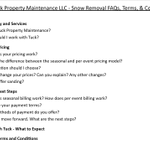
See: THS Snow Removal FAQs, 2022 vs 2026. We send these as an addendum to every quote.
Maybe 2% of customers read it. Not the point.
Every question in the 2026 version is something we figured out along the way: value proposition, pricing, service expectations, customer service complaints, operational processes.


Fun story about trying to sell our MFH in Rumney NH.
A couple of the units had third floor bedrooms and the buyer's insurance required us to build egress in the form of massive PT decks.


The last time most folks on here heard from me, I was selling my Airbnb portfolio in early 2025.
So what has happened since then?
- The real estate portfolio, including a 7 unit class C multifamily long-term rental, sold. Mercifully. Made a little money but nothing exciting.
- Kept building Tuck Home Services (THS), a residential property maintenance and construction company in the White Mountains of Central NH.
Some stats on THS: 250 snow removal accounts, 100 landscaping accounts, 40 weekly trash pickup accounts, and ~100 construction jobs a year. Typical job is a ~$20k remodel. Exterior painting, deck replacement, roof replacement, windows and doors, rot repair.
- This spring, I started transitioning out of the day to day. We hired an office admin and a landscaping supervisor, and scaled back construction. Construction is MUCH harder to scale than maintenance.
- Took the playbook from THS and the real estate portfolio and turned what was a side consulting business with a couple clients into a full-on fractional CFO firm, Veros CFO.
- We work with service business owners between $500k and 10mm who need someone to connect their finances to their operations. Link in bio.
- On the personal end, I moved to Philly after four years in the wilderness in rural NH, living my walkable urbanist fantasies.
We did all of this together, me and @JessePrato. My partnership with Jesse is the only asset that actually matters in the long-run.
Hopefully under the new algorithmic regime, people will actually see this. If not, my shouts into the void will continue.
Trying to explain this statement to a foreigner is like a high school world history teacher explaining to her students - the Archduke gets assassinated in Sarajevo and then World War 1 happens.

Recipe for a perfect Catholic Mass:
-40-60% capacity - it feels full but not crowded and stragglers can easily find a seat
-45-50 minute run time with no liturgical extras
-Strong organ and one solid vocalist who knows their limits and role
-Our Father spoken, not sung - cannot emphasize this enough
-“Lord, hear our prayer” is the response to the intercessions, of which there are no more than 6
-Homily is a mixture of anecdotes and folksy wisdom that tie in the day’s readings and themes with a sprinkling of theology
In hindsight, this deal dying and not syndicating money from friends and family for this was one of the most fortuitous things that has happened to me in my professional career.
You make 100% of the shots you shouldn't take.
An interesting part of rural New England is how much socioeconomic diversity can exist within the same town or ZIP code.
A town of 3,000 might have a trailer park, double-wides on half-acre lots, modest colonials, old farmhouses, and multi-million dollar homes on 10+ acres.
Everyone still ends up at the same post office, dump, Dunkin, town meeting, and hardware store.
Inflation plus an underskilled workforce is a recipe for perennially pissed-off customers.
Inflation squeezes incomes. Workers demand raises. Owners can't afford to lose them, so they say yes and raise prices. The customer pays more.
And what does the customer get for their money?
$70/hour for a landscaper who doesn't lift the blade when the grass stops growing in the heat.
$75/hour for a painter who doesn't caulk the gaps before painting.
$80/hour for a carpenter who frames a deck without flashing the ledger board.
$150/hour for an HVAC tech whose only move is selling you a $10,000 replacement.