

PolSci @LaStatale & to-be @Esercito reservist // @FratellidItalia militant // Into history, (geo)politics, & anthropology, i.a. // ''A certain idea of Italy''
🇮🇹🇪🇺
Joined January 2024
- Tweets9.4K
- Following5.4K
- Followers3K
- Likes197K






Pinned Tweet
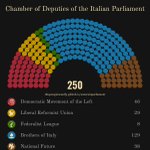
My ideal (though realistically so) Italian parliament
tl;dr: a dominant-party system with Brothers of Italy as a more right-wing equivalent of the historical Christian Democracy party, & with the left largely sidelined from national politics
——————————
𝗕𝗿𝗼𝘁𝗵𝗲𝗿𝘀 𝗼𝗳 𝗜𝘁𝗮𝗹𝘆 (BoI)
𝘍𝘳𝘢𝘵𝘦𝘭𝘭𝘪 𝘥'𝘐𝘵𝘢𝘭𝘪𝘢
𝗜𝗱𝗲𝗼𝗹𝗼𝗴𝘆: national conservatism, big-tent, Eurorealism
𝗣𝗼𝘀𝗶𝘁𝗶𝗼𝗻: center-right to far-right
𝗟𝗲𝗮𝗱𝗲𝗿: Giorgia Meloni
The uncontested leader of the Italian right & of Italian politics more generally, & thus the natural governing party, around whose interests Italian government institutions are molded; it manages to achieve a simple majority in elections by itself fairly often (especially after absorbing the greater part of the Forza Italia party), but otherwise governs in coalition whenever necessary, with either NF or LRU+FL depending on policy priorities
——————————
𝗡𝗮𝘁𝗶𝗼𝗻𝗮𝗹 𝗙𝘂𝘁𝘂𝗿𝗲 (NF)
𝘍𝘶𝘵𝘶𝘳𝘰 𝘕𝘢𝘻𝘪𝘰𝘯𝘢𝘭𝘦
𝗜𝗱𝗲𝗼𝗹𝗼𝗴𝘆: right-wing populism, ultraconservatism, hard Euroskepticism
𝗣𝗼𝘀𝗶𝘁𝗶𝗼𝗻: far-right
𝗟𝗲𝗮𝗱𝗲𝗿: Roberto Vannacci
A sovereigntist, radically conservative, quasi-neofascist party; often (but not always) supportive of BoI policies, though usually advocating harsher positions; whenever included in government coalitions, it is kept away from foreign policy roles as a rule
——————————
𝗙𝗲𝗱𝗲𝗿𝗮𝗹𝗶𝘀𝘁 𝗟𝗲𝗮𝗴𝘂𝗲 (FL)
𝘓𝘦𝘨𝘢 𝘍𝘦𝘥𝘦𝘳𝘢𝘭𝘪𝘴𝘵𝘢
𝗜𝗱𝗲𝗼𝗹𝗼𝗴𝘆: federalism, liberal conservatism, libertarianism
𝗣𝗼𝘀𝗶𝘁𝗶𝗼𝗻: center-right
𝗟𝗲𝗮𝗱𝗲𝗿: Luca Zaia
A post-Salvini League, returned to its federalist roots; chiefly focused on regional interests & autonomy as its main party goal (with the long-term objective of constitutionally reforming Italy into a federal state), but often also characterized by its advocacy for libertarian positions on civil rights issues such as euthanasia or drug & prostitution legalization
——————————
𝗟𝗶𝗯𝗲𝗿𝗮𝗹 𝗥𝗲𝗳𝗼𝗿𝗺𝗶𝘀𝘁 𝗨𝗻𝗶𝗼𝗻 (LRU)
𝘜𝘯𝘪𝘰𝘯𝘦 𝘓𝘪𝘣𝘦𝘳𝘢𝘭𝘦 𝘙𝘪𝘧𝘰𝘳𝘮𝘪𝘴𝘵𝘢
𝗜𝗱𝗲𝗼𝗹𝗼𝗴𝘆: liberalism, Third Way, pro-Europeanism
𝗣𝗼𝘀𝗶𝘁𝗶𝗼𝗻: center-left to center-right
𝗟𝗲𝗮𝗱𝗲𝗿: Carlo Calenda
An amalgamation of all the centrist, moderate parties (including factions of Forza Italia & the Democratic Party); chiefly focused on economic liberalism & European integration, as well as civil rights advocacy to some extent; usually in favor of pragmatic cooperation with BoI rather than principled opposition, & often part of its coalition governments
——————————
𝗗𝗲𝗺𝗼𝗰𝗿𝗮𝘁𝗶𝗰 𝗠𝗼𝘃𝗲𝗺𝗲𝗻𝘁 𝗼𝗳 𝘁𝗵𝗲 𝗟𝗲𝗳𝘁 (DMotL or DM)
𝘔𝘰𝘷𝘪𝘮𝘦𝘯𝘵𝘰 𝘋𝘦𝘮𝘰𝘤𝘳𝘢𝘵𝘪𝘤𝘰 𝘥𝘦𝘭𝘭𝘢 𝘚𝘪𝘯𝘪𝘴𝘵𝘳𝘢
𝗜𝗱𝗲𝗼𝗹𝗼𝗴𝘆: left-wing populism, social democracy, green politics, soft Euroskepticism
𝗣𝗼𝘀𝗶𝘁𝗶𝗼𝗻: left-wing
𝗟𝗲𝗮𝗱𝗲𝗿: Giuseppe Conte
A fusion of the Five Star Movement, the progressive faction of the Democratic Party, & the Greens-Left Alliance; intended to unite leftist efforts against right-wing dominance, it nevertheless remains perennially confined to a minority of the Italian electorate, functioning as the permanent (& largely ineffective) opposition to the BoI-led governments
——————————
Please @GiorgiaMeloni make this real & my soul is yours 🙏🏻


Alessandro ⚜️ retweeted

The older I become, the more I resent "temperamental conservative" middle class people (lower middle class, upper middle class, all of them)
Alessandro ⚜️ retweeted

🇬🇷🌊 In Modern Greek, "πολιτεία" really means "polity" rather than "republic".
Or, well - it does mean "republic", but in the classical sense of the term: "res publica", i.e.: the sense by which the Greek Empire and the Polish-Lithuanian Commonwealth were republics.
The state created by the revolutionaries of 1821 did indeed use the term "πολιτεία"! Because the Greek revolutionary movement was so intellectually rich that it contained everyone from French-educated Jacobins to Orthodox theologians who intended to establish a monarchy, "πολιτεία" was the compromise term which implied neither monarchy nor non-monarchy, i.e.: democracy.
Were the national-revolutionary government of Ioannis Capodistrias to continue unabated, Greece today would be known as the "Hellenic Polity". Alas, he was shot and killed, and a Bavarian monarchy was brought in his stead (long after Greece gained its independence - just saying!), with the "Hellenic Polity" being renamed to "Kingdom of Greece".
In 1922, however, Greece had a Jacobin-fascist revolution against the monarchy. It was a reasonable crashout: Greece had just doubled its size in the Balkans and destroyed the Ottoman Empire under the republican Venizelos, but the monarchists who replaced him in 1920 fumbled our imperial destiny in Asia Minor.
This revolution, which executed the monarchist leadership and eventually abolished the monarchy, also used the term "πολιτεία"! However, this only lasted a few months. As the new, monarchy-less Greece was created in a revolution against the monarchy, "πολιτεία" was seen as too compromising of a term - it was, after all, a compromise from 1821!
Similarly to how many national-liberals in Europe demanded "democratic republics" as opposed to mere "republics", the Greeks wanted a "democratic republic". And "ελληνική δημοκρατική πολιτεία" ("Hellenic Democratic Republic") sounded very clunky, while "δημοκρατία" already existed as a perfectly good noun by itself, so Greece became the "ελληνική δημοκρατία" - the Hellenic Democracy.
The monarchy was eventually re-established, but then it was abolished again in 1974, and, by then, "δημοκρατία" was the term used by republicans and had also grown to have a rather positive connotation as a term, so it was obviously re-adopted.
In my view, we should embrace being named the Hellenic Democracy, as opposed to using the banal translation of "Hellenic Republic". No other country uses the term democracy in its name, and, if we start using it in English, too, perhaps we can undo the bad reputation that reds and many others have inflicted on said term for the last few centuries.


Alessandro ⚜️ retweeted
"You have the courage to tell the masses what no politician told them: you are inferior and all the improvements in your conditions which you simply take for granted you owe to the efforts of men who are better than you."
- Ludwig von Mises, praising Ayn Rand's "Atlas Shrugged"

I really dislike that the official name of the modern Greek state uses 𝘥𝘪𝘮𝘰𝘬𝘳𝘢𝘵𝘪𝘢 instead of 𝘱𝘰𝘭𝘪𝘵𝘦𝘪𝘢 to mean "republic"

Why is this the case, @neoaegean? Did the collaborationist Hellenic State's usage of 𝘱𝘰𝘭𝘪𝘵𝘦𝘪𝘢 delegitimize the term, or something of the sort?
Alessandro ⚜️ retweeted

It's a shame that the Jacobins never had the opportunity to build massive archetecture projects because it probably would have been cool as fuck


"You have the courage to tell the masses what no politician told them: you are inferior and all the improvements in your conditions which you simply take for granted you owe to the efforts of men who are better than you."
- Ludwig von Mises, praising Ayn Rand's "Atlas Shrugged"
Alessandro ⚜️ retweeted

Yes (counterfactual caveats acknowledged). Interestingly, the European Interwar is *mostly* the failure of democracy and imposition of authoritarian solutions which also crowded out or isolated truly extremist movements. Germany is the especially tragic failure of this model.
By early 1933, the NSDAP was:
– past its electoral peak, having suffered a -4.2% decrease from the July 1932 election to the November 1932 election (which was especially shocking to the Nazis themselves after years of constant growth)
– rife with infighting; aside from the SA's rabble-rousing & Röhm's homosexuality scandal creating problems for the party, the Strasserist northern faction was internally challenging Hitler's authority to the point of a potential party split (a more serious one than the previous Black Front split in 1930), & their leader Gregor Strasser was actively in the process of defecting to Schleicher's Querfront plan
– perhaps most importantly, on the verge of bankruptcy as an organization; this was rectified only *after* Hitler's appointment to the chancellorship, through a private meeting with industrialists, who funded the NSDAP for the March 1933 election more out of a concern for government stability (since now Hitler was already in power) rather than genuine sympathy
All of this means that if Hitler hadn't been *given* power precisely at the beginning of 1933, the Nazis would've likely lost their moment & entered an inexorable decline (& many among the NSDAP leadership thought so themselves), especially since the German economy was only going to get better from there on out thanks to Schleicher's just-announced public works program
P.S. By the early '30s the Weimar system was virtually doomed to an authoritarian outcome anyway, but it probably would've happened as a military-backed conservative coup rather than as a seizure of power by the Nazis (or by any other mass party)
Alessandro ⚜️ retweeted

von Papan might've been a moron but his plan of bankrupting the Nazis by dissolving the reichstag every five seconds if they keep refusing to prop up his cabinet was absolutely working
By early 1933, the NSDAP was:
– past its electoral peak, having suffered a -4.2% decrease from the July 1932 election to the November 1932 election (which was especially shocking to the Nazis themselves after years of constant growth)
– rife with infighting; aside from the SA's rabble-rousing & Röhm's homosexuality scandal creating problems for the party, the Strasserist northern faction was internally challenging Hitler's authority to the point of a potential party split (a more serious one than the previous Black Front split in 1930), & their leader Gregor Strasser was actively in the process of defecting to Schleicher's Querfront plan
– perhaps most importantly, on the verge of bankruptcy as an organization; this was rectified only *after* Hitler's appointment to the chancellorship, through a private meeting with industrialists, who funded the NSDAP for the March 1933 election more out of a concern for government stability (since now Hitler was already in power) rather than genuine sympathy
All of this means that if Hitler hadn't been *given* power precisely at the beginning of 1933, the Nazis would've likely lost their moment & entered an inexorable decline (& many among the NSDAP leadership thought so themselves), especially since the German economy was only going to get better from there on out thanks to Schleicher's just-announced public works program
P.S. By the early '30s the Weimar system was virtually doomed to an authoritarian outcome anyway, but it probably would've happened as a military-backed conservative coup rather than as a seizure of power by the Nazis (or by any other mass party)
Alessandro ⚜️ retweeted

O Fascismo na Itália era tipo:
Vou acordar no Sábado Fascista, pegar meu Fiat Fasciomóvel, ir até a Praça do São Fascismo, jogar Fascistoball com meu amigos, então ir pro Bar Nazionale Fascista tomar uma Fascistíssima Bionda.


Wild to realize that a slightly longer Reichstag recess in 1933 would've likely prevented Nazi Germany from ever happening


Who would you vote for in this Italy?
21%Brothers of Italy
60%National Future
13%Liberal Union or League
6%Democratic Movement
63 votes • Final results Alessandro ⚜️ retweeted

It's disappointing how few transnational revolutionaries we have today. The 18th, 19th, and 20th centuries were full of Garibaldis, Guevaras, and Mirandas who traveled continents to lead armies.
Nowadays, who fits that description? Igor Girkin? Just not the same.


