

Building a AI-powered film production pipeline from script to shots | TMT veteran 20+ years | ex-Alibaba Group VP | Aspen Institute Global Leadership Network
Joined February 2022
- Tweets3.2K
- Following1.4K
- Followers1.9K
- Likes8K





Pinned Tweet
🧵 [1/7] Jensen Huang: “You invest in people, not companies.” NVIDIA just backed Higgsfield!
As someone building agentic pipelines for AI short drama (script → shots → consistent output), I’ve been watching them closely. The jump from near-death in 2024 to 40M+ users and $1B ARR is a useful case study in what actually works when you layer professional control on top of frontier models.
@higgsfield @alexmashrabov @nvidia @JensenHuang

Jensen Huang: “… the founders of Higgsfield are visionary in the work that they do … but these are some of the brightest people in the world.”
We're grateful to Jensen and the teams at NVIDIA and TCV for believing in us. Both companies have joined Higgsfield as investors in our Series B
extension.
Since our August Series B:
• We’ve crossed $1 billion in annualized revenue.
• Enterprise contracts are up 71%, growing 100%+ month-over-month
• We’ve grown from 30 million to over 40 million users globally.
TCV has backed Netflix, Facebook, ByteDance and Spotify, companies that changed how people create and consume media. NVIDIA has powered every generation of Higgsfield, from L40 and A40 GPUs through Hopper and Blackwell, with Vera Rubin next to meet growing demand.
Thank you to our creators and customers for building with us every day, and to everyone at Higgsfield whose work brought us here.
The full Bloomberg Announcement is linked below.
How are we going to believe in the stories @nytimes cover?

if you have access to Jensen or his lawyers, please send them this.
I did this research using my own duct-taped agentic intelligence platform called Hyperspace (+Claude), and it’s the most powerful of it’s kind.
this tells a crisp story, in data, of how Jensen was harassed unnecessarily and deliberately into resigning, with selective and persistent news drops based on the “spy” story right around the election leveraging the citation power of NYT - the stage was set that by the time a board meeting happened to discuss the “spy” story, a new story of an affair was dropped on the same day as well which played the role of emotionally compelling a resignation.
none of this is fair.
to real journalists: this analysis here contains sufficient data for the most influential story of our times. I am not going to write it for you, but if you win the Pulitzer, a shout-out would be nice.
consider this goes beyond Jensen. consider the magnitude of the story being dropped days before the mid-terms regardless of political affiliations, and it turns out weeks later, there was no “spy”. so what is going on ?
79
I suspect more experienced, high-caliber people like him—those deeply tied to the culture Jensen built—will start leaving as well. A real loss for Nvidia. Sigh....

I’ve decided to leave NVIDIA. There are a few things I want to say.
As a robotics engineer at NVIDIA, I have seen Jensen as much more than the company’s CEO.
I admire his willingness to invest in a future that was not yet obvious. He committed to CUDA long before the deep learning boom and positioned NVIDIA for AI before it became everyone’s priority. Those decisions helped build the infrastructure that powers today’s AI.
I have seen that same vision in physical AI: investing in robotics, sharing open-source tools and projects, and building computing platforms that bring AI into the physical world. This is the work I do every day—and a future I believe in.
But what matters most to me is the culture he helped build.
Engineers are encouraged to explore, take risks, and learn from mistakes. Jensen reads employees’ Top 5 emails, follows their work, and engages directly. In a company this large, that connection matters. It makes an individual engineer feel that their ideas can still be heard.
That is why this has been so disappointing.
I do not have all the facts surrounding the allegations, and I cannot prejudge the investigation. My admiration for Jensen does not put him above scrutiny.
What I find difficult to accept is having to come to terms with his departure before receiving an explanation that helps me understand it. What this means for our direction, our culture, and the people doing the work remains unclear to me.
I have felt that engineers’ perspectives matter here. On this decision, I have not felt heard. That gap has been more painful than I expected.
I understand that some information cannot be shared immediately. But that does not erase the feeling of being left outside a decision that affects the company we help build every day.
A company’s greatness comes from its leadership, its governance, and the people who turn its ambitions into reality. Employees’ trust and sense of belonging are part of that, too.
Jensen’s vision and the engineering culture he shaped were important reasons I wanted to stay. His departure led me to decide that my own chapter here should also come to a close.
I leave with sadness and gratitude. The colleagues I have worked with, and the work we believed in together, will always matter to me.
These are my personal views.

57
Tibo @thsottiaux you asked how to improve Codex (and told us not to say “model”). I went through the useful replies. Here’s what actually matters right now — the stuff that would move the product the most:
1/ Computer Use is too eager and unreliable
2/ Tasks die early / lack real persistence
3/ Disk + memory problems are killing usability
4/ UI / sidebar / mode consistency is a mess
5/ A few secondary but high-leverage fixes
Thread 👇

2
92
🧵 5/ Other high-leverage secondary issues
- Mobile/iOS remote connections are slow; people want a real agent experience, not just remote desktop
- Stronger project-level instructions (especially multi-directory / AGENTS.md style)
- Browser that actually remembers logins
- Less unnecessary scaffolding and tests
- Clearer “Lite” or reduced-bloat option for people who just want speed
These aren’t as loud as the top three, but they’re easy wins that reduce friction.
1
20
Overall take:
Computer Use behavior + task persistence + resource management are the highest-ROI things to fix right now.
The “just ship a better model” replies are loud, but the people actually using Codex every day are mostly blocked by these product and harness issues.
If Tibo’s team prioritizes the first three, a lot of the current frustration would drop fast.
What issue or painpoint would you add?
27
#SpaceX just gutted the Grok video model team. Turns out NSFW doesn’t actually deliver meaningful returns — and if anything, it quietly erodes the company’s sense of mission.
I’ve seen engineers at Grok complaining about this. While peers at other labs get pumped up every day about actually building toward AGI, they were stuck training Grok how to talk dirty to lonely guys online. Morale took a real hit. One of them left not long after.
The video-gen model itself never really kept up either. It had the “uncensored” branding, but the output quality was not state-of-the-art. Once MiniMax H3 went open source and people could just run NSFW video models locally, Grok Imagine’s edge became even thinner. Elon seems all-in on becoming a compute provider now. High-leverage, pure engineering work is clearly more his comfort zone.
213
Alvin-GenAI retweeted

视频模型:Seedance2.5
提示词:GPT-6-Astra
参考来源:《No Ordinary Love》- @antrofrog_
Alvin-GenAI retweeted

🚨 EXPOSED: David Sacks just blew the lid off the Jensen Huang saga—the REAL scandal is who committed a FELONY by leaking a classified memo to the NYT to take him down!
Someone risked 10 years in prison for a political hit job, and nobody is investigating it. Find the leaker NOW! 🇺🇸🔥
Kicking Jensen Huang out of NVIDIA might be the single dumbest, most pointless thing Washington has managed to pull off.
David Sacks, the former White House AI czar, just came out swinging and laid bare how absurd this whole circus really is. If Huang was actually forced out for wanting to sell chips to China, the political hit job was a complete waste of time — because China was never going to buy them anyway.
Sacks zeroed in on the biggest blind spot among the China hawks in DC: these people are still operating under the fantasy that Beijing is begging Washington to green-light chip sales. Reality is the exact opposite. China is treating semiconductor self-sufficiency as its top strategic priority, the same way the U.S. is desperately trying to break free from Chinese rare-earth dependence. To prop up Huawei, Beijing is perfectly willing to inflict short-term pain on its own tech ecosystem and is forcing local companies and developers to switch over to Huawei solutions.
The latest evidence is already in: DeepSeek’s newest model was trained entirely on Huawei chips. The Washington hawks don’t want to sell, Beijing doesn’t want to buy, and for once both sides are on the same page — the deal was dead before it even started.
Then there’s the intelligence reporting that surfaced on November 12. Even the data collected by U.S. intelligence agencies themselves showed there was no evidence the former Megaspeed executive was a Chinese spy. So over a completely fictional premise of “selling chips to China,” they went ahead and sacrificed the person effectively running global AI compute.
As Sacks put it, no matter how you run the numbers, this one is a catastrophic loss.

David Sacks says if Jensen was ousted for wanting to sell chips to China, it was “the stupidest, most moot hill to die on”
“They’re trying to indigenize chip production. They think it’s a critical industry, in the same way that we’re trying to get rare earths out of their clutches and get our own rare earth supply. They’re trying to create their own chip supply.”
“They’re trying to scale up domestic chip manufacturers, and they’re willing to endure some short-term pain in their ecosystem to prop up Huawei, to force all of their local companies, their developers, to try and use Huawei. And if you look at recent press, the latest DeepSeek model is being trained exclusively on Huawei chips.”
“There’s a big disconnect here, where I think the China hawks in DC think that the Chinese government is begging for their chips, and the truth is that they would love to keep the chips out too, which is why I say, again, the juice isn’t worth the squeeze.”
“The China hawks don’t want the chips sold. The Chinese government doesn’t want the chips sold. So just forget about it. Stop selling them.”
“This is the crazy thing: if Jensen was taken out because he wanted to sell chips to China, it was the stupidest, most moot hill to die on, because China’s not taking those chips anyway.”
2
129
As a fellow Taiwanese, a member of the NVIDIA Global Inception Program (joined in 2023), and someone who has long looked up to Jensen as a role model — an entrepreneur who endured years of struggle and setbacks before building something extraordinary — I’m standing with Jensen.
For 33 years Jensen bet on ideas most of the industry dismissed and built the platform that makes today’s AI possible. My current project — a screen-to-final-shot AI film production agent — sits directly on top of the compute and model ecosystem he helped create. Without that foundation, this work-in-progress wouldn’t exist.
Accountability is necessary. Abrupt removal without a completed independent investigation and a fair chance to respond is not. Thirty-three years deserve more than that.
Signed with ❤️
standwithjensen.com
#StandWithJensen

1
79
Altimeter, an investment firm that has invested in ByteDance, Uber, and Snowflake, has written a very classy letter to Nvidia’s board. Rather than attacking or hurling insults, it makes a “simple request”: Given Jensen Huang’s long record of outstanding leadership and the enormous uncertainty created by recent events, “the board should approach Nvidia’s future leadership arrangements with composure, prudence, and thorough deliberation, keeping all options open, including the possibility of Jensen Huang’s return.” This is in the best interests of all stakeholders, especially Nvidia’s shareholders. “If, after all the facts have been established, the board determines that bringing Jensen Huang back as CEO is not in shareholders’ best interests, that is the board’s prerogative. But as the founder of this extraordinary company and its outstanding leader for so long, he deserves to be treated with care and should not be hastily replaced without cause before all the facts are clear.”

This letter was sent to the Nvidia Board today which we believe outlines the minimum acceptable standards the Board owes shareholders as it manages this difficult situation. Onward. 🫡

1
1
199
This is going to be a whole new paradigm in AI-powered video production and editing

we've been working on something for a while
now you can vectorize your videos into layers and make localized edits to any part of them in real time
> roto and cleanup without masking by hand
> compositing inside the shot
> real color grading
and a lot more.
we're calling it Higgsfield Miracle. currently in private beta, coming soon to Higgsfield MCP
1
75
AI can also DREAM now?
Anthropic inspired from how our brains organize memories during sleep to build a memory system (similar to wikis) for Claude.
agents can now “dream” about past experiences: revisit its transcripts, correct mistakes, and evolve its memory wiki when not in a conversation.
OpenAI also uses this process called “dreaming” for ChatGPTs memories.
this is truly amazing

Memory is what allows Claude to learn from experience. In a new Engineering Blog post, we share how “dreaming” helps Claude organize what it’s learned, correct its mistakes, and find what it needs more easily the next time. anthropic.com/research/compo…

113
SpaceXAI engineer Lauren Tan just released the skills she runs her own agents on.
Her bedtime prompt to them: “i’m going to bed. land the stack even if ci flakes.”
Her workflow into one prompt that turns your Grok Bot into a graph of 15 Bots and lands almost any task by morning.
→ sharpens the ask and writes the pass condition first → cuts the task into slices and runs them in parallel → lets other models try to break every diff, keeps only what a run proves → checks what else a one-line change could break → strips comments and AI tells before review → turns every repeated mistake into a rule for next time → wakes you only for the step that can’t be undone
Give it to your Grok Bot at bedtime with the stack you’ve been putting off for a week, and check it at 8:00. How to tune it for your own work is in the article below. Save it before it gets lost ↓
67
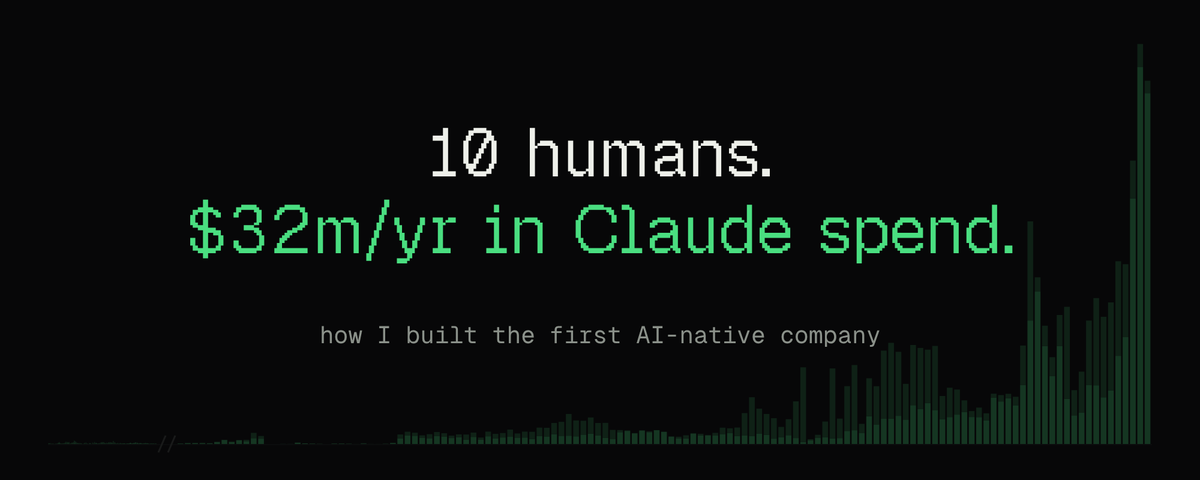
This might be what companies look like in the future. Reading it all the way through is a little unsettling.
Anthropic’s S-1 went viral last week. One of their biggest customers, Spawn (a multiplayer game creation engine), is a 10-person company. Its founder Jacob posted a long piece on X that hit ~1.1M views.
Last month Spawn spent $3.1M on tokens—30× payroll—and shipped 77,000 substantial changes (engine and game logic level). That’s roughly 108 per hour, around the clock. Even after subtracting the free Opus they give creators, they still rank in Anthropic’s top 250.
Jacob’s first instinct was that something had to be wrong. He checked with friends running much larger companies. The conclusion: nothing was wrong; the usage pattern is just different. Most companies have a lot of humans using AI. Spawn has 10 humans directing a large fleet of agents.
They call it the fleet. Each permanent agent has a name, memory, and real permissions, and owns a slice of the company (engine, finance, bug triage, deploys, etc.). Those agents then spin up thousands of helper agents. The humans’ job has shifted to something like paratroopers—drop in wherever something is stuck and unblock it. An Anthropic researcher told him Spawn is the customer that operates most like Anthropic itself.
To make this possible they killed traditional PRs earlier this year. Agents write the change, unrelated helper agents review it, it gets merged, and they ship every hour. If something breaks, another agent is spun up to fix it. An hour without a ship is treated as a SEV-0. Over the past year: 120k+ changes, 1,055 rollbacks (~0.9%).
By October the only remaining bottleneck was Jacob himself. He woke up one morning to 700 decisions waiting. They distilled two years of recorded calls (every conversation since founding lives in the repo) into taste principles and built AI judges. Launched October 6. In eight days the judges handled 11k+ questions; 1,863 were left for humans; Jacob personally intervened 27 times. Before the judges they were landing ~1,000 changes a day. On October 10 it was 7,250.
This might just be what an AI-native organization looks like. It’s impressive, and also a little creepy.

1
1
127
Alvin-GenAI retweeted
Personal (work + life) agents are definitely a big trend.The platform that wins will probably be the one users are already most sticky with — Meta (#MuseAI ), X (Grok Bot) in your case, ChatGPT (Dot), or Anthropic ( #claudeduet ). That’s where their primary personal agent will live.
Standalone startups like @instinct are hot, but onboarding costs are real. And once agents start talking to each other, network effects will matter a lot. As for myself, I’m currently using Dot and Grok Bot.