

#anticlockwise#viewer#Reasoning
Kampala, Uganda
Joined October 2014
- Tweets29.5K
- Following4K
- Followers984
- Likes67.6K
Very insightful & exciting discourse @elisonk

The politics of the Bar is back. The debate about leadership is back. And the future of our profession is once again in our hands.
As the Uganda Law Society's electoral questions return to the centre of our conversations, the East Africa Law Society prepares for its Annual General Meeting. Uganda is entitled to the position of Vice President. And with that entitlement comes a choice.
But this must be about more than who occupies an office. It must be about what that office stands for. What Uganda's voice should be in the regional legal profession. What the East African Bar can achieve together. And whether our professional institutions can rise to meet the expectations of the lawyers they represent.
Because elections should not merely change office bearers. They should challenge ideas, renew institutions and inspire leadership.
Tonight, @JSConversations brings together six voices for the EALS Vice Presidential Debate. The candidates will make their case, defend their vision and answer the questions that matter.
Six voices. One office. A regional profession looking to the future.
Wednesday, 18 November 2026 | 7 PM EAT
Live on X, TikTok and YouTube.
The choice belongs to the lawyers. The conversation belongs to everyone.

21
Mr. Mwenda is a hypocrite, him & Obbo sued attorney general & supreme court pronounced it's self on "freedom of speech"
The same Mwenda now is in some funny pressure group that takes natives to basement for freedom of speech

Just asking: So, how does @cobbo3 view his former protégé @AndrewMwenda in his new role(s) today?
60


*🎙️ X SPACE TONIGHT | 7:00 PM*
THE FEAR IS GONE: ULS TAKES ON MUHOOZI & PLU OVER ABDUCTIONS*
“We are not neutral about abductions. We are not neutral about the disappearance of our colleagues. Join us tonight at 7:00 PM.
— ULS President & Head of the Bar, @IsaacSsemakadde

Very brilliant and bold move by President @IsaacSsemakadde and @ug_lawsociety .
@IsaacSsemakadde Keep going because there light at the end of a tunnel

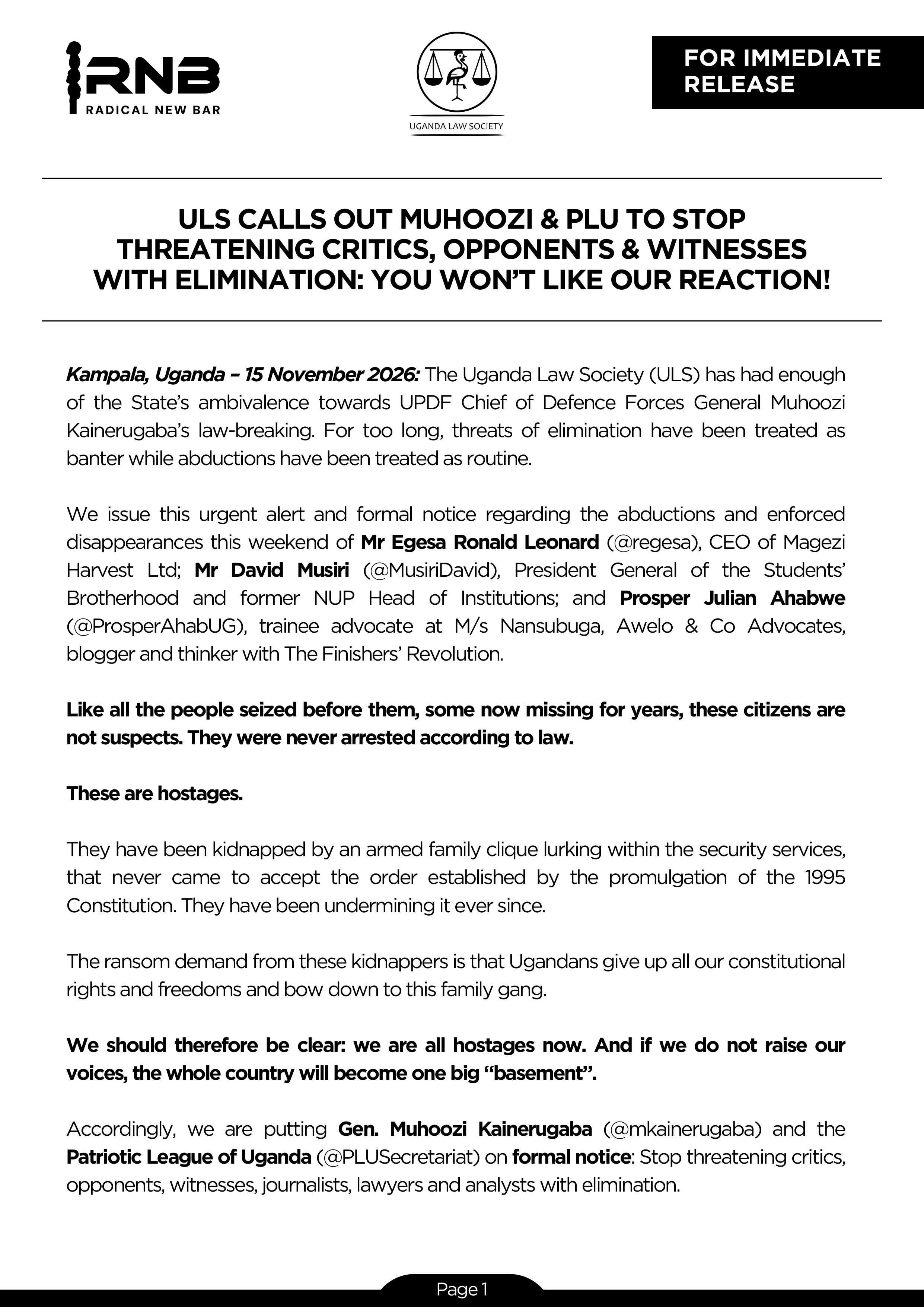
UPDATE ON THIS WEEKEND’S ABDUCTIONS — WE CALL OUT MUHOOZI & PLU TO STOP THREATENING CRITICS, OPPONENTS & WITNESSES WITH ELIMINATION: YOU WON’T LIKE OUR REACTION!
Kampala, Uganda – 15 November 2026: The Uganda Law Society (ULS) has had enough of the State’s ambivalence towards UPDF Chief of Defence Forces General Muhoozi Kainerugaba’s law-breaking.
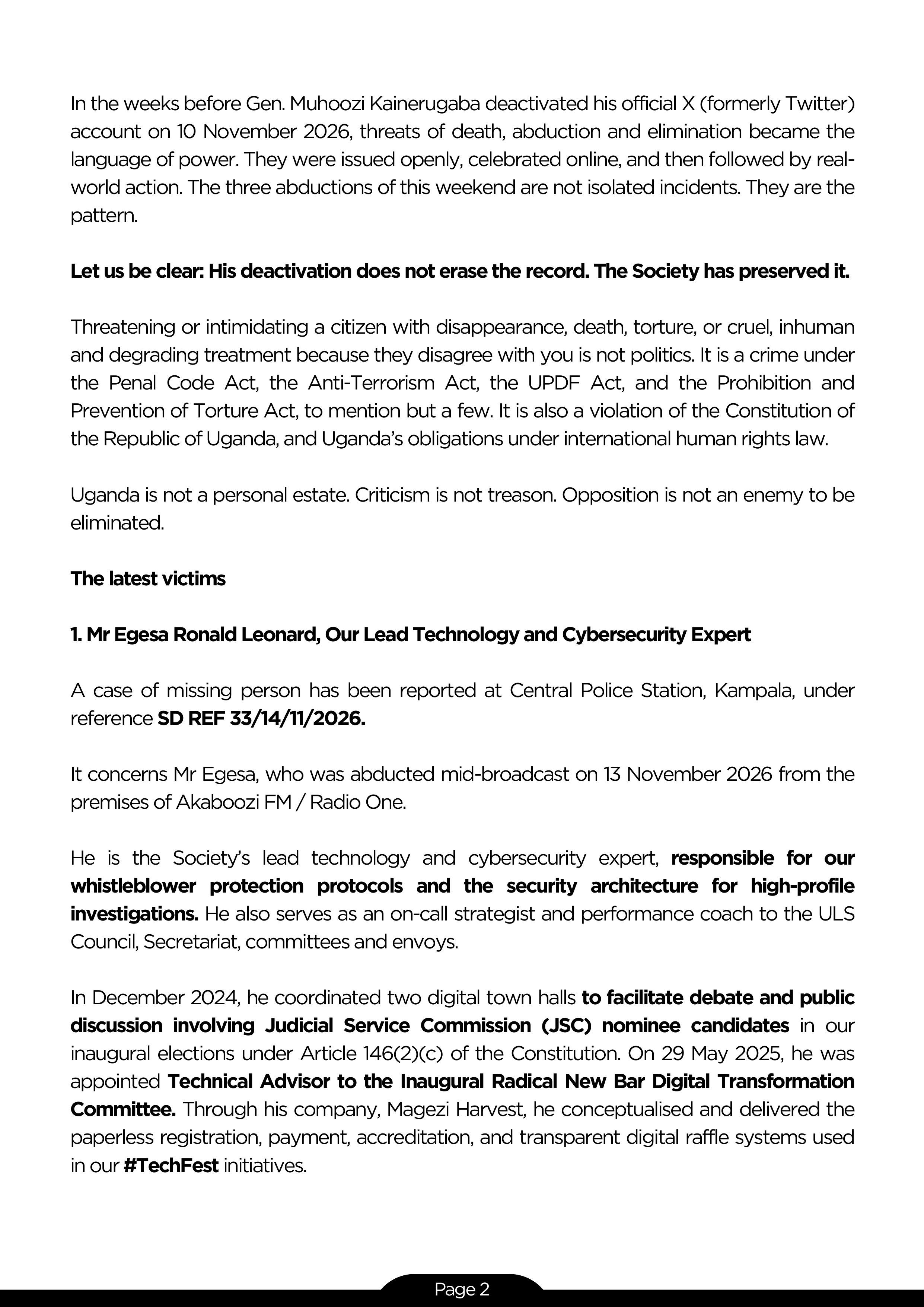
Let us be clear: Threatening or intimidating a citizen with disappearance, death, torture, or cruel, inhuman and degrading treatment because they disagree with you is not politics. It is a crime under the Penal Code Act, the Anti-Terrorism Act, the UPDF Act, and the Prohibition and Prevention of Torture Act, to mention but a few. It is also a violation of the Constitution of the Republic of Uganda, and Uganda’s obligations under international human rights law.
Uganda is not a personal estate. Criticism is not treason. Opposition is not an enemy to be eliminated.
OUR DEMANDS
Pursuant to Section 3 of the Uganda Law Society Act, the Society hereby puts Gen. Muhoozi Kainerugaba, @PLUSecretariat, and all persons acting in their name, on formal notice:
1. Immediately cease all threats of elimination, abduction, and harm against critics, opponents, journalists, lawyers, analysts, and witnesses.
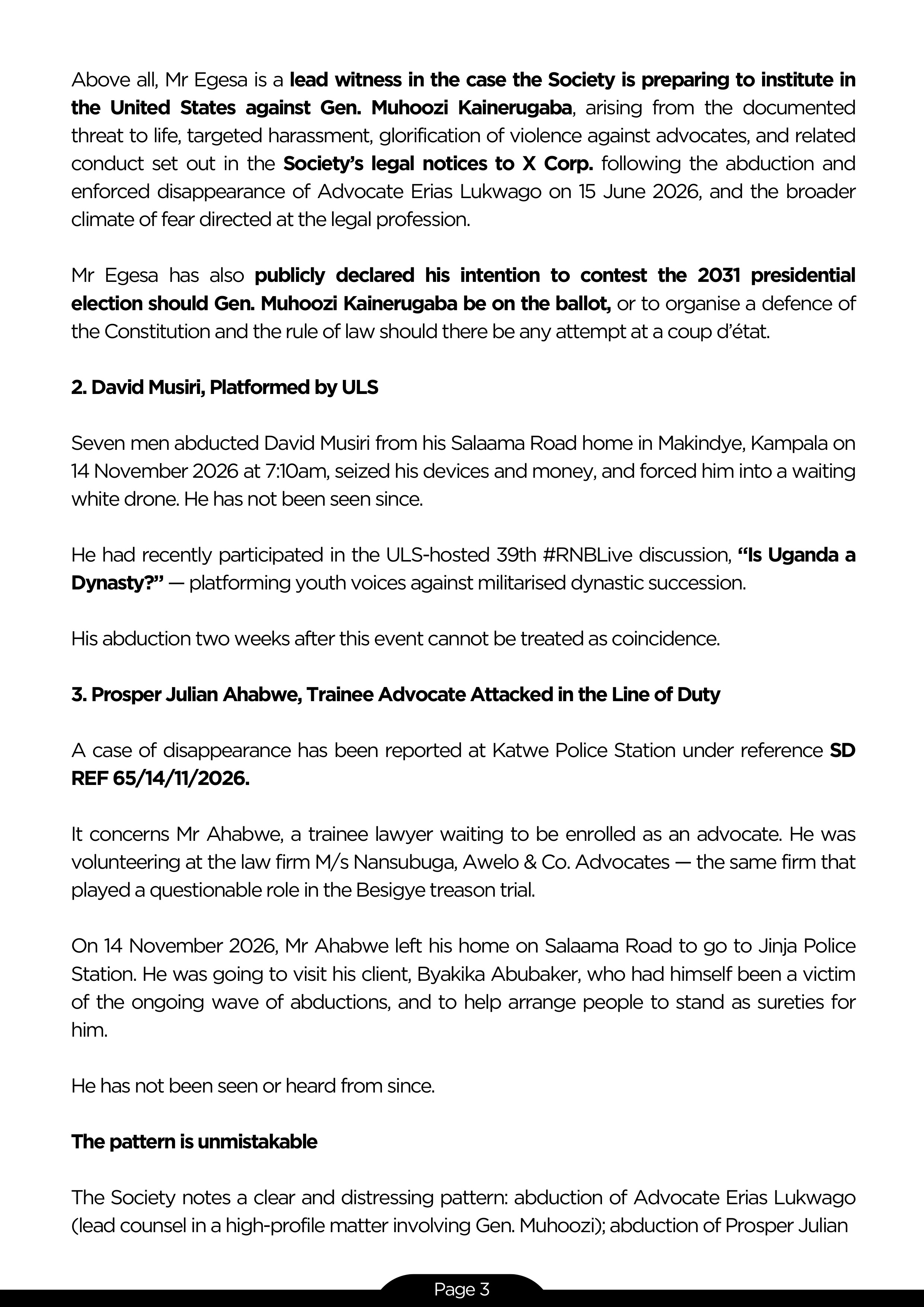
2. Secure the immediate and unconditional release of Mr Egesa Ronald Leonard, Mr David Musiri, Mr Prosper Julian Ahabwe, and all other persons held in enforced disappearance, with full disclosure of their whereabouts and physical condition.
3. Publicly retract all elimination threats issued against Ugandan citizens, including the Vice President Hon @jessica_alupo.
4. @PoliceUg, @ODPPUGANDA, and all security agencies must promptly investigate these acts as criminal abductions and threats, not political banter. Ensure that there is accountability for each enforced disappearance, including that of Sam Mugumya, Christopher Goddy alias King Zale, and JohnBosco Kibalama.
A SUBSTANTIAL REWARD AWAITS any person who provides specific, verifiable, and actionable information that materially advances the location and successful recovery of our disappeared colleagues, or the identification of the perpetrators of these abductions, together with a robust whistleblower protection protocol, including safe evacuation.
No reward will be paid for information already in the public domain, or for information that cannot be independently verified.
We ask every ULS Member, irrespective of ethnicity or party affiliation, to denounce these atrocities categorically as crimes and gross human rights violations and abuses.
To General Muhoozi and PLU: If you continue on this path of threats and abductions, you won’t like our reaction. The Uganda Law Society will document every threat, pursue every legal remedy available domestically and internationally, and mobilize the Bar, the media, and the public to defend the Constitution and the rule of law.
Silence is not an option.
Isaac K. Ssemakadde, SC
ULS President & Head of the Bar
Read the full statement below.
uls.or.ug/uls-calls-out-muho…
#FreeEgesaLeonard #FreeDavidMusiri #FreeProsperAhabwe #ResistLawlessness #FreeAllPoliticalPrisoners #ULSAT70 #RNBVision2060 #BangTheTable #BackOnTrack
@DailyExpressUg @DailyMonitor @newvisionwire @nilepostnews @observerug @ChimpReports @TheLegalReports

3
65


A Financial Intelligence Discourse with A Financial Intelligent senior Counsel.
Tune in to learn more about financial Security.
Keep time
We train lawyers to understand the law. We do not train them to understand money. And perhaps it is time we did.
Think about it. A lawyer can spend thirty years building a reputation, winning cases, advising businesses and handling millions on behalf of clients, yet retire without financial security.
That cannot be right.
Because professional success should mean more than a distinguished career. It should mean independence. Security. The ability to build something that lasts beyond our working lives.
And this is not just about how much lawyers earn. It is about what they do with what they earn. How they invest. How they manage risk. How they build firms that survive their founders. How they turn professional excellence into lasting prosperity.
The truth is, we cannot spend our lives advising others on wealth creation while neglecting our own.
This Wednesday, we are joined by Godfrey Akena, Managing Partner of Godena Associates, the first Ugandan to qualify as both an Advocate and a Certified Public Accountant, and a man with over 25 years of experience at the intersection of law, taxation and finance.
Our subject is "The Financially Intelligent Lawyer."
Because we want a profession that is not only intellectually strong, not only professionally respected, but financially secure.
Lawyers who do well. Lawyers who live well. Lawyers who leave something behind.
Wednesday, 11 November 2026 | 7 PM EAT.
Live on X, TikTok and YouTube.
In collaboration with Konrad Adenauer Stiftung.
Join the conversation.

Ohh!! my my my
@JackieAkampwera you look like Christmas ☃️🌲, Can I be your father Christmas ☃️?


With the many industries in the city centre, we may need "Fresh air reserve spots" where anyone can go and have freshness of inhaled.
However, maintenance fee be attached.
@TonyNatif Ekiteeso kiliya?

Mubiru has done alot of damage in court on this case, he concealed vital evidence of the trigger swab was extracted from the murder weapon.
Mubiru is a fraud and court should disregard ALL his testimonies & fabricated evidence he adduced to court.
UgandaVsMolly Katanga:
ICYMI: The Director of Forensic Services in Uganda Police, ACP Andrew, Admits that DNA results before Court are Edited.
But he doesn’t seem sure as to who between himself, the system or a combination of analyst colleagues is responsible for the editing.
He also refused to provide original DNA results; calling them “confidential”.
The defense challenged this, wondering where Mr Andrew Mubiru has ever seen a person convicted on confidential information they can’t challenge.
Over the defense’s protests, the Uganda Police Forensic Services Director essentially invited the court presided over by Justice Isaac Muwata to substitute scientific rigor with blind trust.
You might recall that the same Mr Andrew Mubiru back when he was working as an analyst at the Directorate of Government Analytical Laboratory (DGAL), was found by the Court of Appeal of Uganda in the Kato Kajubi case, to have tested a non-existent sample and reported results as if he had actually tested a real sample. (See frame 2)
Below is a transcript of that September 2024 cross-examination.
Mr Elison Karuhanga of Kampala Associated Advocates was the defense attorney doing the cross examination.
They’re discussing results from a comparative analysis of DNA material found on different items gotten as exhibits from the Katanga household and from Mrs Katanga in IHK (hospital) where she was receiving medical care for what a prosecution expert categorized as life threatening injuries sustained from being beaten by her now deceased husband, Late Henry Katanga.
The reference DNA samples are; a buccal swab from Mrs Molly Katanga which is reasonably expected to only have her DNA and a swab taken from Mr Henry Katanga during postmortem plus other members of the household. (You can see full video in the quoted tweet)
EK: Now, it then tells us if it was a mixture or a single source, correct?
(Note: a single source profile is when the available DNA is from one contributor/person. A mixture is when the results show there’s at least 2 people.)
AM: This is a qualitative approach which is able to show us that we are matching a single source.
EK: No, no, no, no. Does it tell us if it is a mixture or a single source?
(Note: This point is important because as it was later to be revealed, the state analyzed several DNA samples, got results as per software they used, then state analysts edited them to reflect a picture that’s different than what the system had showed. They then presented these edited results to court as DNA evidence against Mrs Katanga. In some cases, according to Mr Mubiru, some samples had at least 2 people’s DNA, they scrapped off the other person (or people) and reported it as being only Mrs Katanga’s DNA. This was never disclosed to the court or the defense until when Mr Mubiru was caught during cross examination; part of which you can find in the already referenced video)
AM: This is a qualitative arrangement, but it looks as though there are some loci which indicate additional alleles.
(Just for the non-medical science folks, here’s a basic explanation of what it is the defense and the key prosecution witness were arguing over:
At each location in our DNA (called a locus, plural loci), we each carry two versions, called “alleles”: one from our mother and one from our father. In the test used here, an allele is named by a number, such as 12 or 15. The lab's software reads peaks on a chart called an electropherogram and labels them as alleles ("allele calls"), and an analyst then reviews those labels. Because one person can have at most two alleles at any locus, finding a third or fourth points to DNA from more than one person. When Mr Mubiru testified that there appeared to be additional alleles, he was acknowledging material beyond the two that matched Mrs Katanga's reference sample (12 and 15 at that locus). He told court he treated the extra peaks as "stutter," a machine artifact, and edited them out at review, then reported the sample as coming from a single person. The defence argues those peaks were real DNA from someone else, which would mean evidence that might point elsewhere was left out of the report. According to the defense’s cross-examination of Mr Mubiru, it wasn’t just done for one sample, it was done for several samples and the original data hidden because “it’s confidential”)
EK: Hold on, hold on. Does it tell us if it is (a single source or a mixture)? Look, look, there's a word called mixture. Do you see the word called mixture?
AM: Yes.
EK: Now, for the sample 682Y23S004, which is (a swab from) Molly Katanga's mouth, does it say yes or no?
AM stammers: "The mixture called this, the system….”
EK: Does it say yes or no?
AM: It says yes.
(Note: AM saying the swab from Mrs Katanga’s mouth showed a mixed DNA profile would be a bit strange.
Mr Karuhanga is having none of that. He insists that Mr Mubiru should read his own report and tell court what he sees)
EK: No, it says no. Read. 682Y23S004. Mixture; what's the answer to that?
AM: No. (AM eventually admits that it’s a single source profile and not a mixture)
EK: So what about the bed sheet? Is the bed sheet a mixture or a single source profile?
AM: For S008 it says yes. It says it's a mixture.
EK: Yes. And you reported it as a single source?
AM: Yes, and there's a reason why
EK: Let's first record that it says it's a mixture and you recorded it as a single source.
AM: Yes.
(It’s at this point that the wheels started coming off of the state’s DNA evidence juggernaut)
EK: Now, before you even get to the reason, I want you to go to the table at page 45….a color table.
EK: So, can you find for us the loci D8, can you find for us the loci D8, D8S1179, on the top here?
EK: So that is the... that's the eighth one, yeah?
EK to Judge Muwata: If you count this here, my Lord, after sample ID, we have one, two, three, four, five, six, seven, eight, which is the D8S1179.
AM: Yes.
EK: Yeah? Now, what alleles do you have from your table recorded there?
AM: 12 and 15.
(Note: These are Mrs Katanga’s alleles. Basically think about them as part of a unique DNA serial number)
EK: So at location D8S1179, you record two alleles, 12 and 15.
AM: 12 and 15.
EK: 12 and 15 means mother, father. Two alleles, one person, correct?
AM: That's what we were able to record for that specimen.
EK: Two alleles for one person.
AM: This is an evidential material, so you cannot just say mother, father.
EK: Yeah, yeah, yeah. But what it means is she gets one number from the mother and one number from the father.
(Note: what EK was saying is also what the science says; you inherit one from your mother and one your father)
AM: My Lord, I repeat, that is misleading. This is a piece of evidence which was found at the scene.
EK: No, no, no. What I mean, those numbers, one number comes from a father, one number comes from a mother...
AM: For a single source profile. For a single source profile of a known contributor.
EK: So you would say that this is a single source profile because there are two alleles.
AM: It's a single source profile, but remember this is...
EK: Because there are two alleles.
AM: Yes.
EK: And if there are three, those become two people.
AM: That is a mixed profile…because what we usually say is “at least two people”, if there are three (alleles)
EK: Now let's go back to our match statistic. And we go to the same allele, D8S1179. That is on page eight.
EK: But the table has only two numbers, 12 and 15, indicating it's a single source profile.
EK to AM: Now go to the table in the match report.
EK: Not that one. This table, or the report itself, which is Annex 3, page 8.
Judge Muwata: Yes
EK to AM: Now, on the number 682Y23S008, at that location, how many alleles are there?
AM: aaah, the allele call has 12, 15 and 16.
EK: So there's a new number, 16.
AM: That's one of the allele calls which we…
EK: Yes, so it has 12, 15 and 16.
EK to Judge Muwata: That's my Lord here, D8S1179….it is the eighth... It's actually the eighth number from the top. This is at page 8.
Judge Muwata: Yes….
EK to Judge Muwata: And then the location which starts D8S1179. So for the sample for Molly Katanga's mouth, it has 12 and 15, indicating it is one person. For the sample for the bedsheet, it has 12, 15 and 16.
Judge Muwata: It has 12 and what?
EK: It has 12 and 15, that is for 004. And then for the bed sheet, it has 12, 15 and 16.
Judge Muwata: 12, 15 and 16
EK continues: Indicating two people.
AM: At least two people, if you look at it from a qualitative aspect.
EK to AM: So when you write in your report that you recovered a single person (profile), that is incorrect?
AM: That is still not accurate, my Lord.
EK: The report is not accurate?
AM: The report takes into consideration all the analysis I did. This is a qualitative analysis. I also do a quantitative analysis.
EK: So now, let's go slow. When you put in your table that at this location you found only two alleles, is that part of your table false?
AM: No, it is accurate.
EK squeezes AM further: So did you find allele number 16?
AM: Allele number 16 was later reviewed under quantitative arrangement and excluded on grounds of stutter.
EK: Now, it was excluded on grounds of stutter. So can you go to it in the electropherogram?
(Note: The EPG is like the master result form for DNA analysis. Before qualitatively and quantitatively cleaning results, the electropherogram must have them reflected)
AM: It was later reviewed under... It was excluded on the grounds of stutter.
Judge Muwata inquires into how allele 16 was excluded. Mr Mubiru insists “it was excluded because it was deemed to be stutter from peak number 15”.
(Note: Think earthquake and then the tremors after. They can’t be reported as an earthquake. That’s how stutter is; earthquake happens and then you have post-quake tremors. THe defense essentially says that in a series of independent earthquakes, Mr Muburi ignored entire earthquakes and instead picked the one he liked and called the rest tremors.
To relate it to DNA, on an electropherogram (EPG), “stutter” are those peaks that don’t meet the detection threshold. They may be looked at as background noise and at times, it’s best to remove them. But also, in the same vein, one can just remove peaks they find inconvenient to a pre-conceived outcome and blame it on stutter. At times, they can raise the detection threshold to a level much higher than the system is set at just to remove these inconvenient peaks. Mr Mubiru, as we’ve reported previously, was later found through cross examination by the defense and through the testimony of defense DNA expert, Ms Lynne Hingley, that he did both of these “scientific tricks”. He shifted the detection threshold from the system validated 70 to 300. He just didn’t change this on the electropherogram and Ms Lynne Hingley caught it and showed it to current presiding Judge Rosette Comfort Kania. As Mr Karuhanga told another prosecution witness in this same case, “the science caught Mr Andrew Mubiru”. But I digress…)
EK to AM: Let's go to the electropherogram. You testified the only audit which we have are these, and now you are introducing things which are not in your report. But let us move…
EK: I think page 21.
Judge Muwata: Page 21, what are you referring to?
EK: We are looking at the electropherogram, and also here, we don't have the 16, correct?
AM inquires as to the page
EK: Page 21 (of the EPG)…for sample S008
EK: We are looking at the second, at the second D8. There is a row which starts Y-indel, then Amel, then D8.
EK to AM: So for that one, the 16 is not there, correct?
AM: Yah, the 16 is not there.
EK: Do you see the stutter of the 16?
AM: aaaah, errr…I can see there is something there, but...
EK: Where? There are two peaks.
Judge Muwata: What is this one?
EK to Judge Muwata: This is the electropherogram, my Lord. This document is the electropherogram for the bed sheet recovered from Molly Katanga. The witness said that there was stutter. When you look at it quantitatively, there was a peak which he reviewed and looked at as stutter when he went through a qualitative analysis. So I'm asking him to show us the stutter. Now, my Lord, if you look, D8 has only 12 and 15. They are simply two peaks.
EK to AM: So can you confirm that you cannot see any stutter when you look at 12 and 15?
AM: A loud silence….he says nothing.
Judge Muwata to AM: Is that so?
AM: There's a small… peak there, which is…errr…which usually comes as a result of stutter. For example, on D16 you can...
EK: No, no, no. We're on D8! We're not on D16. Give us an example from D8!
AM: Pregnant silence…no answer.
EK to Judge Muwata: My Lord, D8 is just the second... the sample name 682. The first row is this Alpha One, then the second one. Then there's something called Y-indel, there's something called Amel, then there's D8S1179. Below that there are two green peaks. Below the green peaks there are numbers. There's a box which says 12 and there's another box which says 15. Judge Muwata: Yes….
EK to Judge Muwata: So the witness says there's also a box which has stutter, and now I'm just asking him to show us the stutter on the electropherogram.
AM finally walks back his earlier claim and admits the stutter he claimed was there was not there: My Lord, it's not displayed on the electropherogram.
EK: It is not displayed. So it's not there. It's not displayed on the electropherogram. The stutter is not there.
AM: It’s not displayed on the electropherogram
Judge Muwata: The stutter…?
EK: The stutter is not there
Judge Muwata then asks EK whether they’ll bring a technical person to explain all this to him
EK: No, my Lord he’s here. The technical man is here, my Lord…(as he points to Mr Andrew Mubiru)
EK continues: And what he's telling us is that his match report has an allele that doesn't exist on the electropherogram. Is that correct?
AM: My Lord, after a quantitative review, the stutter peak was removed.
EK: So this is an edited electropherogram.
AM: My Lord, these electropherograms are continuously reviewed for purposes of our work.
(Note: He didn’t say which part of their work includes reporting results different than what the system offers)
EK: Let's just get this straight. What has been brought before this court is edited. This particular electropherogram is edited even from the moment we start doing the analysis.
EK: Thank you. First stop there, let’s first record this.
Judge Muwata: How was it edited?
EK: Is another word for edited, Doctored?
AM: No.
Judge Muwata: It was edited, how, Sir?
AM: My Lord, in the course of analysis, the electroherogram has artifacts and those artifacts are filtered by the system upon a quantitative review.
(Note: Here, Mr Mubiru tells Judge Muwata that the editing or “review” is done by the system)
EK: So if they (the artifacts) are filtered, how are they ending up in our match report?
AM: Yah, because when you are doing a qualitative review, the system uploads some information, then you have a chance to look at what it has developed, and then you give it a new metric for quantitative review.
EK: And do you have... let's just get that. When you are doing a what? I didn't hear you. When you are doing a...?
AM: Quantitative review.
EK: So there is a quantitative review and a qualitative review. So before this court, what is there?
AM: We give you the answers regarding the quantitative review.
EK: So we don't have enough information before this court?
AM: You have also the qualitative review, which you have already demonstrated to court.
EK: It's demonstrating that you're editing things…
AM: No, you do a qualitative review and then after that you do a quantitative review.
EK: So there's a review which we don't have?
AM: You already have it in the report.
EK: So show me the stutter. Where is it? Show me the report.
AM: You have already showed court. My Lord, he has already showed you the 16.
EK: Where’s it?
AM: It is in the qualitative report.
EK: Which is where? Show us. Take us to a page and say, "on this page we removed the 16 because there is a qualitative stutter."
AM: My Lord, counsel has already showed you where we uploaded [on] the system; he has already showed you where the stutter is. And after that, it will be a quantitative review.
(Note: EK asked AM to show court the stutter and he eventually said it wasn’t there. It’s unclear what he meant by saying Counsel had showed court the stutter at 16)
EK: No, no, no. This (the EPG) comes first. Doesn't this come first? You testified that the only way we can audit you is by looking at this, the table and the match. I have given you just one sample. I have many I'm going through, so I want us to be clear on the answers.
AM: That's why I explained to court, my Lord, that the qualitative review allows us to go back to the electropherogram in order to understand what a qualitative review you’ve done (sic) so that now you can do a quantitative review.
(It’s unclear as to what the pre-eminent Uganda Police DNA Forensics expert meant by that)
EK: So, and it is your evidence that this electropherogram you provided to this court is edited?
AM: The electropherogram automatically has to be looked in by the analyst.
EK: So it's edited by you?
AM: We all have to look at it.
EK: So you edited it?
AM: Yes, I edited it from the moment we….look at the artifacts….
(Note: Here, Mr Mubiru switches from saying it’s the system that edited to its them (the analysts) that edited)
EK: I think... let's first, hold on. Let's first record that you edited the evidence.
AM: My Lord, it's not (editing) per se. It's called a review. That's the technical term.
EK: And nowhere do you give us the review. Can you confirm that we asked you for internal validation studies and you hid them?
AM: My Lord, the internal validation studies are studies which are done to confirm that the assay is fit for purpose.
EK: Can you confirm that we asked you for the original data and you hid it?
AM: My Lord, the original data is available, but it's confidential.
An exasperated EK then says: My Lord!! Who have you ever had being convicted on confidential information? You're here to give evidence in court. You're supposed to tell the court everything. You don't have secrets. This is not your DNA, it's hers (Mrs Katanga’s). Why are you hiding it from her? It is yours which is confidential.
AM cleverly skirts that point and instead goes on to talk about validation studies: My Lord, the validation studies are not done on the DNA of any suspect or person.
EK isn’t falling for it. He asks again about the original data that pertains to Mrs Katanga’s DNA. That’s the data that Mr Mubiru called “confidential”: “The data... not about... I’m talking about the original data. That there’s no data before this court to confirm this evidence.”
Judge Muwata: The original data is confidential?
EK: Yes
Mr Mubiru again skirts that point and goes back to talking about validation studies: The validation studies are done….
EK cuts him off: The data, I’m talking about the data!
Assistant DPP Samali Wakooli to EK: Nooo…
AM: Yes, the validation studies…
EK: Okay, the validation studies?
AM: the validation studies are done using another set of data and that data is confidential because we utilize a different set of specimens.
EK goes back to the point Mr Mubiru has been trying to avoid: And what about data... What about Molly's DNA?
Judge Muwata asks AM if he wants to answer. AM keeps quiet then Judge Muwata says, “anyway, it’s on record, if you don’t want…”
EK: No, my Lord, I think he says they (validation studies) are done using another set of data.
Judge Muwata: Is that what you wanted to say?
AM: My Lord the validation studies are done at a point when we do installation of the equipment. They’re done in concert with the manufacturer of the equipment and the people who are authorized to run these validation studies. And actually they’re not per se validation, they’re verification studies within the system.
He didn’t speak to Mrs Katanga’s original DNA data and Mr Karuhanga didn’t push him any further. Instead, he moved to another sample
EK: Okay, I want you to look at another sample on the electropherogram first….TO BE CONTINUED.
UgandaVsMollyKatanga resumes on 26th November 2026 for mention.

1
34
Let Mubiru cut the crap, he doctored the DNA results that were presented in court.
Let's not forget that such ethical conduct is in his blood DNA. E.g he did it in Kato Kajubi case & now in Katanga case..
He aided fabricatetion of evidence to cause damage on trial
UgandaVsMolly Katanga:
ICYMI: The Director of Forensic Services in Uganda Police, ACP Andrew, Admits that DNA results before Court are Edited.
But he doesn’t seem sure as to who between himself, the system or a combination of analyst colleagues is responsible for the editing.
He also refused to provide original DNA results; calling them “confidential”.
The defense challenged this, wondering where Mr Andrew Mubiru has ever seen a person convicted on confidential information they can’t challenge.
Over the defense’s protests, the Uganda Police Forensic Services Director essentially invited the court presided over by Justice Isaac Muwata to substitute scientific rigor with blind trust.
You might recall that the same Mr Andrew Mubiru back when he was working as an analyst at the Directorate of Government Analytical Laboratory (DGAL), was found by the Court of Appeal of Uganda in the Kato Kajubi case, to have tested a non-existent sample and reported results as if he had actually tested a real sample. (See frame 2)
Below is a transcript of that September 2024 cross-examination.
Mr Elison Karuhanga of Kampala Associated Advocates was the defense attorney doing the cross examination.
They’re discussing results from a comparative analysis of DNA material found on different items gotten as exhibits from the Katanga household and from Mrs Katanga in IHK (hospital) where she was receiving medical care for what a prosecution expert categorized as life threatening injuries sustained from being beaten by her now deceased husband, Late Henry Katanga.
The reference DNA samples are; a buccal swab from Mrs Molly Katanga which is reasonably expected to only have her DNA and a swab taken from Mr Henry Katanga during postmortem plus other members of the household. (You can see full video in the quoted tweet)
EK: Now, it then tells us if it was a mixture or a single source, correct?
(Note: a single source profile is when the available DNA is from one contributor/person. A mixture is when the results show there’s at least 2 people.)
AM: This is a qualitative approach which is able to show us that we are matching a single source.
EK: No, no, no, no. Does it tell us if it is a mixture or a single source?
(Note: This point is important because as it was later to be revealed, the state analyzed several DNA samples, got results as per software they used, then state analysts edited them to reflect a picture that’s different than what the system had showed. They then presented these edited results to court as DNA evidence against Mrs Katanga. In some cases, according to Mr Mubiru, some samples had at least 2 people’s DNA, they scrapped off the other person (or people) and reported it as being only Mrs Katanga’s DNA. This was never disclosed to the court or the defense until when Mr Mubiru was caught during cross examination; part of which you can find in the already referenced video)
AM: This is a qualitative arrangement, but it looks as though there are some loci which indicate additional alleles.
(Just for the non-medical science folks, here’s a basic explanation of what it is the defense and the key prosecution witness were arguing over:
At each location in our DNA (called a locus, plural loci), we each carry two versions, called “alleles”: one from our mother and one from our father. In the test used here, an allele is named by a number, such as 12 or 15. The lab's software reads peaks on a chart called an electropherogram and labels them as alleles ("allele calls"), and an analyst then reviews those labels. Because one person can have at most two alleles at any locus, finding a third or fourth points to DNA from more than one person. When Mr Mubiru testified that there appeared to be additional alleles, he was acknowledging material beyond the two that matched Mrs Katanga's reference sample (12 and 15 at that locus). He told court he treated the extra peaks as "stutter," a machine artifact, and edited them out at review, then reported the sample as coming from a single person. The defence argues those peaks were real DNA from someone else, which would mean evidence that might point elsewhere was left out of the report. According to the defense’s cross-examination of Mr Mubiru, it wasn’t just done for one sample, it was done for several samples and the original data hidden because “it’s confidential”)
EK: Hold on, hold on. Does it tell us if it is (a single source or a mixture)? Look, look, there's a word called mixture. Do you see the word called mixture?
AM: Yes.
EK: Now, for the sample 682Y23S004, which is (a swab from) Molly Katanga's mouth, does it say yes or no?
AM stammers: "The mixture called this, the system….”
EK: Does it say yes or no?
AM: It says yes.
(Note: AM saying the swab from Mrs Katanga’s mouth showed a mixed DNA profile would be a bit strange.
Mr Karuhanga is having none of that. He insists that Mr Mubiru should read his own report and tell court what he sees)
EK: No, it says no. Read. 682Y23S004. Mixture; what's the answer to that?
AM: No. (AM eventually admits that it’s a single source profile and not a mixture)
EK: So what about the bed sheet? Is the bed sheet a mixture or a single source profile?
AM: For S008 it says yes. It says it's a mixture.
EK: Yes. And you reported it as a single source?
AM: Yes, and there's a reason why
EK: Let's first record that it says it's a mixture and you recorded it as a single source.
AM: Yes.
(It’s at this point that the wheels started coming off of the state’s DNA evidence juggernaut)
EK: Now, before you even get to the reason, I want you to go to the table at page 45….a color table.
EK: So, can you find for us the loci D8, can you find for us the loci D8, D8S1179, on the top here?
EK: So that is the... that's the eighth one, yeah?
EK to Judge Muwata: If you count this here, my Lord, after sample ID, we have one, two, three, four, five, six, seven, eight, which is the D8S1179.
AM: Yes.
EK: Yeah? Now, what alleles do you have from your table recorded there?
AM: 12 and 15.
(Note: These are Mrs Katanga’s alleles. Basically think about them as part of a unique DNA serial number)
EK: So at location D8S1179, you record two alleles, 12 and 15.
AM: 12 and 15.
EK: 12 and 15 means mother, father. Two alleles, one person, correct?
AM: That's what we were able to record for that specimen.
EK: Two alleles for one person.
AM: This is an evidential material, so you cannot just say mother, father.
EK: Yeah, yeah, yeah. But what it means is she gets one number from the mother and one number from the father.
(Note: what EK was saying is also what the science says; you inherit one from your mother and one your father)
AM: My Lord, I repeat, that is misleading. This is a piece of evidence which was found at the scene.
EK: No, no, no. What I mean, those numbers, one number comes from a father, one number comes from a mother...
AM: For a single source profile. For a single source profile of a known contributor.
EK: So you would say that this is a single source profile because there are two alleles.
AM: It's a single source profile, but remember this is...
EK: Because there are two alleles.
AM: Yes.
EK: And if there are three, those become two people.
AM: That is a mixed profile…because what we usually say is “at least two people”, if there are three (alleles)
EK: Now let's go back to our match statistic. And we go to the same allele, D8S1179. That is on page eight.
EK: But the table has only two numbers, 12 and 15, indicating it's a single source profile.
EK to AM: Now go to the table in the match report.
EK: Not that one. This table, or the report itself, which is Annex 3, page 8.
Judge Muwata: Yes
EK to AM: Now, on the number 682Y23S008, at that location, how many alleles are there?
AM: aaah, the allele call has 12, 15 and 16.
EK: So there's a new number, 16.
AM: That's one of the allele calls which we…
EK: Yes, so it has 12, 15 and 16.
EK to Judge Muwata: That's my Lord here, D8S1179….it is the eighth... It's actually the eighth number from the top. This is at page 8.
Judge Muwata: Yes….
EK to Judge Muwata: And then the location which starts D8S1179. So for the sample for Molly Katanga's mouth, it has 12 and 15, indicating it is one person. For the sample for the bedsheet, it has 12, 15 and 16.
Judge Muwata: It has 12 and what?
EK: It has 12 and 15, that is for 004. And then for the bed sheet, it has 12, 15 and 16.
Judge Muwata: 12, 15 and 16
EK continues: Indicating two people.
AM: At least two people, if you look at it from a qualitative aspect.
EK to AM: So when you write in your report that you recovered a single person (profile), that is incorrect?
AM: That is still not accurate, my Lord.
EK: The report is not accurate?
AM: The report takes into consideration all the analysis I did. This is a qualitative analysis. I also do a quantitative analysis.
EK: So now, let's go slow. When you put in your table that at this location you found only two alleles, is that part of your table false?
AM: No, it is accurate.
EK squeezes AM further: So did you find allele number 16?
AM: Allele number 16 was later reviewed under quantitative arrangement and excluded on grounds of stutter.
EK: Now, it was excluded on grounds of stutter. So can you go to it in the electropherogram?
(Note: The EPG is like the master result form for DNA analysis. Before qualitatively and quantitatively cleaning results, the electropherogram must have them reflected)
AM: It was later reviewed under... It was excluded on the grounds of stutter.
Judge Muwata inquires into how allele 16 was excluded. Mr Mubiru insists “it was excluded because it was deemed to be stutter from peak number 15”.
(Note: Think earthquake and then the tremors after. They can’t be reported as an earthquake. That’s how stutter is; earthquake happens and then you have post-quake tremors. THe defense essentially says that in a series of independent earthquakes, Mr Muburi ignored entire earthquakes and instead picked the one he liked and called the rest tremors.
To relate it to DNA, on an electropherogram (EPG), “stutter” are those peaks that don’t meet the detection threshold. They may be looked at as background noise and at times, it’s best to remove them. But also, in the same vein, one can just remove peaks they find inconvenient to a pre-conceived outcome and blame it on stutter. At times, they can raise the detection threshold to a level much higher than the system is set at just to remove these inconvenient peaks. Mr Mubiru, as we’ve reported previously, was later found through cross examination by the defense and through the testimony of defense DNA expert, Ms Lynne Hingley, that he did both of these “scientific tricks”. He shifted the detection threshold from the system validated 70 to 300. He just didn’t change this on the electropherogram and Ms Lynne Hingley caught it and showed it to current presiding Judge Rosette Comfort Kania. As Mr Karuhanga told another prosecution witness in this same case, “the science caught Mr Andrew Mubiru”. But I digress…)
EK to AM: Let's go to the electropherogram. You testified the only audit which we have are these, and now you are introducing things which are not in your report. But let us move…
EK: I think page 21.
Judge Muwata: Page 21, what are you referring to?
EK: We are looking at the electropherogram, and also here, we don't have the 16, correct?
AM inquires as to the page
EK: Page 21 (of the EPG)…for sample S008
EK: We are looking at the second, at the second D8. There is a row which starts Y-indel, then Amel, then D8.
EK to AM: So for that one, the 16 is not there, correct?
AM: Yah, the 16 is not there.
EK: Do you see the stutter of the 16?
AM: aaaah, errr…I can see there is something there, but...
EK: Where? There are two peaks.
Judge Muwata: What is this one?
EK to Judge Muwata: This is the electropherogram, my Lord. This document is the electropherogram for the bed sheet recovered from Molly Katanga. The witness said that there was stutter. When you look at it quantitatively, there was a peak which he reviewed and looked at as stutter when he went through a qualitative analysis. So I'm asking him to show us the stutter. Now, my Lord, if you look, D8 has only 12 and 15. They are simply two peaks.
EK to AM: So can you confirm that you cannot see any stutter when you look at 12 and 15?
AM: A loud silence….he says nothing.
Judge Muwata to AM: Is that so?
AM: There's a small… peak there, which is…errr…which usually comes as a result of stutter. For example, on D16 you can...
EK: No, no, no. We're on D8! We're not on D16. Give us an example from D8!
AM: Pregnant silence…no answer.
EK to Judge Muwata: My Lord, D8 is just the second... the sample name 682. The first row is this Alpha One, then the second one. Then there's something called Y-indel, there's something called Amel, then there's D8S1179. Below that there are two green peaks. Below the green peaks there are numbers. There's a box which says 12 and there's another box which says 15. Judge Muwata: Yes….
EK to Judge Muwata: So the witness says there's also a box which has stutter, and now I'm just asking him to show us the stutter on the electropherogram.
AM finally walks back his earlier claim and admits the stutter he claimed was there was not there: My Lord, it's not displayed on the electropherogram.
EK: It is not displayed. So it's not there. It's not displayed on the electropherogram. The stutter is not there.
AM: It’s not displayed on the electropherogram
Judge Muwata: The stutter…?
EK: The stutter is not there
Judge Muwata then asks EK whether they’ll bring a technical person to explain all this to him
EK: No, my Lord he’s here. The technical man is here, my Lord…(as he points to Mr Andrew Mubiru)
EK continues: And what he's telling us is that his match report has an allele that doesn't exist on the electropherogram. Is that correct?
AM: My Lord, after a quantitative review, the stutter peak was removed.
EK: So this is an edited electropherogram.
AM: My Lord, these electropherograms are continuously reviewed for purposes of our work.
(Note: He didn’t say which part of their work includes reporting results different than what the system offers)
EK: Let's just get this straight. What has been brought before this court is edited. This particular electropherogram is edited even from the moment we start doing the analysis.
EK: Thank you. First stop there, let’s first record this.
Judge Muwata: How was it edited?
EK: Is another word for edited, Doctored?
AM: No.
Judge Muwata: It was edited, how, Sir?
AM: My Lord, in the course of analysis, the electroherogram has artifacts and those artifacts are filtered by the system upon a quantitative review.
(Note: Here, Mr Mubiru tells Judge Muwata that the editing or “review” is done by the system)
EK: So if they (the artifacts) are filtered, how are they ending up in our match report?
AM: Yah, because when you are doing a qualitative review, the system uploads some information, then you have a chance to look at what it has developed, and then you give it a new metric for quantitative review.
EK: And do you have... let's just get that. When you are doing a what? I didn't hear you. When you are doing a...?
AM: Quantitative review.
EK: So there is a quantitative review and a qualitative review. So before this court, what is there?
AM: We give you the answers regarding the quantitative review.
EK: So we don't have enough information before this court?
AM: You have also the qualitative review, which you have already demonstrated to court.
EK: It's demonstrating that you're editing things…
AM: No, you do a qualitative review and then after that you do a quantitative review.
EK: So there's a review which we don't have?
AM: You already have it in the report.
EK: So show me the stutter. Where is it? Show me the report.
AM: You have already showed court. My Lord, he has already showed you the 16.
EK: Where’s it?
AM: It is in the qualitative report.
EK: Which is where? Show us. Take us to a page and say, "on this page we removed the 16 because there is a qualitative stutter."
AM: My Lord, counsel has already showed you where we uploaded [on] the system; he has already showed you where the stutter is. And after that, it will be a quantitative review.
(Note: EK asked AM to show court the stutter and he eventually said it wasn’t there. It’s unclear what he meant by saying Counsel had showed court the stutter at 16)
EK: No, no, no. This (the EPG) comes first. Doesn't this come first? You testified that the only way we can audit you is by looking at this, the table and the match. I have given you just one sample. I have many I'm going through, so I want us to be clear on the answers.
AM: That's why I explained to court, my Lord, that the qualitative review allows us to go back to the electropherogram in order to understand what a qualitative review you’ve done (sic) so that now you can do a quantitative review.
(It’s unclear as to what the pre-eminent Uganda Police DNA Forensics expert meant by that)
EK: So, and it is your evidence that this electropherogram you provided to this court is edited?
AM: The electropherogram automatically has to be looked in by the analyst.
EK: So it's edited by you?
AM: We all have to look at it.
EK: So you edited it?
AM: Yes, I edited it from the moment we….look at the artifacts….
(Note: Here, Mr Mubiru switches from saying it’s the system that edited to its them (the analysts) that edited)
EK: I think... let's first, hold on. Let's first record that you edited the evidence.
AM: My Lord, it's not (editing) per se. It's called a review. That's the technical term.
EK: And nowhere do you give us the review. Can you confirm that we asked you for internal validation studies and you hid them?
AM: My Lord, the internal validation studies are studies which are done to confirm that the assay is fit for purpose.
EK: Can you confirm that we asked you for the original data and you hid it?
AM: My Lord, the original data is available, but it's confidential.
An exasperated EK then says: My Lord!! Who have you ever had being convicted on confidential information? You're here to give evidence in court. You're supposed to tell the court everything. You don't have secrets. This is not your DNA, it's hers (Mrs Katanga’s). Why are you hiding it from her? It is yours which is confidential.
AM cleverly skirts that point and instead goes on to talk about validation studies: My Lord, the validation studies are not done on the DNA of any suspect or person.
EK isn’t falling for it. He asks again about the original data that pertains to Mrs Katanga’s DNA. That’s the data that Mr Mubiru called “confidential”: “The data... not about... I’m talking about the original data. That there’s no data before this court to confirm this evidence.”
Judge Muwata: The original data is confidential?
EK: Yes
Mr Mubiru again skirts that point and goes back to talking about validation studies: The validation studies are done….
EK cuts him off: The data, I’m talking about the data!
Assistant DPP Samali Wakooli to EK: Nooo…
AM: Yes, the validation studies…
EK: Okay, the validation studies?
AM: the validation studies are done using another set of data and that data is confidential because we utilize a different set of specimens.
EK goes back to the point Mr Mubiru has been trying to avoid: And what about data... What about Molly's DNA?
Judge Muwata asks AM if he wants to answer. AM keeps quiet then Judge Muwata says, “anyway, it’s on record, if you don’t want…”
EK: No, my Lord, I think he says they (validation studies) are done using another set of data.
Judge Muwata: Is that what you wanted to say?
AM: My Lord the validation studies are done at a point when we do installation of the equipment. They’re done in concert with the manufacturer of the equipment and the people who are authorized to run these validation studies. And actually they’re not per se validation, they’re verification studies within the system.
He didn’t speak to Mrs Katanga’s original DNA data and Mr Karuhanga didn’t push him any further. Instead, he moved to another sample
EK: Okay, I want you to look at another sample on the electropherogram first….TO BE CONTINUED.
UgandaVsMollyKatanga resumes on 26th November 2026 for mention.
3
105
"There is Emyooga & PDM, join them get the money and start small"... a government official is about to tell you yhat

Dear HE @KagutaMuseveni I am one of the 3 Uganda engineers you sponsored to Japan to develop Uganda's first satellite (PearlAfricaSat-1)under @STIsecretariat but I currently have no job and would love to serve my country.
My email: [email protected]
Kind regards,
Derrick

63

Mubiru is unethical & unprofessional he has normalized committing perjury in courts of law & his testimonies hold nah credibility.
Why is this case still in court?
There is simply no evidence against the suspects.
Prosecution got the wrong suspects here and case be dismissed
ICYMI: The Day The Director of Forensic Services in Uganda Police, ACP Andrew Mubiru Told Court That The Results Before Court Were Edited and Not The Actual Results The Analysis System Produced.
The defense called them “doctored”, he called them “edited” and said there was a reason for the editing, which he never provided.
He also declined to provide the original form of the results, edit history or validation studies for independent verification as well; calling them “confidential”.
I’m not making this up, read on for details.
I’ll explain in a three part series but first, the broad details;
In September 2024, during cross-examination by defence attorney Mr Elison Karuhanga, the Director of Forensics at @PoliceUg, Mr Andrew Kizimula Mubiru, was asked about the DNA electropherograms (EPGs) he had placed before court.
He said he was the analyst and he edited them. When asked for the originals, he said they were “confidential”. You might recall from our earlier reports that Mr Mubiru later denied being the analyst
Why this matters:
EPGs are computer generated graphs that display raw data produced during DNA separation and analysis. Reading them against a reference sample tells you how many people’s DNA is present, whose it is etc. Editing some peaks out cleverly hides this information.
The state's DNA report says a bed sheet recovered from Mrs Molly Katanga carried a single person's DNA profile, hers.
But the system's own match report, which Mr Mubiru attached as Annex 3, said otherwise. It flagged the bed sheet as a MIXTURE. At two DNA markers (D8S1179 and D7), the system recorded three alleles. Three alleles means at least two people.
The electropherograms before court showed only two alleles.
Asked where the third peak went, Mr Mubiru said it was a "stutter", a small artefact of the DNA copying process, and that he had removed it on review.
Mr Karuhanga asked him to show the stutter on the electropherogram.
He said: "It's not displayed”
EK: "So this is an edited electropherogram."
AM: "Yes, I edited."
He later conceded that, according to the system, the bed sheet "indicates a mixture… more than one person's DNA on it."
And when asked for the raw data and internal validation studies that would let anyone check his call? "The original data is available, but it's confidential."
Note: Removing stutter can be legitimate. Labs do it. But a stutter and a second person's DNA can look EXACTLY alike on a graph. The decision to call a peak "stutter" can turn a two-person mixture into a single-source profile. In a murder trial, that can be the whole case.
Mr Mubiru just invited court to not check him; but take his word for it; a courtroom version of “trust me bro”.
He edited the graphs, set thresholds that didn’t match his own testimony, then held the raw data as "confidential".
He invited court to ditch the science and instead trust him.
The Defense’s View
Mr Karuhanga called the police forensics lab “a kitchen that cooks results”.
Fast forward to July 2026;
Defense DNA expert Ms Lynne Hingley (DW4) told court:
1-Mr Mubiru said they used a threshold of 300 RFUs to remove noise (edit). The state's own software report shows 70. (See here: teapawt.net/tonynatif/status/20776…)
2-A negative control contained DNA from at least 2 people, "a gross contamination event."
3-One gun sample with 4 contributors was modelled as if it had 3. The model then failed validation checks 7 times.
4-Even with perfect results, "the DNA result itself does not help address in any way who fired that gun."
On the issue of who was the analyst anyway?
Mr Mubiru answered that. Well, sort of….
On different days, he described himself as the analyst, the lead examiner, the supervisor, "supervisor, not examiner," and the reviewer.
He also told court the logged-in users were ASP Barnabas Haririmana and SP Lillian Mutesi, not himself. (See here: teapawt.net/tonynatif/status/20867…)
You can find the cross-examination link here: youtube.com/live/sP3QIBb-l-U…
5
98