

Toronto, Ontario
Joined August 2015
- Tweets26K
- Following290
- Followers2.4K
- Likes24.5K









Andrei Palitsa retweeted

My brother’s friend drives a Tesla. This is 3 videos of the same accident. The Tesla, on self drive, sees the approaching car coming from behind at excessive speed and moves out of the way. Driver of speeding car was killed. Amazing technology @elonmusk.
Andrei Palitsa retweeted

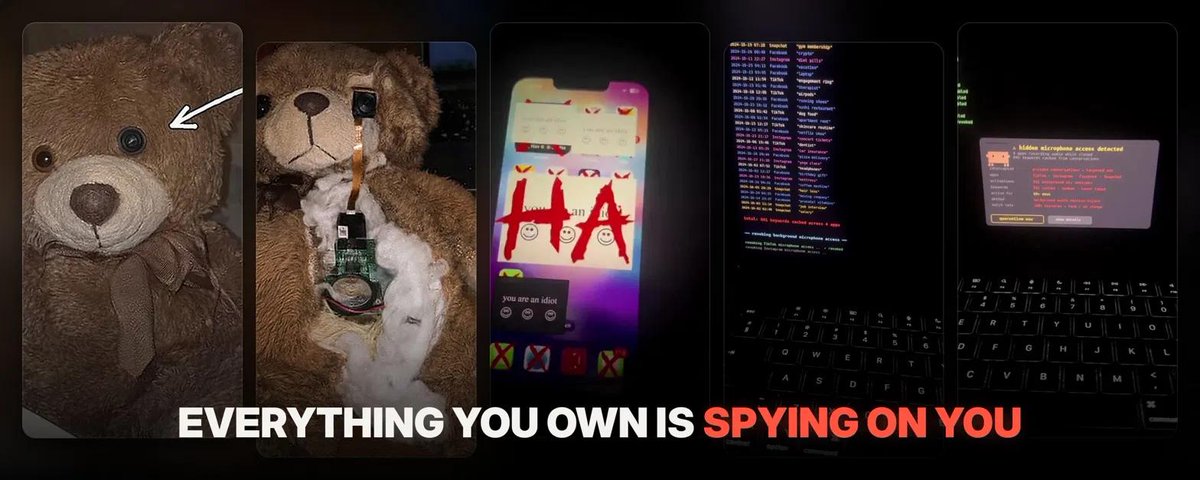
Claude Code just found proof that every app on your phone is listening to your conversations. TikTok, Instagram, Facebook, Snapchat. they're using what you say out loud to build your feed. i have the data to prove it.
i was on a call with my friend and told him i'm thinking about breaking up with my girlfriend. didn't text it. didn't search it. just said it out loud with my phone on the table. two hours later she opens TikTok next to me and her entire feed is breakups. "signs your relationship is over." "how to heal after a breakup." she looked at me and said "why is TikTok showing me this." i said i don't know. but i did know.
i connected my iPhone to my MacBook and ran Claude Code.
it scanned every app's background microphone activity for the last 90 days. apps that only had access to photos or location were activating the microphone anyway.
→ TikTok → 412 background activations while the app was "closed"
→ Instagram → 284
→ Facebook → 197
→ Snapchat → 118
each activation lasted 2 to 12 seconds. enough to catch a sentence. each one tagged a keyword and cached it on the phone with a timestamp.
→ "breakup" — tagged 4 hours before her feed changed
→ "new apartment" — from a call with my mom
→ "engagement ring" — from a private call with my sister i never searched
→ "creatine" — said to my roommate, ads within 40 minutes
→ "bali flights" — mentioned at dinner, travel ads by morning
1,011 keywords cached across 4 apps in 90 days. every one matched something i said out loud near my phone.
checked my girlfriend's phone next. same keywords. same timestamps. both phones picking up the same conversation independently.
Claude Code revoked microphone access, disabled background app refresh, turned off "Hey Siri" and nearby interaction on both phones. within 48 hours both feeds went completely random. nothing personal. that's when i knew for sure.
the full prompt is in the first reply. takes 3 minutes. save it and send it to anyone who's ever said "my phone is definitely listening to me." it is. now you can prove it and shut it down.




Andrei Palitsa retweeted

Recently I was talking with a friend about universal geniuses. And something struck me.
Florence, 1480–1510. Same city, same moment: Leonardo da Vinci, Michelangelo, Machiavelli, Botticelli, Pico della Mirandola. Raphael right behind them. They walked the same streets.
Europe, 1600–1700. Galileo, Kepler, Descartes, Pascal, Huygens, Newton, Leibniz. In two generations, we got calculus, modern mechanics, probability theory, and the scientific method.
Athens, 470–320 BC. Socrates, Plato, Aristotle, Sophocles, Phidias, Thucydides. One century, one city, and the foundations of Western thought were laid.
Europe, 1890–1930. Poincaré, Hilbert, Einstein, Marie Curie, Tesla, Planck, Bohr, then von Neumann.
Always the same pattern. In every great era, the West had 15 to 20 minds of this caliber alive at the same time. People who could touch everything and push the frontier of several fields at once.
Today we have one. Just one. Elon Musk.
And Elon is an anomaly.
Not in the sense that he shouldn't exist. In the sense that the world we built is designed so that someone like him never emerges. Statistically, he shouldn't be here.
Because what forged Elon was an absolutely insane move.
October 2002. eBay buys PayPal. Elon walks away with roughly $180M. Anyone else buys an island and never works another day.
He puts $100M into SpaceX, $70M into Tesla, $10M into SolarCity. Almost everything. On rockets and electric cars, two industries no sane person wanted to touch.
2006–2008. The first three Falcon 1 launches fail. Tesla is burning cash, the financial crisis hits, investors run. He has enough left for one last launch. Just one. He borrows money from friends to pay his rent.
September 28, 2008. The fourth launch reaches orbit.
December 23, 2008. NASA awards SpaceX a $1.6B contract.
December 24, 2008. The Tesla round closes at the last possible hour. A few more days and everything collapses.
That's what a genius is. Not just IQ. The ability to put everything on the table when the entire world tells you it's impossible, and be right.
Now the real question: why do we only have one?
Because a genius needs three things. The freedom to try. The right to get massively rich if it works. The right to fail without being destroyed.
And that's exactly what the collectivist left and the technocrats have torn down across the West for the past 50 years.
They turned success into suspicion. Making a lot of money became a moral failing. Taking risks became irresponsible. Rising above the crowd became an insult to equality.
They stacked up norms, committees, permits, regulations written in Brussels by people who have never built anything in their lives. In Europe, Elon would never have been allowed to blow up three rockets. He'd have been stopped at the first form.
They want to tax capital before it even exists, cap fortunes, redistribute what others created by risking everything.
They replaced excellence with conformity. Our schools produce docile people, not dangerous ones. And a genius, by definition, is someone who disrupts. Their entire system is built to neutralize the people who disrupt.
The result: where we should have 15 to 20 universal geniuses alive at the same time, we have one.
Just one.
And you want to put him in prison.
You summon him before judges, you raid his offices, you insult him morning, noon and night, you dream of breaking up his companies. The man who lands rockets vertically and wants to take humanity to Mars.
You're disgusting.
History won't remember your names. It remembers Galileo, not the inquisitors who tried to silence him.
Andrei Palitsa retweeted

If you've ever wondered why smart TVs are so cheap, this is why.
@log4j rooted his Samsung and found an always-on hot mic, automatic content recognition, geolocation, network mapping, ad targeting and user profiling, shared with Samsung's "400 partners".
A lot of it can be blocked in <15 min, wrote a basic guide below.
What your TV is doing
The main culprit is ACR (automatic content recognition). Your TV screenshots what's on screen, fingerprints it, and sends it home to build your ad profile. Samsung does it every 500ms, LG every 10ms [1].
What is insane: it happens on connected devices too.
Plug in your laptop, your console, your work machine, and your TV can fingerprint that via HDMI [1].
He also found that if your Samsung doesn't have a mic, it'll look for one from a connected soundbar or bluetooth device.
teapawt.net/log4j/status/211376224…
It's on by default, and you likely agreed to it on the setup screen you clicked through in 10 seconds.
Step 1: Turn off ACR
Samsung: Terms & Privacy → Viewing Information Services
LG: Live Plus
Vizio: Viewing Data
Roku: "Use info from TV inputs"
Sony/Google TV: Samba Interactive TV
Menus vary by model, but those are the names to look for. While you're in there, opt out of interest-based ads, reset your advertising ID, decline every optional privacy agreement, turn off voice recognition, and delete apps you never open.
Step 2: Give smart devices their own network
Put the TV, cameras, speakers and vacuum on your router's guest/IoT network. The logic is simple: these devices rarely get patched. If one gets compromised (getting drastically more frequent with AI), it shouldn't be able to see your other devices or home network.
Step 3: Block trackers for the whole house with DNS-level filtering
NextDNS (cloud-based) is easy and has a solid free plan. Pi-hole is a little bit more work if you prefer self hosting. For simplicity we'll focus on the former.
1. Sign up at nextdns.io (free tier is plenty)
2. Privacy tab: add a blocklist (OISD is a good bet) and turn on Native Tracking Protection for Samsung, LG, Roku, Amazon (see attached image)
3. Setup tab: copy your endpoint
4. Paste it into your router's DNS settings as DNS-over-HTTPS/TLS (or use the IPs + "Link IP" if your router only does plain DNS)
5. Bonus: block outbound port 53 except to your router. Some devices hardcode their own DNS to get around you
Then open the NextDNS logs and watch how often your TV phones home. It's eye-opening. If an app or update breaks, find the domain in the logs and allowlist it.
Why they do this
TV prices are down 97% since 2000 [2]. Most of that is better manufacturing and brutal competition. But once margins on the hardware hit zero, the cost moved to you.
In Q3 2024, Vizio lost $6.7M selling TVs and made $115.8M in gross profit from ads and viewing data [3]. They've said on earnings calls that they keep TV prices low to grow the audience they sell to advertisers. Walmart bought them in 2024.
This isn't a conspiracy theory either. Vizio paid $2.2M to the FTC in 2017 for tracking 11 million TVs without consent. Last December, Texas sued Samsung, LG, Sony, Hisense and TCL over ACR. Samsung and LG have since agreed to stop collecting that data without explicit consent [4].
TL;DR
1. ACR off
2. Ads + voice off
3. Smart devices on their own network
4. NextDNS filtering on the router
Sources:
[1] ACR study: arxiv.org/abs/2409.06203
[2] Cost of US consumer goods: aei.org/economics/chart-of-t…
[3] Vizio Q3 2024: sec.gov/Archives/edgar/data/…
[4] Texas v. Samsung: texasattorneygeneral.gov/new…


Andrei Palitsa retweeted

中国花2000万买了个航母空壳?乌克兰专家:光是4个发动机就超过两千万。
一开始乌克兰给这艘未完工的航母开出了4亿美元的报价,连续挂牌五年都无人问津,直到九十年代末,财政窘迫的乌克兰才把价格压到了2000万美元,几乎等同于一堆优质特种钢材的废铁价。
当时西方媒体集体嘲讽,说中国人花2000万美元买了一堆毫无用处的海上废铁,完全是当了冤大头。
可熟悉这艘航母建造全过程的乌克兰工程师却在旁边心疼得直咂嘴:这艘舰上原装的4台TB-12蒸汽轮机,光是出厂时的造价,单台就超过500万美元,四台加起来的价值早就超过了2000万美元。
这四台动力系统,是苏联当年为了对抗美国尼米兹级航母专门研发的核心装备,单台功率高达4.5万马力,四台同时输出能让6万多吨的航母跑出30节以上的最高航速。
整套动力系统的耐高温、抗冲击性能,在当时全球范围内都属于顶尖水平,哪怕放在20多年后的今天,依然是重型航母动力体系里的第一梯队产品。
乌克兰专家心里比谁都清楚,这四台几乎全新的蒸汽轮机,本身的价值就已经远超2000万美元的总成交价,更别说舰体上采用的特种甲板钢、大型舰体结构件,这些东西的总造价,在苏联时期就已经超过了20亿美元。
但当时的西方势力根本不可能让中国完整拿到这套核心装备,在美国的强硬施压下,乌克兰方面被迫对航母进行了“剥皮式”的拆解:舰上所有的武器系统、雷达控制系统、管路线束全部被炸毁切割。
唯独这套安装在舰体最深处、体积巨大难以拆解的蒸汽轮机和配套轴系,被保留了下来。
西方的评估报告里笃定地认为,哪怕留下了动力系统,没有配套的控制系统,中国人也根本不可能让这艘6万吨的巨舰重新动起来,最终只能把它拆成废钢铁卖掉。
当年以2000万美元拍下这艘航母的徐增平,也没有只盯着船壳本身,他在谈判桌上咬死了一个旁人都觉得多余的条件:必须把全套完整的设计图纸一起交付。
最终乌方妥协,整整装了8辆大卡车、总重四五十吨的全套设计图纸,和航母一起交付给了中方,这些图纸里详细标注了每一个舱室的结构、动力系统的安装参数、舰体的应力分布数据,这些资料的价值,根本不是2000万美元能衡量的。
后续的归国之路更是走得无比艰难,瓦良格号1999年从黑海造船厂出发,在土耳其博斯普鲁斯海峡被无理阻拦了整整506天。
光是滞留期间的拖船费、停泊费就烧掉了近千万美元,之后又因为苏伊士运河不让无动力船只通行,只能绕非洲南端的好望角兜了大半个地球,整整走了四年零八个月,才终于在2002年抵达大连港。
算上沿途的所有通行成本、协调开销,整个项目的实际投入,早就远远超过了最初的2000万美元。
后来中国的造船团队接手这艘航母之后,依托完整的设计图纸和几乎完好的原装动力系统,用了7年时间完成了全部改装工作。
2012年,这艘被重新命名为“辽宁舰”的航母正式交付中国海军,中国终于拥有了自己的第一艘航空母舰。
当年乌克兰专家口中“4台发动机就超过两千万”的判断,后来被完全印证了:这套原装的蒸汽轮机,为中国航母动力体系的研发节省了至少十几年的摸索时间,后来国产航母山东舰的动力系统,正是在这套技术的基础上完成了国产化自主生产。
信息来源:环球网《瓦良格号航母刚到中国时满是淤泥破败不堪》

Andrei Palitsa retweeted

"Das Pferd wird es immer geben, aber das Automobil ist nur eine Modeerscheinung – ein Spielzeug für Reiche."
Michigan Savings Bank, 1903
"Ich denke, es gibt weltweit einen Markt für vielleicht fünf Computer."
Thomas Watson, 1943
"No chance that the iPhone is going to get any significant market share."
Steve Ballmer, 2007
"Das Internet hat für die Wirtschaft kaum wichtigere Auswirkungen als das Faxgerät."
Paul Krugman, 1998
"Flugmaschinen, die schwerer sind als Luft, sind physikalisch unmöglich."
Lord Kelvin, 1895
"Das Spam-Problem bei E-Mails wird in spätestens zwei Jahren gelöst sein"
Bill Gates, 2004
"Der Fernseher wird sich auf dem Markt nicht halten. Die Menschen werden es bald leid sein, jeden Abend auf eine Sperrholzkiste zu starren."
Darryl F. Zanuck, 1946
"Es gibt keinen Grund, warum jemand einen Computer in seinem Haus haben wollte."
Ken Olson, 1977
"Wenn die Pariser Weltausstellung schließt, wird das elektrische Licht ausgehen und man wird nie wieder davon hören."
Erasmus Wilson, 1878
"Die Amerikaner brauchen das Telefon vielleicht, wir aber nicht. Wir haben genug Laufburschen."
William Preece, 1876
"Egal wie die Wissenschaft in Zukunft fortschreitet, der Mensch wird den Mond niemals erreichen."
Lee De Forest, 1957
"Reisen mit hoher Geschwindigkeit ist nicht möglich, weil die Passagiere keine Luft mehr bekommen und an Erstickung sterben würden."
Dionysius Lardner, 1830
"Mit Wechselstrom herumzuspielen ist reine Zeitverschwendung. Niemand wird ihn jemals nutzen."
Thomas Edison, 1889
"Mobiltelefone werden die Drahttelefone absolut nicht ersetzen."
Marty Cooper, 1981
#TeslaRoadster
#Tesla





Andrei Palitsa retweeted

Here is the next-gen Tesla Roadster development video from the unveil event that they shared exclusively with us.
Andrei Palitsa retweeted

Jensen Huang told the story of how Elon Musk became NVIDIA’s very first customer for their powerful AI supercomputer
“When I announced this thing, nobody in the world wanted it. I had no purchase orders, not one. Nobody wanted to buy it. Nobody wanted to be part of it.
Except for Elon.
He was at the event, and we were doing a fireside chat about the future of self-driving cars. I think it's like 2016, maybe 2015. And he goes, 'You know what? I have a company that could really use this.'
I said, 'Wow, my first customer.' And so I was pretty excited about it.
And he goes, 'Yeah, we have this company. It's a nonprofit company.'
And all the blood drained out of my face. I just spent a few billion dollars building this thing. It cost $300,000. And the chances of a nonprofit being able to pay for this thing is approximately zero.
And he goes, 'You know, this is an AI company. And it's a nonprofit. And we could really use one of these supercomputers.'
And so I picked it up. I built the first one for ourselves. We're using it inside the company. I boxed one up. I drove it up to San Francisco, and I delivered it to Elon in 2016. A bunch of researchers were there. And I walk up to the second floor, where they were all kind of in a room that's smaller than your place here. And that place turned out to have been OpenAI.”
Andrei Palitsa retweeted
Jensen Huang once admitted that when NVIDIA unveiled its first AI supercomputer, nobody wanted it. Not a single purchase order.
Except for Elon Musk.
"He goes, 'You know what? I have a company that could really use this.'"
But then came the twist: it was a nonprofit😂😂 The machine cost $300,000, and Jensen thought the odds of getting paid were "approximately zero." He delivered it anyway, driving it to San Francisco himself in 2016 to a room full of researchers who turned out to be OpenAI.
Elon saw the value of AI computing when the whole world couldn't understand it. He's done it again and again, spotting the future years before everyone else, then backing it with action instead of words.


Jensen Huang told the story of how Elon Musk became NVIDIA’s very first customer for their powerful AI supercomputer
“When I announced this thing, nobody in the world wanted it. I had no purchase orders, not one. Nobody wanted to buy it. Nobody wanted to be part of it.
Except for Elon.
He was at the event, and we were doing a fireside chat about the future of self-driving cars. I think it's like 2016, maybe 2015. And he goes, 'You know what? I have a company that could really use this.'
I said, 'Wow, my first customer.' And so I was pretty excited about it.
And he goes, 'Yeah, we have this company. It's a nonprofit company.'
And all the blood drained out of my face. I just spent a few billion dollars building this thing. It cost $300,000. And the chances of a nonprofit being able to pay for this thing is approximately zero.
And he goes, 'You know, this is an AI company. And it's a nonprofit. And we could really use one of these supercomputers.'
And so I picked it up. I built the first one for ourselves. We're using it inside the company. I boxed one up. I drove it up to San Francisco, and I delivered it to Elon in 2016. A bunch of researchers were there. And I walk up to the second floor, where they were all kind of in a room that's smaller than your place here. And that place turned out to have been OpenAI.”
Andrei Palitsa retweeted

A retired NASA engineer who had worked on the Space Shuttle program for 25 years was hired by SpaceX at age 62. He described the first week as the most disorienting experience of his professional life.
At NASA, a design change required 3 meetings, 2 committees, a review board, and 6 to 18 months of documentation. At SpaceX, his new supervisor said "if it works, build it. If it doesn't, change it by Friday."
He sat at his desk after the first day and called his wife. He told her he felt like a man who had been swimming with ankle weights for 25 years and someone just cut them off. He could move. He could decide. He could build something in the morning and test it in the afternoon. The constraint that he had accepted as the nature of aerospace engineering turned out to be the nature of bureaucracy.
Within 6 months he had contributed to more design iterations than he had completed in his last 5 years at NASA. Not because he was working harder. Because the time between having an idea and testing the idea collapsed from months to hours. The same brain. The same knowledge. A different operating system.
He described a specific moment where he proposed a modification to a Raptor engine component. At NASA, the proposal would have entered a queue. At SpaceX, the modification was machined by the end of the day and tested by the following morning. He watched his idea become a physical object in 18 hours. At NASA, 18 hours would not have been enough to schedule the first meeting to discuss whether to schedule a meeting.
He told an interviewer: "I didn't get smarter when I went to SpaceX. I got faster. The intelligence was always there. The system was in the way."
The difference between SpaceX and NASA is not talent. NASA has extraordinary talent. The difference is the time between a thought and a test. SpaceX compresses it. NASA elongates it. The same engineer produces 10x more at SpaceX than at NASA because the bottleneck was never the engineer. It was the meetings about the meetings about the work.

Andrei Palitsa retweeted

“If you think tough men are dangerous, wait until you see what weak men are capable of.”
—Jordan Peterson

Andrei Palitsa retweeted

💥NEW REPORT: The Forgotten RCMP Report That Challenges Canada's Reconciliation Story
The 2003 RCMP report found B.C. secret-burial claims, turned up NO EVIDENCE and recorded most deaths from disease. Kamloops logged 79 assault complainants—not 215 hidden graves.
Between 1995 and 2003, the RCMP "E" Division conducted Project E-NIRS—the only province-wide criminal investigation of its kind into allegations at British Columbia's 15 residential schools. Corporal M.W. Pacholuk authored the final report, which examined every allegation of physical and sexual abuse, along with unlawful and suspicious deaths.
The task force didn't just investigate rumours—they physically tested them. On February 24, 1999, with the band's permission, they went to Kuper Island, where stories of dead babies buried there had circulated for years. Investigators dug up suspected burial sites and found no evidence that would support any of these allegations.


Andrei Palitsa retweeted

MŁODZI TO PATOLOGIA.
1. Wyprodukowaliśmy pokolenie ludzi, którzy mają dostęp do całej wiedzy ludzkości w kieszeni, a jednocześnie nie wiedzą absolutnie nic. Nie znają historii, geografii, ekonomii ani własnego kraju, ale posiadają opinię na KAŻDY temat. Dawniej, żeby być ignorantem, trzeba było przynajmniej nie mieć dostępu do książek. Dzisiaj ignorancja wymaga aktywnego wysiłku.
2. Nie panują nad własnymi emocjami. Wszystko jest „toksyczne”, „traumatyczne”, „problematyczne” albo „triggerujące”. Krytyka staje się atakiem. Dyskomfort staje się cierpieniem. Niepowodzenie staje się traumą. Zamiast nauczyć człowieka radzić sobie z rzeczywistością, nauczono go tworzyć coraz bardziej wyrafinowane słownictwo do opisywania tego, dlaczego rzeczywistość powinna dostosować się do niego.
3. Nie potrafią też docenić tego, co mają. Żyją w jednym z najbezpieczniejszych i najbogatszych okresów historii, otoczeni technologią, o której ich pradziadkowie nie potrafiliby nawet fantazjować, a zachowują się tak, jakby zostali zesłani do kopalni soli w XIV wieku. Ciepłe mieszkanie, pełna lodówka, smartfon, wakacje, streaming, dostawa jedzenia pod drzwi — i permanentne poczucie krzywdy.
4. Są źle wychowani. Nie dlatego, że nie znają właściwego widelca do ryby. Gorzej: nie rozumieją, że przestrzeń publiczna należy również do innych ludzi. Głośnik w autobusie, hulajnoga między pieszymi, telefon przy stole, darcie mordy w miejscu publicznym. Świat jest sceną, oni są głównymi bohaterami, a reszta społeczeństwa ma zejść z kadru.
5. Nie potrafią czekać. Nie potrafią się nudzić. Nie potrafią przez pięć minut siedzieć bez bodźca. Telefon musi być sprawdzony podczas jedzenia, rozmowy, spaceru, pracy i kiedyś prawdopodobnie własnego pogrzebu. Pokolenie z największym dostępem do informacji w historii wytrenowało sobie zdolność koncentracji złotej rybki na amfetaminie.
6. Nie potrafią niczego naprawić. Nie potrafią niczego zbudować. Część nie potrafi ugotować pięciu normalnych obiadów, przyszyć guzika, odetkać odpływu ani zorganizować własnego dnia bez aplikacji. Za to doskonale wiedzą, jak powinno zostać zreorganizowane całe społeczeństwo.
7. Nie mają cierpliwości do kompetencji. Chcą rezultatów bez praktyki, pozycji bez hierarchii, pieniędzy bez doświadczenia i autorytetu bez osiągnięć. Jeśli ktoś robił coś przez dwadzieścia lat, to nie jest ekspertem. Jest „gatekeeperem”.
8. Nie rozumieją pieniędzy. Subskrypcja tu, dostawa tam, kawa za 25 zł, telefon na raty, pięć aplikacji pobierających co miesiąc pieniądze z konta — a potem wielkie odkrycie ekonomiczne: NIE DA SIĘ OSZCZĘDZAĆ.
9. Nie mają stosunku do przeszłości, bo przeszłość zaczyna się dla nich mniej więcej w 2016 roku. Wszystko, co było wcześniej, jest albo niezrozumiałe, albo podejrzane moralnie. Człowiek bez pamięci historycznej patrzy więc na instytucje istniejące od stuleci i po piętnastu sekundach namysłu stwierdza, że właśnie odkrył, jak je naprawić.
10. Nie żyją nawet w tej samej rzeczywistości. Algorytm daje każdemu prywatny wszechświat, prywatne fakty, prywatne autorytety, prywatne oburzenie i prywatną epidemię problemu, o którym normalny człowiek nawet nie słyszał. Potem wychodzą z internetu i są zdziwieni, że społeczeństwo nie przeczytało tego samego feedu.
Najbardziej imponujące jest jednak połączenie wszystkich tych cech.
Nigdy wcześniej człowiek nie mógł wiedzieć tak mało, umieć tak niewiele, kontrolować się tak słabo i jednocześnie posiadać tak niewzruszonego przekonania, że to właśnie ON powinien pouczyć wszystkich poprzednich ludzi, jak należało urządzić świat.