

Carpenter running local models on a Mac Mini beside a 6x12 CNC. Helping shops own their stack instead of renting it. Named machines, named failures.
Boston, MA
Joined February 2026
- Tweets2K
- Following1.1K
- Followers1.4K
- Likes4.2K




I hold it by drawing the flip fixture before the first toolpath. Whichever order you pick, the part has to be gripped on the last cut, and that's what decides the order.

Bradley has this one programmed and ready to run, but no matter the order of operations, it's going to get questionable. 😅 How would you hold it? From marvelmachining on Instagram.
#machining #cncmachining #machiningtips #manufacturing #practicalmachinist
A deeper shelf called in while the sheet is already nested is a re-cut, not an edit. Steering mid-run only pays if the change lands before the next sheet goes on.
Leftovers only become stock once the size is written on the end of them. That 4x4 sat three years because nothing on it said 39 inches, so every job cut a new post instead.
On the shaper, the fence is cut to the same radius as the part, so the wood stays supported end to end. If the two radii disagree, the part rocks and the profile goes uneven.

The quote is where it gets decided, and the number deciding it is sheets. Quote three, nest four, and the fourth sheet's margin is gone before anyone looks at the offcut pile.
Job by job. Decking the board is a pass the job needs, and it moves the surface every cut touches off against, so last ticket's Z is stale by one pass.
Shops aren't slow on this, they're careful. A customer's kitchen drawing sits on the machine that cuts it, and once it's on someone else's server you can't call it back.
Winding sticks across both ends and sight down the pair. A straightedge reads flat along the line it sits on, so it never shows you the twist.
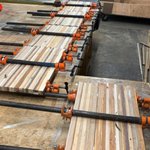
Alternate the clamps over and under on a laminated top and it dries flat instead of bowing onto one face. Overtighten and the glue line goes dry where sanding can't reach.

Set the cabinet sizes as numbers you can change. When a client goes from 30 to 36 inches, every part and the cut list updates with it instead of getting redrawn.
Every thread gauge gets a stone run over its threads and a scrap part to prove it. A burr costs five minutes; a customer who doesn't trust your numbers costs more.


Cases leave the bench square and the store's floor doesn't. That scribe at the base is hand work nobody priced, and it's the first place a bad fit shows.
Small parts come off a nested sheet on tabs, not on the pod pressure alone. Ours stay put while everything around them is cut, then get freed with a knife and a block plane.
Rarely. A list built off the drawing stops at the cabinet parts, and the MDF under them gets left out of the budget until the first through cut goes into it.
Log siding gets milled thin at the lap to fake a round face, and that thin edge cups first. Back-prime the ends or you're recoating the south side every couple years.
Put the height on that template while you have it. A tapered column changes diameter as it rises, so the same bracket ten inches up needs a different arc.
The setup gets written down before the cut, not after, and the sheet says out loud what it hasn't proven: this operation family runs off no proven recipe yet. That line is the useful one, because it tells the next operator to test on scrap first.
xitter.cf/AugmentedPath/status/2…


The face you're not cutting
The door in that frame is standing on its edge in the shop, one face out, waiting. A bar clamp has it at the edge. Nothing's touching the face. There's a pencil circle on the upper panel where the hardware goes.
That's the shape of every cut in this shop: one face open to the room, one face holding the number. Take a case off this floor. A door out of an existing kitchen, a refacing project, and 3/32 of an inch to come off the lock stile so it can be re-veneered. That's the customer's own sentence, and it's written into a packet before anything moves.
The number that runs that cut isn't the 3/32. It's which face Z zero sits on. Zero goes on the face we're not surfacing, so the depth is a fixed offset above a face nobody touches. Target is the original thickness minus 0.0938, rounded down to 0.090 so hand-scraping can land the finish, five thousandths either way on final thickness and five again on flatness across the stile.
Then the other half of the same decision. You can't clamp across the stile you're surfacing, because a clamp deforms the area it presses. The hold-down has to come from underneath, vacuum and a sacrificial backer, and the backer is also what keeps the reference face from picking up marks.
Two passes instead of one, 0.045 and then 0.045, rather than a single 0.090 move, so an error in Z doesn't compound inside one plunge. Measure between them.
The cutter follows the same logic. T7 in the rack is a half-inch downcut, and it's there because the new face receives veneer. Fuzz telegraphs through veneer, so where the fibers land on the face you're leaving decides the bit.
That's the rest of this week's work told faster. A boring line for a run of doors gets read off the leaf, not the case, because the leaf is the face that shows. Inset doors put the case's error on the face, where overlay hides it. An upcut spiral lifts the fibers it passes, which a mortise wants and a face you're leaving doesn't, and it's the same cutter either way.
The bat on the fourth axis takes it as far as it goes. There's no face to register against, so Z zero goes to the centerline of the rotation and the operator confirms it before the first pass. The handle is 0.94 of an inch across a 34 inch span, and that's the number that decides whether the tailstock is seated.
Get the reference wrong and you don't get a bad measurement. You get a good door cut 3/32 under. The veneer goes on and telegraphs it, and the door is gone. What's on the line there isn't machine time. It's an existing part out of somebody's kitchen.
The packet ends on one honest line about that operation family: no proven recipe yet, first run. So the rule stays on the sheet beside the clamp. Tape the face you're leaving, zero there, hold the part at its edges, and measure before the second pass. Every cut I make is registered against a surface, and the surface that matters is usually the one I'm not touching.

We do. That workbench plan is fine, but the torsion box only stays flat if the bench under it is flat, and casters don't fix a twist.
The Augmented Path retweeted

Massachusetts ranked the third-least-free state in America as Healey lands among the five worst governors, new study finds
massdailynews.com/2026/10/26…
