

Writer, Content Marketer, Musician | Content Marketing Manager - Insights & Researh @TRMlabs | debut single "Disgrace," on all major platforms👇
Salt Lake City, USA
Joined November 2017
- Tweets3.6K
- Following300
- Followers652
- Likes2.9K





Brian D Nibley retweeted

Introducing ✨Ardence✨, TRM's AI investigation platform for all-source intelligence.
Follow connections across sources, keep the source trail, and put investigator judgment at the center of the work.
Learn more 👉 trmlink.info/4B0NENP

Brian D Nibley retweeted

BITCOIN’S CRYPTOGRAPHY UNDER SCRUTINY AS AI BREAKTHROUGHS SPARK SECURITY DEBATE
@Rob1Ham has published a detailed analysis of five mathematical approaches that could theoretically weaken Bitcoin’s elliptic-curve cryptography without quantum computers.
The article examines potential shortcuts to solving the elliptic-curve discrete logarithm problem, which underpins Bitcoin’s secp256k1 security and requires roughly 2¹²⁸ operations using known classical methods.
Hamilton emphasizes that none of the approaches represents a demonstrated break, and that mathematical discoveries do not necessarily translate into practical attacks.
The analysis follows growing speculation that AI-assisted mathematical breakthroughs could undermine longstanding cryptographic assumptions.
Coinbase Head of Cryptography Yehuda Lindell has pushed back against the speculation, arguing that there is currently no evidence of a breakthrough threatening elliptic-curve cryptography.

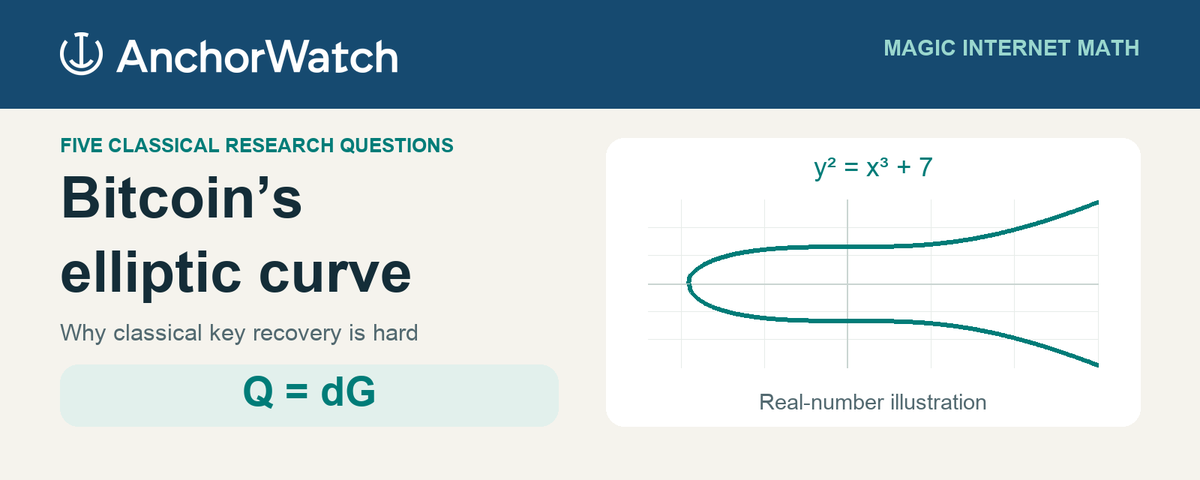
Since Math is in the news this week as it relates to Bitcoin, I sat down with @Fundamentals21m to do an episode of Magic Internet Math.
Today we Red Teamed Elliptic Curve Cryptography and discussed how math COULD break Bitcoin. In short, its very hard.
Brian D Nibley retweeted
Preview of my single "Disgrace."
Pre-save the song now here: distrokid.com/hyperfollow/br…
Brian D Nibley retweeted

Bitcoin's consensus rules have never been written down outside of code. The only authoritative answer to whether a block is valid has been whatever Bitcoin Core does.
So every independent node has had to shadow Core instead of building against a shared reference, and the ones that drifted became chain-split risks.
The Orange Paper is a formal mathematical specification of Bitcoin's consensus rules. Signature validation, UTXO accounting, script execution, and block structure are defined precisely enough for any mathematician, engineer, or court to read and check.
Bitcoin Commons (@BtcCommons) has spent the past 12 months building a from-scratch Rust node against it. Z3 checks consensus paths against the spec on merge, and differential replay compares the node to Core across 900,000+ mainnet blocks.
The spec belongs to everyone. Any implementation can verify itself against it, Core included, and each one that does makes Bitcoin harder to capture through a single codebase.
thebitcoincommons.org


Brian D Nibley retweeted

The last time the Supertrend flagged a BUY signal, Bitcoin was $16K.
It stayed green for 3 years and 700% straight up. It just printed again at $84K 👀


Brian D Nibley retweeted
What I tell people is simple
5 guys have merge access to 350k lines of monolithic spaghetti code that runs 99.9% of the network and requires eight disciplines to reliably maintain. Core is only funded $8-10 million per year and can't afford the necessary polymaths to do the work
Brian D Nibley retweeted
Brian D Nibley retweeted

$BTC MVRV Z-Score just hit the green zone, the same level that's marked every major bottom since 2011.
Most call it another correction. I call it the same setup that's caught every bottom for 14 years.
Push back above without a new low, and I think the bottom's in.
I'll take the other side if you've got one


Brian D Nibley retweeted

95% of all days for $BTC were more expensive than today.
raw MVRV is broken.. it drifts every cycle as the network matures.
bitcoin now sits in the 5th percentile of its own history.

Brian D Nibley retweeted

Hedge funds on CME flipped net long BTC futures.
This is rare. The basis trade keeps them structurally short. That's why this chart's been red for years. You can't carry trade into a net long.
The suits are betting on upside.

Brian D Nibley retweeted
BIP-110 has failed. The mandatory signaling window opened, AntPool mined the first non-signaling block, and the BIP-110 chain is now a distant minority with no realistic path to catching the main chain. This one battle is over in the sense that matters economically.
Though I agreed with the changes proposed in the BIP, I was never a supporter of this activation path. The mechanism required miners who control the overwhelming majority of hashrate to defect against their own economic interests based on pressure from a node minority that couldn't actually make non-compliance costly. That pressure only works when you have enough hashrate to make orphan risk real. They didn't, and the outcome reflects that.
None of this means the underlying problem is resolved. The governance structure that refused to close the Taproot envelope and then eliminated the practical limit on OP_RETURN data is unchanged. Non-monetary data still flows through the cheapest channels at subsidized rates. The people who built and supported BIP-110 were right about the problem. The activation path didn't work.
And this is the pattern. Core doesn't need to win the argument. It never has. It needs to hold the merge authority and the coordination layer long enough for whoever is challenging it to run out of options and reach for a hard fork they can't back with hashrate. Every time someone does that, Core gets to call them reckless, the fork fails on economics, and the governance structure that produced the original problem walks away untouched. The challengers exhaust themselves. Core just waits.
I am not in the Knots camp. I have no investment in any particular activation path or any particular team. What I have is a body of work arguing that non-monetary data embedding imposes real, unpriced costs on every participant who runs a node. I have yet to encounter a counterargument that isn't either a technical misunderstanding or gaslighting.
The most credible path that doesn't end here addresses the coordination layer directly. Another BIP is possible, but it runs into the same governance structure that just demonstrated it can outlast any pressure campaign. The solution is alternative implementations with independent teams, funded outside the institutional layer that funds Core, building on a formal specification that gives miners and node operators a reason to switch based on technical merit rather than political pressure. Accumulate that adoption over years and the leverage is structural. You don't need to pressure anyone into anything.
That work isn't exciting. It doesn't produce a signaling deadline or a fork watch dashboard. It produces something that actually lasts.
@BtcCommons @joinplebly
Brian D Nibley retweeted

So the ColdCard entropy bug that lead to at least $100M of theft, was introduced by then CTO and co-founder himself, who used a fake identity to create and import a buggy library.
What are the chances these were all an innocent mistake?


Brian D Nibley retweeted

Some more verification that Coinkite's cofounder DocHex (Peter Gray) is the same person as the nym switck who contributed the code for libngu.
This code change is at the center of the entire Coldcard RNG bug.
On Clarity.fm clarity.fm/petergray where you can pay Peter for his time, Peter verified his phone number which ends in "44"
This same phone number ending in "44" is tied to both DocHex's and switck's X accounts.
The odds of sharing the same last two digits of a phone number is 1%.
Combined with @jamesob detailed gist and findings that DocHex's GPG key signed 61 switck commits – I think it is conclusive now that they are the same person.


I haven't told the full story yet, but I came to the same conclusion back in May 2025 when I started doing an audit of `coldcard/firmware`.
I wanted to figure out conclusively where the CC RNG was getting sourced from, and found that it backed up to some shady library called libngu (github.com/switck/libngu) that had literally 6 stars on github and was maintained solely by a pseudoanon tranny.
I knew from past experience that linking to libsecp256k1 from Python was pretty easy, which seemed to be the stated purpose of the library use, and so I was confused about why it was there.
I sent a report to the CC team that I had doubts about whether the true RNG was actually in use, and pointed out that the hardcoded yasmarang constants in libngu were sloppy. I advised they rip the whole thing out and link against libsecp256k1 directly.
I was told that if something was wrong "we'd already know about it by now" and that everything was properly configured for the real boards.
I didn't follow up rigorously, which was a horrible mistake on my part.

Brian D Nibley retweeted
The gist cryptographically proves GitHub user switck (author of the buggy libngu library in Coldcard firmware) is Peter Gray / DocHex, Coinkite CTO. 58 commits authored as Switck are signed with Gray's personal GPG key (the same one he uses under his real name). libngu's check (instead of ) caused the weak Yasmarang PRNG fallback for seed generation from 2021-2026.
Brian D Nibley retweeted

THE SHOCK DOCTRINE
Fair warning that in times of great disruption (eg Coldcard exploit), factions with ulterior motives inevitably use the opening to strike.
• They will use this to promote paper Bitcoin.
• They will use this to jam shitcoins onto Bitcoin.
• They will use this to claim self-custody is "too risky."
Don't fall for it. Bitcoin is money. Self-custody works, and it IS worth learning.
Stay sovereign. Be a Bitcoiner.
Brian D Nibley retweeted

Thanks to a generous credit of tokens from @PPQdotAI , Kimi K3 and an ape with a laptop (me) have conducted the following analysis of a bunch of projects / companies wallet softwares. @Coinkite , @OPENDIME , @SeedSigner , @Bitkey , @bluewalletio , @PhoenixWallet , @SparrowWallet , @Trezor , @Blockstream , @Ledger , @BitBoxSwiss , @SpecterDIY , @ElectrumWallet , @SamouraiWallet
🟡 Yellow ≠ broken. None of the nine Yellow products has a confirmed fund-loss-by-default flaw. Yellow means at least one of: (a) something security-critical sits outside independent verification. i.e., closed firmware or secure-element code (Opendime, Ledger, open source please!), vendor-run recovery infrastructure (Phoenix/ACINQ, Jade's oracle, Bitkey's WSM); (b) a real but bounded weakness, such as a zero-work-factor KDF (BlueWallet), weak legacy KDFs on a hot wallet (Electrum), no-SE DIY hardware with thin maintenance (SpecterDIY), a just-patched vulnerability awaiting its report (Bitkey); or (c) a dead/unmaintained product whose crypto reviewed clean (free Samourai!). In every case the entropy/key-generation path itself was reviewed and found sound unless the cell says otherwise.
