





Bayesian retweeted

interpretability might be the most important scientific problem in the world right now, as I don't think we can solve alignment if we don't know what we're building. I think I have good news about it. I co-authored early work in mechanistic interpretability at OpenAI and came away pessimistic, because neural networks appeared to fold into arbitrary tangled knots. years later, I started openai's first large-scale automated interpretability project, finding about 2% of neurons legible with the primitive tools we had
with modern agentic tools and a much closer look, the picture looks totally different. the vast majority in models up to trillions of parameters are legible, and their circuits beautiful. many famous examples of tangled neurons turned out to be misunderstood. The roadblocks I expected mostly aren't there. I now think ambitious interpretability will be solved by the time we need it most, and possibly quite soon, as automated scientists keep improving. it may be a bitter lesson for interpretability: the simple thing, at absurd scale, works
already-clean.goodfire.com/


Bayesian retweeted
Some findings based on Anthropic’s published plot:
- The share of merges on weekends rose steadily from 7% to 18% (+0.33 pts/week). Monday–Wednesday declined the most, Thursday slightly, and Friday held steady.
- The time to double the number of daily merges shortened from 67 days (Jan – May) to 41 days (May – Jul) to 20 days (Aug – Sep)
- Merge growth sped up about 5 weeks before Mythos Preview and Opus 4.7, and again before Opus 5.5 and Sonnet 5.5. That could mean the models were available internally weeks before launch.


Bayesian retweeted

Let's say a frontier model is a 10T MoE on GB300 NVL72. That's ~5 Joules/token or ~50 W at human thinking speed vs our brain at 20 W. The energy grid is $0.08/kWh and eating rice $0.50/kWh. So on an energy-per-thought standpoint rn we're surprisingly similar to frontier models!
Bayesian retweeted

Because my hubris knows no bounds, I've made another 100:1 wager regarding Millennium Problems, betting against a scenario proposed by @Bayesian0_0: another MP solved in 2026, outside the labs, by a team with no human-generated conceptual breakthrough @littmath #litt4arbiter


Bayesian retweeted
This Navier-Stokes mistranslation thing is a nothingburger. Like 5 of you are making a nuanced (frankly pedantic) point about readability issues that are being phrased in a way that sounds to non-math ppl like there are serious doubts the proof is correct. There is no such doubt.
Bayesian retweeted

We’re releasing a broad range of new mathematical results produced by an internal frontier model.
We’ve been consulting with the independent Advisory Group on Mathematics and Artificial Intelligence at the Institute for Advanced Study, and we have drawn on their advice and public recommendations to inform how we release these results.
github.com/openai/math

Bayesian retweeted

Currently I still only know of 1 alignment-specific RL environment company: making RL envs that aim to represent situations in real deployments in which alignment is challenging.
It seems like a huge mistake in hindsight that we have seen so much encouragement and funding to, for example, start 3rd party evaluators, but not comparable encouragement to start alignment data companies.
I do think a lot of traditional AI safety views underestimate the importance of data, so perhaps this is related. But the Hugging Face incident seems squarely downstream of both (a) reward hackable RL envs in general (b) much less effort and $ put into RL envs where alignment is a core component of reward.
A separate idea is alignment by default: the old idea of "find the persona basin which is aligned" and things will just work. This is clearly not guaranteed under increased RL. But my sense is there has not been a huge amount of effort to figure out how custom environments could help "nudge" the model back into good persona basins during extensive RL. Here too, a robust ecosystem of alignment data companies could help significantly.
In the RL data market, there is a trend for some labs to in-house slightly more RL env production. But I don't expect this to fully disappear, and I am convinced the market-based approach to sourcing RL envs produces the best overall volume and quality—for alignment RL, an ecosystem of startups would also greatly help make behind-frontier models safer.


Bayesian retweeted
Based on my estimates, the 10,000-agent swarm that solved the Navier-Stokes problem was about 8 months of frontier progress ahead of a single GPT-6-Astra instance (with a range of 5.5 to 12.4 months)
It used 48,000 times more output tokens than the largest single model evaluation and roughly 68 times more than an entire long-horizon coding benchmark


Bayesian retweeted

Introducing WeirdML v3, a fully agentic benchmark featuring 11 complex hand-made tasks.
Models must explore and understand unfamiliar data, develop ML and data analysis pipelines and produce results despite limited data, unspecified goals and/or very limited feedback.
1/8


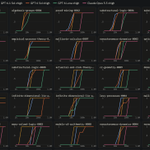
WeirdML v2 is now out! The update includes a bunch of new tasks (now 19 tasks total, up from 6), and results from all the latest models. We now also track api costs and other metadata which give more insight into the different models. The new results are shown in these two figures. The first one shows an overview of the overall results as well as the results on individual tasks, in addition to various metadata.
The second figure shows cost vs performance and shows a clear scaling with better results for higher costs. We also have a very varied pareto frontier with 11 models from 6 different companies having the best accuracy for a given cost for at least some of the cost range. Grok 3, Claude Opus 4 and GPT 4.5 are the ones that underperform for their costs, while Gemini pro and o3 pro have the best results at the highest costs. Qwen3 30B3A, grok 3 mini and deepseek R1 also each represent a good chunk of the pareto frontier.


Bayesian retweeted

6 months ago: Dario Amodei meets Susie Wiles and Scott Bessent at the White House about Mythos.
Asked about Amodei's visit, Trump says "Who?"
cnbc.com/2026/04/17/anthropi…


Bayesian retweeted

I wish OpenAI were more
transparent about the publicly reported cyber incidents caused by our agents.

