Global Head of Research, Newmark. Economics, CRE, finance, technology, demographics & long-term human progress. Views my own.
San Francisco, CA
Joined August 2017
- Tweets10K
- Following732
- Followers623
- Likes7.3K






David Bitner retweeted

Here are the top 20 markets for real estate investment in 2027, according to ULI's annual Emerging Trends Report just released this week. Quick thoughts on multifamily market in each:
DFW stays No. 1, not a surprise. Been steadier than other Sun Belt markets. Still supply to work through, but still attractive and very liquid.
San Francisco ranks No. 5, up 40 spots from last year, and would probably rank No. 1 if not for the fact that many survey respondents would probably never invest in San Francisco regardless how it is. Same for Manhattan, where policy risk questions dampen some enthusiasm and redirect capital elsewhere.
Interesting to see DC's Northern Virginia suburbs rank high, yet its Maryland suburbs rank dead last and the District is in the bottom 5. But that's the reality of the DMV, and its just governance issues-- with the District and Montgomery County competing for the crown of most conspiratorial anti-business market while Northern Virginia gladly benefits from it.
Austin and Boise both rank outside the top 20, but I'd be bet on both being in top 20 next year. ULI's list is supposed to be forward-looking, but this is example of how in reality it's still very much a present-day lens... just like San Francisco ranking No. 45 last year.
Knoxville ranks as highest tertiary market, coming in at No. 20 overall. Good market but surprised it's so high.
ULI's survey respondents put Norfolk and Milwaukee in the bottom 10, but I think they're just saying they don't know these markets. Both are very steady and interesting, low supply.


David Bitner retweeted

My friend @scottahodge is doing tremendous work uncovering the broad abuse of IRS "non-profit" designations by what are functionally quite profitable businesses.
Those looking to close egregious business tax loopholes should be following Scott's work.

It’s No Joke. Nonprofit Hospitals Are More Profitable than For-Profit Hospitals
Studies find that nonprofit hospitals achieve greater profits with higher average prices than for-profit hospitals. On average, nonprofits have 29% greater profits than for-profits.
scottahodge.substack.com/p/i…

David Bitner retweeted

Jobs are modeled as bundles of tasks. But as jobs change, how do we keep those task lists up to date?
Workers often experience new responsibilities and tools before they reach their job descriptions.
We start by listening to them. 🧵
David Bitner retweeted

O*NET tracks the tasks that are required by different jobs. It has been invaluable for research. But it also was clear that it could be improved a lot--and the need to improve it was much greater than ever. So very glad to see this, looks like we'll all be using it.

David Bitner retweeted

Rental rates of older-generation Nvidia GPUs continue to rise, suggesting that the shortage of compute remains acute.
I think we are heading for an AI capex bust but probably not until 2028.
During past capex cycles, stocks have peaked about 6-to-12 months before capex has peaked, so next year could still be volatile.

David Bitner retweeted

Every single (like actually 100%) buy-side junior analysts I know is working through the Anthropic’s S-1 overnight right now.
Luckily a few were kind enough to respond to my texts when taking a bathroom break, so here's an initial impression of the S-1.
TLDR: the strength of the operating numbers caught people off guard and the conversation is shifting toward how much bigger this can get, how much of the economics Anthropic can retain, and which companies benefit from the infrastructure spending.
1) Enterprise adoption numbers are remarkable.
Revenue went from $386M in 2024 to $4.59B in 2025 to $16.29B in just the first half of 2026. Q2 alone was $11.56B, up 1,368% year over year.
By September, there were more than 11,900 customers generating $100k+ of annual revenue, more than 1,900 generating $1M+, and approximately 250 generating $10M+.
2) Expansion inside existing customers is arguably even more impressive.
Net revenue retention was approximately 900%: the eligible customer cohort generated roughly nine times its year-earlier quarterly revenue, excluding Pro and Max subscriptions. Over half the Fortune 500 were already customers generating at least $100k annually.
Yet revenue from the publicly traded Fortune 500 customers in Anthropic’s calculation averaged less than 0.1% of their total quarterly expenses. There is potentially a lot of expansion left inside the installed base alone.
3) The economics are improving faster than expected.
Revenue per dollar of compute and infrastructure expense rose from $0.40 in Q1 2025 to $2.08 in Q2 2026.
Q2 generated $974M of GAAP operating income, or an 8.4% operating margin. Adjusted operating margin reached 19%.
The $80.7B H1 net loss obscures this. It included $72.4B of fair-value losses on convertible notes, derivatives and SAFEs.
H1’s operating loss was $693M, while operating cash flow was positive $3.93B. The current operating trajectory is substantially stronger than the headline loss suggests.
4) Cheaper intelligence can drive a larger market.
Anthropic says Opus 5.5 reduced customer cost per task by approximately 40% versus Opus 5.
With roughly 80% of H1 revenue coming from consumption, the upside comes from customers finding many more tasks worth automating as capability improves and costs fall.
More than 50% of customers generating $100k+ annually used both Claude Platform and a first-party application in Q3, up from approximately 30% in Q4 2025.
5) Infrastructure disclosures create a substantial opportunity set beyond Anthropic.
The commitments include approximately $161.2B of Broadcom equipment lease payments excluding interest, at least approximately $114.5B with Google, at least $110B with Amazon and at least $44.9B with Microsoft, across different multiyear periods.
Anthropic is using Trainium, TPUs, Nvidia GPUs and AMD GPUs. Its direct infrastructure strategy also creates demand across networking, power and data centers.


Anthropic "is burning cash like crazy" was one big lie, spread by the Ed Zitrons of the world.
For the first 6 months of 2026, Anthropic generated positive free cash flow of $3.4 billion ($3.9 billion of cash flow from operations less $482 million of capex).
And stock-based compensation was only $2.2 billion.. So even FCF less SBC was positive.

David Bitner retweeted

I've been thinking about this for a few days. It's an interesting framing.
Everyone (OG AI economists, new AI economists, non-economists) should be constrained by their other explanatory commitments, their model of the world.
This is a necessary part of model-based thinking, so you don't just make stuff up anew each time.
For me (and I think many other economists), the most basic commitment are things like scarcity, trade-offs, constraints, and then equilibrium adjustments. Don't assume away these things.
When you bring this to growth, you don't ignore scarcity, even if economic growth has made scarcity a lot less binding than it was in 1500. You start to think about how improvements (falling prices) interact with other scarce resources and trade-offs. The responses generate other innovations. Growth is the net interaction of all this.
This doesn't magically go out the window when we say AGI. It maybe should but we need a reason, grounded in higher level intellectual commitments.
Take @ChadJonesEcon. If you spend a career thinking about growth through new ideas, nonrivalrous knowledge, allocating goods to research, those don't go out the window. That's your framework for thinking about what drives growth. But also so are the constraints. If you spend your time thinking about bottlenecks as a part of past growth, that's your starting point.
Lo and behold, he starts writing AI papers and that's the starting point. That doesn't mean the framework is "AI as a normal technology". It doesn't mean its the exact same in an AGI world as a non-AGI world but you have a model-based approach to thinking about what changes. The feedback is endogenous, and the same framework can generate explosive growth.
We don't want to like an approach simply because it generates big growth or dislike because it doesn't. You can't simply choose the conclusion you want independently of your account of how the world works.
Building from familiar economics models, even ones with labor and capital, aren't a failure to take AGI seriously. You can still think some things are no longer scarce. That's a huge change.
Of course, we can always use a model badly. Maybe your past model had land as a big constraint and that fit the data in a world where land is a constraint, but then the Industrial Revolution happens and ideas/trade are the constraint. But we want to be clear in the model, what is the constraint that is doing the real work and will that be the same in the future? Maybe it is or maybe it isn't.
We should be very hesitant, and I'm not saying Jan is doing this, of confusing "taking AGI seriously" with arriving at sufficiently radical conclusions. That's not a good epistemic standard.
You can't choose the conclusion you want independently of your account of how the world works. The model/account of the world constrains you the student of the world and theorist.

Few years ago, there was just a handful of economists seriously thinking about AI (@akorinek,@pawtrammell,@erikbryn,Carl Shulman & few of their collaborators) and I was like 'this is insane, there should be 10x as many'.
Now it's ~10x-30x more and frankly it is disappointing so far. Majority of the new economists bring a mindset and frames which are something between unhelpful to directly harmful for understanding AGI
- not taking AGI seriously / "AI as a normal technology"
- merchants of cope dynamic (in high demand by the labs)
- labour/capital mindset
- people were wrong about risks of tech transitions in the past and by induction they are again
etc...
coupled with epistemic arrogance. Sorry for being very blunt, by my impression is part of the problem is economists are often used to be in the broader context of humanities where they are the most quantitative and in some ways the smartest lot in various rooms, and others disagree with them for bad reasons. But this is _not_ the case relative to AI safety a few years ago!
David Bitner retweeted

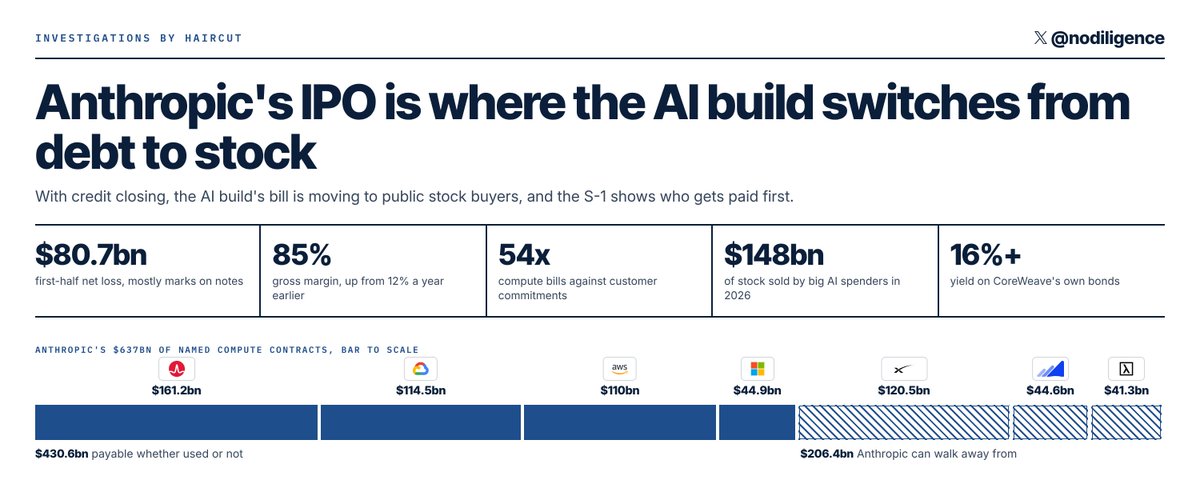
same GPUs, very different interest rates. what sets the price of AI debt is whose name stands behind the cash flow.
-- anthropic's chip debt costs 5.75% with broadcom behind it and about 8.5% on its own.
-- lambda borrowed at 6.78% because two investment-grade customers pay the loan.
-- coreweave's own unsecured bonds yielded above 16% on 15 october.
every AI deal that reached investment grade got there by borrowing someone else's balance sheet, and the part carrying the AI company's own risk is always the small one.

ALT various AI debt borrowings for 2026, detailing annual costs and support sources for each loan.

David Bitner retweeted

Unusually, the Fed’s real policy rate is among the highest of major central banks. One plausible reason is stronger U.S. growth: the New York Fed puts the neutral real rate at 1.0 percent in the United States, 0.1 percent in the euro area.
econvitals.org

David Bitner retweeted

econvitals is an amazing new resource. On the one hand, it shows the power of AI, when well domesticated (by Jason). On the other, it produces incredibly useful stuff. A definitive follow.

Unusually, the Fed’s real policy rate is among the highest of major central banks. One plausible reason is stronger U.S. growth: the New York Fed puts the neutral real rate at 1.0 percent in the United States, 0.1 percent in the euro area.
econvitals.org
David Bitner retweeted

Jefferies moving forecasts by GW over the course of weeks! "Satellite imaging data now points to ~27 GW of data centers by '27 (up from low-20s just weeks ago) and we see SPCX as single-handedly skewing estimates higher."
GW seems like a tech spec vs massive infrastructure project but for example, going from 20-> 27GW:
-+$350BN capex
-+$560BN monetized inference opportunity (illustrative)
-7 San Franciscos worth of power
It's a crazy time cause sellside and buyside treat these inputs very flippantly when in reality they are MASSIVE
What is clear, though, is the project-level trackers (e.g., SemiAnalysis, Aterio, etc.) increasingly seeing huge lines of sight.
Few months ago I would've told you impossible to get ~30GW/yr but it seems like construction trends point to that being true (on a facility basis) for 2027 and 2028. Just because it's under construction and scheduled to come online mean it hits the target, but clear the ambitions and tracking of real construction progress continue to move up...
*Not going to dive into the separate debate about what level of GW is needed, etc.


David Bitner retweeted

wrote about AI AS THE INFINITE WORK MACHINE, creating a world where we're all just constantly deploying agents to fight against everyone else's agents, running constantly to end up in the same place:
bloomberg.com/news/newslette…


David Bitner retweeted

A big surprise. Anthropic is NOT bleeding cash. They are in fact, mostly paying for their huge training (and inference) investments with their inference income.

The most mind blowing stat we've seen so far is this:
"As of June 30, 2026, we had raised an aggregate of $141.1 billion of capital and had cash and cash equivalents of $112.4 billion and short-term investments of $19.3 billion."
That means to date, they have burned 9.7b, they are growing at a rapid pace, and are profitable on an operating income basis as of the June quarter! This is likely the most efficient scaling of a business in the history of capitalism.
xitter.cf/AnthropicAI/status/211…
David Bitner retweeted

The underappreciated reason Fed will eventually likely have to hike: interest rates look *low*. The long-run (i.e. neutral) rate is 4.3% according to the ACM term premium model, higher than the current rate (3.88%) and the FOMC's own long-run 3.2%. Read more in my newsletter (free to subscribe): wsj.com/economy/central-bank…

David Bitner retweeted

I am shocked, absolutely shocked, that Anthropic ARR has likely gone vertical in October after they cut token prices.
Except the exact same thing happened for the entire AI market, which is why GPU rental prices have surged while token prices declined.
$100b plus in year-end ARR looks possible again.


David Bitner retweeted

After almost 10 years of work corporateownershipdata.com now makes available all publicly available ownership records of 7,156 publicly traded firms, not just the S&P 500, including dual-class shares.

David Bitner retweeted

there remains unbelievable alpha in paying attention to data broker procurement postings as well as frontier lab postings.
literally a public roadmap for where the frontier is at a given moment


We’ll pay you up to $100K for every company you refer that licenses its data to @Mercor.
We’ve partnered with > 500 companies so far.
If you know a company with 100+ employees and data in code, gaming, manufacturing, healthcare or professional services, refer them at data.mercor.com/refer.