





Blade Doc retweeted

The problem with the Mass Effect series in general, as well as with Half-Life, is that the writers painted themselves into a corner with genre selection.
They're both written as cosmic horror.
Cosmic horror is a genre where the universe itself in inherently hostile, either literally or in effect because the antagonist is overpowered beyond hope of evening the scales.
The reason that cosmic horror stories are unwinnable isn't story logic, it's genre convention. Think of Cthulhu.
Cthulhu, as written in the stories, if you think about him logically, is kind of a wimp. He's just a big dude sleeping on the bottom of the ocean. The maximum extent of his toughness is that you can drive a steamship through him and he won't die.
That's pretty formidable in 1927, but in 2027, or 2450, not so much. At least not from a logical standpoint.
But to conclude this would be to miss the point. Cthulhu isn't an unbeatable menace because of what he can do. He's an unbeatable menace because the genre convention calls for the author to make him unbeatable.
Cthulhu, in other words, is a Mary Sue. The very tropes of cosmic horror fiction demand that no matter what force is brought to oppose him, the author will always asspull some nonsense about how it doesn't work because of Thing I Just Made Up.
The whole purpose of having a cosmic horror genre is to evoke that creepy feeling of overwhelming dread, wherein the monster can never be destroyed, only escaped, and often only temporarily.
Which is why it's a great set up for a certain type of short story, but not so good for novels.
Now, genres are for readers, not for writers. If I'm writing a Cthulhu story, I can always allow the humans of 2450 to utterly annihilate Cthulhu with 60 grams of antimatter.
But the problem with this approach is exactly the same as the realization that allows it: genres are for readers. If you thwart the very same setup convention, the defining characteristic of the chaos monster that makes it unstoppable, you unwind the very thing that gave the story its dramatic tension in the first place.
And this feels like a letdown. If Cthulhu wasn't so tough after all, then the stakes weren't so high after all. Everything unravels in a vague sense of letdown, which is exactly what we experienced at the end of Mass Effect 3.
The genre of "heroic high-stakes video game plot" demands that the protagonist/player win in the end, and win big. The player's efforts must be rewarded with triumph, or the ending sucks. BioShock: Infinite, and Spec Ops: The Line both failed in precisely this way, and came off as pretentious crap with their "take that, player" endings.
But the genre of cosmic horror demands that the foe be unbeatable. As we have already discussed.
So if you make Mass Effect or Half-Life, you have to deliver a triumphant ending without actually destroying the threat.
Now, this is not impossible with clever writing. I could think of several ways to do it in a series of novels. But novels are the efforts of one dude typing, and they come out when they're good and ready. In a video game, you have hit a deadline on a budget, and anything the writers write, the coders must code, and the artists must draw.
So, unfortunately, Mass Effect and Half-Life were both doomed from first episode. Which is the real, underlying reason why one was completely badly, and the other not at all.
We think fondly of the first episodes of these because they were very well executed, but also because that's where cosmic horror is strongest... in the setup.
The payoff is a lot more difficult. And both creative teams couldn't deliver under the pressure of competing demands.
If you're going to write cosmic horror, it's wise to know at the beginning exactly where you plan to end.

The problems with ME3 are there from the very first scene of the game but the ending is somehow even worse - "the Crucible" is incoherent slop - a way to somehow pull out an ending when the writers were painted into a corner by their own choice to even have the Reapers arrive at all
The idea that somehow each cycle somehow stone soup-ed a super weapon is ridiculous - that's not how anything could possibly work - like writing a story one sentence at a time with different authors except it's not a story, it's some kind of machine and no one actually *knows what the machine is supposed to do*
This could be the worst, most ridiculous idea in any serious science fiction


Blade Doc retweeted

Europe: we don’t have air conditioning 🥵
America: our flying cars have air conditioning 🫵😹

Blade Doc retweeted

The only people celebrating on 10/7 hate Jews. They can spin it in 1000 directions with their justifications, while they support a fundamentalist-terror-militia who has made their intentions (eradicating Jews) repeatedly known. It’s not that deep. It is depraved & un-American.
Blade Doc retweeted
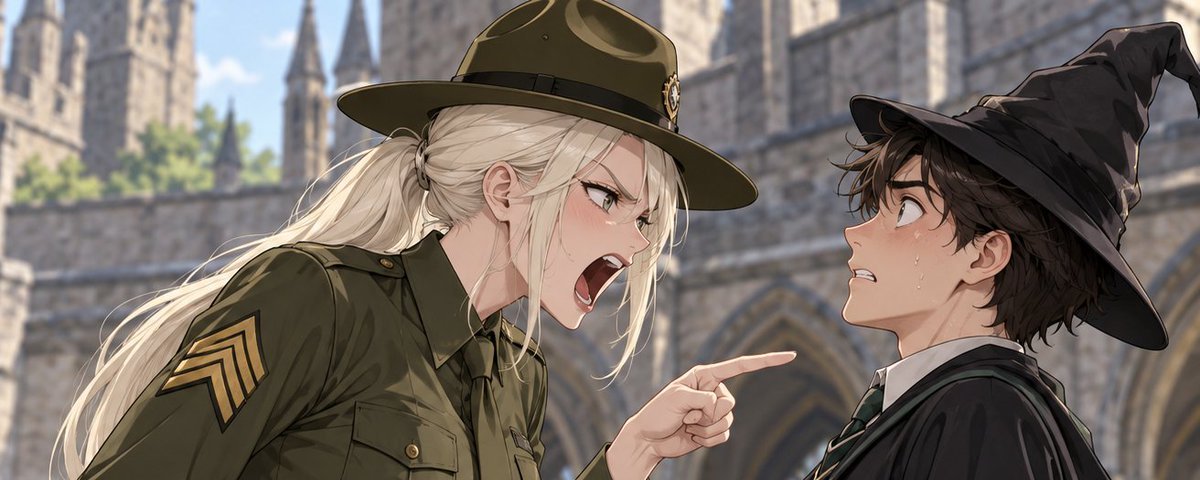
Now that I've dabbled in this trend a bit, and played around with what's possible, I'm going to put on my *other* Serious Professional Author Hat, and explain why you like her so much.
Draecena, or Draconia, or Drakenia, Malfoy — the "Mal-foid" — is NOT a gender-swapped version of Draco Malfoy. That's why her eyes are green and not grey.
She's a completely different character.
She fits into the socket that Draco fills in the story, but for an author, characters are defined by their wants. Because their wants determine their choices, and their actions, and these determine the ultimate outcome of the story.
Draecina is a different person from Draco, because she wants different things.
Draco, as written, is a simple creature, created for a simple utilitarian role in the story. He wants power and attention. He wants to advance his family's political agenda. He wants to defeat Potter. Rowling may have put a little spin on the ball in the later books, but he never strays too far from this.
Draecina is completely different. She not only wants more things, she wants conflicting things, and she is torn between them.
She is split between duty, love, and pride.
She wants to advance her family's cause and political agenda, to help them, to earn their love and make them proud. And for this, like Draco, she must defeat Harry Potter and everything he represents.
But she is also a teenage girl. And she wants to kiss the most popular boy in the school. The hero, the sports star, the celebrity.
No, she takes that back, she doesn't just want to kiss him. She wants him to kiss her. And more fundamentally, she wants him to yearn for her, as she yearns for him. Look at me, Harry Potter, her soul cries. See me. Do you think I'm beautiful? Please think I'm beautiful. Please want me.
But she cannot say a word of this. Because she also has pride. She cannot, she will not face the humiliation of anyone else knowing how she worships her mortal enemy. No one must ever see the stolen scarf she presses to her face, in the darkness of her bedroom.
But if she is to say nothing, how will he ever know? How will he ever look at her?
This is the rack she is stretched upon, torturing herself inside her head late at night, tossing and turning when she should sleep.
Conflicting wants make the best, deepest, most living characters, and drive the best stories.
Through the alternate set of books (that exist now only as a shared idea in scattered heads) these drive her actions towards Potter himself... not simply opposition and aggression, but a dance of approach and avoidance, of fights and arguments and timid, plausibly deniable bids for something more.
Until, as in the originals, the two are driven to crisis point, a violent confrontation, each desperate not to hurt the other, but also driven to violence by the fear that this other holds no goal but lethal hate.
And Harry, seeking only to defend himself, strikes her down with a magic that does not merely disable but *cuts* with lethal force, tearing into her body, almost killing her, and leaving her with a terrible scar across the smooth, soft, perfect white skin that his eyes used to devour the merest glimpse of.
This is the worst point, the pit, the long dark night of the soul that every author must eventually walk a character into.
Draecina curses herself for a fool. None of it meant anything. He never cared for her. He hates her with every fiber of his being, and why would he feel otherwise? But try as she might, she cannot actually blame him. He overheard her plotting his death. They fought. Is it any wonder that he struck at her with whatever weapon he had to hand? She cannot stop loving him, even though she knows now that it is utterly hopeless.
In her hospital bed, left unable by her injuries even to toss and turn, she stares at the ceiling and weeps in despair.
Harry feels... sick. He fought for the right cause, he knows that. But this doesn't feel like goodness, and it doesn't feel like winning. It feels wrong, like he has destroyed something beautiful. He has left her with terrible scars, and terrible memories, that she will carry for the rest of her life.
More than anything he wants to go to her, to kneel beside her hospital bed and beg her forgiveness. But that is foolish. She hates him. He is the last person she would ever want to see, and she would never, ever forgive him. It's hopeless.
This is the greatest task of the author, to create this terrible moment, and then, somehow, perform some magic to walk these characters to the ending the story demands, where the day, the hero, and the world are all saved by the very thing that started the story to begin with... the love of a woman who would give her life to save his.
Except this time, that love is not an inheritance, for Harry is no longer a child. He is a man now, facing a dark and terrible enemy, and that love is not simply given, nor can it even be earned.
It must be inspired.
And the two lovers must defeat their enemy together... not through a cheap magic trick, nor through a vague and sappy appeal to ill-explained abstraction like "the power of love", but for the very real and concrete reason that heroes have friends and allies, families and lovers, while tyrants have only reluctant and fearful slaves.
And from that first inflection point, the pit of despair, it is difficult to see the second, the moment of triumph.
In all the best stories, the ones that really matter, there is a moment so dark that sometimes we don't want to go on, because how could the ending ever be happy?
But we must go on, because that is the third moment the story demands, the moment we must reach. And it is not Harry, but Draecina, who must give it to us, that happy ending.
Look at me, Harry Potter, she must say. Look at my scars. I will not hide them from you, not anymore, though they make you flinch with guilt and turn away. Look at me. I forgive you, my love, not merely because I love you, but I because I understand in my very soul the impossible trap you were caught in, the conflicting forces that tore you apart inside.
But you must look at me, all of me, and see me as I am, flawed and scarred and imperfect, for I must know if I am still beautiful in your eyes, if you can accept my love and forgiveness as I have accepted yours.
We must bury the anger and bitterness that passed between, and pass on only good to the next generation. Because I have just learned that the next generation is coming very soon now, and I hope we are ready.
It takes a wise character to say this, so she must grow throughout the story from a scared and lonely little girl to a woman who can face the future, even though she is afraid.
This is why you love this character. Because she makes a beloved story into something that is even more about the things that matter, the universal experience of what it feels like to be a human.
And it's why I'm not ashamed, nor embarrassed, to "fix" a billion-dollar success story. Because humans are a pack animal. We hunt together, and build on each other's work. Everything we have achieved as a species, from great stories to great civilizations to rockets to the stars, was built on foundations laid down by others, and will be the foundation for others to build on.
Frodo carries the ring across Middle-Earth, through Mordor, and halfway up the mountain.
And then it's your turn to carry him the rest of the way.


"And you never wondered why Fred made that bet with you in the first place, did you, Potter?"
She rolled her eyes at him, just a bit. They were smug and green and somehow catlike.
"He had to know you'd be brave enough to do it. Have you ever known Fred to make a bad bet? To voluntarily lose money?"
She had a point there.
She also had her hands on the wall on both sides of his head, like she wanted to pin him there, probably so she could get out all the choice insults she saved over summer break.
Except she probably hadn't thought through the part about teenagers and growth spurts, because, well, he towered over her now, and she was forced to reach almost directly upward.
"Unleeeesssss, of course, someone bet him TWO galleons that he couldn't trick the famous Harry Potter into setting himself up for a humiliating rejection."
"Uhhh... wait. You're trying to tell me you planned that whole, uh, disaster?"
"Did I say anything of the sort? I don't think I did. I just said 'someone'.
"The point is, I'm taking pity on you, Potter. Heaven knows you need it. These people aren't your friends, not really. They're low-class, and they'll sell you out the moment they can earn a galleon doing it. You should try to associate with a better class of people."
Harry took hold of one slender, elegant white wrist, and gently but firmly pried her hand off the wall, stepping to one side.
Her cheeks flushed, probably from anger that he had dared to touch her aristocratic skin, but he wasn't going to let her push him around. Not anymore.
He quickly dropped his hand before she could express her disgust by wrenching hers away.
"Oh, so if 'someone' had a plan to humiliate me, why'd you say 'yes', then, Malfoid? Did you have a different idea?"
He should just walk away, but he had to admit he was... curious. Ever since they'd been forced to fight the Bandersnatch together, and especially since that incident in the Gryffindor dormitory with the Truthstone, she'd been acting... strangely.
"Well, I wouldn't have wanted your humiliation to end too quickly, would I? It would have just been one single moment, with no one there to witness it, and you wouldn't have learned a thing," she said with a haughty sniff.
"I may not think much of you, or your entire ridiculous House, but Hoggwarts is a quality school, and no one else seems to be willing to step up and teach you not to embarrass us all."
She hadn't tried to trap him against the wall again, but she was still standing far too close. Ever since they'd returned from summer break, she always seemed to be hovering somewhere near him, always ready with a sneering word.
"Well, Miss Malfoy, you needn't worry about suffering my obnoxious presence again this year, I won't ask you again."
"Oh! Well, you.... you... Ahh... good! Good! It's not like I wanted to! And you wouldn't have the guts to ask me again, anyway! I bet you wouldn't!"
"Oh! Well if you're so dead certain, why don't you just go make another bet with Fred and get your money back?"
She recoiled as if he had slapped her.
"Yeah, well, maybe I will!"
"Good! Go then!"
But she was already storming off down the corridor, looking a lot less smug than she had a few minutes ago.
That felt... satisfying. But somehow, also not. Perhaps he wasn't as used to her verbal barbs and constant hostility, from being on vacation these three months.
He didn't know what else to think. For some reason, his fingers still tingled where he'd held her wrist.
Hmmmm... come to think of it, he should try to find out if she actually made that bet again. Because if she did, he could actually ask her again, and make her lose.
Which would be no more than she deserved. Even if she was rich enough for it not to matter, it was some small measure of revenge for everything she'd put him through.
Yeah, that was it. Revenge, he thought, rubbing at his hand a bit.
Besides, it wasn't like she would say yes or anything.

Blade Doc retweeted

I’ll tell you a secret. I dislike the Harry Potter series. I read them to my kids when they were younger and my only take away was an intense distaste for the British upperclass. So image how it feels to be sucked into a fanfic with a Malfoid. HP as it should have been. Read it. Then read his actual book Theft of Fire.


After a day as terrible as the one he’d just had, Harry was more than ready to shamble back to the Gryffindor dormitory, throw himself onto his narrow bed without so much as pulling back the covers, much less undressing.
But as he climbed, the noises coming down the stairs from the boys’ section told him this probably wasn’t going to happen.
It sounded like someone ransacking one of the rooms. There were definite rummaging noises, punctuated occasionally by the sound of a thrown object bouncing off a wall or some furniture, and a muted sputtering, as if someone were trying to swear in frustration, but couldn’t, not really, because she didn’t actually know all that many bad words.
Wait.
She?
Harry bounded up the last few stairs, and the hall, and through the door. Then stopped dead in his tracks.
Even though he had already heard what was happening, what he saw was the last thing, the very last thing, the absolutely last thing, that he ever expected to find.
It was Malfoy.
She stood over Harry’s bed, surrounded by a scattering of Harry’s possession all over the floor, spilled from an overturned chest, all the drawers she has removed from his dresser.
No one else seemed to be around.
Harry was too surprised even to be properly angry. He could only sputter out the first thing that popped into his mind.
“Malfoid? What are you doing here?”
She whirled to face him, her face twisted in a furious expression. There were dust bunnies clinging to her skirt, and her hair was an absolute mess.
“Stop calling me that! My name is Draecina! Dray-see-na! Draecina Esmerelda Aribeth Malfoy! The Third!”
Harry rallied his thoughts a bit. “I’m not going to say all that. And you haven’t answered my question. What are you doing here? How did you even get into the Gryffindor dormitory at all?”
“Fairy lights,” she snarled at him, “The password is ‘fairy lights’. Did you really think I couldn’t get that information out of one of you weak-minded idiots any time I wanted?
“Except the last place, the very last place, that I would be caught dead is your bedr— your dorm room! If I didn’t need to find it!”
“Find what?”
“Don’t play innocent with me, Potter! You know what I’m looking for! A doll! Made out of beeswax infused with moonleaf sap and three drops of my blood, which you probably collected last year when we fought the Bandersnatch. Then you dressed it in a scrap of my clothing that you stole from somewhere, and bound the neck, wrists, and ankles with three strands of your hair!”
Harry was far too surprised to say anything. He’d never seen or even heard of any doll like that, of course. But the description seemed oddly… specific.
“Does that sound familiar, Potter? I found the spell you used! It took me a year of searching through half the library, but I found it! Now tell me where the blasted doll is so I can take this curse off!”
She kicked a pile of what turned out to be Harry’s spare robes, and then looked disappointed that they didn’t fly very far.
“Malfoid —”
“Draecina!”
“— I have no idea what you’re talking about. What curse? Did someone curse you?”
“Of course they — of course you did! Just look at me!”
Harry was looking at her. Same pale blonde hair, so blonde it was more snow than gold. This was the first time Harry had ever seen so much as a strand of it out of place. Same dainty, aristocratic features, upturned nose and pointy chin. Come to think of it, those green eyes, smoldering with fury, had slight dark shadows under them for once.
And her wrists seemed the same, too. For some reason, Harry’s gaze always seemed to linger on her wrists, on how very pale and delicate they looked, on how they always seemed to pose at some elegant angle.
“I… ah… can’t stop looking at you.”
There was a long, uncomfortable pause.
“I mean, because you’re standing in the middle of my room throwing all my stuff on the floor. If there’s some sort of curse on you, I don’t see any effect. What’s it supposed to do?”
“Hah! As if you didn’t know! There’s no one here but the two of us, so there’s no point in pretending you don’t know!”
“Malf — ah, Draecina, I really have no idea what you’re talking about. How do you know you’re under a curse, and what is it that’s happening?”
Her expression shifted from rage to… well, if it was anyone but Malfoy, Harry would have called it a pout.
“Oh, I see. You just want me to say it out loud, so you can humiliate me more. Well, I won’t. And I won’t give you the satisfaction of hearing me beg. So gloat if you have to, mudblood. Get it over with. Have your fun. Then. Take. It. Off.”
“Look, I really don’t have any idea what you’re talking about. I haven’t cursed you.”
“Last year in potions class, you turned me purple!”
“Well, yes, that. But it wore off in a few hours. And you deserved it for hiding that Strong Toad in my locker. I mean I didn’t do it this time. If someone’s really cursed you, then couldn’t it be… well, you haven’t exactly been nice to a lot people, have you? It could have been anybody.”
“No, couldn’t! It has to be you, because you’re the one that I — arrrrrrghhh!”
She trailed off in a snarl of pure frustration, and then slowly and deliberately drew her wand out of her jacket and pointed it at Harry, squinting down the length of hazelwood.
“Harry Potter, you take this curse off me right now, or I’ll… I’ll… well, I’ll think of something equally awful to do to you!”
Harry didn’t doubt it. And only now it occurred to him that, like every wand carried by every student, it wasn’t just a tool, or a device for playing harmless pranks. Wands could be weapons, and some spells you could do with one were no laughing matter.
He thought about going for his own wand, trying a simple disabling spell to buy some time to talk sense into her. It wouldn’t be impossible. He usually beat her in Wizard Dueling practice.
On the other hand, her wand was already pointed right at him, which was more than a little bit of an advantage. Maybe he should just skip right to the talking-sense part.
Not that talking sense into Draecina Malfoy was ever the easy option.
“Look, Drae, I —”
Why did he call her that? Only her friends called her that.
“I really didn’t do anything to you this time. If it’s something really bad, can’t you just go to one of the instructors for help?”
“Oh, you’d just love that, wouldn’t you? Me humiliating myself like that. Well, fine. If you’re sooooooo innocent, and you just have nooooo idea what I’m talking about, then prove it!”
“What?”
“Prove it!”
“How I supposed to prove —”
Malfoy tore at the neck of her blouse with her other hand, and a single button popped off, bouncing away somewhere into the mess, as she came up with a small pendant, hung around her neck on a black leather cord. Her hair mussed every which way again as she yanked it over her neck and head, and thrust it at him.
“There! See? I came prepared! Take it. Go on, take it!”
“What… is that?”
He could see it clearly enough, a little white stone on a gold bezel, shaped a bit like an egg, and carved with… well, carved with something. Not for the first time, Harry wished he had paid more attention in Runes class.
“It’s a Truthstone, idiot. Don’t you know anything? Why should any decent wizarding school waste its valuable time trying to educate useless mudbloods like you if you’re not going to come out any smarter than dirt?
“You hold it, stupid. Now put your grubby fingers on it and hold it up where I can see, and tell me the filthy lie you just told me. Say it again. I dare you. Say it again so I can put a hex on you that the entire faculty won’t be able to remove for a week. Er… as soon as I pick one out, I mean.”
Bemused, Harry reached out, very slowly, and took the stone from her. It seemed unusually cool in his fingers. Belatedly, it occurred to him that he could have just grabbed her wand and disarmed her instead, or at least tried to. But however this… Truthstone… worked, if it could prove he wasn’t lying, then perhaps he could find out what on earth was going on.
He held it up in front of his face, between thumb and forefinger. Stared past it into her green eyes that still glittered with suppressed rage.
“Okay, fine, look. I didn’t know you were under a curse, I have no idea what curse you might be under, I didn’t put it on you or ask anyone else to put it on you, and I have no idea who did. Okay?”
The stone… did nothing. Harry really had no idea what it was supposed to do, whether it was supposed to do something if he told a lie, or to force him to tell the truth, or what. But it just stayed slightly cool in his hand, with no light, no noise, no vibration. As if it were just a rock.
Draecina’s face went blank with shock.
“But… but… I thought that…”
The pointing wand wavered and drooped, slowly, until it hung at her side.
“But, if you didn’t… If I’m not cursed… Then I actually…”
She didn’t seem to be able to finish a sentence, much less explain herself.
“No. No, no, no. It’s not possible. It’s not!”
She leaped forward and snatched the stone out of his hand, hunching over it, peering at it intently, shaking it as if it were a malfunctioning watch.
“No, no, no, no, you must have tricked it somehow, you must…”
Then she straightened up, staring at him, blinking rapidly. Her eyes seemed to be watering for some reason.
“Damn you, Potter! I hate you! I hate you so much!” she screamed, hurling the Truthstone past his head with a full arm motion, where it bounced off the wall with a loud clack.
And then she stormed out of the room before Harry could even open his mouth, much less think of anything to say, leaving him alone with the mess she had made.
Wondering what that was all about.
Wondering if she had meant to miss.
As he stooped to try to sort out the mess, or at least begin to figure out even how to sort it out, the first thing his hand landed on was the Truthstone, lying under it tangled leather cord.
It didn’t seem any worse off for having been thrown against the wall. It wasn’t chipped or cracked or broken.
Except now, for some reason, it was jet black.

Blade Doc retweeted

If you’re mad about this you need to learn how the Prospective Payment System works.
Hospitals are paid not for any individual service or bit of care, but rather a lump sum for the entire hospital stay, and it’s based on how much the government thinks it should cost to care for any given patient with a diagnosis. This is called a DRG or diagnosis related group. It’s higher for patients who are sicker and more complex, lower for healthier and more straightforward cases.
AI is being used by hospitals simply to help them prove on paper that the patients are as complex as they really are, and get paid what the government says it costs.
The care was already being given, but the hospitals were being paid as if the patients were a lot less sick and a lot less expensive to take care of. Many hospitals are financially struggling because reimbursements keep getting cut year after year, while insurance profits soar.
Insurance obviously doesn’t like it. It cuts into their profit. They’d rather not have to pay what the government says they owe.
The whole system is the government’s doing, though. Both sides are trying to maximize their profit and under this law, that’s done not by serving customers well but by gaming the Byzantine rules.

The Blue Cross/Blue Shield Association says that AI is already driving *up* healthcare costs, as hospitals use the technology to find instances where they can bill more for the same level of care. bcbs.com/about-us/associatio…

Blade Doc retweeted

OMG, American economy will soon have more state control than Norway


Blade Doc retweeted

I just published some thoughts and recommendations that I hope will prompt constructive discussion:
A New Blueprint for American Jewish Self-Defense
Link 👉 spengjr.substack.com/p/a-new…
2/2
Blade Doc retweeted

OMG a @Tesla using FSD decides to take the pedestrian path to cross the world’s longest floating bridge at 75 MPH! (HWY 520 West in Seattle).
UPDATE: it turns out it was a @chevrolet running Human Pilot that put so many pedestrian lives at risk.
Blade Doc retweeted

The problem with flock cameras:
They don’t prevent crime, they just help you figure out who did the crime
So when the “crime” is a guy in an insured and registered car pull up to a red light at 2 o’clock in the morning, there’s no one around for miles, so he just decides to drive through it to get home and go to bed, they catch him and they punish him
But when the crime is a violent rape or assault by a member of the Democrat Party shock troops (a.k.a. career criminals) even if they catch him, they don’t actually punish him.
So when you ask why I’m against mass surveillance, it’s not that I don’t see the potential benefits of it. It’s that I know that the downsides of it will be aimed at me, a law abiding citizen.
And I know this because this is how every gun regulation works. Criminals still get access to whatever guns they want. But if I met my Massachusetts residence and I have a 30 round magazine, I can go to jail for it. Meanwhile, the members of the superior caste, they have no problem carrying around a 30 round magazine.
If these things have been around during Covid, they would’ve turned them off for the George Floyd riots, but they’d have used it to nail me going to church or going to the beach.
So take your flock cameras and shove them up your ass.

Blade Doc retweeted

Aaaaaaand THERE you go. What we all knew this was about. Like every authoritarian surveillance dystopia, it’s not about behavior or crime, but opposition to tyranny


Blade Doc retweeted

"do you believe that?" is also a significant problem with Flock cameras.
the argument for Flock cameras seems to be if we had easy video evidence of crime, that would help police put those offenders away, stopping the crime.
but do you believe that's what will happen in a world where we regularly see people with 30, 40, 50 or more arrests for violent crime eventually escalating to commit some shocking crime and (maybe?) finally getting dealt with?
Flock cameras will make no difference at all in a place like San Francisco where the difficulty isn't that these criminals are just so devious and sophisticated that catching them is nigh-on impossible, the difficulty is that the powers controlling the city want the crime and chaos to continue.
giving those in control of San Fran infinite tools to make it easier to stop crime and chaos will do nothing so long as it remains true that they want crime and chaos to continue.


Blade Doc retweeted

Anybody care to nominate a better contemporary columnist than @asymmetricinfo? I can’t think of one.

“Rouse had one job in that interview: to defend the integrity of her discipline. She botched that assignment because the only audience she cared about believes it has no reason to be defensive.
“Their idea of a solution is to imperiously inform Americans they are wrong: wrong that academia has let politics infect its work, wrong that reform is needed, and wrong that there are two sexes, male and female.”
Self-reform just around the corner.

Blade Doc retweeted

This is a particularly evil form of rent-seeking


You were correct. I was rage baited. share.google/UxQIHglSszP0cVM…

Blade Doc retweeted
Then I asked for a simplified version of the above :
Here it is in plain English. Denver hired UnitedHealthcare to run its employee health plan. Denver pays the actual medical and drug bills itself — United just processes them. That’s what “self-funded” means. The problem is that Denver can’t see what it’s actually paying for drugs.
1. United buys the drug for one price and charges Denver a different price. It keeps the difference. Say the pharmacy gets paid $40 for a prescription. United bills Denver $100. United keeps $60. Denver never sees the $40. The contract says this out loud in three different places — it’s not hidden, it’s just written in language nobody reads. There’s no cap on how big that gap can be.
2. Drug companies pay rebates. United keeps all of them and hands Denver a flat number instead. United collects rebate checks from drug manufacturers. Instead of passing those through, it promises Denver a fixed amount per brand prescription (about $740 in 2023). If the actual rebate was $1,500, United keeps the extra $760. The contract literally says any rebates above the fixed amount belong to United. Denver has no right to know what the real number was.
3. United decides which drugs are “specialty” — and specialty drugs are where the money is. The contract defines a specialty drug as, essentially, “whatever United’s own specialty pharmacy sells.” United also reserves the right to reclassify drugs whenever it wants. Once a drug is labeled specialty and filled at United’s own pharmacy, it drops out of the normal price guarantees entirely. So the most expensive drugs are the least protected.
4. The most expensive drugs of all — the ones given in a doctor’s office or infusion center — have no price guarantee at all. The contract flatly excludes them. Cancer drugs, infusions, injections administered by a provider. Zero pricing protection.
5. Denver can’t shop around, and it can’t leave without a penalty. Denver isn’t allowed to negotiate directly with any drug manufacturer. It must use United’s mail-order pharmacy exclusively. And if Denver hires an outside vendor that steers employees to cheaper drugs or cheaper pharmacies, United can cancel all the pricing guarantees. If Denver ends the drug program early, United keeps every rebate it owes.
6. Denver can’t audit its way out of this. Denver is allowed one audit a year, capped at 300 prescriptions, using a random sample United has to approve. No auditors paid on commission. No computer-based searches for errors. You cannot find a pricing problem across hundreds of thousands of claims by randomly checking 300 of them. The audit rules exist to make sure nothing gets found.
Is any of it illegal? Almost none of it. It’s a legal contract that Denver signed. The one thing that might cross a line: federal law since 2021 bans “gag clauses” — contract terms that stop an employer from seeing its own cost and claims data. This contract says United may let Denver see its pricing information, at United’s discretion. Federal regulators have said that “only if the vendor allows it” language is exactly what the gag-clause ban prohibits. And Denver has to certify to the government every year that it has no gag clauses in its contracts.
The one thing Denver could actually do about it: Colorado banned this drug markup practice, effective January 2025, and self-funded employers like Denver can opt in. It’s an election, not a lawsuit. Somebody should check whether Denver ever filed it.
The bottom line for an HR person: the drug program looks free. There’s no fee for it anywhere in the contract. That’s the tell. United isn’t working for free — it’s getting paid out of the drug prices, and the contract is built so Denver can’t measure how much.