

Staff Research Scientist (actively recruiting research interns!), NVR TW @NVIDIAAI @NVIDIA (Project Lead: DoRA, EoRA, 4D-RGPT, SpatialClaw) | Ph.D. @GeorgiaTech
Taipei City, Taiwan
Joined July 2011
- Tweets1.2K
- Following1.8K
- Followers2.6K
- Likes34.5K




Pinned Tweet
(1/N)
Are you looking for #Vision #Transformer papers in various areas?
Check out this list of papers including a broad range of different tasks!
github.com/cmhungsteve/Aweso…
Feel free to share with others😀
@Montreal_AI @machinelearnflx @hardmaru @ak92501 @arankomatsuzaki @omarsar0

Min-Hung (Steve) Chen retweeted
Honored to be part of this.
First time contributing to a model release at this scale. Grateful to the Nemotron team — the model, the data, and the evals are a much bigger effort than any one piece.
Our piece was SpatialClaw: used to build the agentic vision training data for video understanding.
📄 Paper: arxiv.org/abs/2606.13673
💻 Code: github.com/NVlabs/SpatialCla…
📑 Report: research.nvidia.com/labs/nem…
Grateful to the folks who pulled SpatialClaw into the agentic vision data — @EhsanHAsl @leoyerrrr @amy030619 @goelarushi27 @currenator @drewtao . The model, the filtering, and the evals were the larger lift.
SpatialClaw accepted to #NeurIPS2026 🎉
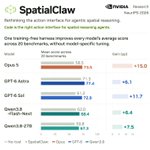
Even GPT-6 Astra gets better with the right action interface.
Same training-free harness, no model-specific tuning, 20 spatial benchmarks:
GPT-6 Astra: 71.3 → 77.4 (+6.1)
Opus 5: 58.5 → 73.5 (+15.0)
GPT-6 Sol: 61.2 → 72.9 (+11.7)
Qwen3.8-27B: 59.8 → 67.3 (+7.5)
Astra already looks “spatial.” A persistent Python kernel on top of it still wins.
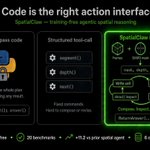
Code is the action interface: the VLM writes one cell per step, inspects SAM / depth / geometry outputs, revises, then answers.
📄 Paper: arxiv.org/abs/2606.13673
💻 Code: github.com/NVlabs/SpatialCla…
🌐 Website: spatialclaw.github.io/
@NVIDIAAI

Update: SpatialClaw was used in the agentic vision training data for NVIDIA Nemotron 3.5 Super VL. Grateful to be part of that effort.
14,169 trajectories, 81,366 actions. Details: xitter.cf/CMHungSteven/status/21…

Honored to be part of this.
First time contributing to a model release at this scale. Grateful to the Nemotron team — the model, the data, and the evals are a much bigger effort than any one piece.
Our piece was SpatialClaw: used to build the agentic vision training data for video understanding.
📄 Paper: arxiv.org/abs/2606.13673
💻 Code: github.com/NVlabs/SpatialCla…
📑 Report: research.nvidia.com/labs/nem…

Min-Hung (Steve) Chen retweeted

Remember VIEScore? It scored generated images with a VLM and explained why in text, across every image generation and editing tasks.
Today we are releasing VIEScore2: one model that scores generated & edited images AND marks exactly where they go wrong on a N by N grid, in a single pass.
Most failed mods still load. They just behave wrong: no texture, a recipe that never registers, crafting that doesn't consume its inputs.
Easy edits land. Deeper ones don't.
That's the gap we're investigating.

Min-Hung (Steve) Chen retweeted
AI game modding is suddenly all over X. Funny timing for us: we have been chasing a nearby question for almost two years.
What does it mean to deliberately *edit* an existing world, rather than generate a new one? We call it World Editing. 🧵(1/10)
Min-Hung (Steve) Chen retweeted

SpatialClaw
Rethinking Action Interface for Agentic Spatial Reasoning
paper: huggingface.co/papers/2606.1…

Min-Hung (Steve) Chen retweeted
SpatialClaw accepted to #NeurIPS2026 🎉
Even GPT-6 Astra gets better with the right action interface.
Same training-free harness, no model-specific tuning, 20 spatial benchmarks:
GPT-6 Astra: 71.3 → 77.4 (+6.1)
Opus 5: 58.5 → 73.5 (+15.0)
GPT-6 Sol: 61.2 → 72.9 (+11.7)
Qwen3.8-27B: 59.8 → 67.3 (+7.5)
Astra already looks “spatial.” A persistent Python kernel on top of it still wins.
Code is the action interface: the VLM writes one cell per step, inspects SAM / depth / geometry outputs, revises, then answers.
📄 Paper: arxiv.org/abs/2606.13673
💻 Code: github.com/NVlabs/SpatialCla…
🌐 Website: spatialclaw.github.io/
@NVIDIAAI
4 papers accepted to #NeurIPS2026 🎉
1 spotlight + 3 posters.
I led SpatialClaw: rethinking the action interface for agentic spatial reasoning.
Code is the action interface — training-free, +13.6 on 20 spatial benchmarks.
Also accepted:
🌟 TTB — Test-time MLP Baking for decoder-only view synthesis (spotlight)
📄 TTVidT — Decoupling the temporal axis for motion-centric video pretraining
📄 MARS — Harmonizing multimodal convergence via adaptive rank search
More details soon 🧵
Huge thanks to all collaborators.
@NVIDIAAI
SpatialClaw details →
SpatialClaw accepted to #NeurIPS2026 🎉
Even GPT-6 Astra gets better with the right action interface.
Same training-free harness, no model-specific tuning, 20 spatial benchmarks:
GPT-6 Astra: 71.3 → 77.4 (+6.1)
Opus 5: 58.5 → 73.5 (+15.0)
GPT-6 Sol: 61.2 → 72.9 (+11.7)
Qwen3.8-27B: 59.8 → 67.3 (+7.5)
Astra already looks “spatial.” A persistent Python kernel on top of it still wins.
Code is the action interface: the VLM writes one cell per step, inspects SAM / depth / geometry outputs, revises, then answers.
📄 Paper: arxiv.org/abs/2606.13673
💻 Code: github.com/NVlabs/SpatialCla…
🌐 Website: spatialclaw.github.io/
@NVIDIAAI
If you work on agents, robotics, or VLM spatial evals:
Cite: arxiv.org/abs/2606.13673
Star/Fork: github.com/NVlabs/SpatialCla…
Happy to help people reproduce the new frontier-model numbers.

Huge thanks to the SpatialClaw crew — this one was a real team effort.
@seokju_cho led the work during his NVIDIA internship.
Grateful to @RHachiuma, Abhishek Badki, @suhangpro, @BKLEE_NANO, @luke_ch_song, @Sifei30488L, @subhashree_r, Seungryong Kim, and Yu-Chiang Frank Wang.
Min-Hung (Steve) Chen retweeted

TT-VidT is accepted at #NeurIPS2026 🎉
A temporal-decoupled methodology in video pretraining to provide real "motion" info extracted from the video and only requires small scale training to reach high quality results.
Huge thanks to all collaborators, @NVIDIAAI and @spellbrush

Min-Hung (Steve) Chen retweeted

SpatialClaw, our work at @NVIDIAAI, was accepted to NeurIPS 2026! 🎊
Even GPT-6 Astra gets better with SpatialClaw. 71.3 → 77.4 (+6.1%p), averaged across 20 spatial reasoning benchmarks. Opus 5 gained +15.0 points, and GPT-6 Sol gained +11.7.
With one shared SpatialClaw harness, we saw improvements across open-source and proprietary models, without any model- or dataset-specific tuning.

Min-Hung (Steve) Chen retweeted
GPT-6 Astra’s 3D jump is showing up when the model writes Code.
That is also the claim of our SpatialClaw (released in June): for spatial agents, the action interface matters as much as the backbone.
A VLM writes Python Code in a persistent kernel.
It composes perception outputs, inspects them, then revises — no extra training.
20 benchmarks, 6 open-source VLMs:
59.9% avg, +11.2 over the prior spatial agent.
Code: github.com/NVlabs/SpatialCla…
Website: spatialclaw.github.io
@NVIDIAAI @seokju_cho


What is the role of academic computer vision research in the age of increasingly powerful large models? Is GPT-6 Astra a step change? How can a researcher have an impact today in academia?
These are the questions I ask myself as I head off to ECCV 2026, a conference I’ve attended since 1992. One of my papers this year is VIGA, a method that takes an image as input and outputs a 3D Blender scene that represents that image. This is a classical inverse-graphics task and VIGA was the first method to solve it using an agentic approach.
The idea is now several years old and the first version of the paper was rejected. This delayed publication significantly. After it was accepted at ECCV, it was quickly surpassed by people using Claude Code for the same purpose. Today GPT-6 Astra blows away all previous results. But we still head off to ECCV to tell the community about our invention that is now fully out of date.
The way academic work often progresses is that one reads recent papers, notices that they have limitations, comes up with a new idea, explores this, publishes it, etc. Any published paper I read today is based on ideas that are at least a year old. And those ideas were based on the literature of the time, which was also a year old. That means that any paper I see at ECCV is likely two years out of date. In AI today, two years means your work is likely irrelevant.
At CVPR this summer I noticed that many authors have not gotten the message. They continue to work on “old” problems that have a long history. This history is based on assumptions about how the “vision problem” will be “solved”. The truth is that it is being solved in a very different way and many of these problems are no longer relevant. Another group of papers focuses on very niche problems where large models likely fail because of insufficient data or lack of business interest. The impactful papers were largely from industry and had long author lists and massive data+compute behind them. These papers were also out of data, describing systems that had been released months before, but at least they served to provide the community with more complete documentation and analysis of commercial systems.
So what should academics do? First, we need to put aside the tools we’ve used for years and start from scratch. Every project should start by trying really hard to solve the problem with existing tools. I would like to see every paper begin with a detailed experimental analysis of how existing models perform and why they fail (if they do). This gives the kind of insight we need today. Then, assuming current models fail, the solution should provide some fundamental insight that will outlive the next release of such models.
Reviewers today still focus on technical novelty. This pushes people to focus on tweaking architectures rather than clearly moving the field forward. Papers need to be judged based on their novel insight and not their novel technical contribution. This is a real shift in thinking but it focuses us on what matters - progress of the field.
If we want there to be a “field” of computer vision, then it can’t become a marginal backwater, focusing on esoteric problems. If you haven’t tried using Astra (or whatever comes next) to solve your problem, then you have not done your homework. This omission should be seen as negatively as not having a previous work section.
Concretely, I think papers should include a new section analogous to “Related Work” where that related work is current models and how they perform on the task. Reviewers should start asking for this and expecting authors to be able to articulate their insights about the limitations of existing large models.
I'm interested in your thoughts.