

GM! Building Sovereign: software that runs researched multi-strategy trading systems on your own server, on Hyperliquid Your keys Your control @CryptosystemsFi
Obsession is progression
Joined November 2022
- Tweets1K
- Following236
- Followers933
- Likes1.3K
Pinned Tweet
What we build, in simple terms:
"Sovereign" is software that runs multi-asset, multi-strategy trading systems on your own server, on Hyperliquid.
Setup takes around 30 minutes.
No technical skills or know-how required.
You set it up on your own AWS account, using one-click setup and connect a trade-only API key. It can place trades. It can't withdraw. The capital stays in your account the whole time.
Then you pick the systems and the risk level. Each system combines several strategy types and behaviors, built to get paid in different market and volatility regimes. You can select from the two different pre-sets or combine your own selection of strategies/approaches fitting your preferences and desired outcomes.
We do the part that takes the hours.
- Researching the strategies: spotting when one stops fitting the market, shipping new versions.
- Adding strategies that don't move together, so you're not betting everything on a single market period and providing more diverse options to serve different requirements.
- maintaining and improving the infrastructure as well as enhancing the execution and all the other small tasks that occur randomly.
Your server picks up updates when nothing is trading and rolls back if one fails. Even if we change nothing, it keeps running on the version you have.
It's not a fund, not a bot and it's not a signal group.
It's software running on your own server with you in control.
It's built for people putting $300k or more into systematic digital asset exposure who don't have the hours to run and maintain it themselves.
Software and engineering services. Not financial, tax, or investment advice.

Option 4 - Building your own automated execution.
It has become easy to start out with but you still are responsible for upkeep and fixing things.
And most start this whole endeavor backwards.
They build for the sake of building.

CelestialEye | Cryptosystems.org retweeted
Option 3 - Managed accounts.
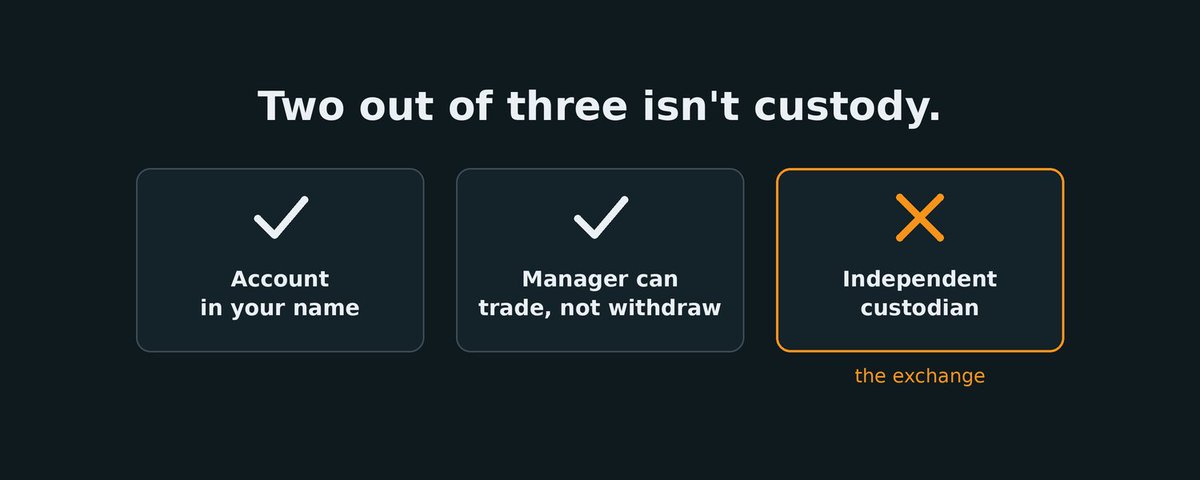
A TradFi favorite that has some limitations in Crypto where you often have no independent custodians and where the exchange is everything at once: Clearing house, custodian and counterparty.
Option 3 - Managed accounts.
A TradFi favorite that has some limitations in Crypto where you often have no independent custodians and where the exchange is everything at once: Clearing house, custodian and counterparty.
CelestialEye | Cryptosystems.org retweeted
2. Option where capital is allocated- Vaults
Vaults are very interesting.
They do have some technical limitations though (e.g. a vault is a single account so you cannot run multiple strategies that cannot be netted and rebalance them in a vault)
CelestialEye | Cryptosystems.org retweeted

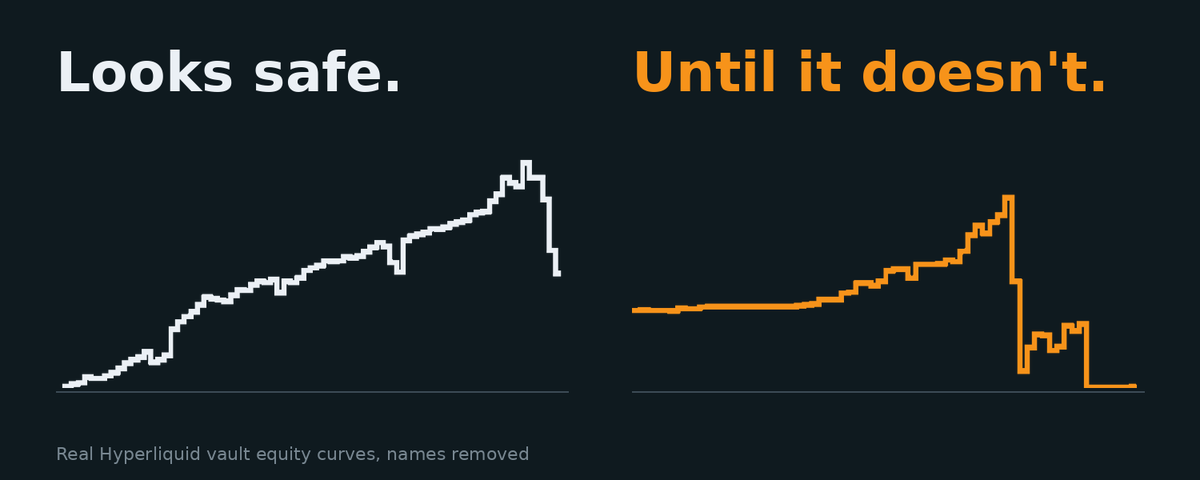
The people who struggle the most are the ones treating risk as a bug to be fixed rather than the price of admission. They keep adding complexity trying to get the return without the pain and they end up either curve-fitting or shifting the risk somewhere they can’t see it until it blows up.
There’s a reason it’s called risk management and not risk avoidance. You manage the risks that pay you and you avoid the ones that don’t, innit?
2. Option where capital is allocated- Vaults
Vaults are very interesting.
They do have some technical limitations though (e.g. a vault is a single account so you cannot run multiple strategies that cannot be netted and rebalance them in a vault)

Option 1 - On holding, the why, the risks and how to possibly get more out of it
Full article on this link:
teapawt.net/CelestialEye_/status/2…

Most people with capital in digital assets and not much time end up doing one of five things.
They hold. They put it in a vault. They allocate to managed accounts. They follow someone's calls. Or they build their own bot.
None of these is stupid. They are all valid and solve something real, and each one leaves a gap that usually only shows up a few months in.
Buy and Hold doesn't really need you and that is great. The cost for that is that you are allocated through all the moves. The good years and the bad years.
Vaults hand off the research. Most run one strategy, and general human psychology makes allocators leave the vault at the worst moment.
In crypto that often means lock-ups and handing your capital to a third party, usually on a centralized exchange. That brings back the control problem digital assets were supposed to solve."
Call channels are a big thing in this space and might feel like help, but you're still the one clicking, and you never really know what the strategy is or when the next call comes.
Your own bot gives you full control. Then it gives you a second job as you get to experience the whole influx of random things that will go wrong over time.
I'll go through the ones I see most this week and share my thoughts on what each gets right, where it breaks, who it actually suits and how to get the most out of each.
CelestialEye | Cryptosystems.org retweeted

2. No Pain, No Premium
The philosophy of “no pain, no premium” is just a reminder that over the long run, we get paid to bear risk. And, eventually, risk is likely going to manifest and create losses in our portfolio. After all, if there were no risk of losses, then why would we expect to earn anything above the risk-free rate?
Modern finance is largely based upon the principal that the more risk you take, the higher your expected reward. And most people seem to inherently understand this idea when they buy stocks and bonds.
But we can generally expect the same to be true for many investment strategies. Value investors, for example, are arguably getting paid to bear increased bankruptcy risk in the stocks they buy.
What about strategies that are not necessarily risk-based? What about strategies that have a more behavioral explanation, like momentum?
At a meta level, we need the strategy to be sufficiently difficult to stick with to prevent the premium from being arbed away. If an investment approach is viewed as easy money, enough people will adopt it that the inflows will drive out the excess return.
So, almost by definition, certain strategies – especially low frequency ones – need to be difficult to stick with for any premium to exist. The pain is, ultimately, what keeps the strategy from getting crowded and allows the premium to exist.
Ask any trading related service: what happens if you stop touching it?
Sovereign keeps running on your server, on the version you have. We research and ship updates on top.
It doesn't lean on us day to day.
Even if we were to disappear, it would still continue running with you in control.
5
252
Gut-feel trading needs your attention at exactly the moments you have none.
Rules don't get tired, distracted or scared.
Sovereign runs rules-based systems on your server.
3
208
What if an update goes wrong?
Sovereign rolls back and keeps running the last working version. With automatic updates off, it stays on its version until you update it.
A bad update doesn't break you.
1
2
182
Updates don't mean anyone logs into your server.
Sovereign checks its version against the pinned live one. With automatic updates on, it updates itself when nothing is trading.
Nobody logs in.

3
157
Sovereign is built for the rare kind of person putting a serious part of their wealth to work while running a company or a career.
You need the systems working and under your control, without being the one who keeps them working.
1
8
256