
Official Twitter account of NASA’s Chandra X-ray Observatory. Operated for NASA by Smithsonian (SAO). Verification: https://xitter.cf/t.co/oQRMjHqCRI Legal: https://xitter.cf/t.co/BUQNO29Sjg
- Tweets78.1K
- Following198
- Followers419K
- Likes13.4K




ALT This X-ray image of the supernova remnant G306.3-0.9 features a very small, bright purple object in the center of a dark and starry sky. The purple nebula has some bits of red and blue peeking through. It has a cartoon-like fish shape, poised as if swimming down into the water. It stands out from the surrounding stars due to its colors, brightness and contrast against the darker background. The image is roughly 20 arcminutes across, which corresponds to 150 light-years at the remnant's estimated distance of about 26,000 light-years.


ALT This cartoon of the Swift observatory shows it pointing at a target in the sky. Against a black background, the Swift spacecraft has a boxy grey body with long blue solar panels extended on each side and a yellow triangular section pointed out into space. Swift is pointing toward a star on the left that is marked with a triangular pink flag on a blue pole and surrounded by four pink L-shaped brackets. There are five additional targets across the image, three with a blue checkmark above them indicating that Swift has already observed them. This image is watermarked with “Credit: NASA’s Goddard Space Flight Center.”


ALT This is a composite image of a remarkable radio wave formation that strongly resembles a treble clef musical symbol, hovering in the midst of two colliding galaxy clusters. Here, galaxies in the galaxy clusters, plus foreground and background stars and galaxies, blanket the image with specks of light set against the blackness of space. At the center of the frame is a large, oval, blue-purple cloud with ragged edges. In the middle of the purple field, tilting slightly to our left, is what appears to be a giant treble clef, loosely drawn with a neon pink marker. Like the musical notation for which it's named, the formation has a strong vertical stroke with a continuous, fluid line swooping back and forth as it moves from top to bottom.


ALT A barred spiral galaxy packed with regions where stars are actively forming. Chandra X-ray data (magenta) highlights stellar nurseries and X-ray binaries scattered along dusty spiral structures brought to life by Hubble optical (white and gray) and Webb infrared (orange and red) observations.

ALT A composite image of a remarkable radio wave formation that strongly resembles a treble clef musical symbol, hovering in the midst of two colliding galaxy clusters. Here, galaxies in the galaxy clusters, plus foreground and background stars and galaxies, blanket the image with specks of light set against the blackness of space. At the center of the frame is a large, oval, blue-purple cloud with ragged edges. In the middle of the purple field, tilting slightly to our left, is what appears to be a giant treble clef, loosely drawn with a neon pink marker. Like the musical notation for which it's named, the formation has a strong vertical stroke with a continuous, fluid line swooping back and forth as it moves from top to bottom.

ALT A four-panel image with composite images of galaxies. At upper left is a spiral galaxy with gleaming blue and purple arms wind around its center. In the upper right, another spiral galaxy has a glowing pale-yellow core, surrounded by a muddle of clouds in shades of purple. In the lower left, an irregular galaxy resembles a splatter painting in orange, purple, blue, and white. Another spiral galaxy is in the lower right. It has a bright, golden orange and purple core with spiraling blue arms wrapped tightly around the center and spreading as they extend outward. The image is watermarked “Credits: X-ray: NASA/CXC/SAO and ESA/XMM-Newton; UV: NASA/Penn State Univ/Swift and NASA/CAS/CNES/John Hopkins Univ. Applied Physics Laboratory; Optical: NOIRLab/NSF/AURA/MCELS Team/Middlebury College/F. Winkler, Mark Hanson (used with permission), and Armen Akopian (used with permission); Infrared: ESA/NASA/JPL-CalTech/STScI; Image Processing: NASA/CXC/SAO/L. Frattare.”
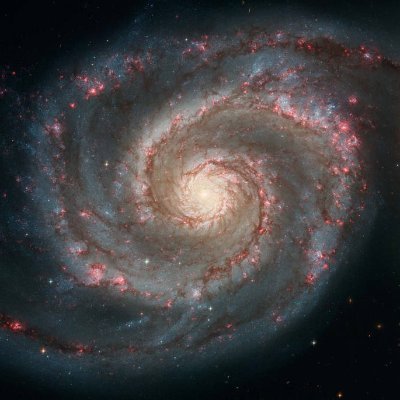

ALT This image combining X-ray data from Chandra and optical data from Hubble features a galaxy nicknamed the Teacup due to its unusual shape. A brilliant off-center purple glow marks the location of the galaxy, whose central supermassive black hole is causing an ongoing storm. The wispy, green and blue, handle-shaped feature to the galaxy’s left is a bubble formed by one or more eruptions powered by the black hole. A few tiny red and yellow dots scattered across the image represent other objects in the same area of the sky. The image is watermarked “X-ray: NASA/CXC/Univ. of Cambridge/G. Lansbury et al; Optical: NASA/STScI/W. Keel et al.”

ALT A composite image of the center of our Milky Way Galaxy. Overall, it looks like an impressionist oil painting with patches of diffused color. At the heart of the image is a light purple cloud and a spiraling, bright yellow tangle. The purple cloud represents X-rays from the center of the supernova remnant. Inside the bright yellow tangle is Sagittarius A*. Surrounding the remnants of the exploded star and its black hole neighbor, is a neon red gas cloud with trails drifting toward our upper right. Here, red represents radio data from the NSF's Very Large Array. A faint, dark blue cloud, barely discernible against the blackness of space, begins at our upper left and exits the bottom of the frame. This is submillimeter-wavelength data from the James Clerk Maxwell Telescope. Mottled, faint patches of forest green stretch across the image from our lower left to our upper right. These are lower-energy X-rays detected by Chandra, possibly linked to past outbursts from Sagittarius A*.

ALT A unlabeled image of the center of our Milky Way Galaxy. Overall, it looks like an impressionist oil painting with patches of diffused color. At the heart of the image is a light purple cloud and a spiraling, bright yellow tangle. The purple cloud represents X-rays from the center of the supernova remnant. Inside the bright yellow tangle is Sagittarius A*. Surrounding the remnants of the exploded star and its black hole neighbor, is a neon red gas cloud with trails drifting toward our upper right. Here, red represents radio data from the NSF's Very Large Array. A faint, dark blue cloud, barely discernible against the blackness of space, begins at our upper left and exits the bottom of the frame. This is submillimeter-wavelength data from the James Clerk Maxwell Telescope. Mottled, faint patches of forest green stretch across the image from our lower left to our upper right. These are lower-energy X-rays detected by Chandra, possibly linked to past outbursts from Sagittarius A*.

ALT M104 has a wide, flat, round brim, shown here as a hazy violet ring viewed nearly on its edge. At the center of the brim-like ring is a cluster of golden specks surrounding a warm white core.

ALT A composite image of a spiral galaxy, M101; one of six identified galaxies housing a new class of mysterious objects that give off unusually low-energy X-rays. In this image, M101 faces us directly. It has multiple arms in shades of purple, spiraling clockwise around a golden yellow core. Scattered along and between the arms are scores of tiny specks in white and purple. Most of those specks are pairs of stars, but seven of them are a mystery. To casual observers, the unusual objects are visually indistinguishable from the other specks of light in the galaxy. The curious objects give off X-rays of such low energy, they in fact produce large amounts of ultraviolet radiation, as UV radiation borders X-rays on the electromagnetic spectrum. Searching images of galaxies with low-energy X-rays in the Chandra Observatory archive, scientists have found a total of 84 such objects spread across M101 and five other galaxies. They have dubbed these mysterious objects "hypersoft X-ray sources."


ALT NGC 1569, a compact dwarf irregular galaxy undergoing a violent, compact burst of star formation. Chandra and XMM-Newton observations (blue and purple) reveal massive bubbles of million-degree gas inflated by stellar winds, set against a backdrop of optical light (magenta, orange and white) imaged by Adam Block. Dwarf starburst galaxies can serve as local laboratories for studying the conditions of the early universe, where small, primitive galaxies formed stars at frantic rates. Overall, NGC 1569 resembles a tangle of glowing red yarn surrounding a white sparkler.

ALT This is a multiwavelength image of galaxy NGC 1672. At its center are two thick, spiraling, dark purple arms that bridge a brilliant white and neon pink core. Those bridging arms create a bar, which channels gas to the core, making NGC 1672 a barred spiral galaxy, like our own Milky Way. Longer, wispier arms also spiral out from the core, dotted with gleaming white and pink stars.


ALT The Tarantula Nebula—vibrant and colorful. Clouds of red, yellow, orange, and green crest over a background of deep blue haze, black space, and red stars. Bright spots of light line the center, causing parts of the clouds to glow luminous gold. Credit: X-ray: NASA/CXC/Ohio State Univ./J. Rodriguez et al; Infrared: NASA/ESA/CSA/STScI; Optical: NASA/ESA/STScI; Image Processing: NASA/CXC/SAO/P. Edmonds

ALT Three images of the Tarantula Nebula, each representing a different wavelength of light, presented in a different color. When layered atop one another, like sheets of colored cellophane, they combine to produce a vibrant and informative singular image. The base layer features a blanket of wispy blue clouds against a black backdrop. These clouds represent hot gas observed by Chandra. The second layer cuts diagonally across the cloudy blue square, tilted from our upper left down toward our lower right. This red layer represents infrared data collected by Webb. The third layer is a diamond-shaped image, with its points touching the edges of the big blue base layer. This green layer represents data captured by NASA's Hubble Space Telescope. In the center of the combined image, the three translucent layers overlap, resulting in an image of intermingled blue, red, and green clouds that blend to include lively shades of fiery orange, golden yellow, and deep purple.


ALT Digital artwork of the Chandra Xray orbiting Earth against a starry sky with a distant planet and the Sun visible.

ALT The Lighthouse Nebula (upper left) and a pulsar (lower right) are illuminated against a spotty starfield. The part of the nebula shown in this image looks like a diffuse, purple cloud with a bright star in the center. The pulsar looks like a bright white streak of light with a purple jet extending from one end, forming the shape of a checkmark. Credits: X-ray: Chandra: NASA/CXC/Stanford Univ./J.T. Dinsmore et al.; IXPE: NASA/MSFC/J.T. Dinsmore et al., Radio: CSIRO/ATNF/ATCA; Optical: 2MASS/UMass/IPAC-Caltech/NASA/NSF; Image processing: NASA/CXC/SAO/L. Frattare