

DATA + TECH Studio. We design & build intelligence platforms powered by knowledge graphs
Joined January 2023
- Tweets15
- Following6
- Followers40
- Likes72
Collective Lab retweeted

Say hello to Gemini Embedding 2, our new SOTA multimodal model that lets your bring text, images, video, audio, and docs into the same embedding space! 👀


Collective Lab retweeted
IF you are into context graphs & agentic memory, this is for you:
I've built local-first graph DB for coding agents
🔼 On-device property graph
🔼 One CLI. One Folder. No server
🔼 Schema as code: 100% typesafe
🔼 Fast: Arrow-native, built with Rust
🔼 Full time-travel: query any past state
meet: nanograph
Been using it for 4 days & it feels like magic🪄
Agents pick it up right away:
building typed graphs with clean ontology in minutes
nanogrpah has DuckDB/SQLite energy
.nano graph is a build artifact, not a service.
stored locally on device & backed-up via GitHub
100% open source.
Your agent can set it up in minutes with link↓
Try it, drop a star⭐ and DM me any feedback!
Collective Lab retweeted
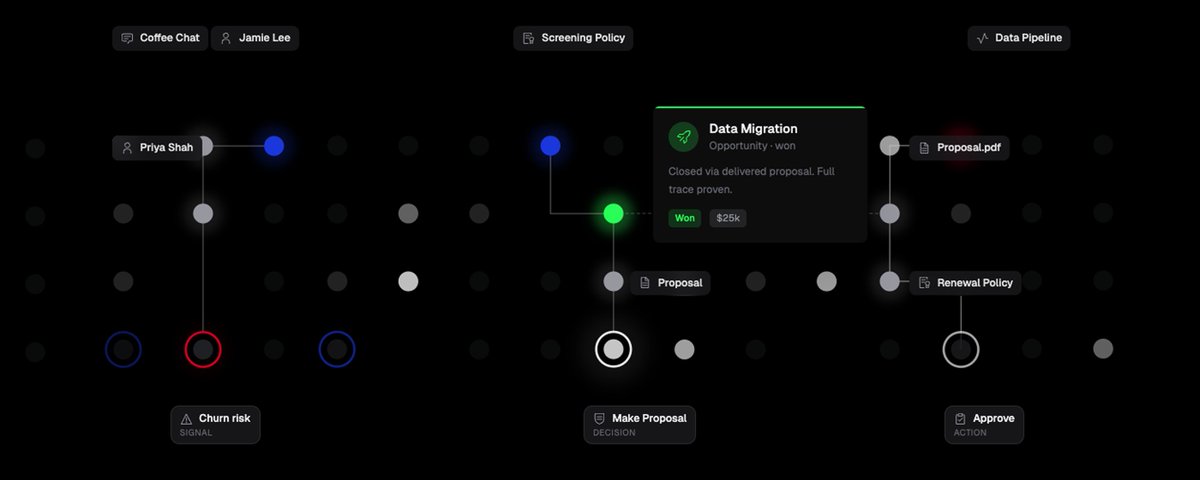
Here's RevOps system we use @CollectivelabHQ
CRM + PM + Finance + BI
Aligned with other OPS
Integrated with comms:
Email, Slack, Zoom
Built on @MongoDB
Managed by agents
[via Mongo MCP & custom tools]
→ 90% inputs are automated
→ Mirror our business ontology
→ Focused [not bloated]
→ 100% stack we like
→ Full data & code ownership
RevOps SaaS is sooo cooked
This year we've built 7 custom RevOps systems.
None of our clients want to go back to
generic bloated SaaS walled gardens
It's just a matter of time now...


Collective Lab retweeted
CRUCIAL PATTERN for all agent builders🛠️
I'm refactoring several of my toolkits right now
to follow this paradigm
BEFORE: large tools with complex logic inside
[made sense to encapsulate logic from agent → not get it confused]
NOW [with 🆕GEN of models]: agents became way smarter:
→ can handle more tools
→ use them creatively & non-linearly
→ can handle more steps & tools calls in one go
Real example → my RAG tooling [Hyper9 System]:
BEFORE: complex agentic RAG
Separate agentic calls INSIDE the tool built around SPIKE logic:
Signals | Patterns | Insights | KnowHows | Elements
[simpler agent living inside the agentic tool]
NOW: set of small & clean composable tools for the main agent to use
Multiple agents use them independently:
Some as CLI tools [@claudeai Code, @warpdotdev]
Some via MCP [custom, @mastra based]
This automatically upgrades:
GraphRAG → AgenticRAG
Just ran my RAG evals:
the results are 🔥🔥🔥
Unix philosophy wins again💪


I’m getting more and more convinced that the Unix tool approach of having a bunch of focused, composable functional units that can be used in isolation or as part of a larger pipeline is also the best approach for tooling for coding agents.
The problem with trying to make a big unified system that does everything is that people have their own workflows and ways of doing development, and it’s usually too hard to try to make a one-size-fits-all project that can accommodate that without it turning into sprawling complexity that doesn’t work well in practice.
So I have one tool for agent mail, one tool for task management (Steve Yegge’s beads), one tool for task selection (bv), one tool for past history search (cass), one tool for polyglot linting and bug-catching (ubs), one for sensitive command handling (slb), one for managing tmux and agent sessions (ntm), one for memory (csm), etc.
And you can use one of them, some of them, or all of them. And they’re partially integrated with each other, but always optionally. So slb can use agent mail if you have it set up, but it also works standalone. And ntm can display info from bv but it isn’t forced.
They become like little Lego blocks that you can use to build up whatever system you want, and it becomes easy to create your own little tools to add the functionality you want.
And then your AGENTS dot md file sort of becomes like an operating system where you “install” the tools in the agent’s working memory and configure them by describing how, when, and why to use them (weirdly, you now have to worry about persuading the machine to use the tools!)
So you can have all your tools set up on your machine but only activate specific ones depending on the project by including just the relevant blurbs explaining the tools you want to use.

Collective Lab retweeted
I turned my course into MCP server
It exposes my know-hows & methods as callable toolkit
STACK:
▲ Vercel [ecosystem]
NEXT.js [backend]
MCP‑handler [wiring]
Mongo [DB + vector index]
MUX [video & transcripts]
OpenAI [vector embeddings]
Claude [transcript cleanup]
LangChain [text splitters]
Clerk [auth]
Plug it to your favourite AGENT
and now it can apply my expertise at scale🎱
Explore this 🆕 expertise distribution model
Check out the full breakdown
↓
Collective Lab retweeted
YouTube videos → GraphRAG pipeline:
Metadata
↓
Transcript
↓
Cleaning
↓
Staging @supabase
↓
Chunking
↓
Embeddings
↓
Vector store
↓
Knowledge extraction
↓
Knowledge graph [SPIKE] →
→ Signals | Patterns | Insights | Know-hows | Elements
@neo4j for graph + vector [native GraphRAG]
structlog for beautiful logging
Collective Lab retweeted
ALL IN on these guys!
Every agent we build @CollectivelabHQ runs on @mastra
Best decision ever💎

we raised a $13m seed round from 120+ of Silicon Valley’s top investors
for @mastra, the leading TypeScript agent framework

Collective Lab retweeted
GraphRAG made knowledge graphs sexy again
Here's how to make sense of it:
✳️ Graph vs Knowledge Graph
✳️ Property Graph vs RDF
✳️ SPARQL vs Cypher
✳️ Graph DB vs Traditional DB
✳️ GraphRAG vs RAG
Full cheat sheet ↓
Collective Lab retweeted
Memory architecture blueprint
for @mastra Slack agent
3-layer system:
✳️ Thread context
✳️ Semantic recall
✳️ Durable memories
L1: Thread context
[Mastra memory → @upstash Redis]
• Recent messages
• Convo context within threads
• Auto-generated titles
L2: Semantic recall
[Mastra memory → Upstash Vector]
• Vector embeddings
• Semantic search for older threads
• Can index shared knowledge [FAQs, SOPs]
L3: Durable memories
[Mastra tool → @mem0ai]
• Specific facts across threads
• User preferences & decisions
• Searchable & persistent long term
How it works:
✳️ Thread memory keeps conversations coherent
✳️ Vector search finds relevant past context
✳️ Mem0 remembers user preferences forever
Perfect context engineering → no agent amnesia
Slack Agent can be used to:
→ Sync the team
→ Nudge team members
→ Manage projects
→ Track decisions
→ Do follow-ups
NO memory: agent perceived as fungible & disposable
THIS architecture: agent becomes valuable part of the team
Collective Lab retweeted
I'm building my own graph visualization library
I tried everything that's out there
And nothing hits my requirements:
✦ React-first with clean API
✦ WebGL 2D super-fast rendering
✦ Handle 5K+ nodes @ 60 FPS
✦ Web workers for algorithms
✦ Super smooth animations
✦ Nice developer experience
✦ Real data science focused
I need something optimized for heavy commercial projects, not for 3D showcases
So hyper-graph is born!
STACK:
🔼 React → Components & API
🔼 PixiJS → WebGL rendering
🔼 D3-force & ForceAtlas2 → physics
🔼 Web Workers → Algorithm runs
🔼 Graphology → Data model
🔼 Zustand → State management
Learned soooo much already!
As you see in the demo → not perfect yet, but we're getting there
Coming to npm next month🤞