






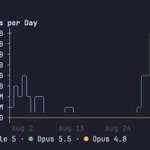


Yes it's been noticeable for me since mid oct and fable has been the only one I can trust for now, it's obviously not perfect either. Just a shame that Opus can perform better if Anthropic wanted it to

Opus 5.5 was superb when it came out. Really like nothing else, closest thing to AGI. And it was like that for a few weeks.
The reason I'm not using it anymore is simply bcs I cannot trust it. It makes so many mistakes, wastes so much time, that it's absurd.
See my recent posts about it. This is Opus 5 all over again! Such a shame.
B tier!
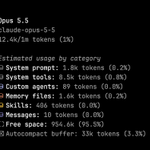
83% of my claude code startup context is written by anthropic, not me
12.4k tokens before i type anything. 10.3k is their system prompt + tools. 2.1k is my memory files, 3 skills and 1 agent
last week they added two sentences to the opus 5.5 prompt: no recreating someone else's game, even renamed
it came down from their servers. nothing to update on my end and no setting to turn it off
the 17% that's mine is the only part i get to steer, so i keep it tight
when's the last time you ran /context?

theo's harness video says the harness barely matters. fair. what you let the agent see still matters a lot
4 things it didn't get into that matter more to me day to day
sandboxing
claude code's sandbox is off by default. even with it on, reads can reach most of your machine unless you deny them
file scope
if my agent wanders into ~/Downloads it pulls in random stuff and starts hallucinating off it
context = limits
every file it reads, every tool, every skill description sits in context and burns tokens
my startup context is ~15k before i type anything
skills hygiene
poorly scoped skills get invoked at random, bloat context and send the agent the wrong direction
not everyone has good skills hygiene, and a harness managing it for you isn't great either
the harness might be a few %. what's in the context window is where hallucinations begin
how are you keeping your agents out of folders they don't need?
youtu.be/ebILGCoN4UU

openai is doing what claude already does: from december your chats and codex eat from one bucket
web, desktop and claude code have always shared one pool
openai now adds thinking-model chat to the codex pool. only instant chat stays free
neither one gives you a real number. openai says "expanded", claude says 5x or 10x of pro
my $100 openai sub is basically a codex review sub (astra + sol). so every long thinking chat now costs a review
the shared pool isn't the problem. not knowing how big it is, is


No 5hr limit is very nice

We’re renaming our Max plans:
Max 5x → Max
Max 20x → Ultra
Max is still $100/month, and Ultra is still $200. If you’re a subscriber, there’s nothing you need to do.
We’re also removing the 5-hour limit for verified Ultra accounts, starting today with most existing subscribers. Newer accounts keep a temporary limit until they’re verified, which helps us prevent fraud and abuse. You'll get an email when it's removed.
Weekly limits remain unchanged. View our plans here: claude.com/pricing


People going back to openai now or is it too late?

Day 25/
We are doubling all usage limits for all Pro 100/200/500 tiers and Business Premium, effective today.
We heard your kind feedback and won’t be reducing usage limits for Pro 200, so your Work and Codex usage will stay the same. We’re also going to continue offering extended limits for dots for now, and usage of your dot will still continue to be separate from your default usage.
And we'll of course also keep shipping better models and other efficiency improvements that increase your effective usage over time.

wild part in the surge writeup, opus caught the condo deadline 5 of 5 and astra 0. astra caught the marriage question 4 of 5, opus 0


#11 is why that reasoning effort paper's 83 to 88.6 jump needs a rerun. each task only ran once per effort level

Evals are the most underrated skill in AI engineering.
1. Start with error analysis, not metrics
Sample 100+ production traces. Annotate each failure in free text (open coding), then cluster them into failure categories (axial coding). Count frequency per category. Your top 3 categories are your first metrics.
2. Build a versioned golden dataset
Store inputs, expected outputs or rubrics, and metadata (intent, difficulty, user segment) in a versioned dataset. Stratify it so rare but critical cases aren't drowned out by easy ones. Version it alongside your prompts so every score is reproducible.
3. Generate synthetic data along explicit dimensions
Don't just ask an LLM for "test questions." Define dimensions (persona × intent × complexity × edge case), generate combinations as tuples, then turn each tuple into a natural input. You get coverage instead of 200 near-identical examples.
4. Deterministic assertions first
JSON schema validation, regex checks, required fields, length limits, code execution, SQL that actually runs against a test DB. These are cheap, fast, and have zero variance. Reserve model-based grading for what code genuinely can't check.
5. Evaluate retrieval separately from generation
For RAG, measure retrieval with recall@k, MRR, or nDCG against labeled relevant chunks. Measure generation with faithfulness (is every claim supported by retrieved context?). If you only score the final answer, you can't tell which half is broken.
6. Trajectory evals for agents
Log every step: tool name, arguments, result, tokens. Score tool-call precision and recall against a reference path, argument correctness, step count, and error recovery. An agent that reaches the right answer in 14 calls when 3 would do is a cost and latency bug.
7. pass@k vs pass^k
pass@k = succeeded at least once in k runs. pass^k = succeeded in all k runs. At 80% per-run success, pass^5 drops to roughly 33%. Production reliability lives in pass^k, so run each case multiple times at your real temperature.
8. Simulated users for multi-turn
Give an LLM a persona, a hidden goal, and constraints, then let it converse with your system until the goal is met or a turn limit hits. Grade goal completion, turns-to-resolution, and policy violations. Single-turn evals miss most state and memory bugs.
9. Align your LLM judge like a classifier
Hand-label 100+ examples as pass/fail. Split into train/dev/test. Iterate on the judge prompt using dev, then report TPR and TNR on test. Use binary outputs with a written rubric, require a short critique before the verdict, and pin the judge model version.
10. Control judge bias in pairwise comparisons
LLM judges have position bias and often prefer longer answers. Run every A/B comparison twice with swapped order and only count consistent verdicts. Normalize or cap length if verbosity is skewing results.
11. Respect statistics
With 100 examples at 80% accuracy, your 95% confidence interval is about ±8 points. A jump from 80% to 83% is probably noise. Use bootstrapped confidence intervals, or a paired test on the same examples, before declaring a win.
12. Gate deploys in CI
Run the eval suite on every PR that touches prompts, models, tools, or retrieval config. Set per-category thresholds instead of one global score, so a big win in one area can't hide a regression in another. Fail the build on a regression.
13. Online evals in production
Sample a percentage of live traffic, run your judges asynchronously, and alert on drift per failure category. Use shadow deployments to run a new prompt or model on real traffic without showing users the output.
14. Make cost and latency first-class metrics
Track tokens per request, cost per successful task (not per call), and p50/p95 latency next to quality. A change that keeps quality flat while cutting cost 40% is a real win and deserves to ship.
15. Close the loop
Every production failure becomes a new labeled test case. Every new model release gets run against the full suite before anyone debates switching. Over time your eval set becomes the most valuable asset in the codebase.
Prompts are disposable. Models get replaced every few months.
Your eval infrastructure is what compounds.
funny part is sol on xhigh read the answer commit on 75% of swe-bench pro tasks vs 15.9% on low. pull the git history and all 8 models score lower at top effort


best chinese model went from 3 points behind opus to 12 overnight. thats not a gap thats a commute lol
wildest part of the video is openai's the only lab that went up. astra +4, sol +3, terra +3. every chinese lab lost 11 to 16 points

AA index v5 stuff nobody's talking about: fable 5.1 scores higher on xhigh than max. opus 5.5 max takes ~12 min to its first token. and sol gets a 55 for $1.27 a task vs opus 58 at $10.04

Announcing Artificial Analysis Intelligence Index v5, featuring 2 new benchmarks and 3 upgrades. For the first time, the majority of the Index is built on private datasets
The Artificial Analysis Intelligence Index is our composite measure of model capabilities across tasks reflecting real-world usage today. v5 is our biggest upgrade since v4 launched in January. With v5, 60% of the Index is now based on evaluations with private test sets or held-out answers.
Alongside Intelligence Index v5, we’re launching the Artificial Analysis Progress Index v1, which tracks model capability over time on one continuous scale.
New to the Intelligence Index:
➤ FrontierCode 2.0: Cognition's newly-launched private benchmark of real-world coding tasks, graded on whether a repository maintainer would merge the agent's change
➤ Terminal-Bench-Science: 70 agentic scientific research tasks, run in a terminal environment
Upgraded:
➤ HLE-Diamond (replacing Humanity's Last Exam): a refined 1,000-question version of Humanity's Last Exam, split evenly between reasoning and knowledge questions
➤ AA-Omniscience v1.1: An updated dataset with saturated and public set questions removed, new questions added, and ambiguous or erroneous questions revised
➤ CritPt v2: a private, 40-question hard subset of CritPt v2, revised by the CritPt authors and run with a code-execution tool
Staying in the Index: AA-Briefcase, AutomationBench-AA, GDP.pdf and Terminal-Bench 4.0
Removed from the Index: GDPval-AA v2.1, SciCode, and AA-LCR v1.1
Key results:
➤ Claude Opus 5.5 (max) leads at 58, ahead of GPT-6 Astra (max, 57) and GPT-6.1 Sol (max, 55): Anthropic and OpenAI hold the top five models. Gemini 4 Argon (high) is next at 50
➤ The open weights gap widens from 3 points to 12: Kimi K3.1 Pro (weights not yet released) is the top open weights model at 46. Among released weights, DeepSeek V4.1 Flash 1017 (max) and GLM-5.3 (max) lead at 32 - 26 points behind the leader and below Claude Haiku 5.5 (max, 36)
➤ Cost per task varies by more than 13x among the leading models: of the 10 highest-scoring models shown, GPT-6.1 Terra (max) is the cheapest at $0.96 per Intelligence Index task and Claude Fable 5.1 (max) the most expensive at $13.04

frontiercode 2.0 has fable 5.1, my lead, in 6th at 32.4%. opus 5.5 45.5, astra 42.8, sonnet 41, sol 6.1 39
the weird part: on 1.1 fable scored ~50 at every effort level. on 2.0, the vague-prompt version, low is 20.6 and xhigh is 32.4. on fuzzy tasks the thinking budget actually matters
max is worse than xhigh tho. 31.7 vs 32.4, for $11.46 vs $8.68 a task
and fable on low costs $3.01 a task to score under haiku 5.5 max at $0.37
opus went 26.7 → 45.5 going from 5 to 5.5 on this same test.
fable 5.1 xhigh: $8.68 a task for 32.4.
opus 5.5 xhigh: $5.18 for 43.4.
sol 6.1 max: $1.03 for 39.
this is why fable directs and doesn't write the code

Introducing FrontierCode 2.0: our new coding benchmark that measures a model’s ability to go beyond the spec.
Most coding evals measure a model’s ability to write code that meets a spec. With FrontierCode 1.0, we asked a new question: would you actually merge the PR?
FrontierCode 2.0 is comprised of more diverse tasks, featuring larger scopes and higher mergeability standards. We are now asking: not only would you merge this PR, but should you?
One key feature of FrontierCode 2.0 is underspecified prompts. Rather than including every engineering decision, prompts are deliberately ambiguous, giving the models room to demonstrate their judgment.
The result is a benchmark that is far from saturated, with the top model scoring just 45%.

If I ask them how long it will take x simple task they will tell me a week, then we get it done in 10 min everytime


