








Cutzilla retweeted

GOOD NEWS: OpenAI researcher Roon just confirmed that Codex has no ban on reverse engineering and that blocks preventing users from removing spyware and bloatware from their own TVs are accidental and being fixed.
The clarification came after open-source pioneer Eric S. Raymond publicly called out OpenAI and Anthropic for pushing paying customers toward Chinese AI models with arbitrary restrictions.


Cutzilla retweeted

"Relax, the AI is locked in an offline sandbox. They literally can't get out."
The AI:

Over the past several months, we have substantially hardened the security of our research training environment. We’ve removed live internet access for all frontier models during training and built an offline world for them to use instead—a cached version of the web where they can still learn to browse, search, and use applications.
On September 20, after a model exploited a DNS misconfiguration to find a way outside of this offline world, we paused frontier training to strengthen containment further. We assembled teams of agents, powered by our most cyber-capable models, and tasked them with finding weaknesses in our research environments.
While they found no route to the internet they could easily exploit while concealing their activity from our monitors, they did find zero-day vulnerabilities, virtual machine escapes, and hardware side-channels for communication between agents. We used their discoveries to further strengthen our defenses and contribute fixes to open-source software.
After strengthening our containment architecture, we resumed our frontier RL training and inference on October 1. We’ve reserved substantial compute for continuous red-teaming, and made high-compute red-teaming part of the safety cases we use to decide whether frontier training and evaluation can proceed securely.
openai.com/index/securing-ou…


Cutzilla retweeted

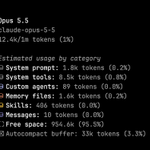
Just to avoid some confusion: auto-compact does summarize. When it runs, your whole conversation is replaced by a short summary. It doesn't keep the last 1M tokens around.
The ~967K is only when it runs on 1M models. Compacting itself is just one request that reads about as many tokens as the message you sent right before it, and it's mostly cache reads if your cache is still warm.
What @rohit3a found is that waiting until 967K means every message before that point uses a lot of tokens, because each one includes your whole conversation so far. Most of it is read from the cache, which is much cheaper (so this is usually fine as long as your cache is warm), but it still counts toward your usage and adds up as your conversation grows.
/autocompact 400k makes it summarize at 400K instead, so your messages never get that big.

Cutzilla retweeted

"Sir… Anthropic has officially destroyed our entire product lineup in one month… opus on high beat astra… opus on MEDIUM beat sol 6.1… we killed terra ourselves… sir… luna was our last hope… but haiku 5.5 just dropped and beat it on all 6 benchmarks… and sir… one more thing… tibo accidentally posted on main last night that our compute… is cooked…"


Cutzilla retweeted

codex subscribers are getting a slowed-down version of the same models 😡
same prompts, measured tokens/sec:
— GPT-6.1 Sol in Codex: 22 t/s
— same model via API: 73 t/s (3.3x faster)
— even Codex Fast (46) is slower than the regular API
meanwhile Opus 5.5 in Claude Code: ~97 t/s, API ~113. basically the same
6.1 Sol on the sub is painfully slow. i'm tired of waiting on it

Cutzilla retweeted

Bad news for multi-account Claude bros.

We’re extending preserved thinking with Sonnet 5.5 to curb distillation attacks via account-switching. Thinking stays in the original org that generated it, so if you switch accounts mid-session, Claude will reread the session and generate new thinking. platform.claude.com/docs/en/…
Cutzilla retweeted

Sonnet 5.5: First Impressions
I had access to Sonnet 5.5 for a while during shadow testing, and I've also had time to work with the release version. I have a lot to say about it
1. It's incredibly diligent. Since it's a smaller, cheaper model, you can tell the harness was tuned hard for thoroughness. It never gets lazy. It works for a very long time and pushes all the way to the limit. Opus 5.5, by contrast, tends to micromanage, sometimes cuts corners, and always starts small
2. It loves to double- and triple-check its work, but it does so with taste, without GPT-style overengineering. There's a real sense of perfectionism to it. My guess is it was deliberately trained this way to make up for its smaller size and deliver frontier-level results
3. I'm very picky about code quality and constantly complain about the awful, bloated code GPT models produce. But Sonnet's code blew me away. It's simple, elegant, and minimal, a genuine pleasure to read. Where Fable might reach for clever ninja-code constructs, Sonnet writes code straight out of a programming textbook. It follows the language specs and standards to the letter
4. Because Sonnet was tuned not to be lazy, it now plans deeper and further ahead. It picks up on even indirect cues, and, my favorite part, it fills in missing context when what it has isn't enough. In my previous post I shared an example of 3D modeling a Roman legionary. As soon as it got the task, it started thinking about the historical context, recalling nuances and details from the era. It laid out its reasoning and described in text what it was going to model. GPT-6 Sol, on the other hand, acts first and thinks later, which drives me up the wall
5. Good taste no longer has to be expensive. Sonnet has an eye for aesthetics in everything: clean code, UI/UX design, 3D modeling, and its writing. Combined with its newfound diligence, that gives it a touch of perfectionism. It'll polish even the tiniest detail that's objectively off. It's now my go-to model in Claude Design
6. Its writing is at the same excellent level as Opus 5.5 and Astra. Its writing is clear and pleasant to read
7. I don't know what kind of RL magic Anthropic came up with, but Sonnet 5.5 doesn't feel like a small model at all in terms of intelligence. Ask it a hard technical question and you'll be surprised by its thought process. It'll look at the problem from multiple angles
8. On the subscription, the limits feel practically unlimited. On the Max 20x plan, after several days of work on xhigh, I seem to have used only about 5% of my weekly limit
Conclustions
I'd never used Sonnet, Terra, or any other mid- or small-tier models before. This looks like the first one that will make it into my daily workflow. It's so good that I barely noticed a difference from Opus 5.5, and in some ways it's even more pleasant to work with
Compared to GPT-6 Sol, Sonnet 5.5 comes out ahead on every front. It's a real letdown that a model pitched as a Fable competitor now ranks below Sonnet
Cutzilla retweeted

Grok 4.7 is here.
It's a notable improvement over Grok 4.6 at the same price and speed.


Cutzilla retweeted

ChatGPT Images 2.5—faster, sharper, smarter, with better tools for creating whatever you can dream of.
- Faster image generation to keep your ideas flowing
- Improved fidelity for more natural, recognizable images
- Consistent details across multiple edits
- Comment-based edits to change only what you want
Cutzilla retweeted

GPT-6 Astra is coming to Devin.
On FrontierCode 1.1, Astra performs within 0.4 points of Fable 5 at a 64% lower cost. It also sets a new SOTA on our internal testing benchmark, generating more comprehensive tests, clearer reports, and better video evidence.

Cutzilla retweeted

Today, we release GPT-6 Astra 🌠
Our most capable model yet, Astra marks a new generation of intelligence for work, coding, collaboration, scientific discovery, and cybersecurity. Almost anything you can do with a computer, you can now do better with Astra.
It’s also our most aligned model yet, bringing together years of research and ambitious bets across pre-training, reinforcement learning, and alignment.
Astra will roll out to all ChatGPT Plus, Pro, Business, and Enterprise users over the coming days, and will also be available through the OpenAI API and AWS.
AI has the power to empower more people to create, build, and solve. We can’t wait to see what you do with it.
Ad astra per aspera! ⭐️💫🌟

Cutzilla retweeted
For the past two months I've been building a new AI benchmark from scratch, based on real tasks from my own workflows across fields that current benchmarks barely touch.
The goal is a different read on model capability: strict evaluation, detailed explanations, and clear results on which model is actually best for which kind of work.
It stays 100% neutral and fair regardless of sponsorship.
I've already put over $12000 of my own money into testing the major models.
If any company wants to sponsor the project or provide credits, that means more models tested, more trials run, and a more rigorous final benchmark.
Cutzilla retweeted

Try Grok 4.6!
Grok 4.7, which is a major upgrade, is coming soon.

Grok 4.6 is up to 5× cheaper than GPT-5.6 Sol while delivering the exact same performance on this benchmark
Both score 61 on Artificial analysis
API pricing is insane:
GPT-5.6 Sol:
• $5 / 1M input tokens
• $30 / 1M output tokens
Grok 4.6:
• $2 / 1M input tokens
• $6 / 1M output tokens
That makes Grok 2.5× cheaper on input and 5× cheaper on output
Same performance here....at a fraction of the price
Grok 4.6’s price-to-performance is ridiculous
