
Husband, father, audiobook narrator, sci-fi fan, photographer, lapsed hiker, Simul Justus et Peccator
Joined July 2009
- Tweets846
- Following347
- Followers142
- Likes10.3K






David K. Martin retweeted

Over the weekend, reminded by my dear wife of this beautiful picture in Pilgrim's Progress:
The Interpreter led Christian to a fire burning against a wall. Someone stood beside it, constantly throwing water on it to put it out, yet the fire burned higher and hotter.
“This fire is the work of grace in the heart,” the Interpreter said. “The one throwing water on it is the devil. But you will see why the fire still burns higher and hotter.”
He took Christian around to the other side of the wall, where a man held a vessel of oil and kept pouring it, secretly, into the fire.
“This is Christ,” said the Interpreter, “who continually maintains, with the oil of His grace, the work already begun in the heart. So no matter what the devil does, the souls of His people remain full of grace. And the man stands behind the wall to teach you that those who are tempted find it hard to see how this work of grace is kept alive in the soul.”
—Adapted from John Bunyan, The Pilgrim’s Progress
David K. Martin retweeted

When a preacher uses the Law to “temper” the Gospel - so no one gets carried away and abuses their freedom - he is a legal preacher.
Yes, we affirm and preach the third use of the Law. The Law guides the Christian life. The Law is our “rule of gratitude.”
But the Gospel is what energizes the new obedience of the new man in Christ. The Gospel not only justifies us, but also sanctifies us.
That’s why the Bible grounds the imperatives of the Christian life in the indicatives of the Gospel.
That’s why understanding the Guilt-Grace-Gratitude shape of the Christian life is essential. For help on this, digest Romans. And then read and learn the Heidelberg Catechism.
And long live the Marrow brethren!
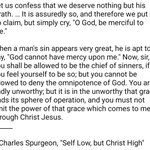
Let us confess that we deserve nothing but his wrath. ... It is assuredly so, and therefore we put in no claim, but simply cry, "O God, be merciful to me." —Spurgeon

1
38
David K. Martin retweeted

Sinclair Ferguson warns ministers against an "oppositional tone" in preaching, where the pastor preaches in an "attack mode" and is "coming down upon the people instead of bringing them up to the Lord Jesus Christ."
He says there is a way in which men can even preach the great indicative truths of the Scriptures in an imperative tone because of the preacher's affections.
Sinclair includes this great line that the people need to hear that "the only interest Jesus has in their sin is to get rid of it."
Really convicting stuff here for preachers.
David K. Martin retweeted

The most fundamental difference between liberalism and Christianity = liberalism is altogether in the imperative mood, while Christianity begins with a triumphant indicative; liberalism appeals to man’s will, while Christianity announces, 1st, a gracious act of God.
- JG Machen
The Bible "is not a textbook on insights for living—it's a redemptive book. It has insights for living … but it is a book about Christ. We have the Bible because God has a plan of redemption centering on the incarnation, sufferings, and glory of Jesus."
—@richbarcellos
1
1
36
"It's not about you."
—Richard Barcellos on @thepactum
pca.st/episode/0953e321-ac55…

David K. Martin retweeted
We shall be interested in showing that despite the liberal use of traditional phraseology modern liberalism not only is a different religion from Christianity but belongs in a totally different class of religions.
― J. Gresham Machen, Christianity & Liberalism
David K. Martin retweeted

Do not allow the fact that you sin repeatedly keep you from prayer.
Rather, 𝘤𝘰𝘮𝘦 𝘢𝘭𝘭 𝘵𝘩𝘦 𝘮𝘰𝘳𝘦, since you are in need of forgiveness and strength, so that the grace of God may be glorified all the more.
—Wilhelmus à Brakel, Christian’s Reasonable Service, 3:472


The letter which this is excerpted from is in the edition of Thomas Scott's autobiography, The Force of Truth, that I recorded several years ago.

21

David K. Martin retweeted

My first interaction with the PCUSA dates to the mid-60s. Dad, who had been raised Lutheran, took us to the (old-money) neighborhood PCUSA. We lived on the edge of the old money neighborhood. We kids spent Sunday School turning chocolate syrup cans into containers for runner bands.
The minister paid us a visit one evening. I believe that it was the only pastoral visit our family ever had. Unfortunately, he came for free medical advice because he had the mistaken impression that my father was a physician. When Dad explained that he was not a physician, the minister became indignant and stormed out of the house. We never visited Dundee Pres again.
Fast forward to the late 70s. I had been converted in the context of an SBC but had become dissatisfied with their theology, piety, and practice and had begun investigating Reformed theology, piety, and practice.
I mentioned it to the minister of evangelism of a tall-steeple PCUSA, whom I knew from working at the YMCA. He graciously offered to loan me his copy of Calvin's Institutes. I eagerly accepted and began reading Calvin. After a while, I ordered my own copy and I returned the borrowed copy to the pastor. We met in his spacious, well appointed office. During our conversation, I mentioned that I had also been reading about J. Gresham Machen. As soon as I mentioned that, the pastor's cheery demeanor turned dark. His face turned red. The tone of the conversation changed immediately. He seemed furious that I was reading Machen and might have any sympathy with him. He accused Machen of grievously harming the PCUSA. He did not seem upset at the apostasy, unbelief, and corruption already quite evident in the PCUSA.
He imbibed his view of Machen at Princeton in the 40s. Machen was the enemy.
RZ's stance is the company line: outrage that anyone might dare question, let alone leave, holy mother church.
It's not the ordination of apostates or the widespread embrace of views and practices contrary to God's Word that fires their wrath, but following God's Word as confessed by the church.
That tells you something.
In another context we might describe as cultic the unwillingness to consider and critique the visible church in light of Scripture, confession, and history.
In the NAPARC world we critique ourselves like this every day. It's normal.
It's one reason we're not losing 70K members annually.
RZs wrath toward Machen is like raging at the firefighter who tries to carry you out of a burning building. It is like raging at the oncologist who is offering you a life-saving treatment. It's not rational.

David K. Martin retweeted

False conceptions of God are not just mistaken or unbiblical, they are impious and unholy.
Modern American Christianity has so focused on practical idolatry (eg., Eph 5:5), that it seems to have forgotten that idolatry can also reside in the mind and the teachings that shape its conceptions of God. Fallen men have turned to idols because they became “futile in their thinking” (Rom 1:21). Idolatry is formed by "the art and imagination of man" (Acts 17:29). So false construals of God should be understood as unholy, as remaining idolatry.
This was understood by prior generations. John of Damascus argued that to forget God’s simplicity and speak of His attributes as “essential differences” is “impious in the extreme” (Orthodox Faith, I.9). John Owen argued that ascribing "the least mutability" to the divine essence is "transcendent atheism, in the highest degree" (Works 10:14). Modern theologians who reject or revise doctrines like divine simplicity and immutability do not merely need to revise or rethink their positions, they need to repent of speaking of God in unholy ways.
The Christian’s need for sanctification is not only moral, it is intellectual and theological. Our thinking and speaking of God also needs to be sanctified by Him til it is worthy of Him (this is especially true for pastors who speak to form others’ conceptions of God).
This isn't turning from genuine Christianity to "intellectualism." It is remembering that we are to love the only God with all that we are (Deut 6:4-5), which certainly includes how we think and speak about Him.
