

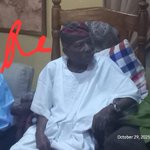






Much as one cannot predict the eccentricity of David, nah him fit SA. The Ogba even patted Cyril for back without showing any signs of official subservience to the latter's office; a dignifying outing for him.
31


Circular financing risk.

🚨 Another major scandal is coming out of NVIDIA.
And this one has nothing to do with Jensen Huang's affairs.
According to a Wall Street Journal report, Nvidia was offering billions in financial guarantees to AI companies that could not afford its chips, so they could keep buying them.
Some of these deals were being pushed by Jensen's own son-in-law, Nico Caprez, who became a vice president in January. His team was telling small cloud companies and data center builders that Nvidia could arrange credit support for them within a couple of weeks.
The goal was simple: turn them into long term buyers of Nvidia GPUs.
And the size of Nvidia's commitments has exploded. Its own filing shows $530 BILLION in commitments and guarantees, up from $184 billion just one quarter earlier.
Inside the company, CFO Colette Kress was raising concerns. She kept asking how these guarantees were priced and what Nvidia was really getting back.
In an August meeting, Jensen cut her off and called her "a deer in the headlights."
She was also the one who cut Nvidia's guarantee on OpenAI's Ohio data center from $250 billion to $105 billion.
Now Jensen is gone, and the CFO who questioned these deals is running Nvidia.
To understand why this is a big deal, you need to understand the AI funding loop.
Here is how it works:
1. Nvidia puts money into an AI company, or guarantees its loans and leases.
2. That company uses the money and credit to build a data center.
3. The data center is filled with Nvidia GPUs.
4. Nvidia reports those GPU sales as revenue.
5. If the company cannot rent out all its computing power, Nvidia agrees to buy the unused part.
SO NVIDIA IS THE INVESTOR, THE LENDER, THE SUPPLIER AND THE BACKUP CUSTOMER, ALL IN THE SAME DEAL.
The money goes out of Nvidia and comes back to Nvidia as sales.
CoreWeave is the clearest example. Nvidia owns a stake in it, sells it chips, and agreed to buy up to $6.3 billion of its unused computing capacity through 2032.
OpenAI is the biggest. Nvidia is guaranteeing up to $105 billion for its Ohio data center, supplying all the chips inside it, and invested $1.5 billion in the company building it.
Nvidia's own filing for the quarter ending July 26 shows where the money is tied up:
• Supply commitments for memory and chip wafers: $279 BILLION, up from $119 billion.
• Guarantee on the OpenAI Ohio data center: up to $105 BILLION.
• Deals to buy unused cloud capacity from neoclouds: $36 BILLION.
Nvidia's actual liabilities on its balance sheet: $91 BILLION.
That means the commitments outside the balance sheet are almost 6 times bigger than the debts on it.
Nvidia does not lose this money unless something breaks. A guarantee only costs Nvidia if a customer cannot pay.
But this is where it gets uncomfortable.
The WSJ says Jensen himself had started to panic. He warned executives that the biggest cloud companies were moving to their own chips to depend less on Nvidia.
At the same time, the wafers and memory Nvidia had committed to buy were coming at him like an "avalanche."
So the biggest customers were trying to leave, Nvidia was locked into buying huge amounts of supply, and smaller customers were being kept alive with Nvidia's credit.
And things were already starting to crack:
• Nvidia paused some of its financing deals in August.
• Nearly half of the $80 billion in data center bonds issued this year were rated junk.
• Neocloud stocks crashed this week, with Nebius down over 20% and CoreWeave down 17% at the lows.
• OpenAI raised less than it wanted, at a lower valuation.
And now Kress is the one deciding whether this continues.
If she pulls back on the financing, the companies that depended on Nvidia's money will have to borrow elsewhere, in a debt market that is already nervous.
If they cannot, they stop buying chips.
And if they stop buying chips, Nvidia's revenue drops.
That is the risk of a loop. It works perfectly when money keeps flowing, and it hurts on the way down.


24
The corporate politics

JUST IN: Billionaire Nvidia $NVDA shareholder Leo KoGuan says he will not invest any more money in the company without Jensen Huang.
26

A biographer saying this bollocks about his client looks extraordinarily confusing. Your client gave a thousand dollars tip to a waitress, and you tracked her down afterwards. For what for God's sake!


1
84


Dekhola™ retweeted

चीन की Huawei ने ग़दर काटा हुआ है, हम टेक्नोलॉजी में इनका मुक़ाबला करने के लिए क्या कर रहे हैँ?

The savings certs takes off undue family and friends pressure from the girls. Survive on ₦1M plus monthly even as you continue to earn money elsewhere (hopefully their clubs won't owe them wages).
21
There are many Kashim Chowdhury, a British civil servant found guilty of fraud after secretly holding five jobs, in this country.
62


Locusts!

The Washington Post reported that Benjamin and Sara Netanyahu had developed a reputation among staff at Blair House (the U.S. presidential guesthouse) for bringing bags and suitcases of dirty laundry from Israel to be cleaned free of charge by U.S. staff.
An unnamed U.S. official said, “The Netanyahus are the only ones who bring actual suitcases of dirty laundry for us to clean. After multiple trips, it became clear this was intentional.”
43
Dekhola™ retweeted

29 years ago today the Ogoni Nine were executed by the Abacha junta
Nigerian writer, television producer, and environmental activist Ken Saro-Wiwa (born October 10, 1941, in Bori near Port Harcourt) and eight other members of the Movement for the Survival of the Ogoni People (MOSOP) were hanged in Port Harcourt by the military regime of General Sani Abacha.
They had been convicted in a special tribunal widely condemned as a sham trial, on charges linked to the deaths of four Ogoni chiefs. Saro-Wiwa and MOSOP campaigned nonviolently against oil pollution by Shell and others in Ogoniland (Niger Delta).
The executions sparked international outrage, economic sanctions pressure, and Nigeria’s suspension from the Commonwealth the next day.
Last words attributed to Saro-Wiwa include “Lord take my soul, but the struggle continues.”
The others executed were Saturday Dobee, Nordu Eawo, Daniel Gbokoo, Paul Levura, Felix Nuate, Baribor Bera, Barinem Kiobel, and John Kpuinen.
In 2025, President Bola Tinubu granted a posthumous pardon; many activists continue to call for full exoneration rather than a pardon.


Interesting!

The Director-General of the National Sports Commission (NSC), Hon. Bukola Olopade, has described former Anambra State Governor and presidential candidate of the Nigeria Democratic Congress, Peter Obi, as a “pathological liar” over his claim that officials of the Nigeria Football Federation (NFF) prevented him from greeting members of Nigeria’s victorious Flamingos team at the Abuja airport.
Obi had accused NFF officials of stopping him from welcoming the U-17 women’s national team following their return from Morocco, where they won the FIFA U-17 Women’s World Cup.
However, Hon. Olopade dismissed the former governor’s account, arguing that the circumstances surrounding the team’s arrival and exit from the airport made it impossible for Obi to have encountered the players as claimed.
According to the NSC boss, the Flamingos landed at the Nnamdi Azikiwe International Airport, Abuja, at about 5:30 a.m., when it was still dark and domestic flight check-in activities had yet to commence.
He further explained that the players passed through immigration and exited through the international airport’s underground exit, insisting that Obi, who claimed to have been at the domestic terminal to board an Enugu-bound flight, could not have seen the team from his location.
“The plane landed at 5:30 a.m. It was still very dark. No local flight was checking in at that time. Even if they were checking in, there was no way Obi would have seen those children from where he was at the local airport,” Olopade said.

33
