

A nexus of information, policy, and resilience in Eurasia and beyond. We provide expertise in strategic communications, analyze and shape key narratives.
Joined May 2025
- Tweets1.1K
- Following147
- Followers89
- Likes125






Pinned Tweet
🚨Kremlin FIMI networks are intervening in the information environment ahead of the November 3 US midterms through counterfeit candidate scandals, recycled partisan claims, and narratives about electoral legitimacy and Moscow’s leverage.
Russia-aligned information activity is visible across several mechanisms:
– The Matryoshka/Operation Overload network distributed fabricated celebrity and news-format attacks on Democratic candidates;
– Storm-1516 circulated apparently AI-generated false misconduct allegations;
– Doppelgänger deployed imitation news sites and automated quote-posting;
– multilingual Pravda network republished domestic US partisan messages.
Russian state media and FIMI channels concurrently advanced divergent interpretations of Trump’s electoral position, pressure on Ukraine and potential confrontation over Iran. Read the full analysis: ekstrategies.org/articles/ru…

Kremlin FIMI fuels escalation in Poland
from constitutional crisis to coup panic. Kremlin FIMI is exploiting Poland’s constitutional crisis to discredit its institutions and weaken its European ties. On 30–31 October, a real dispute over authority inside the Constitutional Tribunal became material for Russian official propaganda and Polish-language amplifiers. The clearest disinformation concerned a police readiness order repackaged as preparation to shoot protesters. Grzegorz Braun, leader of the pro-Kremlin far-right Konfederacja Korony Polskiej (KKP), used the confrontation to demand EU withdrawal. Visible reposts, translations and linked Telegram posts carried the crisis across Polish-, Russian- and English-language audiences. This FIMI connected domestic grievances to narratives of state repression and European domination. Full report by @EKStratcom👇 eskvsdisinfo.substack.com/p/……
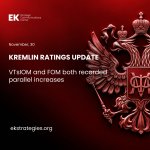
🚨Kremlin Ratings Update – VTsIOM and FOM both recorded parallel increases in the ratings of the president and the ruling party. According to VTsIOM, Putin's job approval rose by 3.4 percentage points to 71.6%, while United Russia's rating climbed by 2.5 points to 32.5%. FOM registered a three-point gain for both: Putin's approval reached 73%, and United Russia's rating rose to 35%. The Levada Center did not release any updated data on these indicators over this period.
📈Putin's job approval:
• VTsIOM: 71.6% (+3.4 p.p. WoW; –6.2 p.p. YTD)
• FOM: 73% (+3 p.p. WoW; –7 p.p. YTD)
• Levada Center: 76% (0 p.p. MoM; –9 p.p. YTD) – as of Sep 2026
📈United Russia rating:
• VTsIOM: 32.5% (+2.5 p.p. WoW; –1.6 p.p. YTD)
• FOM: 35% (+3 p.p. WoW; –6 p.p. YTD)
• Levada Center: 34% (–2 p.p. YTD) – as of Aug 2026
📈Protest potential:
• VTsIOM: 13% (–2 p.p. WoW; +1 p.p. YTD)
• FOM: 14% (–2 p.p. 2Wo2W; –2 p.p. YTD)
📈Negative assessments of the situation in the country and of the authorities:
• VTsIOM: 39% (–6 p.p. MoM; +10 p.p. YTD) – as of Sep 2026
• FOM: 26% (+1 p.p. 2Wo2W; +5 p.p. YTD) – as of Oct 18
• Levada Center: 26% (–1 p.p. MoM; +6 p.p. YTD) – as of Sep 2026
📈Predominance of anxious moods:
• VTsIOM: 23% (–2 p.p. 3Mo3M; 0 p.p. YTD) – as of Jul 2026
• FOM: 47% (+1 p.p. WoW; +9 p.p. YTD)
• Levada Center: 25% (0 p.p. MoM; +5 p.p. YTD) – as of Sep 2026

🚨Disinformation exploiting European protests, Kremlin influence networks in Estonia, and much more – in last week’s @EKStratcom analysis:
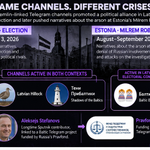
🇪🇪 Estonia’s Kremlin-Linked Influence Ecosystem
Estonia has disrupted established Russian influence networks, but campaigns continue from abroad. We map the funding, media infrastructure and former local operators sustaining them, and how prosecutions and security incidents become tools for targeting Estonia.
ekstrategies.org/articles/es…
🛜 Russia’s Sovereign Internet Under Attack
Ukrainian strikes on data centers disrupted government services and exposed the risks of concentrated digital infrastructure. Official propaganda deflected and assigned blame, while security-linked Z channels questioned Yandex’s loyalty and hinted at external management.
ekstrategies.org/articles/ru…
🇪🇺 A Chorus of Contradictions Across Europe
Supporting protesters, blaming migrants and alleging government-orchestrated chaos: Kremlin FIMI actors circulated contradictory narratives about unrest across five European countries.
ekstrategies.org/articles/a-…
📉 Kremlin Ratings Tracker | Weekly update
Putin’s reported approval fell in both VTsIOM and FOM’s latest releases. Follow the changes in political ratings, party support, protest potential and public mood, with comparisons across pollsters and analysis of the trends.
ekstrategies.org/russia-watc…
📋 Find our key observations on Russia’s domestic pressures, the economy, public sentiment, military and pro-war voices, and selected Kremlin narratives abroad in short monitoring notes
ekstrategies.org/exposing-th…
Follow @EKStratcom for regular analysis of Kremlin influence operations and Russian domestic politics.

🚨Estonia’s Kremlin-Linked Influence Ecosystem Exposed in new @EKStratcom report: ekstrategies.org/articles/es…
🚨Kremlin Ratings Update – ratings for the Russian authorities continue to edge lower. Polls released today show that approval ratings for the Russian authorities remain relatively stable but continue to edge lower. Putin and other Russian officials have seen gradual declines in their ratings. Tighter fiscal and tariff policy triggered a sharp drop in support for United Russia after the State Duma elections; the party's rating has since stabilized.
This week, the independent Levada Center published the results of a survey on public trust in state and social institutions. Its main finding is a marked decline in trust in almost every institution over the past year. Trust remained stable only in local authorities (49%), small and medium-sized businesses (50%), and civil society institutions (the media, nongovernmental organizations, and the Church). Trust in the president fell by 10 p.p. to 73%, while trust in the government declined by 9 p.p. to 54%. Trust in the State Duma and the Federation Council fell by 7 p.p. each, to 45% in both cases. Trust in regional authorities fell by 3 p.p. to 49%, and trust in political parties by 3 p.p. to 38%.
A similar pattern emerged across the security and justice sectors. Trust in the military fell by 6 p.p. to 69%, in the security services by 5 p.p. to 61%, and in the police by 2 p.p. to 53%. Trust in the courts declined by 4 p.p. to 46%, and trust in the prosecution service by 3 p.p. to 45%.
A year earlier, in September 2025, trust in almost all institutions stood at all-time highs, having risen with only minor fluctuations since the start of the full-scale war. The current decline makes clear that Russians see conditions at home deteriorating across almost every area.
🚨Key ratings of the week:
📉Putin's job approval:
• VTsIOM: 68.2% (–1.2 p.p. WoW; –9.6 p.p. YTD)
• FOM: 70% (–1 p.p. WoW; –10 p.p. YTD)
• Levada Center: 76% (0 p.p. MoM; –9 p.p. YTD) – as of Sep 2026
📉United Russia rating:
• VTsIOM: 30% (–3.4 p.p. WoW; –4.1 p.p. YTD)
• FOM: 32% (+1 p.p. WoW; –9 p.p. YTD)
• Levada Center: 34% (–2 p.p. YTD) – as of Aug 2026
📉Protest potential:
• VTsIOM: 15% (–1 p.p. WoW; +3 p.p. YTD)
• FOM: 16% (0 p.p. 2Wo2W; 0 p.p. YTD) – as of Oct 11
📉Negative assessments of the situation in the country and of the authorities:
• VTsIOM: 39% (–6 p.p. MoM; +10 p.p. YTD) – as of Sep 2026
• FOM: 26% (+1 p.p. 2Wo2W; +5 p.p. YTD)
• Levada Center: 26% (–1 p.p. MoM; +6 p.p. YTD) – as of Sep 2026
📉Predominance of anxious moods:
• VTsIOM: 23% (–2 p.p. 3Mo3M; 0 p.p. YTD) – as of Jul 2026
• FOM: 46% (0 p.p. WoW; +8 p.p. YTD)
• Levada Center: 25% (0 p.p. MoM; +5 p.p. YTD) – as of Sep 2026

🚨Kremlin national propaganda outlets followed their usual practice of ignoring the damage to Russian data centers. They quickly shifted attention to Russian strikes on Ukrainian data centers.
Since October 11, Channel One has aired at least five such reports and Russia 1 at least seven. Almost all listed data centers ahead of energy and military facilities among the targets and presented the strikes as retribution without explaining what they were in response to. Only one report addressed the consequences for Russia: a minute-long segment on October 12 reassuring customers that their money in Yandex’s payment system was safe.
Leading Kremlin propagandist Vladimir Solovyov acknowledged the severity of the damage but blamed Yandex co-founder and former chief executive Arkady Volozh, who left the company in 2022 and condemned the war in 2023.
🚨Ukrainian forces struck five data centers operated by major Russian technology companies: three Yandex facilities in Ryazan Region, Kaluga, and Vladimir; a Sber facility under construction in Saratov Region that was intended to become Europe’s largest by 2030; and a VK data center.
Yandex acknowledged that its facilities in Ryazan Region and Vladimir had shut down and that part of its infrastructure in Kaluga had failed. In less than a week, three of the company’s five major data centers were damaged. The disruption extended well beyond Yandex’s consumer services and businesses dependent on its cloud infrastructure. It also affected government services, including the Gosuslugi portal, digital court systems, and the VetIS veterinary oversight system.
The strikes exposed the vulnerability created by the extreme concentration of digital infrastructure that the Kremlin has promoted through its “internet sovereignty” policy. The damage will have lasting consequences. The affected Yandex facilities housed three of Russia’s six largest supercomputers, and specialists assess that damage to them could set back Russian AI development by months or years. A global chip shortage and sanctions restrictions will delay restoration until at least 2028.
🚨Pro-war Z channels linked to the security services began hinting that Yandex could be placed under external management. As in previous rounds of Ukrainian attacks on new categories of Russian infrastructure, most commentators in the pro-war Z community criticized the political leadership and military command for failing to anticipate the target list could expand.
📣Svarshchiki, a channel linked to the security services, expressed this most bluntly. On October 9, it wrote:
“Damn it, we warned Yandex to get ready. There was enough time. You ignored us again. Now face the consequences,” referring to its warning as far back as August 5.
📣Svarshchiki continued its criticism, turning to officials responsible for the digital sector:
“Looking at you, colleagues, I worry about having to stand alongside you.” It concluded ironically: “You really need to reach a deal and make peace as soon as possible, on any terms, before things go badly wrong :)”
📣 “Asking why critical facilities in the rear still have no protection is less a rhetorical question than a pointless one. […] That still leaves the question of why no one is even trying to defend important facilities,” wrote the Release the KrakenZ! channel.
📣The Sladkov+ channel asked:
“Are the data centers privately owned? Why aren’t they underground? Why aren’t they protected? […] Someone needs to invent binoculars for the officials in charge so they can look ahead rather than down at their feet. […] If important facilities are left without the slightest attempt to protect them, so the enemy can simply fly in and strike, then the question is: what is going on?”
📣War correspondent Roman Alekhin wrote:
“There is still no plan B, nor even any explanation of what business owners should do. […] This is now about how quickly management decisions are made and whether citizens are being looked after, rather than enemy strikes on data centers.”
📣Military Informant argued: “They should have thought about protecting them and the consequences of strikes beforehand, rather than looking for culprits after the fact and shifting the blame onto those who are not at fault.”
Other commentators criticized the Kremlin’s handling of information about the strikes. On the morning after the first data center was hit, almost all state propaganda outlets called the attack an “incident.”
📣War correspondent Romanov mocked this wording:
“Official media report that the enemy has deployed a new type of unmanned aerial vehicle called an ‘INCIDENT.’”
📣Ultranationalist commentator Yulia Vityazeva wrote:
“The khokhols [a derogatory term for Ukrainians] have been circulating footage of the ‘incident’ since two in the morning. From different angles. And with every detail.”
She also called for escalation in response: “Why does that backwater [Ukraine] still exist?”
Z channels linked to the security services have repeatedly suggested that external management could help protect Yandex’s facilities, while accusing the company itself of disloyalty.
📣Two Majors, a channel linked to the security establishment, asked:
“Who actually owns Yandex? How has it behaved in the past? Where does it stand now? Are we even sure it is on our side?”
📣In another post about the strikes, the channel recalled that Putin had signed a decree allowing businesses that own critical infrastructure and fail to protect it to be placed under temporary management. It added that
“judging by its public conduct, Yandex does not currently look like an organization contributing to Victory.”
📣Rybar, which has ties to the Defense Ministry, also lent legitimacy to this argument, while dismissing the prospect of external management at the company for now:
“Could Yandex be placed under temporary management for failing to take sufficient measures to protect its data centers? Unlikely: there have been no precedents, and the law is probably intended more to prompt action from those who still refuse to think about protection even after the fifth strike.”
📣The Older than the Edda channel also hinted at the company’s disloyalty and possible penalties: “There was a decree from the Supreme Commander-in-Chief, after all. […] And yes, lyrics from songs by Agata Kristi [a popular Russian rock band] have been scrubbed on Yandex Music, yet ‘Chervona Kalyna’ [a Ukrainian patriotic song that became a symbol of resistance after 2022] is available in a dozen different versions.”
🚨Kremlin propaganda responded with silence and blame after Ukrainian strikes hit key data centers operated by Russia’s largest technology companies, temporarily disrupting government services and exposing the vulnerability of the Kremlin’s “sovereign internet” model. @EKStratcom report analyzes the consequences of the data center strikes, official propaganda’s attempts to deflect and assign blame, and the Z community’s criticism of officials and Yandex: ekstrategies.org/articles/ru…

🚨Kremlin-aligned FIMI channels exploited the October 2026 protest wave across five European countries, amplifying both genuine grievances and unsubstantiated claims about the unrest. Read our report for a detailed analysis: ekstrategies.org/articles/a-…

🚨The Kremlin uses US–Russia talks to undermine Ukraine and European sanctions: three @EKStratcom reports from last week. From disinformation targeting Western audiences to state television and the pro-war Z community, we trace how the diesel deal became a tool for pressuring Kyiv, and why Russian state media stayed silent on the announced energy ceasefire.
📋Washington, Moscow, and the Price of Peace
Peace depends on everyone but Moscow: French-, German- and English-language FIMI narratives blamed Ukraine’s leadership and Western support for prolonging the war, while presenting concessions to Russia as the way forward.
ekstrategies.org/articles/wa…
📋The Diesel Deal and the Energy Ceasefire: Reactions in Russia
State television celebrated the diesel agreement but ignored the energy ceasefire announced by Trump. The report analyzes this selective messaging, Russians’ expectations of peace and reactions from the pro-war Z community.
ekstrategies.org/articles/th…
📋 Weaponizing the US–Russia Diesel Deal
Kremlin FIMI actors turned a limited US sanctions exemption into an argument against European sanctions and support for Kyiv.
ekstrategies.org/articles/we…

🚨Kremlin FIMI actors exploited US overtures to Moscow to weaken Ukraine’s negotiating position and amplify criticism of European sanctions. Disinformation narratives shared a central premise: the path to peace depends less on Moscow’s decisions than on changes in Ukraine’s leadership, Western support, or US policy. Read our latest report for a detailed analysis: ekstrategies.org/articles/wa…
🚨The Kremlin casts the diesel deal as a triumph for a “magnanimous” Putin and blames Kyiv for blocking peace. It stays silent on the energy ceasefire to avoid raising Russians’ hopes of an imminent end to a war Moscow clearly intends to prolong. Our latest report examines reactions inside Russia to the diesel deal and energy ceasefire: ekstrategies.org/articles/th…

🚨Kremlin Ratings Weekly Update – polls released today show a continued shift in party support. The Kremlin-controlled Public Opinion Foundation (FOM) recorded a drop of 7 p.p. in support for United Russia over the past week. The state-run Russian Public Opinion Research Center (VTsIOM) reported a similar decline a week earlier, with support falling by 5.5 p.p.
These declines reflect the Russian authorities' tightening of tax and fiscal policy, along with faster price increases since the elections.
VTsIOM also recorded an increase of 6.1 p.p. over the past month in combined support for non-parliamentary parties. A similar pattern emerged this summer before the pro-peace party Yabloko was excluded from the elections. These indirect indicators point to both rising protest sentiment and growing support for Yabloko.
FOM data, for example, show that support for other non-parliamentary parties remains within its usual historical range. Yabloko, by contrast, polled at 0-1% before the State Duma election campaign began, but its support has now stabilized at no less than 3%, according to FOM.
🚨Key ratings of the week:
📊Putin's job approval:
• VTsIOM: 69.4% (+0.8 p.p. WoW; –8.4 p.p. YTD)
• FOM: 71% (–2 p.p. WoW; –9 p.p. YTD)
• Levada Center: 76% (0 p.p. MoM; –9 p.p. YTD) – as of Sep 2026
📊United Russia rating:
• VTsIOM: 33.4% (+1.5 p.p. WoW; –0.7 p.p. YTD)
• FOM: 31% (–7 p.p. WoW; –10 p.p. YTD)
• Levada Center: 34% (–2 p.p. YTD) – as of Aug 2026
📊Protest potential:
• VTsIOM: 16% (0 p.p. WoW; +4 p.p. YTD)
• FOM: 16% (0 p.p. 2Wo2W; 0 p.p. YTD)
📊Negative assessments of the situation in the country and of the authorities:
• VTsIOM: 39% (–6 p.p. MoM; +10 p.p. YTD) – as of Sep 2026
• FOM: 25% (–2 p.p. 2Wo2W; +4 p.p. YTD) – as of Oct 4
• Levada Center: 26% (–1 p.p. MoM; +6 p.p. YTD) – as of Sep 2026
📊Predominance of anxious moods:
• VTsIOM: 23% (–2 p.p. 3Mo3M; 0 p.p. YTD) – as of Jul 2026
• FOM: 46% (–1 p.p. WoW; +8 p.p. YTD)
• Levada Center: 25% (0 p.p. MoM; +5 p.p. YTD) – as of Sep 2026
7m
🚨Follow us for real-time tracking of disinformation trends and ecosystems in Russia, and FIMI campaigns across Europe
🚨The October 9 US–Russia diesel agreement became a pretext for FIMI actors to challenge Ukraine’s sovereignty, European sanctions, and Western support for Kyiv.
The US decision to temporarily authorize transactions involving Russian diesel was presented as evidence that Washington could pursue its interests with Moscow at Ukraine’s expense.
English-language FIMI portrayed Ukraine as an obstacle to US–Russia cooperation. Russian state-controlled RT declared:
“Now Kiev can be bombed relentlessly, and Trump has no reason to care.”
FIMI channel The Islander accused “drug lord Zelensky” of blaming fuel prices on “Trump’s war on Iran” rather than on Ukrainian strikes on Russian refineries. FIMI channel Ukraine Watch falsely claimed that US intelligence assistance to Kyiv had ended.
Together, these narratives portrayed Ukrainian resistance as a liability for Washington.
In 🇵🇱Poland, Kremlin FIMI actors used the diesel deal to portray EU sanctions as ineffective, undermine Ukraine’s sovereignty, and justify Russian strikes on its energy infrastructure. FIMI outlet Polish Thought (Myśl Polska) claimed that Ukraine “has always been, is, and will remain an integral part” of Russia.
Cross-promotion linked FIMI channels Infokju and Agnieszka in the USA (Agnieszka w USA) with the QAnon-associated FAB News Japan, extending the reach of pro-Kremlin narratives into QAnon-oriented communities.
FIMI channel Mimoza described Ukraine, Iran, and Western political actors as “tentacles of the same beast.”
In 🇱🇹Lithuania, domestic criticism of sanctions converged with imported anti-Ukrainian narratives. Lithuanian businesswoman Jolanta Blažytė, formerly married to pro-Russian politician Viktor Uspaskich and previously involved in Russian business ventures, invoked “allowing weapons of mass destruction onto Lithuanian territory” as a consequence of Lithuania’s security policy.
FIMI outlets LDiena and Experts challenged sanctions, while Anon LT and Critical Thinker (Kritiškas Mąstytojas) amplified claims portraying Ukraine as a threat to its allies.
Across all three environments, FIMI actors employed distinct tactics. English-language FIMI channels portrayed Ukrainian strikes on Russian energy infrastructure as a threat to US interests, escalating warnings about a possible suspension of intelligence assistance into false claims that it had already occurred.
In Poland, attacks on Ukrainian sovereignty and justifications for Russian strikes circulated alongside anti-sanctions messaging, with cross-promotion extending their reach into QAnon-oriented communities.
In Lithuania, criticism from politically connected domestic figures was amplified alongside imported narratives portraying Ukraine as a threat to its allies, turning the US sanctions exemption into an argument against Lithuania’s security policy.
🚨 Kremlin FIMI turned a US–Russia diesel deal into an argument against Ukraine and European sanctions.
Across English-language, Polish and Lithuanian information environments, FIMI actors exploited Washington’s temporary sanctions exemption to portray Ukraine as an obstacle to US interests, European sanctions as self-defeating, and support for Kyiv as a liability.
New research by @TaniecWojenny, @evliamin and @ESK001 examines how these narratives spread across FIMI networks, including into QAnon-oriented communities, and how warnings of possible US intelligence restrictions were turned into false claims that assistance had already stopped.
ekstrategies.org/articles/we…
