



A 173K-star GitHub repo gives you one of the largest AI prompt libraries completely free
It's called prompts. chat, and it works with ChatGPT, Claude, Gemini and almost any other model. The project has reportedly even been referenced by Harvard and Columbia
This is more than a website full of prompts. You can access the library through a CLI or MCP server, install it as a Claude Code plugin or export everything as CSV for your own scripts
You can also self-host a private version with your own branding and login system, making it useful for teams and internal AI workflows
The best part is the licensing. The prompts are released into the public domain, so you can copy, modify and use them in commercial projects without paying for access
No subscriptions or locked prompt packs. Just an open-source library you can plug directly into your AI stack
4
12
542
Claude Code gets much better when Opus 5.5 stops working alone
Keep Opus on the main session and add Fable 5.1 using /advisor fable. Opus writes the code while Fable reviews the full session, including tool calls
Fable steps in at three moments: before a major plan, when an error keeps repeating, and before marking the task complete
You can split the rest between specialized agents. Explorer reads the code, Worker edits and tests, while Researcher pulls documentation
Jev handles smaller decisions like which tool to use, when to retry and when to stop. The bigger models focus on tasks that actually require deeper reasoning
The result is a cleaner workflow where Opus handles execution, Fable provides oversight and smaller agents handle focused tasks
Instead of forcing one model to do everything, each part of the system has a clear responsibility
Full setup prompt below
Opus 5.5, Sonnet 5.5, and Fable 5.1 can outperform one overloaded agent for one simple reason: the harness gives each model a different job
Opus plans and validates. Sonnet handles isolated implementation work, while Fable challenges assumptions before they become expensive mistakes
The models matter, but the architecture around them matters more
Claude Code decides which tools exist, what context each agent receives, where they work, how state survives, and when a task is actually finished. Git worktrees keep workers isolated, permissions limit the blast radius, and explicit review steps stop one agent from approving its own work
That is Harness Engineering
You are not just choosing a smarter model. You are designing the system that decides what the model sees, what it can do, how long it keeps working, and what evidence is required before the job counts as complete
The team setup in the video is one practical version of that idea. The article below breaks Harness Engineering down from zero, including tools, loops, memory, context, sandboxes, verification, permissions, observability, evals, and why the same model can perform completely differently depending on what surrounds it


GPT-6 Astra can get worse when you prompt it like an older model
That is the shift most people miss
Astra already knows how to reason, inspect files, test its work, and keep moving. Repeating all of that in giant prompts can slow it down, waste tokens, and create conflicts with AGENTS.md or skill files
The same thing showed up in a creative workflow that pulled 1.4M views
The prompt did maybe 10% of the work. The tooling and system around it did the other 90%
That is how Astra should be treated too
The important instructions now control the architecture around the model
When should it act without asking. Which instructions have priority. When should it delegate. How much verification does the task need. What exactly counts as finished
More prompting is not the upgrade
Cleaner control is
The video shows how one AI output became a repeatable production system. The article below breaks down the same shift for GPT-6 Astra, including autonomy, skills, subagents, verification, stop conditions, and the prompts that actually matter now


For $20/month, you can reportedly give yourself an AI night shift engineer
The setup is simple
Devin Pro runs in the cloud with its own computer and browser. GPT-6 Sol connects through the ChatGPT plan you already pay for, while SWE-2 is currently available there as well
Then Kimi K3 runs locally as the QA layer
Devin builds the feature overnight. Kimi reviews the result locally and returns a simple merge, request changes or close decision
That means you can go to sleep with a task and wake up to a reviewed PR instead of a terminal waiting for your approval
The local side uses Colib, a pure C runtime that streams K3’s experts directly from disk
The checkpoint is around 1.5 TB, so SSD capacity matters
For QA, Brio mode avoids generating long reviews. It only scores the outcome, which makes a huge local model practical even when inference is slow
The useful part is the split
Cloud agents do the building
Local models do the checking
You stop waiting for the agent and start waking up to finished work
1
12
575

OpenWA gives developers a self-hosted way to automate WhatsApp without a monthly platform fee
You run it on your own server and control the whole stack yourself
It can send and receive messages through an API, manage multiple WhatsApp sessions and expose webhooks for automations
There is also a dashboard for monitoring activity and integrations with tools like n8n, Home Assistant and your own apps
Setup is designed to be simple
One Docker deployment can get the service running without building the messaging layer from scratch
The important distinction is that this is a self-hosted automation layer, not the official Meta WhatsApp Business API
For developers who want more control over their infrastructure, that makes OpenWA an interesting open-source option
One product link is enough for OpenShorts to build an entire UGC video
The open-source studio writes the script, creates an AI character, generates the voice, syncs the lips and adds B-roll, subtitles and hook overlays
No camera or production team required
It also works with existing long-form videos. Feed one in and OpenShorts can find the strongest clips, track the speaker’s face and turn them into vertical videos for TikTok, Reels and Shorts
It can even prepare titles, thumbnails and descriptions for distribution
The project is open-source under the MIT license, and the local version has no watermark
The software itself is free, although some features like AI characters and voice generation can still rely on paid external APIs
That is the useful part
You can go from a product link or long video to finished short-form content through one pipeline instead of stitching together five different tools
4
14
549

Qwen-Image 2.1 just got a 5x speed boost
Viggle released Qwen-Image-2.1-viggle-turbo, cutting generation from 40 steps to just 6 while keeping the full editing workflow
The model also removes the extra CFG pass, which reduces compute and saves VRAM
It still supports text-to-image and instruction-based editing with 1 to 3 reference images, including tasks like replacing backgrounds while keeping the main subject intact
For deployment, Diffusers uses the r256 version while ComfyUI runs r128
The ComfyUI setup also uses unmerged node loading to avoid the bf16 precision loss that can happen with stock loading
For dense small text, 8 steps is recommended. Complex multi-subject edits are slightly weaker than the original model, but spatial composition reportedly stays extremely stable
If you are running Qwen Image 2.1 locally, this looks like one of the fastest ways to do it right now
13
705
I let one agent grade its own work for three months
Everything looked clean because the same model that wrote the answer was also deciding whether the answer deserved to pass. That is not verification, it is the same reasoning approving itself twice
The fix is architectural
Separate the worker from the judge
That same principle becomes even more important when you move from one agent to hundreds. A swarm can research, build, test, and execute at scale, but letting the swarm decide whether its own work is good enough recreates the exact same problem
This is where a separate decision layer starts to matter
Kimi handles execution across hundreds of agents. Jev sits outside that work and decides which agent runs next, whether a result passes, what happens after a failure, and when the whole loop should stop
Execution and judgment become two different jobs
Now the system is not asking the worker whether the worker did well. It is giving the result to a separate layer with a different role and a narrow decision to make
The video shows why self-review can look reliable while quietly agreeing with itself
The article below shows how to separate execution from decision making and turn a 300-agent swarm into a loop that can route, score, recover, and stop without a human watching every turn


This open-source repo puts Grok, Claude, GPT and Gemini on the same trading desk
Each model analyzes the exact same PumpFun launch from a different angle
Grok scans live X activity for coordinated shilling. Claude audits the first trades and top wallets for wash trading
GPT scores the narrative and meme virality, while Gemini inspects the actual token artwork for effort and obvious red flags
Any one of them can veto the trade
Then a fifth model steps in as an adversarial checker
Its job is to read all four opinions, find contradictions and actively argue against the trade before anything gets approved
If the setup survives, a risk layer decides position size, caps daily loss at 0.5 SOL and automatically reduces exposure during losing streaks
The important part is that this is not an autonomous trading bot
The executor is only a stub. It is a research harness built to test whether using four different models actually produces better decisions than one
Every buy, skip and disagreement is logged to JSONL
So instead of trusting the “multi-agent” label, you can audit whether the extra API calls were actually worth it
One agent just beat an entire fleet across all six task families
That sounds backwards until you look at how the fleet was built. More agents only help when the work can actually be separated
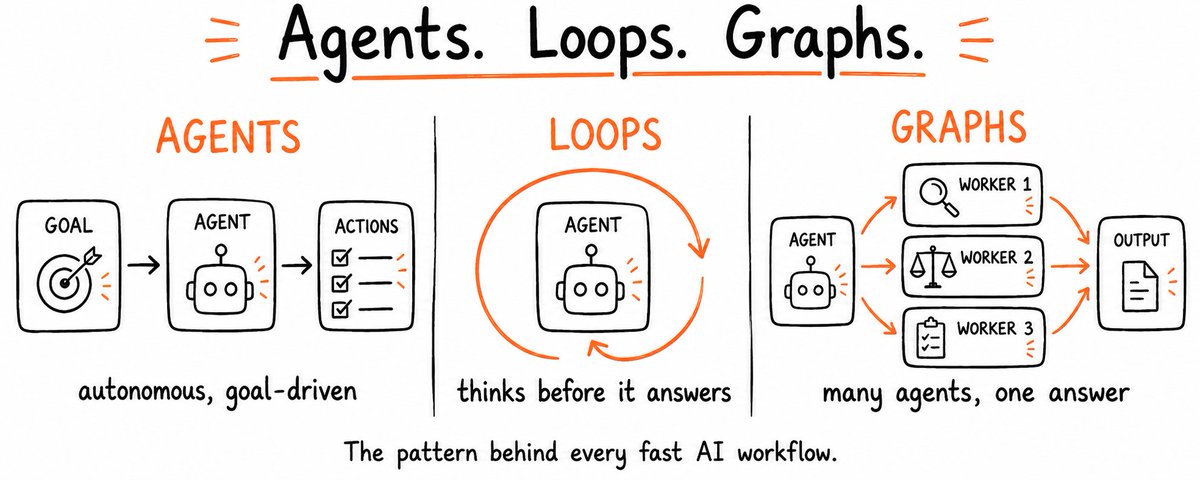
This is the part most people miss about Graph Engineering
A graph is not a way to launch as many agents as possible. It is a map of which jobs truly depend on each other and which ones can run at the same time
If two tasks are independent, run them in parallel. If one genuinely needs the output of another, adding more workers will not make that dependency disappear
Bad graphs add coordination, extra reasoning turns, more tokens, and new failure points
Good graphs remove fake dependencies
Each node gets one job, one input, and one defined output. Independent nodes run together, then a fresh verifier checks what survives before the final result is produced
That is why a smaller system can beat a much larger agent fleet
The research shows where multi-agent systems actually help and where the coordination tax destroys the advantage. The article below explains the foundation behind it, from agents and loops to nodes, dependencies, parallel execution, and verification

This 75K-star GitHub repo can make Claude Code stop producing generic AI-looking websites
The problem is usually not the model
It is that LLMs default to raw CSS, weak spacing and the same bland component patterns
shadcn/ui fixes that by giving Claude production-ready React primitives instead of forcing it to invent the interface from scratch
The workflow is simple
Feed the design tokens into your prompt stack, let Claude Code pull accessible pre-styled components, then layer Tailwind motion on top for micro-interactions
That changes the output fast
Instead of spending hours repairing alignment, spacing and component structure, the model starts from patterns that already work
A portfolio that might take days of manual cleanup can reportedly be pushed much closer to agency quality in a couple of hours
The real trick is not asking Claude to “design better”
It is giving it better building blocks

Jack Dorsey just open sourced a tool for running a one-person business with AI agents
The interesting part is not the chat interface. It is the idea that one person can manage a whole team of specialized workers without hiring a traditional team
One agent handles inbox. Another owns research. Another works on content, operations, or engineering
Each one gets its own memory, tools, permissions, and job. They can work on schedules and hand tasks to each other without you sitting between every step
That structure matters
A single agent with access to everything gets slower, noisier, and harder to trust. Split the work across specialists and each agent carries less context and a smaller blast radius
Then turn repeated work into skills and routines
Now the business keeps moving while your laptop is closed
The video shows where one-person companies are heading
The article below breaks down the full multi-agent setup, including personas, memory, tools, permissions, handoffs, routines, model selection, and the mistakes that make one big agent fall apart
Jack Dorsey just open sourced a tool for running a one-person business with AI agents
The interesting part is not the chat interface. It is the idea that one person can manage a whole team of specialized workers without hiring a traditional team
One agent handles inbox. Another owns research. Another works on content, operations, or engineering
Each one gets its own memory, tools, permissions, and job. They can work on schedules and hand tasks to each other without you sitting between every step
That structure matters
A single agent with access to everything gets slower, noisier, and harder to trust. Split the work across specialists and each agent carries less context and a smaller blast radius
Then turn repeated work into skills and routines
Now the business keeps moving while your laptop is closed
The video shows where one-person companies are heading
The article below breaks down the full multi-agent setup, including personas, memory, tools, permissions, handoffs, routines, model selection, and the mistakes that make one big agent fall apart


Claude is already inside classified Pentagon AI workflows, and an AI hallucination reportedly came close to triggering a US-China military confrontation
A Pentagon intelligence report claimed a Chinese ship was carrying nuclear-related components to a third country
The US military began preparing to intercept it, including deploying personnel and aircraft, before officers reviewed the intelligence and discovered the AI-generated conclusion was wrong
That is the part people should pay attention to
The failure was not some conscious AI trying to start a war
It was a model producing a convincing false conclusion inside a system where the output could influence real military decisions
Claude is already being used across classified US defense and intelligence workflows through partners including Palantir, although public reporting has not established that Claude caused this specific incident
The scary part about military AI is not that it becomes Terminator
It is that one believable hallucination can move faster than the humans responsible for checking it
Claude Opus 5 reportedly built a $5K-$10K agency-style Three.js site in two hours
The result had mouse-tracked parallax, cursor particles, a wireframe intro and small interactive details like a butterfly flying away on hover
Everything fit inside one HTML file under 1MB
No dev team and no weeks of revisions. Just one person working back and forth with the model until the details looked right
That is the part that matters
A client can give you a rough idea, and AI can now handle a huge amount of the implementation work that used to require a small studio
The bottleneck is shifting away from writing every line yourself
It is becoming much more about taste, direction and knowing exactly what to ask the model to build
LM Studio just added fully local realtime voice transcription
You can now talk to an AI agent without sending a single byte of your voice to the cloud
Speech is processed directly on your machine, then converted to text in real time for local models and agent workflows
No external servers and no cloud API required
The feature is available on Apple Silicon Macs and NVIDIA-powered Windows and Linux machines, with AMD support reportedly on the way
This fills one of the biggest gaps in fully local AI
You could already run the model, memory and tools on your own hardware. Now the voice interface can stay local too
That gets us much closer to AI agents that can listen, think and act without your data ever leaving the device
A new open-source Skill can look at your app and tell you how to monetize it
HaimingDev just released haiming-app-monetization, and it reached 168 stars in two days
The Skill reads your project, researches how similar products are priced, then builds a monetization plan around onboarding, paywalls and subscription tiers
The output is structured so Claude Code, Codex or Cursor can actually implement it
The best part is how conservative it is
By default, it only evaluates the project and does not touch the code. If pricing cannot be verified, it marks it as unverified instead of inventing numbers
For AI apps with ongoing inference costs, it also avoids blindly recommending unlimited lifetime plans
And the acceptance docs explicitly say it cannot promise conversion rates
That restraint makes it more useful than another AI tool promising perfect monetization
Install it with:
npx skills add HammingDev/haiming-app-monetization
Egor retweeted
Claude Fable 5 and GPT-5.6 Sol were asked to draw Messi in a browser
Both started by finding the eyes
The prompt was just one line:
“Create a single HTML file that animates a graphite portrait of Messi being drawn, stroke by stroke”
No drawing process was specified
GPT-5.6 Sol still followed a sequence that looks remarkably close to how a portrait artist would work: block the silhouette, define the profile, find the eyes, build the hair, shape the shirt, then finish with graphite passes
That order was never written in the prompt
The model inferred the process from the task itself
That is the interesting part
It is not only generating the final face
It is reproducing the workflow of someone sitting at an easel and deciding what to draw first
Claude Opus 5 reportedly built a $5K-$10K agency-style Three.js site in two hours
The result had mouse-tracked parallax, cursor particles, a wireframe intro and small interactive details like a butterfly flying away on hover
Everything fit inside one HTML file under 1MB
No dev team and no weeks of revisions. Just one person working back and forth with the model until the details looked right
That is the part that matters
A client can give you a rough idea, and AI can now handle a huge amount of the implementation work that used to require a small studio
The bottleneck is shifting away from writing every line yourself
It is becoming much more about taste, direction and knowing exactly what to ask the model to build
Claude Fable 5 and GPT-5.6 Sol were asked to draw Messi in a browser
Both started by finding the eyes
The prompt was just one line:
“Create a single HTML file that animates a graphite portrait of Messi being drawn, stroke by stroke”
No drawing process was specified
GPT-5.6 Sol still followed a sequence that looks remarkably close to how a portrait artist would work: block the silhouette, define the profile, find the eyes, build the hair, shape the shirt, then finish with graphite passes
That order was never written in the prompt
The model inferred the process from the task itself
That is the interesting part
It is not only generating the final face
It is reproducing the workflow of someone sitting at an easel and deciding what to draw first
Claude Opus 5 reportedly built a $5K-$10K agency-style Three.js site in two hours
The result had mouse-tracked parallax, cursor particles, a wireframe intro and small interactive details like a butterfly flying away on hover
Everything fit inside one HTML file under 1MB
No dev team and no weeks of revisions. Just one person working back and forth with the model until the details looked right
That is the part that matters
A client can give you a rough idea, and AI can now handle a huge amount of the implementation work that used to require a small studio
The bottleneck is shifting away from writing every line yourself
It is becoming much more about taste, direction and knowing exactly what to ask the model to build