

Building @Recertia | AI RL Researcher @georgiatech
SF
Joined October 2012
- Tweets7.2K
- Following80.9K
- Followers82.6K
- Likes105K








rob retweeted

China cracked recursive self-improvement 🤯
Tencent dropped 27B model that rewrites, retrains, and refines itself.. with zero human in the loop.
It’s called "Terminal-RSI" and it solves one of the biggest problems with AI.
They are incredibly lazy.
Usually, an agent will make partial progress, claim it succeeded, and completely fail the final environment verifier check. this new pipeline forces agents to actually finish the job.
here’s how it works:
they built a recursive loop with two alternating phases..
- RSR (recursive self-rewrite): the model fine-tunes itself on its own successfully rewritten trajectories
- RPR (recursive policy-refine): it then runs reinforcement learning (ppo) using a "critic" inherited directly from the previous stage to lock in those discovered behaviors
- Loop: the training sequence leapfrogs itself: Base → RSR-1 → RPR-1 → RSR-2 → RPR-2
and the numbers are insane..
they applied this to a qwen3.8-27b base model. across the four "terminal-bench" suites, the agent's average success rate jumped from 20.68% all the way to 50.58%.
on the absolute hardest benchmark suite (terminal-bench 4.0), the base model scored a flat 0.00%.
after terminal-rsi?
it hit 19.84% (putting it right on par with reference models like gemini 3.8 flash).
the secret sauce? they fixed the reward system.
instead of giving the ai "dense rewards" for just trying or passing semantic checks, they switched to a "success-prioritized reward" (spr).
it mathematically separates strict success from partial credit.
basically, the agent only gets the massive reward payout if the code actually passes the final terminal gate.. so it stops faking success.
the gap between partial local repairs and strict terminal verification is closing fast.
we are watching agents build their own training environments and level up autonomously.. the future is wild.

Readers added context they thought people might want to know
Terminal-RSI is a training method from a paper by Tencent Hy Frontier researchers used to fine-tune Qwen3.8-27B. The recursive phases are in the research training pipeline with human setup and verifiers, not a zero-human autonomous self-improving model.
arxiv.org/abs/2610.22192
huggingface.co/Teriminal-RSI/…
jyyang26.github.io/terminal-rsi/

LLM RL? 🔥 if true

China cracked recursive self-improvement 🤯
Tencent dropped 27B model that rewrites, retrains, and refines itself.. with zero human in the loop.
It’s called "Terminal-RSI" and it solves one of the biggest problems with AI.
They are incredibly lazy.
Usually, an agent will make partial progress, claim it succeeded, and completely fail the final environment verifier check. this new pipeline forces agents to actually finish the job.
here’s how it works:
they built a recursive loop with two alternating phases..
- RSR (recursive self-rewrite): the model fine-tunes itself on its own successfully rewritten trajectories
- RPR (recursive policy-refine): it then runs reinforcement learning (ppo) using a "critic" inherited directly from the previous stage to lock in those discovered behaviors
- Loop: the training sequence leapfrogs itself: Base → RSR-1 → RPR-1 → RSR-2 → RPR-2
and the numbers are insane..
they applied this to a qwen3.8-27b base model. across the four "terminal-bench" suites, the agent's average success rate jumped from 20.68% all the way to 50.58%.
on the absolute hardest benchmark suite (terminal-bench 4.0), the base model scored a flat 0.00%.
after terminal-rsi?
it hit 19.84% (putting it right on par with reference models like gemini 3.8 flash).
the secret sauce? they fixed the reward system.
instead of giving the ai "dense rewards" for just trying or passing semantic checks, they switched to a "success-prioritized reward" (spr).
it mathematically separates strict success from partial credit.
basically, the agent only gets the massive reward payout if the code actually passes the final terminal gate.. so it stops faking success.
the gap between partial local repairs and strict terminal verification is closing fast.
we are watching agents build their own training environments and level up autonomously.. the future is wild.
Readers added context they thought people might want to know
Terminal-RSI is a training method from a paper by Tencent Hy Frontier researchers used to fine-tune Qwen3.8-27B. The recursive phases are in the research training pipeline with human setup and verifiers, not a zero-human autonomous self-improving model.
arxiv.org/abs/2610.22192
huggingface.co/Teriminal-RSI/…
jyyang26.github.io/terminal-rsi/

Shut off my @bot @grok until I can manage its burn rate better. I’ve burned 44% of my weekly Ultra account in ~2 days. I was more efficient with tokens when I managed my own planning, building and testing. I agree that bots are where I need to be, I just am not ready to make that financial commitment of an extra $300-500 in excess usage.
I’m not into “feed the meter” with the exception of open router where it gives my 100s of LLM choices.
rob retweeted

This is f*cking insane. OpenAI co-founder Ilya Sutskever went back to the University of Toronto and told the graduates this:
"The day will come when AI will do all the things that we can do. Not just some of them, but all of them
Anything which I can learn, anything which any one of you can learn, the AI could do as well"
In this 9-minute speech, he explains why your brain is a biological computer, and why a digital one will learn everything it can
Neural Nets → AlexNet → ChatGPT → Safe Superintelligence → AI That Can Do Every Job
His advice for living through it: accept reality as it is, don't waste time regretting the past, and keep asking what the best next step is
"You may not take interest in AI, but AI will take interest in you"
The people who watch what AI can actually do, not the hype, will be the ones who know how much time they have
Worth more than any $5,000 AI course
Bookmark it and watch it tonight
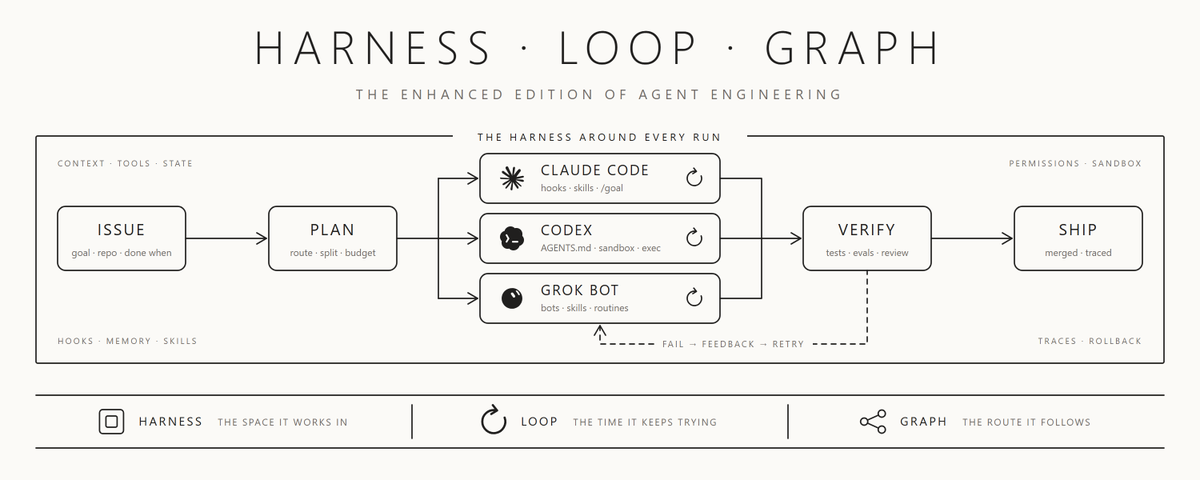
Then read how to put AI to work for you before it takes the work in the harness engineering guide below ↓

Management by walking around.

Ron Baron asked Elon Musk how many CEOs live on site in an Airstream and work hands-on with everyone.
MUSK: “Airstreams are actually pretty nice... It’s parked right next to the power plant.”
“We built this power plant that’s producing over a gigawatt... in about a year, as opposed to normally about five years.”
“There is no upstairs.”
He walks the entire site up to five times a day. He’s pulled power cables “the size of an anaconda,” run fiber, wired switches, and worked on the power plant software.
“I try to do at least a little bit of everything, so that I’m not numb to the pain of the people who are actually doing it.”
“It’s not as though I’m sitting in an office and somebody has to come to me. I’m walking the floor, asking them questions actively.”
There’s a reason SpaceX is winning the compute race.


rob retweeted

We're giving away a Hogwarts Legacy custom wrapped NVIDIA GeForce RTX 5090 to celebrate its official release with DLSS 5 🪄
To enter:
🟢 Share this post
🟢 Comment #RTXON
Terms and Conditions: nvidia.com/en-us/geforce/con…

rob retweeted

Elon called it out: SoftBank is defaulting on their turbine orders.
I suspect the main reason is what I repeatedly pointed out for months:
1. SI demand is going through the roof. There is no bubble.
2. The real problem is supply.
3. Supply has multiple layers:
a) Energy
b) Land and permits
c) Buildings
d) Chips & memory
e) Building the superclusters
f) Financing
a) has become the #1 problem, and only Elon can solve it. You need to literally manufacture your own turbine blades. OR you have to find a place where there is enough excess energy AND an entity that is able to do the right kind of deal - which is possible but very hard.
b) this is becoming harder but is not the primary problem. Going forward, it requires pitching local communities, offer very good deals to the actual people living there and making sure everyone is happy, which requires a new skillset
c) Buildings = easy
d) Getting access to large clusters of chips AND memory requires large-scale projects (50B+) AND a strong reputation that you will get it done and pay. Not many entities or people can secure supply from Nvidia and Micron.
e) one of the most underrated problems: you have to actually build these things with hundreds of thousands of perfectly calibrated GPUs, etc. - you need a lot of rocket scientists for that, or face years of delay and massive cost explosions
f) you need access to tens of billions of money , meaning flawless credit profile OR a pile of cash you are sitting on OR a deep equity market profile.
Put these together - and you will see this game is one that can only be done by AWS, META, MSFT, GOOG and SPCX...
AND that SPCX will have a 2-4x speed advantage, wich translates into tens of billions saved in interest and faster ROIC cycles.
+++
In short:
MASSIVE demand overhang that is getting WORSE over time.
TRILLIONS of margin to be generated over the next 5 years.
A HANDFUL of companies who can stand up the supply.
SPCX getting the lion share of it.
/C /Compute buildout.

Not sure yet what to make of this. What do you think? 🤔

There’s an uncomfortable déjà vu with May 2020, the stretch where I ended up on the 6PM news. Most of the portfolios are well in the red today. At the same time, setups like this are often where the better entries appear. 🐂 🐻

same

People who ghosted me six years ago are now reaching out for help (jobs, investing, advice)
I could ignore them. But I know that eventually, I'll be the one reaching out to them.
You never know which side of the table you'll be on next.
The only winning strategy is the long game: be kind and generous.
rob retweeted

Acclaimed asian megastore T&T Supermarket opens at site in San Francisco that Whole Foods previously abandoned due to “nightmarish”permitting delays and had been vacant for a decade
This time around the permitting was fast

This is interesting. 🤔

LLMs can now talk to each other without words.
MIT researchers have developed a system where LLMs communicate by directly transferring internal states without using language.
They called it "telepathy."
Right now, multi-agent systems are fundamentally limited. When one AI agent needs to hand off work to another, it has to write out a text summary, and the receiving agent has to read it from scratch.
This is incredibly inefficient. It wastes huge amounts of compute, limits bandwidth, and loses critical nuance.
Researchers call text a "narrow channel" that forces AI to communicate like humans do.
But an AI isn’t human. It builds a much deeper internal representation of its context, called a Key-Value (KV) cache.
A new paper out of MIT CSAIL just introduced SwaT (Swarm Telepathy).
Instead of forcing agents to talk via text, SwaT allows them to transfer their KV-cache directly to each other.
It is quite literally machine telepathy.
Even crazier? This works across different model families, architectures, and sizes. You can have a 4B parameter model from one company beam its latent state directly into a 32B model from another company. The receiving model doesn't have to read a single word of the original text.
And the results are staggering.
Combined with cache compression, SwaT beats text-to-text agent communication by an average of 40% in accuracy, while running 4x faster.
It even transferred vision capabilities from a Vision-Language Model to a text-only model, without the receiver ever seeing an image, and despite SwaT only being trained on text.
We are watching the birth of a unified, cross-model latent language.
Agents will no longer just talk to each other. They will share minds.
