

Building @Recertia | AI RL Researcher @georgiatech
SF
Joined October 2012
- Tweets7.2K
- Following80.9K
- Followers82.6K
- Likes105K








rob retweeted

China cracked recursive self-improvement 🤯
Tencent dropped 27B model that rewrites, retrains, and refines itself.. with zero human in the loop.
It’s called "Terminal-RSI" and it solves one of the biggest problems with AI.
They are incredibly lazy.
Usually, an agent will make partial progress, claim it succeeded, and completely fail the final environment verifier check. this new pipeline forces agents to actually finish the job.
here’s how it works:
they built a recursive loop with two alternating phases..
- RSR (recursive self-rewrite): the model fine-tunes itself on its own successfully rewritten trajectories
- RPR (recursive policy-refine): it then runs reinforcement learning (ppo) using a "critic" inherited directly from the previous stage to lock in those discovered behaviors
- Loop: the training sequence leapfrogs itself: Base → RSR-1 → RPR-1 → RSR-2 → RPR-2
and the numbers are insane..
they applied this to a qwen3.8-27b base model. across the four "terminal-bench" suites, the agent's average success rate jumped from 20.68% all the way to 50.58%.
on the absolute hardest benchmark suite (terminal-bench 4.0), the base model scored a flat 0.00%.
after terminal-rsi?
it hit 19.84% (putting it right on par with reference models like gemini 3.8 flash).
the secret sauce? they fixed the reward system.
instead of giving the ai "dense rewards" for just trying or passing semantic checks, they switched to a "success-prioritized reward" (spr).
it mathematically separates strict success from partial credit.
basically, the agent only gets the massive reward payout if the code actually passes the final terminal gate.. so it stops faking success.
the gap between partial local repairs and strict terminal verification is closing fast.
we are watching agents build their own training environments and level up autonomously.. the future is wild.

Readers added context they thought people might want to know
Terminal-RSI is a training method from a paper by Tencent Hy Frontier researchers used to fine-tune Qwen3.8-27B. The recursive phases are in the research training pipeline with human setup and verifiers, not a zero-human autonomous self-improving model.
arxiv.org/abs/2610.22192
huggingface.co/Teriminal-RSI/…
jyyang26.github.io/terminal-rsi/
rob retweeted

This is f*cking insane. OpenAI co-founder Ilya Sutskever went back to the University of Toronto and told the graduates this:
"The day will come when AI will do all the things that we can do. Not just some of them, but all of them
Anything which I can learn, anything which any one of you can learn, the AI could do as well"
In this 9-minute speech, he explains why your brain is a biological computer, and why a digital one will learn everything it can
Neural Nets → AlexNet → ChatGPT → Safe Superintelligence → AI That Can Do Every Job
His advice for living through it: accept reality as it is, don't waste time regretting the past, and keep asking what the best next step is
"You may not take interest in AI, but AI will take interest in you"
The people who watch what AI can actually do, not the hype, will be the ones who know how much time they have
Worth more than any $5,000 AI course
Bookmark it and watch it tonight
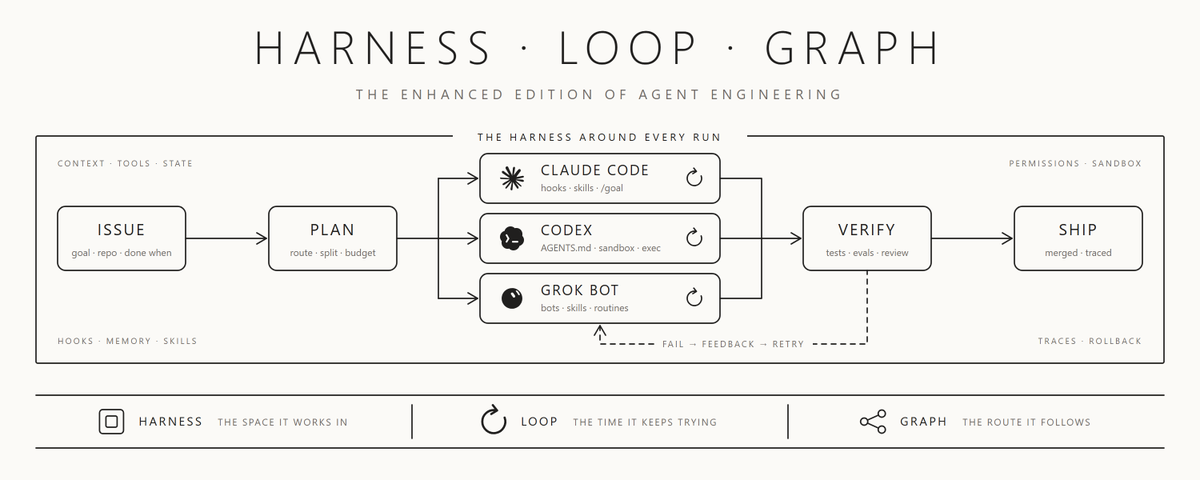
Then read how to put AI to work for you before it takes the work in the harness engineering guide below ↓

rob retweeted

We're giving away a Hogwarts Legacy custom wrapped NVIDIA GeForce RTX 5090 to celebrate its official release with DLSS 5 🪄
To enter:
🟢 Share this post
🟢 Comment #RTXON
Terms and Conditions: nvidia.com/en-us/geforce/con…

rob retweeted

Elon called it out: SoftBank is defaulting on their turbine orders.
I suspect the main reason is what I repeatedly pointed out for months:
1. SI demand is going through the roof. There is no bubble.
2. The real problem is supply.
3. Supply has multiple layers:
a) Energy
b) Land and permits
c) Buildings
d) Chips & memory
e) Building the superclusters
f) Financing
a) has become the #1 problem, and only Elon can solve it. You need to literally manufacture your own turbine blades. OR you have to find a place where there is enough excess energy AND an entity that is able to do the right kind of deal - which is possible but very hard.
b) this is becoming harder but is not the primary problem. Going forward, it requires pitching local communities, offer very good deals to the actual people living there and making sure everyone is happy, which requires a new skillset
c) Buildings = easy
d) Getting access to large clusters of chips AND memory requires large-scale projects (50B+) AND a strong reputation that you will get it done and pay. Not many entities or people can secure supply from Nvidia and Micron.
e) one of the most underrated problems: you have to actually build these things with hundreds of thousands of perfectly calibrated GPUs, etc. - you need a lot of rocket scientists for that, or face years of delay and massive cost explosions
f) you need access to tens of billions of money , meaning flawless credit profile OR a pile of cash you are sitting on OR a deep equity market profile.
Put these together - and you will see this game is one that can only be done by AWS, META, MSFT, GOOG and SPCX...
AND that SPCX will have a 2-4x speed advantage, wich translates into tens of billions saved in interest and faster ROIC cycles.
+++
In short:
MASSIVE demand overhang that is getting WORSE over time.
TRILLIONS of margin to be generated over the next 5 years.
A HANDFUL of companies who can stand up the supply.
SPCX getting the lion share of it.
/C /Compute buildout.

rob retweeted

Acclaimed asian megastore T&T Supermarket opens at site in San Francisco that Whole Foods previously abandoned due to “nightmarish”permitting delays and had been vacant for a decade
This time around the permitting was fast


rob retweeted

And electrical equipment, cooling, networking and batteries

Elon Musk says the AI boom will hit a WALL by the end of 2026.
He says the whole industry is about to learn a hard lesson in hardware.
Chip output is exploding, but electricity is nearly flat everywhere outside China.
So the two lines cross this year.
He says by the end of the year, we will be making more AI chips than we can actually turn on.
Millions of them pile up with nowhere to plug in.
In his words, the bottleneck for the next year is not chips, it is raw power.
Whoever can turn on the most chips fastest wins the race.
In the end, the AI race comes down to one thing:
Raw electricity.
— Elon Musk (.@elonmusk) on Dwarkesh Patel's (.@dwarkesh_sp) podcast


rob retweeted

New Tsinghua and Microsoft paper finds that DeepSeek Harness used 87.93% fewer tokens than its original version on 98 HumanEval tasks while success rose from 71.43% to 85.71%.
Agent tools like Codex and DeepSeek Harness call the LLM after each tool result to choose the next step. Often that step was already decided, like running tests once the code compiles.
HarnessMM lets the model write future commands with exact arguments, plus a check for each, such as a successful build. When a tool result passes the check, the agent runs the command and skips the LLM call.
On 98 HumanEval tasks, Codex kept its 90.82% success while using 29.54% fewer tokens than plain Codex. DeepSeek Harness rose from 71.43% to 85.71% success and used 87.93% fewer tokens than the original.
If your agent runs predictable chains like write, build, test, have the model plan them once with pass checks instead of re-asking each step.


rob retweeted

First in my bloodline to use a quantum computer
It's easier than you think:
> Create an account at @IBM Quantum Platform
> Create an Open Plan instance and copy its CRN
> Generate an API key from the dashboard and keep it private.
> Install Qiskit and IBM’s runtime package: pip install qiskit "qiskit-ibm-runtime>=0.50.0".
> Build your circuit in Python, connect using your API key and CRN, and select a real quantum computer.
> Submit your circuit, track it under Workloads, and retrieve the measurement results when it finishes

rob retweeted
If you look closely enough, breakthroughs in everything are accelerating exponentially.
An exponential always starts off looking small.

this might be my last normal tweet before biotech goes vertical
i'm not a whistleblower. I don't work at Lilly, Novo or any of the big labs
but there is a massive shift happening in human biology right now.
it's sitting in press releases and almost nobody reads them
the last 6 months alone:
- a once-daily pill roughly doubled median survival in metastatic pancreatic cancer (13.2 vs 6.6 months)
- a one-time gene editing infusion cut hereditary angioedema attacks 87%, and 62% of patients stayed attack-free and off all other prevention for 6 months
- a one-time gene edit for cholesterol dropped LDL up to 62%, and it held for over a year
- a personalized mrna vaccine beat keytruda alone in a 1,137 patient melanoma phase 3
- retatrutide hit ~28% weight loss in a phase 3
- an ai-designed drug entered phase 3
- a pill that regrows hair passed its second phase 3
- an immunotherapy that could let some rectal cancer patients skip surgery, chemo and radiation just got fda approved
- a man lived 271 days off dialysis on a pig kidney
- human cells were caught passing chromosome-sized chunks of DNA to their neighbors, and it changes how the neighbors behave
we are on the verge of an era where the human body is a software problem and the update cycle gets shorter everyday
stick around, it's going to get weird
bio/acc
rob retweeted

Unfortunately, I think it is likely a major change to the software development career option. Oregon State University has seen a -23% drop YoY in computer science enrollment.
Oregon State U. Put Its Chips on Computer Science. Then the Bottom Fell Out. archive.is/UKvr9
Nationally, computer science enrollment has fallen by 53,000 students. archive.is/7hNMN
rob retweeted

Home prices in San Francisco are soaring. But it's just a handful of ZIPs—in SF proper and Silicon Valley—that are hot. Prices in the broader SF-Oakland-Fremont metro area are up only ~3% (not spectacular in a national context). My map:

rob retweeted

Prices in Osaka and Bangkok are ~same despite 4x wage difference.
I knew Japan was cheap these days but WOW.
And Japan has all the standard First World attributes like drinkable tap water, clean air, safe roads.
Explains why everyone and their dog are going to Japan in 2026.
🤖 Made with AI


rob retweeted
Recursive Self-Improvement

A retired NASA engineer who had worked on the Space Shuttle program for 25 years was hired by SpaceX at age 62. He described the first week as the most disorienting experience of his professional life.
At NASA, a design change required 3 meetings, 2 committees, a review board, and 6 to 18 months of documentation. At SpaceX, his new supervisor said "if it works, build it. If it doesn't, change it by Friday."
He sat at his desk after the first day and called his wife. He told her he felt like a man who had been swimming with ankle weights for 25 years and someone just cut them off. He could move. He could decide. He could build something in the morning and test it in the afternoon. The constraint that he had accepted as the nature of aerospace engineering turned out to be the nature of bureaucracy.
Within 6 months he had contributed to more design iterations than he had completed in his last 5 years at NASA. Not because he was working harder. Because the time between having an idea and testing the idea collapsed from months to hours. The same brain. The same knowledge. A different operating system.
He described a specific moment where he proposed a modification to a Raptor engine component. At NASA, the proposal would have entered a queue. At SpaceX, the modification was machined by the end of the day and tested by the following morning. He watched his idea become a physical object in 18 hours. At NASA, 18 hours would not have been enough to schedule the first meeting to discuss whether to schedule a meeting.
He told an interviewer: "I didn't get smarter when I went to SpaceX. I got faster. The intelligence was always there. The system was in the way."
The difference between SpaceX and NASA is not talent. NASA has extraordinary talent. The difference is the time between a thought and a test. SpaceX compresses it. NASA elongates it. The same engineer produces 10x more at SpaceX than at NASA because the bottleneck was never the engineer. It was the meetings about the meetings about the work.
rob retweeted

David Sacks: The fears about Super Intelligence are rotating hoaxes meant to stop the thing that will make life affordable
SACKS: “What creates abundance? Technology in general, and specifically Super Intelligence...
AI is going to put everyone out of work? Total fake narrative. That was last year’s hoax.
Data centers using up everyone’s water. That’s the data center hoax.
There’s a new hoax about human extinction...
So we have a series of rotating hoaxes, where every six months there’s a new one to try and convince us to sabotage the thing that’s going to solve so many of our problems.”
The Economist estimates SI has already created about a million new American jobs, while people are still being told it will put everyone out of work.
Which hoax did you fall for first: the job loss, the extinction, or the water?