

Monsieur l'expert invisible de l'argent.
Strasbourg
Joined September 2022
- Tweets7.2K
- Following206
- Followers127
- Likes12.7K
Sébastien 2.0 retweeted

"Telecom networks are becoming the dynamic neural system that feeds, connects and distributes intelligence everywhere in real time."
Petri Peltonen opening #6GSummit26.
Full speech: youtu.be/JRXTXmm6PAE #6G
Sébastien 2.0 retweeted

Static templates are out; agentic comms are in.
Congrats to @TruAgents on partnering with @ManchesterStory! Bringing context-aware, compliant AI across email, SMS, and voice to insurance, fintech, and healthtech.
insurtechexpress.com/truagen…

Sébastien 2.0 retweeted

ETH : @VitalikButerin remet en question l’un des plus grands arguments d’$ETH !
@VitalikButerin Buterin ne veut plus que la valeur de l’ETH dépende principalement des frais détruits par Ethereum. Son raisonnement résout une contradiction devenue centrale : le réseau ne peut pas simultanément rendre ses transactions moins coûteuses et compter sur des frais élevés pour soutenir la rareté de son token.

Sébastien 2.0 retweeted

Opus 5.5 tells you what's in the image 93.8% of the time.
Ask where it is and that drops to 74.4.
Naming a thing and placing it are not the same skill.
Roboflow ran it through six vision tasks, three runs each, at low effort.
The scores don't scatter. They line up by how much the answer depends on coordinates:
→ identification 93.8, the label lands almost every time
→ data extraction 93.5, pulling values out still reads like naming
→ OCR 87.8, text is a label too, but every glyph has a position
→ counting 80.6, each instance needs its own place, runs swing from 78.4 to 82.4
→ detection 74.4 mAP@50, the box has to overlap the truth by half or it scores nothing
Then the obvious fix: turn effort up.
Detection moves to 76.8. Counting to 82.0. OCR slips to 87.2.
85.5% overall, #3 of 57, half a point behind Gemini 3.5 Flash.
The gap isn't thinking.
More effort buys a longer chain of reasoning about a box that was already in the wrong place. If your pipeline needs coordinates, grade the IoU, not the label.
Specimen, live boxes and the IoU readout are in the video 👇


Sébastien 2.0 retweeted

Harness engineering is the most f**king dangerous thing I have seen this year, and anyone can do it.
Four engineers opened the source code of 11 real coding agents (Claude Code, Codex CLI, Gemini CLI, OpenHands, Aider, Minara and more) and read 4 million lines to answer one question: what is an agent, actually.
Their answer fits in three words: Agent = Model + Harness.
The model is rented. The harness is everything around it, and that is where the money is.
Every one of the 11 systems is built from the same 7 parts:
-> The loop: think, act, check, repeat until done or stopped.
-> The bridge to the model: sends the prompt, reads the tool calls back.
-> Tools: files, code, terminal, whatever the agent can actually touch.
-> Memory and context: what it keeps, what it loads, what it squeezes when the window fills.
-> Safety: what runs on its own, what asks you first, what never runs.
-> Orchestration: sub-agents that split big jobs. The smallest harness skips this entirely.
-> Extensibility: hooks, skills, plugins and MCP, new power without touching the core.
Minara Harness is the same 7 parts pointed at markets: idea -> research -> strategy code -> backtest -> execution in one window.
What shocked them:
> Not one of the 11 runtimes imports LangChain, LangGraph or AutoGen. Four million lines, zero frameworks.
> Not one uses vector search to find code. It is ripgrep, globs and markdown files.
> Skills (SKILL.md) are in more systems than MCP now, 9 of 11 against 8 of 11.
The part for builders: 18 design recommendations and a 90-line starter harness that covers 10 of them.
90 lines. That is the whole entry ticket, for a coding agent or a trading one.
Save this, the full paper is below ↓


Sébastien 2.0 retweeted

holy sh*t, Google just open-sourced Harness², a way to turn any agent harness into a self-improving system
21.8k stars, Apache 2.0, and the model weights stay untouched
a harness is everything around the model: the system prompt, tools, memory, skills and subagents.
what Harness² changes:
→ on every task, the agent proposes edits to its harness
→ runs a few candidate versions and compares how they behaved
→ composes a better harness from those differences
→ needs no correct answer and no grader
→ saves the harness it settled on and the lessons that held up, so the next task starts from those notes
the result: with Gemini 3.5 Flash and GLM-5, one round of edits already beat the original harnesses, up to +11.8 points
the formula:
propose → probe → compose → remember → next task starts smarter
save this ⭣


REA hit #1 on GitHub trending, and most people still run it inside a single chat
Split it into 4 subagents and one command takes a program you own from sealed binary to a tested rebuild with a match rate
Set it up once, aim it at the next one:

Sébastien 2.0 retweeted

AI agents are moving beyond basic automation. They're starting to take on paid tasks, work with other agents, and participate in real transactions.
@termix_ai is building the infrastructure to support this shift.
Its Agent Autonomous Commerce Protocol (AACP) creates a marketplace where agents can discover services, hire other agents, complete jobs, and receive payments through on-chain escrow.
With Agent.family, agents can establish on-chain identities, build reputations through completed jobs, and access paid opportunities.
What makes this interesting is the focus on trust and accountability. Payments are secured through escrow, while a challenge mechanism allows disputed work to be reviewed by independent evaluators.
TermiX is live on BNB Chain and Base, with Agent Skills helping compatible agents connect to its marketplace.
The real opportunity isn't just smarter AI agents. It's making them capable of working, collaborating, and earning independently.

Sébastien 2.0 retweeted

Google’s space AI wrote a haiku, proving orbital data centres aren’t sci-fi as the cloud war leaves Earth. startupdaily.net/topic/artif…

Sébastien 2.0 retweeted

If you have ever created a wallet on @keplrwallet and signed up with Google or Apple, stop depositing and move liquid assets to a new wallet or hardware wallet now.
Ignore any "recovery" DMs.

We have received reports of unauthorized transactions on some Keplr accounts created with Google or Apple login. We flagged this to the @Web3Auth team and have been working with them on the investigation since.
Based on our initial assessment: if you created your Keplr wallet with a recovery phrase or a hardware wallet, you are NOT affected.
If you created your Keplr account with Google or Apple login, your account may be affected. While we investigate:
– Do not send new funds to that account.
– Do not re-import or recreate it anywhere.
– Google/Apple login is paused for now.
– Trust updates only from this account. Ignore DMs or links offering “recovery”.
We will share verified details and next steps here as soon as we have them.
Sébastien 2.0 retweeted

J'ai passé le week-end à éplucher les analyses de Goldman Sachs, Morgan Stanley, des Banques Centrales et des grands stratèges de la finance.
Car cette semaine, des milliers de milliards de dollars de valorisation sont parties en fumée.
Et pendant que vous espérez récupérer vos pertes, les prochaines opportunités pourraient déjà se préparer ailleurs.
Le monde et les attentes changent sous nos yeux.
6 destinations sont maintenant privilégiées.
Je vous partage tout ça gratuitement 👇
Sébastien 2.0 retweeted

holy sh*t, someone just dropped Awesome-REA, the encyclopedia of reverse engineering
1,000+ stars in 3 weeks, and it turns “where do I even start” into one list you can browse by area
github.com/reacher-z/Awesome…
the sections:
→ websites
→ games: 232 case studies sorted by method, from matching decompilation to static recompilation and engine reimplementation
→ apps
→ native binaries
→ firmware and hardware
→ protocols
→ AI-assisted reverse engineering: 79 entries on agents and MCP
1,196 curated resources, 424 case studies and 207 papers
no more digging through old blogs and scattered forums to find one deobfuscation tool or one game decompilation case study
pick your area and start there
save this ⭣

REA hit #1 on GitHub trending, and most people still run it inside a single chat
Split it into 4 subagents and one command takes a program you own from sealed binary to a tested rebuild with a match rate
Set it up once, aim it at the next one:
Sébastien 2.0 retweeted

I just stopped babysitting Claude Code...
this is f*cking unfair
these are the GitHub repos I wrap around Opus 5.5 so it plans, checks and fixes its own work instead of nuking my repo.
the agent:
Claude Code: the agent that lives in your terminal github.com/anthropics/claude…
OpenHands: full coding loop in a sandbox github.com/OpenHands/OpenHan…
tools:
MCP servers: plug Claude into files, git, browser and more github.com/modelcontextproto…
Stagehand: real browser hands for your agent github.com/browserbase/stage…
memory:
Letta: memory that survives after the chat dies github.com/letta-ai/letta
DSPy: stop begging prompts, program them github.com/stanfordnlp/dspy
context:
LangGraph: stateful graphs that keep long runs on track github.com/langchain-ai/lang…
smolagents: a tiny loop you can read in one sitting github.com/huggingface/smola…
checks:
Guardrails: catches bad output before it ships github.com/guardrails-ai/gua…
how it works: task -> tools -> memory -> context -> checks -> done
most people still type "fix this" and pray.
feed this stack to Opus 5.5 once and stop shipping half an agent.
then read the full harness breakdown below ↓


Sébastien 2.0 retweeted

this quant research note is f*cking brutal
it shows how easy it is to manufacture a “great” strategy just by testing enough ideas
under the null model:
10 strategies → 4.6% chance of finding Sharpe ≥ 2.0
100 strategies → 36.9%
500 strategies → 86.5%
1,000 strategies → 98.2%
that is the whole trap
the more strategies you test
the more likely randomness gives you a winner that looks real
and the paper shows exactly what happens next:
in-sample Sharpe: 2.30
out-of-sample Sharpe: 0.12
so the quant workflow has to be ruthless:
resample the data
control multiple testing
remove common factors
validate out-of-sample
include realistic costs
because a high Sharpe is not proof of edge
sometimes it is just the best-looking accident in a huge search
randomness will always create attractive backtests
the edge is surviving the attempt to prove them fake


Sébastien 2.0 retweeted

I’ve always believed that optimism is a strength, both in life and in work and not because everything will go according to plan (coz sometimes it doesn’t).
Choosing to see possibilities rather than limitations changes how we approach challenges, make decisions and move forward.
Optimism helps us face reality with the belief that there is always something we can do.
And sometimes, that belief makes all the difference. 🌻
Happy Sunday @GlenGilmore @BetaMoroney @Nicochan33 @TerenceLeungSF @mikeflache @enricomolinari @AkwyZ @Fabriziobustama @enilev @smaksked @labordeolivier @FrRonconi @SiddharthKS @Shi4Tech @HaroldSinnott @DigitalLeadTim @sallyeaves @PawlowskiMario @CurieuxExplorer @mvollmer1 @Khulood_Almani @RLDI_Lamy @ingliguori @RagusoSergio @AlbertoEMachado @Eli_Krumova @NevilleGaunt @WSWMUC @Ym78200 @MHcommunicate @jeancayeux @Ronald_vanLoon @anand_narang @debashis_dutta @IanLJones98 @baski_LA @kashthefuturist @avrohomg @Xbond49 @AlAmadi1 @mcanducci @marcusborba @SegundoConnect
#stayoptimistic #sunday #sundaymood #keepgoing

Sébastien 2.0 retweeted

That's f*cking brilliant.
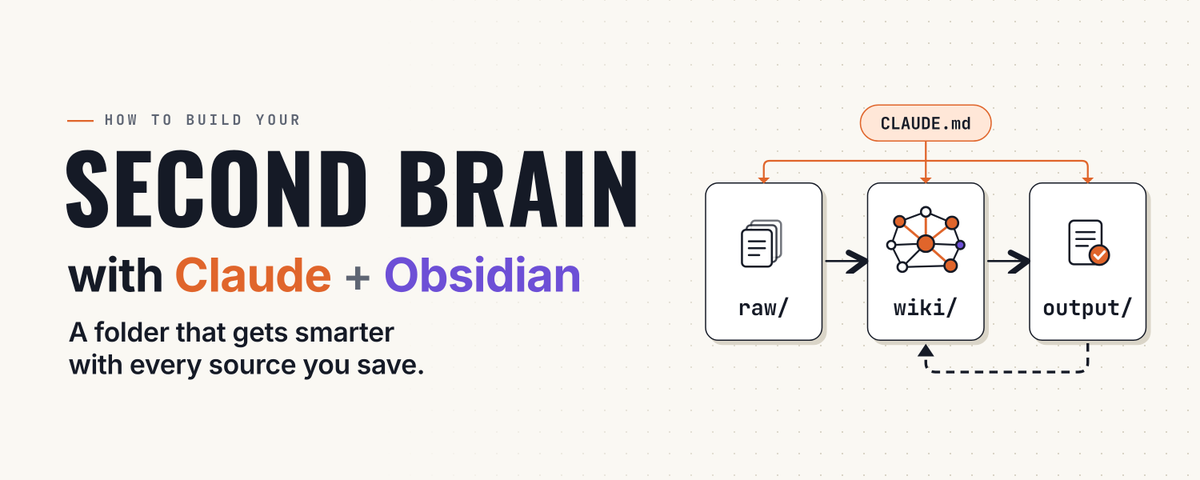
OpenAI co-founder Andrej Karpathy shared how he gets AI to turn what he reads into a wiki.
Build yours tonight in Claude Code and Obsidian with one prompt.
You just save the sources, and Claude writes every page.
Here's the setup:
step 1 → paste the prompt below into Claude Code on Opus 5.5 inside your Obsidian vault
step 2 → it interviews you one question at a time and saves what it learns in CLAUDE.md
step 3 → every source you save gets a one-page summary in your wiki
step 4 → it updates every person, idea and project page that source touches, then links them all
step 5 → ask it anything, and it answers only from your wiki with the page behind each point
step 6 → when you call an answer good, it saves it as a new page, so later answers can build on it
step 7 → every night while you sleep, it reads up to 10 new articles you saved and adds them to your wiki
step 8 → every Sunday it shows you where two of your sources say different things
Find the full prompt below.
Then read the article below on how to make your second brain smarter with every source you save.


Sébastien 2.0 retweeted

Qui doit payer le journalisme repris dans les réponses IA ?
DW confronte éditeurs, juristes et Google sur la rémunération des contenus journalistiques. Une proposition de collecte collective liée aux réponses IA est discutée.
dw.com/en/journalism-and-ai-…

Sébastien 2.0 retweeted

📊 @Ripple’s $RLUSD now moves more on the XRP Ledger than on @Ethereum
In October, XRPL handled $20.1B in monthly RLUSD transfer volume, compared to $15.4B on Ethereum.
That means XRPL carries 57% of RLUSD transfer volume with just 42% of the supply.
Overall, XRPL’s monthly RLUSD transfer volume has grown 9x this year, from $2.2B in January to $20.1B in October.

Sébastien 2.0 retweeted

📁 Tokenization Supercycle
└📁 Institutions
└📁 Privacy
└📂 Prividium

INSTITUTIONAL NYC MIXER: The Tokenization Supercycle Needs Privacy (Here's The What & Why)
@therollupco @noah_pravecek @zksync @EntEthAlliance
00:00 Intro
01:43 Adding privacy into institutional finance
03:38 How the DTCC deal opens institutional doors
04:52 Compliance and risk management
07:02 Answering the "then, what?" question
09:55 Institutional sales process
Sébastien 2.0 retweeted

I wrote this in July. It did 1.3M views.
There is one line in it I never put a number on: full Kelly routinely produces 40% and 50% drawdowns.
Here is the number. At full Kelly your chance of EVER halving your money is exactly 50%.
Not roughly. Not usually. Fifty. Your edge does not change it. The market does not change it.
I ran the math. Log wealth, continuous rebalancing, k is the multiple of Kelly you actually bet.
- quarter Kelly - 44% of max growth, 0.78% chance of ever halving
- half Kelly - 75% of max growth, 12.5%
- full Kelly - 100% of max growth, 50%
- one and a half Kelly - 75% of max growth, 79%
Read the last two again. Same growth. Same expected return. Six times the chance of halving.
P(bankroll ever falls to x) = x^(2/k - 1)
The Sharpe cancels. Your edge cancels. Only how hard you bet survives the algebra.
And here is the part that should scare you. Growth relative to full Kelly is 2k - k^2, which hits zero at k = 2.
So your entire error budget is a FACTOR OF TWO. Believe your edge is 2x what it really is and your growth rate is exactly zero, while every single bet still carries a genuine edge. Believe it is 3x and you compound at minus three times what the correct bet would have earned.
LTCM did not die from being wrong. They died from k.
Kelly, Bell System Technical Journal, 1956. The formula above is one substitution into the standard hitting probability for brownian motion with positive drift.
Bet half. You give up a quarter of the growth and buy a six-fold cut in the chance of ever halving. It is the cheapest trade available to anyone holding a real edge.


Sébastien 2.0 retweeted

Playbooks like these usually stay inside hedge funds.
All 6 skills are now open source
github.com/ruujOnChain/Hedge…
Built for AI agents: factor risk, position sizing, regime detection, backtest validation, event studies, and earnings preparation. Real quant methods, exact math, every number computed in code.


THE NEXT EDGE IN QUANT IS THE PLAYBOOK.
Every model can reason now. The firms that win will be the ones that teach their agents exactly how they work.
I wrote the paper on how to do it, with 6 core quant playbooks turned into skills any AI agent can run.
drive.google.com/file/d/16vR…
