

SwissChris – I invest in frontier tech: AI · Robotics · Energy · Quantum · Crypto · Space 🚀 || Signal over hype || Contrarian || Never Financial Advice.
Switzerland
Joined June 2022
- Tweets4K
- Following1.5K
- Followers605
- Likes341






With America's money supply at a record and Bitcoin $BTC 56% below its top on 21 Nov:
Is this is the SETUP or the END?
👇

195
Which part of the robot business fell hardest in a year?
The companies whose robots are out doing the work.
I lined up 9 US-listed robot stocks, from the parts makers to the robots at work.
Dates: 25 Nov 2025 to 25 Nov 2026.
Motion parts (motors and factory controls):
Emerson $EMR: +22%
Regal Rexnord $RRX: +12%
Rockwell $ROK: 0%
Machine eyes (cameras and vision chips):
Cognex $CGNX: +26%
Ambarella $AMBA: -59%
AMBA was down 37% until 23 Nov. The rest came on 24 and 25 Nov, after a memory-shortage warning.
Robot makers (Teradyne mostly sells chip testers):
Teradyne $TER: +28%
Intuitive Surgical $ISRG: -24%
Robots at work (warehouse and delivery fleets):
Symbotic $SYM: -48%
Serve Robotics $SERV: -75%
Of the 3 parts stocks, the middle one rose 12%.
The two fleet stocks fell 62% on average.
⚠️ This is 9 stocks over one year. A different start date would give different numbers.
If the next year rewards the fleets, it's $SYM or $SERV.
Bet on the suppliers instead and you're looking at $EMR or $RRX.
|| Source: TradingView, 25 Nov 2025 open to 25 Nov 2026 close
Not advice.
I'D LOOK AT THE SUPPLIERS FIRST.

60
Traders are 95.5% sure the Fed hikes in December.
And Washington just floated fresh tariffs on top.
Hawks and bears have had a great week.
Fine. Squeeze growth hard enough and the Fed blinks.
I'm still on the forced-cut side for 2027.
Could be wrong on timing if prices keep climbing into spring.

The Fed's own forecast just said the quiet part.
Rates at 3.75–4% and PCE inflation at 2.3% in 2027 is TIGHT policy by the Fed's own yardstick.
Traders still bet on more hikes, about 4.5% by July 2027.
One of them is WRONG.
I'm betting on a forced cut.
🧵

54
How can the Fed see 2.3% inflation in 2027…
...while traders bet on rates near 4.5% by July 2027?
Full breakdown with the charts on my Substack, link in the reply 👇

1
27
Go deeper? Check out my new Substack – with the numbers and charts 🧐
investinthefrontier.substack…
12
True!
"Running it hot" seems to play out quite well, indeed.
Fed: rear-mirror.
Watch the bond markets...

GDP revision highlights a productivity boom!
The Fed Is Fighting a Boom It Doesn’t Understand
This morning’s GDP revision was not a demand scare. It was a supply-side productivity story. Third-quarter growth was raised from 3.4 per cent to 4.3 per cent, led by software and AI equipment investment. Real gross domestic income rose 4.4 per cent.
Nonfarm business output is now running at 4.9 per cent. Labour productivity, 3.6 per cent on the preliminary reading, should be revised to about 4.8 per cent on 8 December. Unit labour costs, already falling at a 0.7 per cent pace, would decline at about 1.8 per cent. Core PCE inflation in the quarter was unrevised at 2.5 per cent, annualised.
Fact, productivity up, unit labour costs down. This is not inflationary. Wall Street still treats the AI buildout as a three-year product cycle. It is not. It is infrastructure, more like the railroads: a multi-decade build of power, chips and data centres.
Policy is feeding it.
The key provision of last July’s tax law is 100 per cent expensing, so firms can deduct capital investment immediately. Alongside it came deregulation. A January executive order requires agencies, for each new rule, to identify at least 10 existing ones for repeal. A July order speeds federal permitting for large AI data centres and the energy infrastructure they need.
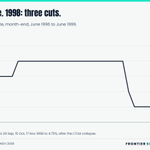
Alan Greenspan recognised a similar pattern early. At the September 1996 Federal Open Market Committee meeting he argued that official data were understating the gains from information technology, and the Committee held the funds rate at 5.25 per cent even as unemployment fell. In December he asked whether “irrational exuberance” had taken hold. He still held off. A single quarter-point rise in March 1997 was the only tightening for a year and a half. Inflation stayed quiet. The expansion ran on.
This Federal Reserve is doing the opposite. Christopher Waller wants a half-point hike to “shock people.” Alberto Musalem has called for several increases by spring and a real policy rate of 2 to 2.5 per cent.
Potential output is rising, and labour costs per unit are falling. Greenspan trusted that. When will this Fed follow his lead?

1
38
🇺🇸 US GDP, third quarter: +4.3% annualised.
Revised up from 3.4% a month ago.
Spending by US households and businesses grew 5.8%.
That's not an economy asking for a rate cut.
NOT YET 👇
teapawt.net/FrontierSignalX/status…
The Fed's own forecast just said the quiet part.
Rates at 3.75–4% and PCE inflation at 2.3% in 2027 is TIGHT policy by the Fed's own yardstick.
Traders still bet on more hikes, about 4.5% by July 2027.
One of them is WRONG.
I'm betting on a forced cut.
🧵
61
Core PCE, the Fed's favourite gauge, rose to 3.3% in October.
That's up from 3.1%, a notch above the 3.2% forecast.
This is the number the hawks will quote on 9 December.
They have a point.
93
Looks like we're approaching a violent snap-back to the UPSIDE

"Leveraged investors have sharply reduced Nasdaq futures exposure... the biggest negative change since the 2022 bear market"
Goldman Sachs via @MikeZaccardi

34
Essential read!
Fed CUTS come way sooner than the markets think.
Williams speech, and why the Fed Will Need to Cut in 2027
Monday’s reinstatement of Jensen Huang as Nvidia’s chief executive was the first step, removing a cloud of uncertainty over the AI buildout.
John Williams’s latest speech is a second step in the right direction. Compared with Christopher Waller’s call for a half-point hike to “shock people,” the New York Fed president offered a welcome measure of restraint. But he needs to follow his analysis to its logical conclusion.
Consider his most important acknowledgement: “Although the effects of tariffs, geopolitical conflicts, and the AI surge are showing up in prices of certain categories of goods, there is little evidence of these spilling over significantly into broader and more persistent inflation.”
That is no minor qualification. It decides the policy debate.
The data back him. In the year to September, consumer energy prices rose 20 per cent; core goods rose 0.7 per cent. That is a supply shock, not a wage-price spiral.
Private-sector wages are up 3.1 per cent, and the five-year, five-year-forward breakeven, at 2.11 per cent, is lower than a year ago. Williams’s own forecast has inflation just above 2 per cent next year.
I’m sorry, but a focus on headline numbers is not good enough! And the Fed keeps hiding behind it!
A 2 per cent target never required every component to rise at 2 per cent. From 1995 to 2019, core PCE inflation averaged 1.7 per cent while services excluding energy and housing averaged 2.5 per cent and core goods 0.2 per cent. Services ran hot; goods did the balancing.
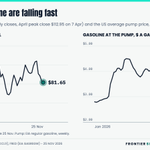
Now the energy shock is reversing, and fast. The 3-2-1 crack spread, the refiners’ margin, is now close to $ 38 a barrel, down from $ 79 in late September. West Texas crude is heading below $ 80, from $ 115 at its April peak. Wholesale gasoline is below $ 2.45 a gallon.
When crude and refining margins fall together, pump prices fall faster than either. Gasoline at the pump is already down 15 per cent since September, to $ 3.81, and retail margins remain 30 cents above normal. More relief is coming.
Then come the base effects. Energy prices jumped almost 11 per cent in March 2026 alone. Even if energy merely holds at October levels, that increase drops out of the annual comparison and subtracts about 1.2 percentage points from headline CPI inflation, and 0.6 from PCE, by April.
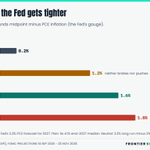
Here is what the hawks miss: the Fed can tighten without raising rates. Hold the funds rate at 3.75 to 4 per cent and let the real rate do the work. In our scenario, with gasoline easing to $ 3.10 and crude to the high $ 60s, headline PCE inflation falls to about 2 per cent by mid-2027. The real policy rate climbs from 0.2 per cent today to roughly 1.9 per cent, without a single hike. The New York Fed’s own models put the neutral real rate between 1.0 and 1.65 per cent; the FOMC says 1.2. Two cuts would be needed just to get back to the FOMC’s neutral; six to keep today’s stance unchanged.
Even the Fed’s own September projections, PCE inflation of 2.3 per cent and a 4.1 per cent funds rate at the end of 2027, imply a real rate of 1.8 per cent, well above its own neutral.
The hawks’ counterpoints are energy echoes: core’s three-month pace is inflated by transportation services, up 0.8 per cent in October alone, and Michigan’s one-year expectations jumped from 3.8 to 4.7 per cent when gasoline spiked in April.
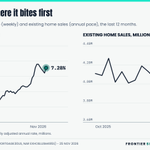
Williams himself warned against being “overly focused on inflation’s path in the past.” Steering by the rear-view mirror is how a central bank tightens into a slowdown. With the 30-year mortgage rate at 7.28 per cent and existing-home sales at a 3.75 million pace, housing is already paying.
Huang’s return was the first step. Williams’s speech is the second. What is needed now is a Fed that is objective, apolitical and truly data-dependent. As energy falls, the data will say one thing: cut in 2027.


30
The Fed's own forecast just said the quiet part.
Rates at 3.75–4% and PCE inflation at 2.3% in 2027 is TIGHT policy by the Fed's own yardstick.
Traders still bet on more hikes, about 4.5% by July 2027.
One of them is WRONG.
I'm betting on a forced cut.
🧵
Quick update to my Plain Alpha weekly.
On Friday, ARK sold about $17 million of Nvidia $NVDA.
On Monday, Jensen Huang was back as CEO.
The stock jumped over 30% that day.
Selling into the fear is a decision too.
It just shows up later on the chart 😅
Nvidia $NVDA reported $115.8B of sales, $6.9B above the estimate.
The shares fell 22.9% in the week.
Then on Monday it reinstated Jensen Huang as CEO, and the stock jumped 33%.
Invest in the Frontier: what really mattered in the week to 20 Nov 🧵

66

Nvidia $NVDA reported $115.8B of sales, $6.9B above the estimate.
The shares fell 22.9% in the week.
Then on Monday it reinstated Jensen Huang as CEO, and the stock jumped 33%.
Invest in the Frontier: what really mattered in the week to 20 Nov 🧵
Global money supply sits near a record: about $103 trillion.
Yet Bitcoin $BTC is at $60,700, about half its record.
All three big US stock indexes are below their 200-day average.
So where is all that money? 🧵

1
46

Fair point, tech's weight is past the 2000 peak.
I get why people worry.
But tech now trades below the S&P 500 on expected profits.
That hasn't happened since 2017.
Doesn't smell like 2000 to me.
I think the AI fears are running ahead of the numbers.

WALL STREET'S AI SELLOFF FLASHES WARNING SIGNS OF THE 2000 DOTCOM CRASH
TS Lombard warns that the spreading AI-driven stock rout resembles market patterns seen before the dotcom crash.
Strategist Dario Perkins highlights troubling parallels as selling pressure spreads from the Nasdaq to the broader market.
🔸 S&P 500 tech weighting: Over 40%, versus 35% at the 2000 peak.
🔸 Broader tech exposure: Exceeds 46% when including major technology-related companies.
🔸 S&P 500: Heading for its worst week since April 2025.
Unlike 2000, today's tech giants remain highly profitable, with strong earnings and AI investment demand.
TS Lombard warns that temporary rebounds can precede deeper market declines, as they did during the dotcom collapse.

20
AMD $AMD is down 8% on a report from a firm betting against it.
Even Hunterbrook says its findings don't prove a violation.
AMD hasn't answered yet, so I'm waiting.

$AMD -8% FOLLOWING HUNTERBROOK REPORT
Hunterbrook, which says it is short AMD, alleges AMD technology is reaching a Chinese server maker on the US trade blacklist. AMD did not answer its questions, and Hunterbrook says its findings do not establish an export-law violation.

1
117